Saturday, October 16, 2010

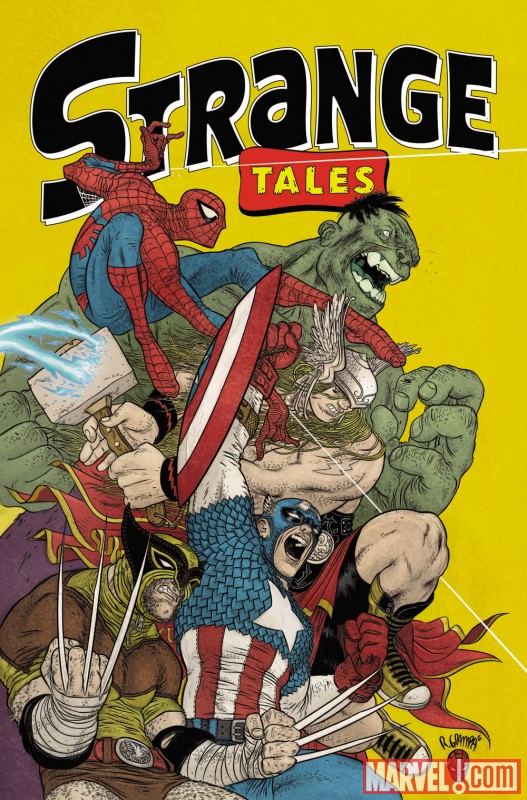
Strange Tales II #1

by various creators

I'm pleased to see that the first run of this title was successful enough for Marvel to do a second series of this anthology comic that showcases a wide variety of "indie" and comix artists playing in the Marvel sandbox.

Like the first run, there are a lot of stories in here that did absolutely nothing for me, but the stuff I liked made purchasing the comic worthwhile and rewarding none the less.

This issue has a number of strengths.  To begin with, Rafael Grampá's cover is phenomenal.  I love that Thor's hammer has a handle shaped like a bread knife, and that he's wearing lace-up high tops.  The first story is also by Grampá, and it's a gritty and nasty tale about Wolverine involving the extreme fighting circuit and very kinky sex.  It's also one of two stories in here that have Wolverine whining about how he can't heal a broken heart - it's cool in this story, and cheesy in the other.

Gene Luen Yang brings back the Frog-Man, a character I had forgotten about, but who seems to have been made for Yang.   I thought that Shannon Wheeler's story about a "gone native" Red Skull was pretty funny, and while I didn't enjoy the stories, I found Frank Santoro's Silver Surfer tale, Dash Shaw's Spider-Man story, and Nicholas Gurewitch's Galacatus piece to be very pretty.  I also liked Jeff Lemire's story of the RCMP, the Wendigo, and the Man-Thing.  That's a winning combination I'd read a twelve-issue maxi-series about.

This is by no means a perfect compilation, but it is pretty cool that Marvel is doing it.  I look forward to seeing who contributes to issue number two.

The Unwritten #18

Written by Mike Carey
Art by Peter Gross

The last few issues of this series have had a lot of stuff happening, so it makes sense that Carey slows things down a little, and gives Tom a chance to examine his sub-conscious (guided by a huge load of illegal drugs of course).  That his revelation is that he should trust in his friends is a little weak, but then Tom's a bit of a jerk, so it makes sense that he actually has to be told these things, even if it's from his fictitious alter-ego.

Of far more interest to me were the scenes involving the Cabal that has been set up as the villains of the series.  Mr. Callendar, who up to now I took to be the absolute leader of the group, is looking to cast blame for the recent fiasco involving the new Tommy Taylor book.  He decides that the fault lies with Pullman, the Cabal's assassin and enforcer.

This leads to an interesting scene involving a statue that dispenses justice, and a power shuffle in the Cabal.  This group is of a lot of interest to me - I like how on the first page Carey shows us some of their other on-going literary projects - and I'm pleased to learn a little more about them, even if that may actually raise more questions than it answers.

Friday, October 15, 2010

Northlanders #33

Written by Brian Wood
Art by Riccardo Burchielli

I've been enjoying Metal since it started, but I think this is the best issue of the story to date.

Erik and Ingrid are continuing their rampage across the Norselands like a Viking Micky and Mallory Knox, hunting down and slaughtering Christians everywhere.  Their legend has grown, and one night, while sharing a fire with some local Norsemen, they learn about how the locals see their deeds.

At the same time though, the spectre of Black Karl, the man they killed last issue, pursues them.  The way Wood has structured this arc, I'm not sure what is real and what is in Erik's mind.  Northlanders has always been delivered as a historical fiction series, so this arc, with its spirits (and now Draugrs) is jarringly out of place.  I tend to read scenes like the last one in this comic as proof of Erik's addled mind, but I suppose it is also possible that Wood is giving us an old school Vertigo story, with all the dark fantasy that usually entails.

Either way, I'm enjoying this book.

Sweets #3

by Kody Chamberlain

I'm glad I decided to stick with Sweets.  On the one hand, it's a fairly conventional police procedural, but Chamberlain has done enough to the story to make it stay pretty interesting.

I like that the story is set in New Orleans just days before Hurricane Katrina is set to make landfall.  It adds a sense of urgency to the story, as the reader knows a few things the characters don't about how hard it will become to catch the killer in just a matter of days.

Also, I like the way that the two detectives go about their business.  Their crotchety relationship, and innovative approaches to policing remind me a little of some of the better scenes in Homicide: Life on the Streets, which is always a kind comparison to make.  Finally, the flashback pages, with their bright colours and more primitive art style continue to be my favourite part of the book.

I did find the last few pages of the comic to be pretty confusing.  Was that Sweets, the killer, firing at the two cops, or was that just some random New Orleans violence?  The other two issues gave Sweets some screen time, and this issue does not, so I wasn't sure who I was looking at.

Still and all though, this is a pretty good comic.

Welcome to Tranquility: One Foot in the Grave #4

Written by Gail Simone
Art by Horacio Domingues

I hope, when the dust from the cancellation of the Wildstorm line settles, that there will be a place at DC for another Welcome to Tranquility series.  I love Simone's stories set in this small town mostly populated by retired super-folk.  The characters are very likeable, and the setting is pretty unique.

This second series, featuring the return of Mayor Fury and the Pink Bunny's son, Derek, an incredibly powerful monster, is pretty plot-heavy, but Simone is still finding ways to make the individual issues stand out.  In this installment, there's a scene where the Bunny, waiting in the hospital for Fury, has a chat with a little girl who is reading a monster comic.  While this is happening,  the Coyote Kid is in the middle of a pitched battle with Derek, and the narration matches the little girl's comic book perfectly.  It's a neat trick.

Atelier

by Fábio Moon and Gabriel Bá

There are a number of reasons why I love my comic book store, but the main reason this week is because they returned from NYCC with a small stack of Fábio Moon and Gabriel Bá's recently self-published sketchbook/mini-comic/how-to guide, Atelier, and didn't even over-charge for it.

This book is forty pages long, and is basically a stream-of-consciousness tone poem, complete with the twin brothers' musings about creating comics, presented in four different languages.  The book lacks the story-driven punch of their incredible Daytripper series (which is on my very short list for 'best series of the year'), but instead is designed to show off their impressive artistic talents and sensibilities.

This is a surreal piece of work.  A scene where the twins, as young boys, are drawing in the sand on a beach, slowly turns into a series of drawings centring on sea life.  It's a very lovely piece of work.

I'm glad I got the chance to pick this up.  The brothers are favourites of mine (see below), and it was a nice surprise to see a book I didn't even know had been (self-)published.

The Umbrella Academy Vol. 2: Dallas

Written by Gerard Way
Art by Gabriel Bá

Having just read the first volume of Umbrella Academy, the over-the-top superhero saga drawn by Gabriel Bá and written by some rock star who has become a bit of a comics darling, I quickly decided to read the second volume. 

Dallas would never be able to stand on its own, as very little is introduced or explained here, but it is a pretty enjoyable replacement for Grant Morrison's wonderful Doom Patrol run.

In this book, the surviving members of the team are all in worse places than they were at the start of the series (there is a general sense of lingering injury, depression, and discontent).  Number Five, the member of the team who has returned to the present after a lengthy sojourn in the future, has some unfinished business that soon embroils the whole team in a plot to assassinate (or protect) JFK in Texas in 1963.  The plot is hard to follow, but it does allow for a number of very cool moments.

As with the first book, the main appeal to me was Bá's artwork.  It's interesting how, on a title like Daytripper, he keeps such tight control over his characters' environments, but with this book, he's able to really go wild.  There are very interesting designs, and crazy scenes, like the one where Kraken and Spaceboy fight vampires and a giant mummy in the middle of the Vietnam War.

I'm not sure if this title is going to continue, but I'll definitely be on board for any future installments.

Thursday, October 14, 2010

BPRD Hell on Earth - New World #3

Written by Mike Mignola and John Arcudi
Art by Guy Davis

As much as I've enjoyed BPRD in the past, I think I'm beginning to enjoy it even more since it's become "BPRD Hell on Earth".  This has always been a title where unpredictable things can happen, but I feel that they've really removed any sort of safety net now, and made the book even more random in terms of wanton destruction and the chance that characters won't survive.  For example, in this issue, a volcano suddenly appears and kills millions in Texas.

What makes this book so strong is the interactions between the characters.  I loved seeing Abe working with Daimyo again, as they deal with some kind of tentacle-y thing in BC, and the conversation between Kate, Johann, and the UN guy (does he have a name yet?) is priceless.  As the world starts falling apart all around them, this book is funnier than it ever was before.  I appreciate that.

Monday, October 11, 2010

Cinderella: From Fabletown With Love #1-6

Written by Chris Roberson
Art by Shawn McManus

I foolishly passed on this mini-series when it came out recently because I was trying to cut back on my comics purchasing, and was unfamiliar with Chris Roberson's writing.  Now that he's writing I, Zombie, which is becoming one of my favourite Vertigo titles, I figured it was time to check this out.

In this series, which has been collected recently, Cinderella sets off on one of her usual spy missions.  For this one, she's to track down the source of new magic showing up in the Mundy.  While it's a solo mission, she soon finds herself working alongside Aladdin, who has the same mission for his masters in the One, True Baghdad.

Cinderella and Aladdin have good chemistry, as they Mr. and Mrs. Smith their way through Dubai, the North Atlantic, and one of the Homeworlds, chasing down a trio of familiar Arabian Fables, and another Fable who had a huge impact on Cindy's life.  While all this goes on, there is also a subplot involving Cinderella's shoe store back in Fabletown.
This title restores some of the madcap fun that I got used to in the main Fables title, and the earlier Jack of Fables issues, which has been sadly absent of late.  Roberson's writing is witty and sharp, and Shawn McManus is always a fantastic choice for this type of book.  I'm glad to see that there is a new Cinderella series on the way, and this time I'll be sure to pick it up as it comes out.

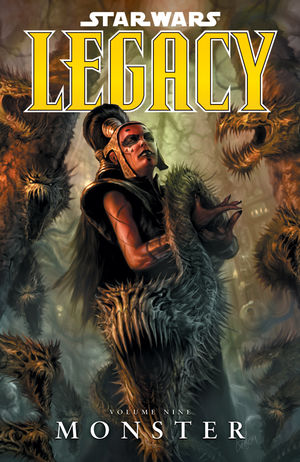
Star Wars Legacy Vol. 9: Monster

Written by John Ostrander and Jan Duursema
Art by Jan Duursema, Dave Ross, and Dan Parsons

As I get closer to being caught up with Star Wars Legacy, I'm increasingly impressed by how well-plotted this series is.  Ostrander and Duursema have clearly organized their entire story, and are steadily working their way towards their conclusion (is this going to happen in Star Wars Legacy - War, or are there going to be more mini-series after this one?).

In this volume, Cade and his friends get lured to the planet of Wayland, the place where Cade's father first started some terraforming experiment using the Yuuzhan Vong (who are an alien race that had invaded the galaxy in another Star Wars series, I assume).  Cade gets captured of course, and there is some stuff with one of the Sith, and Cade's relationships with his friends get tested, and new characters pop up.  This plotline, while being the main one for this book, follows the usual path on this title.

More interesting is the single-issue story of an attack on Admiral Ghazi, and the continuing plotlines concerning a possible alliance between the Jedi and Emperor Roan Fel against the Sith.  These storylines have been my favourite since I started reading this title, and I found them to be pretty exciting in this book.

As I've said before, Star Wars Legacy is Star Wars finally done properly.

Saturday, October 9, 2010

Be Warned! Skrull Kill Krew #1-5

Written by Grant Morrison and Mark Millar
Art by Steve Yeowell and Chris Ivy

Okay, so I figured that a 90s Marvel comic about a group of shapeshifters who got their powers by eating beef tainted with dead Skrulls and use these abilities to seek out Skrulls and kill them would not be very good, even despite the fact that it was written by two of the most acclaimed comics writers of the 00's, but I had no idea it would be this bad.

Because the Skrull Kill Krew is BAD.  Really, really bad.  It's obvious when reading it that Morrison had a very limited involvement in this title.  I can see the concept being his, but there is no way that he wrote even a word of this dialogue (even if it was the first comic he ever wrote not under the influence of something).  Instead, this has Mark Millar's hands all over it, but not his usual hands, more like the ones that were recently reattached after some kind of horrible accident, before he started physiotherapy.

The book follows Ryder and Moonstomp, the founders of the Kill Krew, as they start to travel the country looking for new recruits.  I'm not sure how they found people, or how one batch of Skrull meat would travel so far before being eaten, but let's not worry about that.  Instead, let's worry about what horrible stereotypes all the characters are.  Ryder is an ex-SHIELD agent (or something) and a black activist who has Nick Fury worried (although not enough to do something).  Moonstomp is a British skinhead (who uses the word 'fagging' a lot) who is slowly turning black out of his hatred of black people.  Or something like that.  Then we get characters like Cowboy and Catwalk, who are as two-dimensional as you can imagine.

In the course of their mercifully short five issues, the Krew tangles with Hydra (and Captain America), and exterminates a town full of Skrulls, protected by the Fantastic Four (who are also Skrulls).  They kill them with guns and with their shape-shifting powers, which are apparently more formidable than the Skrulls' own abilities.

The dialogue is ridiculously bad, and not even edited to reflect the fact that the book is American (unless people in the mid-West also call phone booths 'call boxes').  The art, by the usually skilled Steve Yeowell, is rushed and horrible in all kinds of 90s ways.  Truly, this thing is a trainwreck, and I can't believe it's by the same team (minus Millar) who gave us the wonderful Sebastian O.  What I also can't believe is that Marvel brought these characters back for a bit part in the Avengers Initiative Secret Invasion chapters.  I'd have thought it would be better if all involved never admitted to this thing existing.

Sweet Tooth #14

by Jeff Lemire

This is the second issue in a row where a lot goes down in Sweet Tooth.  Jeppard has convinced the weird mask-wearing city cult to help him take down the militia.  To do this, he's promised them all of the hybrid children that are kept captive there, while he really intends to use them as cover so he can sneak in and rescue Gus.

Gus, meanwhile, is saved by Johnny, who sends him and three other hybrids out the back door.  Gus is starting to show some real direction, as he rescues one of the other kids from an alligator hybrid, and then takes charge of their destiny.

It's going to be interesting to see if the two groups meet up, assuming that Jeppard and his companions ever make it to the militia base - something's going on there too, although that is left for the next issue to be revealed.

Lemire's doing a terrific job with this title.  While it can sometimes feel overly decompressed, this newest arc has a lot of plot movement while still finding time for some quieter moments.  I love what Lemire's been doing with the covers on this title.

Greek Street #16

Written by Peter Milligan
Art by Davide Gianfelice

I feel like this is a comic that should have worked better than it did.  Milligan is usually a terrific writer, and most of his best work has been at the Vertigo imprint.  Gianfelice is a terrific artist, and the book looked great.  But things never quite gelled for this series, and I think that Vertigo was pretty generous giving it almost a year and a half to work itself out before pulling the plug.

The concept of Greek Street was that a group of people living in modern-day London were reliving the lives and stories of Ancient Greece, but with a twist.  The main character was Eddie, a young man who killed his own mother in the first issue after meeting her for the first time, and sleeping with her.  Later, Eddie hooked up with Cassie, a girl that had visions of the future, which no one believed.  And so on, with Lord Menon, the Fureys, and a Greek chorus of strippers.

I'm not sure why, exactly, this book never worked.  It was hard to follow at times, and maybe a little too gratuitous in its violence and self-mutilation (Eddie tried to castrate himself at one time, and plucked out his own eye another).  I'm a little surprised that I stuck with it, but I felt like there was a lot of potential here, it just unfortunately was never realized.  I think Milligan must feel the same, as evidenced in his deus ex machina ending to the series.

Lucifer Vol. 11: Evensong

Written by Mike Carey
Art by Zander Cannon, Peter Gross, Aaron Alexovich, Dean Ormston, Ryan Kelly, and Jon J. Muth

There was a stretch of time, through the second half of Carey's 75-issue long Lucifer series, where I was becoming less and less impressed with the book.  The art was always lovely, and Carey's writing was pretty strong, but I found that I was starting to lose interest in the plot, as it became more and more about the second war in heaven, and was losing its focus on the supporting cast that made this comic so good.

At the core of my displeasure was the fact that Lucifer, as a character, was never very interesting.  I never found myself caring about his plans, or his rage at his father.  What I liked were the creatures he'd surrounded himself with.

This final volume, which collects the last five issues of the series, wisely spends less time with Lucifer than it does with his crew, and for that reason, I found it to be an excellent send off.  Elaine, taking on her new role in the universe, spends a little time saying good-bye to her companions.  The book starts with her visiting a Centaur storytelling contest, where she meets an old acquaintance, and gains some positive human experience (I can't think of a better artist than Zander Cannon to tell this story).  Later, Elaine has a 'girls' night' with Mazikeen, Spera, Jill Presto, and Mona that is poignant and funny, and helps bring all of these characters' arcs to a close.  There is also a final Gaudium story, which is always a nice addition.

Of course, the central part of the book is the last meeting between Lucifer and Jahweh, after Carey gives us a retrospective look at Lucifer's existence.  This meeting is a big deal, but I found that the quieter moments were of more importance.

Also included at the end of this book is a one-shot painted by Jon J. Muth, and published in the early days of this title.  I found that it was jarring to read this so quickly after finishing Lucifer's story, and it's addition (beyond being beautiful) did nothing to add to my enjoyment of these characters.

I'm glad I finally got around to reading this series.  It demonstrated how well Carey and Gross have worked together in the past, and was a reminder of the days when there was some form of continuity among some of the Vertigo books.

Friday, October 8, 2010

iZombie #6

Written by Chris Roberson
Art by Michael Allred

I, Zombie has been a pretty entertaining series, introducing an interesting and novel approach to all sorts of revenants and monsters that has a very reasonable internal logic to it, and introducing a large cast of supporting characters that have been given very little screen time.

This issue addresses that imbalance some, by focusing on Scott, affectionately known as Spot, the Were-Terrier.  In this issue, Spot narrates his entire life story, from growing up with his grandfather who was a voice actor for cartoons, to how he became a were-terrier, to meeting Gwen, the usual star of this comic.

Spot has been a favourite character of mine since the book debuted, and I'm glad to see him get more of the spotlight.  He's usually portrayed as a pretty nice guy, although this issue reveals a level of self-centredness that I didn't expect.  Basically, he stopped speaking to his aging grandfather for years because they didn't always agree.  He comes around though, as his grandfather passes on.

The biggest draw for me, at the start of the series, had been Allred's art, and that continues to play a massive role in this comic's success.  In this issue, Allred plays with homages to old superhero comics (a little bit Doom Patrol, a little bit Legion of Super-Heroes), and the old Scooby Doo cartoon, as Spot indulges in a little positive visualization.

This is a really good book - if you haven't tried it yet, this issue would be a good place to jump on.