Showing posts with label Yoshihiro Tatsumi. Show all posts

Saturday, January 11, 2014

Good-Bye

by Yoshihiro Tatsumi

I'm pretty sure that, with Good-Bye, I've now read all of Drawn & Quarterly's collections of Yoshihiro Tatsumi's manga that have been published so far.  Tatsumi really is a marvel, and I consider myself lucky to have been able to have read so much of his work.

Lucky, and kind of depressed, as his stories are all about people who have been brutally isolated by modern, post-war Japanese society.  In one story, a man mourning his upcoming retirement decides to spend all of his money so that his cold and controlling wife doesn't get any of it, and even manages to end up in bed with the girl he's had a crush on, only to find the entire thing so incredibly sad and empty.

Another story has a young man become the only resident of his apartment building, after a corpse is discovered in the adjoining apartment.  In another tale, a young woman decides to prostitute herself out to American soldiers stationed nearby, mostly because she doesn't know what else to do with herself.

This is a very bleak book, and with its frank and sometimes explicit approach to sexuality, not at all what I would have expected to have been published in Japan in the 70s.  These are very literary and mature stories, and reading them in quick succession is a little numbing, but ultimately in a good way.

Tuesday, August 13, 2013

Fallen Words

by Yoshihiro Tatsumi

Compared to the rather dark and brutal stories of Tatsumi's Abandon the Old in Tokyo, which I read recently, Fallen Words is an absolute delight.  Tatsumi, the father of gekiga manga, a sub-genre analogous to alternative comics in North America, experimented with this book.  Each story told here comes from the Japanese storytelling tradition of rakugo, which features moral fables that end with a punchline or joke.  Tatsumi decided to fashion these classic stories in the gekiga style, and see where it took him.

These are old stories from mostly the Edo period, and as such are all set during that time.  They play with themes of marital deception, and many of them involve prostitutes or the lengths people will go to to escape poverty.

The lightness of the stories is carried over into Tatsumi's storytelling and art, which feels a little looser than his earlier work.  I didn't find it difficult at all to relate to these characters, despite their being from a distant time and culture, and that is a credit to the ease with which Tatsumi weaves his tales.  Now, not being familiar with rakugo at all, I can't really assess how closely he stays to the source material, but that doesn't really matter.  What does matter is that this is a fun read.

Thursday, August 1, 2013

Abandon the Old in Tokyo

by Yoshihiro Tatsumi

I'm not sure I was prepared for the utter bleakness of the stories collected in Abandon the Old in Tokyo.  I've read a few of Tatsumi's books now, most notably A Drifting Life, but I still didn't expect that his work would be quite this dark.

Tatsumi uses these stories, which originally saw publication in the 1970s, to explore the growing sense of isolation in Tokyo's cities, and the pressures placed on young men to be successful and happy.  His protagonists usually look the same in each story, giving the impression that we are seeing the same poor sap again and again.  His protagonists are also often silent or men of very few words; they allow others to shape their existences, be they demanding fiancés, infirm parents, creditors, or unfriendly editors.  Again and again we see these poor guys get beaten down, until they make some questionable life choices.

The most disturbing story in this book is 'The Hole', in which our protagonist is tricked into falling into a hole on a mountain, where a woman with a burned face and chest holds him captive for reasons that are never made clear.  Things get really twisted when the man's wife shows up, but insists she will only help him if he gives up his plans to divorce her.

Often when reading manga, I feel a cultural disconnect with the characters.  That's not the case here, as Tatsumi focuses on the problems of the modern condition; in many ways, this work is as relevant in post-recession North America as it was in post-war Japan.  This is a disturbing book, but it has been made by a master of the art form, and for that reason, it is a worthy read.

Sunday, December 16, 2012

Black Blizzard

by Yoshihiro Tatsumi

I really enjoyed reading A Drifting Life, manga legend Yoshihiro Tatsumi's gigantic manga memoir a couple of years ago.  It portrayed his early days in the manga industry, a business that he helped shape with his resolve to write darker, more adult stories for a more adult audience.

In that book, the act of his creating Black Blizzard is a watershed moment for the young Tatsumi, and I was curious to read this book.  Luckily, the fine people at Drawn & Quaterly decided that this book was deserving of a North American edition, and so I was able to get the chance.

Black Blizzard is a Japanese noir story set in the late 1950s.  It opens with a young pianist showing concern that he may have murdered another person, although he was drunk at the time, and does not remember what happened.  He is arrested, but while being transported alongside another prisoner, to whom he is handcuffed, the train derails.  The two men make good on this chance for freedom, and end up spending hours together in a forest ranger's cabin, hiding from the police and trying to get warm (they've just walked through the titular blizzard).

The young man tells the hardened criminal his story, one of love, music, and the cruel ringmaster father of his circus performing girlfriend who does not want them to be together.  Later, desperate to be free, the older criminal contrives to drug the younger, and cut off his hand.

The story is pretty simple in its design and execution, but for all that, it is effective.  This is a classic noir story, and it illustrates how little that genre has changed in sixty years.  Tatsumi's early art is much cruder than what was in A Drifting Life, but there is a charm to this work by a young man looking to stretch the possibilities of an entire medium.  As a story, this is entertaining.  As a historical document, this book is essential.

Thursday, March 17, 2011

A Drifting Life

by Yoshihiro Tatsumi

I'd wanted to read this for a while now, and was even more interested in checking it out after I read The Push Man a little while ago.  As this is such a huge book (834 pages), it's taken me a while to read it, and it has only been since I started it that the Japanese earthquake, with all its attendant destruction and threat of nuclear catastrophe, took place.
I'm sure that this coloured my reading of this book quite a bit.  Tatsumi crafted A Drifting Life to be basically a memoir of his early life, outlining how he broke in to manga, his relationships with publishers and other artists, and how he grew frustrated with the constraints of the art form, and created his own 'gekiga' movement.  Tatsumi also uses the book to show us how Japan recovered from the war, and chronicles the various cultural influences, from American and French films to Japanese pop artists that affected his mindstate and work.

This massive book is incredible, even if for long stretches of time it seems that we are reading the same conversations over and over again, as Hiroshi Katsumi (Tatsumi's alter ego) is subtly manipulated by his publishers, or argues with his brother.  The brother, Okimasa, is an interesting character.  When Hiroshi is younger, Okimasa is frequently ill and a tyrant.  As his health improves, and he enters the manga world as well, he seems to vacillate between being a supportive friend and Hiroshi's harshest critic.

Having not read much manga, I found the perspective that this book takes, demonstrating both the business aspect and the the desire among some artists to have it viewed as an art form, to be fascinating.  I feel like I learned a lot reading this book, but I also really enjoyed watching Hiroshi grow from a boy submitting four-panel strips on postcards to his favourite magazines, to basically creating a new genre of manga.  I am definitely interested in reading more of Tatsumi's work.

Saturday, December 4, 2010

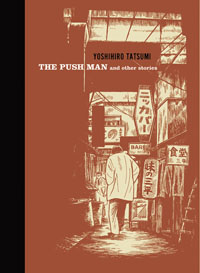
The Push Man and Other Stories

by Yoshihiro Tatsumi

I've mentioned before how I would like to have a better understanding of manga, but for the most part, it eludes me.  When Drawn & Quarterly had their annual sale a few months back, I thought I'd give this collection of the earliest stories from the "grandfather of Japanese alternative comics" a try.

The Push Man contains sixteen stories from 1969 in one beautifully constructed hard cover volume.  The stories are for the most part, eight pages in length, with a couple of longer stories.  They've been reconstructed to read from left to right.

For the most part, these stories feature low-wage workers in Japan, who have difficult relationships with their wives or girlfriends, who in turn are usually bar girls.  Many of these stories end in betrayal or dissolution of the relationships, and I felt like there was a current of misogyny in many of these tales.  Of course, this stuff is very Japanese, and from a time just prior to Japan's massive technological growth and modernization, which makes the comics difficult to understand without some further explanation, which is not included.

Many of these stories touch on the same themes.  There are repeated images of sewers and rats, and (inexplicably and horrifyingly) fetuses that have been dumped in the sewer.  These stories also contain a rather raw approach to sexuality, and more homosexuality than I would have expected based on the time they are from.  Basically, these stories drove home to me that I don't know much about Japan, although it is a place I've always had an interest in.

Tatsumi's art is quite lovely - many of his establishing shots, which depict poor neighbourhoods or slums, are amazingly detailed and rendered.  I would like to check out some more of his work.