Avengers #341-342, 345-347, 350-351, 368-369, and 400-402 (Nov ‘91 - Sept ‘96)

Written by Fabian Nicieza (341-342), Bob Harras (345-347, 350-351, 368-369), John Lewandowski (350), and Mark Waid (400-402)
Pencilled by Steve Epting (341-342, 345-347, 350, 368-369), Kevin Kobasic (350), Kevin West (351), Jan Duursema (369), Mike Wieringo (400), and Mike Deodato (401-402)
Inked by Tom Palmer (341-342, 345-347, 350, 368-369, 400-402), Ariane Lenshoek-Pinheiro (350), Bud LaRosa (351), and Don Hudson (369)
For these five years (and at least a year afterwards), I didn’t buy the Avengers regularly, and have never felt the need in all the years since to fill in the gaps. I was getting pretty bored with the inconsistencies of the book that I outlined in my last retro-review, and as this was the early nineties, there were a ton of more interesting books crowing the comics store shelves.
When I did return to this book, it was because it was either tying in to a book that I still bought (like the Operation: Galactic Storm event or the Bloodties cross-over), or it featured guest characters I cared about at the time (like the New Warriors and the Starjammers). Going through these issues, it’s clear that I didn’t miss much, especially over the thirty issues between 369 and 400, which look pretty god-awful. I’ve heard a lot about the storyline called The Crossing over the years, but none of it has ever been good.
 It’s interesting to look at this stuff now, and see how the trends of the 90s played out in what was previously always a pretty staid and calm title. This period began with the in-your-face character Rage being sidelined (a good thing, believe me), and moved through elements like many of the Avengers starting to wear matching jackets over the uniforms (with their sleeves rolled up, 90s style), long hair and stubble on men (Hercules shaves his beard, and Black Knight gets red eyes and stubble, making him look like Gambit), weird costume choices (Thor begins to bare his mid-riff, and adds a length of chain to the end of his hammer), bizarre character redesigns (Wasp somehow turns into a giant taloned cross between a woman and an actual wasp, but looks more like an alien; Iron Man gets replaced by a teenage Tony Stark from another dimenson), and, of course, pouches (like the ones that ring Goliath’s armpits).
Of course, because it’s the 90s, we should also mention the shiny covers, although I only ended up buying one of the three or four this series sported. On a side note, I always hated the shiny cover phenomenon. I found that they never looked very nice, necessitating less detail in the art than usual, and were spotlighting titles seemingly at random (for example, issue 369 is the end of a storyline; a weird place to try to pick up extra readers). At this time, I was working in a pretty mediocre comics shop on week-ends, and the owner was one of those victims of the 90s, who was hoarding shiny covers, immediately marking them up to $10 an issue on the day of release, waiting for the right customer to come in and buy them all. FYI, that never happened, and the store didn’t last long. I didn’t even shop there…
One thing I did really like was the paper quality in that era. It was a higher quality newsprint than what came before, which didn’t yellow, and provided more freedom in the quality of the colours it could support. In some ways, I prefer it to the thin paper being used today.
Anyway, let’s take a quick look at some of the things that happened in these comics:
- Rage gets angry when NY police beat a friend of his in a racially motivated incident (proving that things haven’t changed a whole lot since the 90s in the real world), and his involvement, along with the New Warriors and the Sons of the Serpent get the Avengers involved. The presence of the Hate Monger makes them all angry.
- I’ve never liked Mark Bagley’s costume designs, but the pink armor that Namorita wore for a while has to be one of the worst designs in the history of everything.
 Falcon gets added to the roster for the length of this story alone, because when you need to counter-balance Rage, you get a nice calm African-American superhero, and Falcon’s the only one the Avengers know.
- In Operation Galactic Storm, the Avengers get involved in the war between the Kree and the Shi’ar. The Stargates they use are putting our sun at risk, so Captain America leads a group into space to mediate.
- The whole war seems to be the product of the manipulations of the Supreme Intelligence, who wants to just about wipe out his own people so they can grow back stronger.
- After a devastating event, the Avengers have to decide what to do with the Intelligence. The more angry Avengers decide that they have to kill or destroy him (since it’s not clear if he’s alive or not), but Cap doesn’t agree with this decision. The Black Knight goes ahead and does it anyway, which makes Cap angry (even though the Intelligence actually escapes).
- A couple of issues later, two of the Starjammers are hired by a Kree to go to Earth and kill the Black Knight for his crime, and that turns into a thing. Professor X and Cyclops are there hanging out when it happens, and so is Binary.
- Seventeen issues later, the Avengers and the X-Men get involved in some nonsense involving Genosha, and the Acolytes’ desire to kidnap Luna, the daughter of Crystal and Quicksilver (and granddaughter of Magneto), because she is human (despite being half-Inhuman). Nick Fury gives a lot of orders, and looks very 90s in this issue.
- Exodus shows up at the end, and there is a nice shiny cover.
- Thirty odd issues after that, Mark Waid shows up to try to fix the book’s reputation before it ends, in the ill-conceived Heroes Reborn event, which had Image folk like Rob Liefeld and Jim Lee redesign all of Marvel’s main books.
- Waid and artist Mike Wieringo have the Avengers fight almost all of their greatest enemies in an extra-long and extra-fun issue. This is not what’s really going on, instead one of their earliest foes is manipulating Jarvis into creating this threat.
 In the lead-up to the Onslaught storyline, which cleared the main non-X-Men heroes out of the Marvel U, the Avengers go to arrest Joseph, the amnesiac younger version of Magneto that used to hang out with Rogue and the X-Men in that era.
- As Onslaught starts trashing New York, the Avengers go around trying to rescue people, and fill in some story space before heading off never to return (for a year or so).


There are a few things that I wondered about while reading these issues, that were perhaps addressed within the issues I missed, but could also have been the victims of 90s storytelling, and a very casual approach to continuity. For the most part, I am curious to know what happened to the new headquarters, the building of which was featured throughout the run I wrote about in my previous column. I also would like to know what happened to all the support staff. At one point, people like Peggy Carter were still working for the Avengers, and then suddenly, Jarvis was all on his own. Does anyone know?
The roster stabilized a little over these issues, but these issues still contained a number of characters at different times. These comics featured:
- Captain America
- Vision (both the white and the coloured versions)
- Thor (both Eric Masterson and the usual guy)
- Sersi
 Black Widow
- Quasar
- Hercules (both bearded and long-haired Fabio version)
- Rage
- Falcon
- Crystal
- Black Knight
- Iron Man (both regular and young Tony Stark)
- Hawkeye
- Quicksilver
- Scarlet Witch
- Wasp (in her weird insect form)
- Goliath

Art-wise, there are a few interesting things going on in these issues. To begin with, it’s interesting to see what Steve Epting drew like at the beginning of his career, especially when you compare it to the work he has done recently on books like Captain America and Velvet. There is promise in Epting’s work, especially when he’s inked by the great Tom Palmer (more on him momentarily), and it’s nice to see how far he’s come.
It was a nice surprise to see an issue drawn by the late great Mike Wieringo, an artist who was nothing but promising, and who had a unique approach to superheroics.
Mike Deodato drew the last two issues of the first volume of this title, and that seems suiting, seeing as there is no other artist I would associate with the Avengers in the 00’s and 10’s more than him. He’s worked on almost every Avengers title of the last fifteen years, supporting both Brian Michael Bendis and Jonathan Hickman’s visions. While I don’t always love his work, he’s also definitely come a long way since the mid-90s.
Tom Palmer deserves some special recognition, for having put in something like fifteen years on this title, and providing it with a visual consistency while the stories generally degraded. He began working on this book with Roger Stern, just after the period that I started re-reading these comics at.
 When I began writing these Retro-Reviews, it was August, I was stuck at home recovering from minor surgery, and looking to travel a little ways down memory lane. Now, I’ve reached the end of this historic volume of one of Marvel’s most important titles, and have a few thoughts on that trip. The Avengers was never Marvel’s most exciting or dynamic book in the 80s and 90s. It often became overly concerned with the team’s procedures, and they were consistently a reactive rather than proactive force, constantly getting sucked into events (and frequently other dimensions) unexpectedly. The line-up kept changing, and while at times the team worked very professionally, at others it barely functioned. As the 80s gave way to the 90s, the focus on character arcs that Roger Stern brought to the fore in the title disappeared, and things got really convoluted.
It’s not hard to see why Marvel felt the need to reboot these characters, although the way they went about it, by giving the books to some pretty terrible writers (based on the popularity of their art), was unfortunate.
I’d thought about continuing my Avengers journey into the excellent Kurt Busiek/George Perez run (or perhaps the even better Busiek/Carlos Pacheco mini-series Avengers Forever), but am going to take a break from Avengers Mansion for a while, to dive into another Marvel title from the same era.
Which will it be? I’m not saying now, but I will give a couple of hints. There’s an X in the title, and the book went through a few overhauls in its time, changing not just creative teams and line-ups, but central concepts on multiple occasions. It is still being published today, but not for long, and not in any way that resembles how it began.

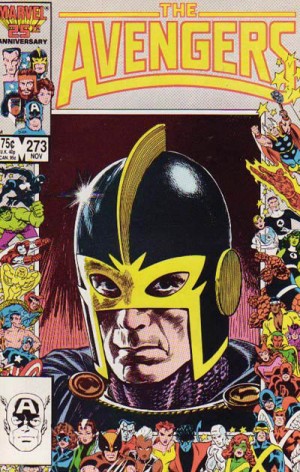
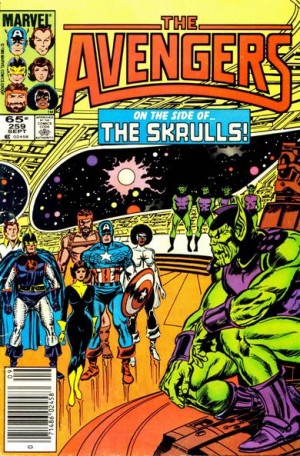 I remember being home sick from school, and my dad bringing me a copy of Avengers #259 that he picked up at a corner store, not knowing I already had it. I remember reading #273 a few times in a row, as I was stuck on a long road trip, with my grandmother crammed into the backseat of the car with my sister and I, and it was all I'd brought with me to read. Going through these books brings back some good memories.
 The Avengers lease Hydrobase from Stingray after losing their security clearance, and receiving notification that they can't fly their Quinjets out of their mansion anymore. Eventually, they move the whole mansion to Hydro Base (I don't remember when it was moved back to Manhattan).
 Zeus gets angry with the Avengers for allowing Hercules to be hurt (he's in a coma), and brings them to Olympus (by way of Hades) for revenge.
 to himself) that the Wasp should not be giving him orders, mostly because she is a small woman. From the beginning, Stern shows that Dr. Druid has designs on taking over the team, but does almost nothing else to develop his character aside from taking every opportunity to show his arrogance.