Showing posts with label Jim Rugg. Show all posts

Tuesday, July 2, 2013

Supermag #1

by Jim Rugg, with Brian Maruca and Robin Bougie

Supermag is not an easy project to define, but then, none of Jim Rugg's comics work fits into easy classification.  His books Street Angel and Afrodisiac are both brilliant explorations of genre, but he plays so much with the medium that they are neither parodies of the superhero genre, nor straight examples of it.

With Supermag, Rugg has created something like a comics magazine, filled with short strips that show off the versatility of his skill.  Many of the strips are just one or two pages long, and don't really end.  In many cases, I was just settling into a longer story when I realized that Rugg had already moved on to something else.  He's very good at creating character in a limited amount of space, so I often found that to be disappointing - especially with his more 'slice of life' pieces - imagine reading one page of an Adrian Tomine story, and you can understand what I'm talking about.

Rugg also plays around with some of the classic comics genres, like war comics, but subverts or twists them, such as in his story about the US Army's top golfer, who is used to fight off an air attack.  We get an army ape attacking a meeting of Osama bin Laden, Kim Jong-Il, and Hugo Chavez.  We also get an appearance of the Bald Eagle, a character from Street Angel.

Rugg is a terrific artist with a strong eye for design.  I'd like to see him settle into a longer piece of work again, as I feel he can create some very powerful long work, but it was nice to go through this book to see how truly talented he is.

Saturday, April 7, 2012

iZombie #24

Written by Chris Roberson
Art by Jim Rugg

The news out of last week's Emerald City Comics Convention was that iZombie is not long for this world, with four issues remaining after this one.  I always treat news like this with two minds - I've been enjoying iZombie since it began, and am going to miss many of the characters, but at the same time, I buy way too many comics every month, and my wallet is usually okay with one or two of them disappearing.

I've been wondering for a while if the book was getting closer to finishing, as the long-promised Apocalypse has been getting started, and the end of the world always feels like the right place to finish a series (it's safe to presume that the Apocalypse will be stopped by Gwen and her friends).

Knowing all of this going into this week's newest issue of the series, I was a little surprised to find that regular artist Michael Allred didn't draw this comic, and even more surprised to find that it is another flashback issue, this time focusing on Kennedy, the zombie Dead President, and introducing a new character/concept to the series.

When the book opens, Kennedy is putting down an incursion of other-dimensional beings that have taken over the bodies of employees at a burger joint.  She is aided by Horatio, Gwen's monster-hunting boyfriend, who has either been possessed by, or is cosplaying as Strider, the fictional hero of a series of novels by writer Adam Morlock.

This all brings Kennedy back to the seventies, when she investigated a fantasy-rock band called Ghost Dance, who had connections to Morlock.  Clearly, Morlock is meant to evoke British writer Michael Moorcok, whose Elric novels hold some similarities to what we are shown here, and who was somewhat wrapped up in the psychedelia movements of his day.  It seems that this band was able to call forth Xitulu, the same entity currently threatening Eugene with Apocalypse.

This issue is drawn by Jim Rugg, of Street Angel and Afrodisiac fame, which was a nice treat. I don't see nearly enough of Rugg's artwork.

I'm very curious to see how Roberson is going to wrap up the numerous plotlines of this series in just four issues.  This book has a very large cast, many of whom have been working through their own character arcs, so giving each a complete story, while still dealing with all this Apocalypse stuff, is going to be difficult.  Personally, I'm most interested in learning what the story is with Dixie, the diner owner.

Friday, March 16, 2012

The Guild

Written by Felicia Day
Art by Jim Rugg

I was rather late coming around to watching The Guild, but when I finally did give Felicia Day's web television show a try, I was hooked.  I knew that there had been a mini-series (I'd tracked down the issues for a friend who doesn't buy comics), but had paid it no mind, despite being drawn by Jim Rugg (of Street Angel and Afrodisiac fame).  I did start to buy the various one-shots that Day was writing with the various actors from the show, but it wasn't until this week that I got around to reading the original comic, collected in trade.

The web show follows the on- and off-line tribulations of a group of total strangers who met playing a fantasy MMORPG, and began spending all of their free-time together.  When the show opens, they've not met, or even know each others' real names.  That doesn't last past the first episode, as their worlds collide in a number of ways that make them very uncomfortable.

In writing this comic, Day decided to share the 'secret origin' of the Knights of Good, by showing us what led Cyd (Day's character) to abandon the real world and move into the on-line one.  She has always been wracked with uncertainty, and we watch as her boyfriend Trevor alternately uses and ignores her.  Seeking some sort of personal connection, she tries out this new videogame, and it's not long before she's met all the other main characters of the show.

As this is written by Day, who also writes the show, the characters' voices are spot on.  Jim Rugg is a good choice for the art - he uses his standard style to show the everyday world, and has also developed a more Frazetta-esque, digitally painted style for the in-game scenes, which are more detailed than they could ever be on the show. 

Reading this has left me yearning for more Guild; too bad it doesn't look like the show will be returning.

Friday, April 29, 2011

The New York Five #4

Written by Brian Wood
Art by Ryan Kelly and Jim Rugg

Throughout this mini-series, which is a sequel to the Minx book The New York Four, there has been a recurring sense of disjointedness, as scenes shift suddenly and plot elements are introduced and go nowhere.

This concluding issue suffers from this sense of dissonance more than some of the others.  To begin with, a character is killed off (I know that's a spoiler, but look at the cover) suddenly, and to a disappointing effect.  The character was not very well developed, so not only is it hard to care about her, it's also hard to understand why her friends are upset.  Her wake leads to a possible romantic opportunity for Merissa, but that also goes absolutely nowhere.

I feel bad slamming a book like this.  Wood is usually an amazing writer, but I remember his writing in the first issue that he had a lot of difficulty making his story fit a four 20-page issue format, as he was originally planning for this to be a longer-form graphic novel.

The art in this series has been amazing, as Ryan Kelly always is.  The addition of Jim Rugg (read Street Angel!) on inks is seamless, as Kelly continues to give us some gorgeous shots of New York City.

Thursday, February 24, 2011

Superior Showcase #1-3

by Nick Bertozzi, Mike Dawson, Dean Trippe, John Campbell, Maris Wicks, Joey Weiser, Farel Dalrymple, Jim Rugg, Brian Maruca, Laura Park, and Dustin Harbin

So, here's the thing with a lot of independent cartoonists who have 'indy cred' in certain circles:  they just want to write regular superhero comics.  With a couple exceptions, these are pretty much just normal superhero stories, and don't do much to say anything new or unique about the genre.

The perfect example is the brilliant Farel Dalrymple's story about Hollis, an overweight Batman-type.  If you read this as a Batman story, it would not be even the slightest bit different from how it appears here.  I'm not sure what, aside from Dalrymple's wonderful art, makes things indy.  I'm also not sure why I'm bothered by this, though.  I think I just feel like complaining a little today.

So, to focus on what I liked in this three-issue mini-series.  In the first issue, there is an Ace-Face story that I'd already read by Dawson, and a cute enough Robin-esque story by Trippe.  The second issue had that Dalrymple story, and really, that was about it.

The third issue is by far the stand-out, starting with a cool Street Angel story by Rugg and Maruca.  Street Angel is a cool comic general.  This story has her dealing with a Japanese monster movie creature in a ninja hospital.  It's always fun when she's around...

The best story in this whole series though comes from Laura Park, an artist I am completely unfamiliar with.  Her quiet little piece about young siblings who appear to be raising themselves is understated, evocative, and just about perfect.  It is a very sweet story, and it makes me want to learn more about Park and see more of her work.

Wednesday, December 29, 2010

One Model Nation

Written by C. Allbritton Taylor
Art by Jim Rugg and Cary Porter

This is a real oddball of a graphic novel.  It's written by a guy who's in the Dandy Warhols, and it's about a German industrial band who were famous in 1977.

One Model Nation were right in the thick of things in late-70s Berlin.  They were performing in illegal venues, and their concerts frequently became the scene for shoot-outs between the Red Army Faction and the police.  The band themselves were apolitical for the most part, but they seemed incapable of separating themselves from the time and their surroundings.

The book chronicles their time, as they have their studio tossed by the police, and as they argue with each other.  They end up getting involved with the Baader-Meinhof Gang (one of the guys is perhaps dating Meinhof I think), and lots of stuff happens.  The problem is that it's none to clear for someone who hasn't spent years studying post-war Germany.  I think that a lot more exposition is needed, as the writing doesn't always make it clear as to what the context is to these different scenes.  I would have been happy with at least a foreword to explain some of the politics.

Rugg's art is the best thing about this comic, which is not really a surprise.  While lacking the wild excesses of Street Angel and Afrodisiac, Rugg does a great job of portraying the band members as individuals (which is not easy when they all have the same hair cut and dress the same), as well as showing the austerity of Berlin after the war.  This is an entertaining comic, although it never quite recovers from the flaws in its writing.

Wednesday, September 8, 2010

Myspace Dark Horse Presents Vol. 4

by a lot of people

My thoughts on this volume of Dark Horse's on-line comic collection are basically no different from my thoughts on the previous three.  Dark Horse is putting together a very mixed bag with this series, and while I appreciate diversity in story content and art, I don't like it when there is a lot of diversity in quality.
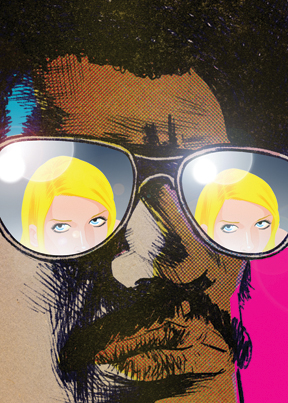
There are some very good short comics in this book, but there are a lot of plain old mediocre ones too.  The mix is about 50/50.  As I prefer to accentuate the positive, I should talk about what I like.

I think my favourite story in this book David Malki's 'The Catch!: A Wondermark Tale.'  I think there may have been a Wondermark story or two in previous volumes, but they didn't catch my notice the way this very funny story about a Victorian man who brings home an early computer to helps him find things, only to discover that it's part of an ingenious marketing ploy.  The story is funny enough on its own, but when you start to accept the weirdness of people dressed in Victorian clothing talking about their TV remote, the story takes on a new level of enjoyment.  Very cool stuff.

I also loved the Achewood story, and really liked Matt Kindt's Giant Man piece.  There are stories that didn't do much for me but that had some very pretty art, contributed by people like Farel Dalrymple, Jim Rugg, and Kristian Donaldson.

As usual, most of the licensed stories (Star Wars, Buffy) were weak, and the stories that were effectively trailers for minis (like The Rapture) were pretty ineffective.  I keep holding out hope for more, but am increasingly disappointed.  I am now in the market for some of the Wondermark books though...

Wednesday, May 26, 2010

Afrodisiac

by Jim Rugg and Brian Maruca

The character of Afrodisiac really stood out when he appeared in Rugg and Maruca's classic Street Angel series, and returning to the character in this slim hardcover was a really good idea.

This book is designed (brilliantly, I might add) as a series of excerpts from the lengthy publishing history of Afrodisiac, a blaxploitation character who supposedly had comics, cartoons, and toys based on his adventures through the seventies and into the early eighties.  Afrodisiac is a super-pimp, with a large stable of girls to watch over.

In the different comics, designed to mimic different styles from that era, his origin always changes.  What remains constant is that he's one cool badass.

What I like about this book is the amount of time and effort put into its aesthetics.   Pages are artificially yellowed, and Rugg works in a number of different styles.  There is very little substance to the book; it's all flash, and that's exactly what it's supposed to be.  This is one hell of a cool book.

Sunday, April 4, 2010

Street Angel

Written by Jim Rugg and Brian Maruca
Art by Jim Rugg


I think I am in awe of this comic. In five individual issues, with a few short stories tossed in for good measure, Jim Rugg and Brian Maruca create a whole urban environment with its own pantheon of strange villains, aging heroes, and accepted weirdness.

Twelve year old Jesse Sanchez is a homeless middle school student, expert skateboarder, kung fu master, and champion for justice. She lives in Wilkesborough, the toughest ghetto in Angel City, where she squats in various abandoned buildings, and hangs out with some older hobos or her sometime crime-fighting partner the Bald Eagle, a multiple-amputee with only one arm.

As Street Angel, she fights evil geologists, time-lost Spanish Conquistadors, Satanic cults, evil robots, and a truckload of ninjas. The action and mood of most of the stories here are quite lighthearted and fun, with appearances from characters such as Cosmick (an Irish spaceman fluent in Australian), Inti, the Incan Sun God, Jesus, and a past his prime Aphrodisiac (a nice mix of Shaft and Luke Cage).

Then you get to the fourth story in the book, which is basically a typical (ninja-less) day in Jesse's life. She wanders the ghetto looking for food, hangs out with an old bum, and gets embarrassed that a classmate might see her dumpster-diving. There is a poignancy to this issue that I didn't expect. Rugg's art, which has leaned towards the cartoonish so far in the book suddenly becomes much more realistic, as he fleshes out his backgrounds with architectural details that make Wilkesborough look like Hamsterdam in The Wire. This is a quiet, surprising issue in the middle of a quick and funny book, and it's what is going to stick with me after reading it.

I really enjoyed this book, and wondered if it was an influence on Mark Millar when he started writing Kick-Ass, as the character of Hit-Girl is not far off from Street Angel in terms of her violence. The big difference is that while Street Angel doesn't curse much, she does drink and smoke, which I imagine would cause movie audiences an even bigger fit than anything else.