Showing posts with label Xeric. Show all posts

Thursday, August 29, 2013

Fishtown

by Kevin Colden

In Fishtown, Kevin Colden gives us a chilling and believable portrait of bored, remorseless teenagers who have been involved in the murder of one of their peers.

The kids, a trio of drug-addled boys and a manipulative girl, have pretty lost little lives.  They argue with their parents or adoptive uncles, and take whatever substances they can find.  When the girl comes up with the idea of robbing a high school dropout their age, everyone happily goes along with the plan, even when the suggestion is made that they kill the guy to escape being identified.

Colden tells the story from the perspective of the kids after they have been caught and incarcerated.  It's not always clear if they are speaking to a cop, a lawyer, or a therapist, and it doesn't really matter, as they seem more than happy to explain what happened.

Stories like this are sadly not uncommon - it wasn't that long ago that we heard of a couple of kids who killed a tourist for something to do, and Colden's portrayal of the kids feels very real.  The girl argues with her mother, and flies into a rage that she doesn't believe her, despite the fact that she's lying.  They seem to believe that a score of $500, split four ways, is all they'll need to lead themselves to a better life.

Colden's monochromatic pencils do a terrific job of capturing the slow decay of the parts of Philadelphia that have passed their prime, although he could be drawing any mid-sized American city.  The bleakness of this book lingers and sticks with you.

Sunday, May 13, 2012

Lost Dogs

by Jeff Lemire

In Timothy Callahan's introduction to this new edition of Jeff Lemire's first published graphic novel, Lost Dogs, he talks about how when he saw the first edition at MoCCA just after it came out, he almost passed on it due to the roughness of Lemire's art.  This reminded me of a time a few years back, right before Sweet Tooth began, but after I'd read the Essex County books, when I was in a complete hole in the basement comic book store (we've all spent too much time in places like that) in Toronto's north end, looking for some back issues.  They had a copy of Lost Dogs, I think priced at $10, but for some reason I don't recall, I didn't buy it.  Reading today that there was only a 700-copy press run for that book (it won a Xeric grant), I definitely regret not picking it up.

Anyway, thanks to Top Shelf, the chance to read the book, now with legible lettering, has come around again.  Lost Dogs is a pretty rough piece of work, but it's not hard to see the seed of Lemire's later brilliance in this very heart-felt graphic novel.

The book is about a gentle giant of a man who wears a red and white striped shirt, set some time in the late 19th or early 20th century.  He lives in a rural setting with his wife and daughter, and shortly after the book opens, they take a trip into a big city.  When the daughter begs to look at the boats in the harbor, the family is attacked by ruffians.  The man tries to fight back, but is overwhelmed and dumped in the water.  Later, he is found by some fisherman, and through a strange course of events, he ends up being used in some bare-fist boxing match to defeat the unstoppable Walleye Thompson.

As I said, the book, and Lemire's art, are both very rough.  Lemire slops ink all over the place, and that creates a very distinct look for this comic.  Some of his panels and figures are awkward, but his better pages look very much like what we are used to seeing from him today.  I enjoyed this book as a piece of comic book archaeology, and as the only published piece of work by a creator that I admire a great deal that I have not read yet.

Saturday, March 24, 2012

Freedom #1

by Seamus Heffernan

This comic caught my eye on the stands this week.  At 8" by 12", it towered over the other comics, looking more like a European comic, yet in soft cover.  Curious, I picked it up and was delighted to see that it was an historical comic with nice art.  I quickly decided that it needed to come home with me.

Freedom is an ongoing series (I have no idea when the next issue is to be published) that has been given a Xeric grant, a sure sign of quality.  It is set in 1779, two years after the Americans lost their revolution.  The star of this comic is young Adam Farr, who looks to be about twelve or thirteen.  He lives with his mother and brothers on a farm a ways outside of Boston.  As the comic opens, we learn that he is to go to Boston to be apprenticed to a Tory merchant.  It doesn't take long for Heffernan to establish that all of the Farr boys are strong-willed and fiercely independent.

Post-Revolutionary New England is still a hotbed of Patriot terrorist activity and brutal repression by the British soldiers.  At a checkpoint before entering the town, Adam throws an apple core at a soldier who is roughing up a young lady, an act which almost finds him shot by a firing squad.  It's clear that this is not a safe town, and Adam does not seem too willing to listen to the advice and commands of his older brother.  It's not long before conflict finds the brothers again, in this exciting debut issue.

I've often been fond of alternate histories, when they are done correctly (ie., not by Newt Gingrich).  I don't think Heffernan is pushing a political agenda with this comic, he's just telling a very good story.  The larger pages give his art plenty of room to breathe.  His style is similar to Guy Davis's, but a little cleaner.  He is quite deft at developing characters, and I'm very happy that I picked this comic up.  I will definitely be watching the pages of Previews for more of this series.

Sunday, February 20, 2011

Content #1

by Gia-Bao Tran

I pulled this gem out of a bargain box, and was interested by Tran's linework, which reminded me a little of Dave McKean's Cages.

The story is about Elin Ohmart, a young man who participates in a psychological experiment involving his dreams.  He's not entirely sure what the purpose of the experiment is, and mostly is there to talk to the pretty woman who is running things.  When he drifts into his dreams though, Elin finds himself talking to his younger self, and their conversation effects some change in Elin's memories.  In short, he realizes that he can change his past, and so he insists on being able to return to the experiment again and again.

Tran paces the story very well, as we see Elin become both more and more obsessed, but also happier than he has been in some time, as he starts a relationship with Stef, the woman conducting the experiments.  It is Elin's insistence that he correct the problems of his past that threaten the happiness he's now found in the present.

Before I read this, I was interested in checking out Tran's new book Vietnamerica; now I really want to read it.

Friday, June 11, 2010

Power Out

by Nathan Schreiber

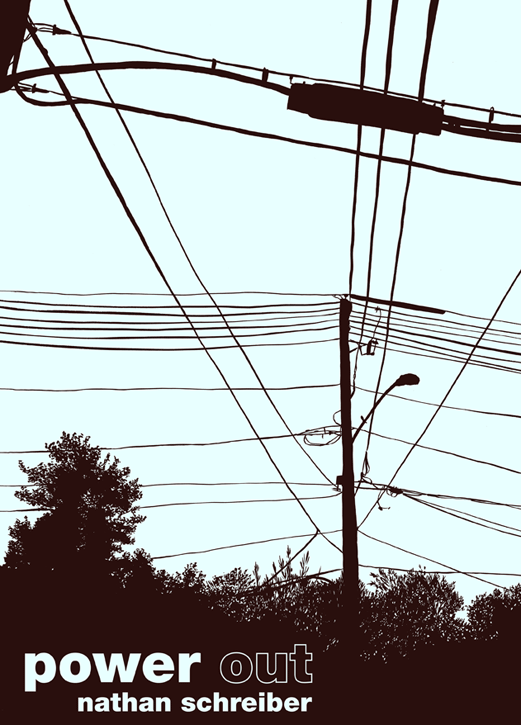
Power Out is a webcomic on the act-i-vate site, the first volume of which has just been published.  I don't read web comics, and bought this slim volume on the strength of it being the 2009 Xeric Award winner.

This is a really powerful comic.  My only complaint is that it doesn't tell a complete story, but is instead the first volume of a series, the length of which I don't know.

The story is set in some New England suburb, and features Justin, a fourteen year old kid who doesn't fit in at school, and would prefer to spend his days playing video games.  The kid is set up as a complete loner - he barely speaks throughout the comic, and could be a little autistic based on what we are shown of his life and interactions.

When his parents go on a cruise, he is left home with his older sister.  She promptly has a party, and then takes off for a week-end at the shore, leaving Justin completely alone.  Normally he would be quite happy with this turn of events, but a massive black-out kills any chance he has of playing video games without interruption.  Instead, Justin is at the mercy of the intense heat wave gripping his town and of his own inability to relate or interact with people.

Not much happens in this volume, but it's all in the way not much happens.  Schreiber is really inside Justin's head, and does a wonderful job of capturing both the callousness of teenagers and the confusion of adolescence.  As a reader, you feel for Justin, but at the same time, you recognize that you wouldn't particularly like him if you met him in life.

Schreiber's art is a little like David Lapham's, and he does a great job at showing peoples' expressions.  I particularly like his establishing shots - the cover had a huge appeal to me.  The interiors are coloured with only the same shade of blue as you see on the cover, and this was a very effective choice.  The book is published by Canal Press out of BC, and they use a type of ink that is almost glows on the page, providing an aesthetic experience I really enjoyed.

Recommended.

Saturday, March 27, 2010

Malinky Robot 1 & 2

by Sonny Liew

I first came across Sonny Liew's work in Liquid City, the Image anthology of Asian comics, and his Malinky Robot story was my favourite in the book. I found it quite charming, and resolved to track down the comics in the series that had been published (in 2002 and 2005). I got them both this week off Ebay, and I'm pleased with the purchase.

Malinky Robot is about two young kids living in a run-down Japanese city (I think). Atari is the scarred leader of the duo, always coming up with big plans or dreams. I don't know what Oliver is - he looks a little like a stuffed trunkless elephant. They hang out in the rough areas of town, don't go to school, and are watched over by Mr. Bon Bon, a friendly construction worker.

The first issue of the series, 'Stinky Fish Blues' is the exact same story published in Liquid City. The only difference is that this earlier publication is not coloured, and is harder to follow than the lushly coloured later printing. It's still a cute story, although I was hoping for a little more content. This issue was self-published with a Xeric grant.

The second comic was published by Slave Labor Graphics, and is at least partially coloured. It is smaller than a regular comic, being about the size of Jason Lute's Berlin or Chester Brown's Louis Riel comics. In this issue, the two kids 'borrow' a pair of bicycles to travel to a suburb or other town and visit their friend Misha who has recently moved there. The middle of the comic is filled with two other stories, ostensibly told and illustrated by Misha and Atari, about Mr. Bon Bon. Between them are a series of comic strips modeled on a Sunday comics section, by Oliver.

There's not much story to hold onto in this comic. Nothing really happens, but it continues to be pretty cute and charming.