Showing posts with label TV shows. Show all posts

Sunday, April 10, 2011

Treme: The Complete First Season

Produced by David Simon and Eric Overmyer

The Wire has basically ruined all television for me, so I felt a great deal of relief to learn that David Simon's new HBO series, Treme, was finally being released on DVD (I don't get HBO Canada, and something like this is too good to stream on-line).

Treme explores New Orleans in the months following Hurricane Katrina.  It follows a group of characters as they try to rebuild their lives and their city.  As with Baltimore in The Wire, the city of New Orleans is the main character, and the ten episodes that make up the first season comprise a long love letter to the place.

Comparisons to The Wire are easy to make throughout this review, especially since the shows share actors as well as an aesthetic sensibility and a commitment to novelistic storytelling, but this is a show that deserves to be judged on its own merits.  Over the course of the show, a number of social and political issues are addressed, and a broad cross-section of the city's racial and class-based sub-groupings are portrayed and given space to shine.

We follow along as these characters go through the pain of losing their homes, their loved ones, their way of life, and in some cases, their dignity.  The subtitle for the season is "Won't Bow Don't Know How", and that ethic is evident in scene after scene, as people face their problems with stoicism and humour.

There are a number of strong performances, mostly by actors recognizable to anyone who has watched Simon's other shows.  Clarke Peters (Freamon on The Wire) plays Albert Lambreaux, a politically active Big Chief of a New Orleans Indian tribe.  Wendell Pierce (Bunk on The Wire) plays a down and out trombone player.  Khandi Alexander (who was the absolute best part of The Corner) plays his ex-wife, who is trying to locate her brother, who has been missing since the storm.  Her lawyer is played by Melissa Leo, who I loved in the earlier seasons of Homicide: Life on the Street.

New to the troupe are John Goodman, Steve Zahn, Kim Dickens, and Lucia Micarelli, who plays a street fiddler.  That brings me to the music, which is as big a character on this show as is the city.  Each episode is infused with a variety of musical pieces, and a lot of screen time is given to the performance of different brass bands in clubs and on the street during the famous Second Line parades.  There is a plethora of local musicians and artists featured here, making this one of the best-sounding tv shows I've ever seen.

I'm a little surprised to see that the show is returning in another couple of weeks for a second season.  This is good news, but I feel as if there is no need to return to these characters - the first season tells their stories completely, and ends just like a good novel does, leaving you wanting to know more about those characters, but also giving you a sense of closure.  Of course, when people like David Simon are in charge of setting the tone for the next chapter, I don't mind if the show runs forever.

Sunday, May 10, 2009

Caprica

Written by Remi Aubuchon and Ronald D. Moore
Directed by Jeffrey Reiner


Going in to this, I wondered if a prequel to Battlestar Galactica was such a great idea. I recognized that Moore and the other creators of the series had put a lot of time and effort into making the twelve colonies a viable background for their series, but I was nervous that the notion of tieing the Adama family into the creation of the Cylons was a huge mistake. If their was such an intimate connection, it seems odd that Admiral Adama would have never mentioned it.

All of those concerns were quickly washed away when I started to watch Caprica. It's an excellent film in its own rights, and it lays very fertile ground for a television series.

It, like Battlestar, is firmly grounded in religion, and the struggle between a monotheistic minority and the pantheistic majority that is common in the parent series. That the Soldiers of the One, a terrorist group dedicated to spreading the word of their god has so many parallels in today's society can not be accidental, and I find it interesting that the worship of many gods is trotted out as a solution to fundamentalism. I wonder if there are some Hindus on the writing staff....

Also of interest is the technological superiority of these Capricans to the ones in Battlestar Galactica. That makes perfect sense in a post-Cylon world, that people will have ditched their robot butlers and cell phones, but it creates a completely different aesthetic for this series, one that is very attractive. The houses in this film are beautiful, as are the carpets, which seem to score a lot of screen time.

I'm very interested in watching this series play out, and am looking forward to its premiere, some time in 2010.

Saturday, March 28, 2009

Hellhole

by Atul Gawande

America currently houses a minimum of twenty-five thousand prisoners in conditions of near-total isolation, at very high costs, and despite the fact that studies show this treatment does not engender a positive change in the convict.

Gawande's excellent article details the effect isolation has on the human mind, using examples of American prisoners, American prisoners-of-war, and individuals taken hostage, such as Terry Anderson, who was held prisoner by Hezbollah in Lebanon for seven years. All of them experienced intense mental breakdowns, and many of them became unable to function properly in society following their release.

So, Gawande asks, why does America continue to utilise this form of correction, when it is proven that it doesn't correct? His biggest excuse would be that it would be unpopular politically to be seen as 'soft on criminals'. This becomes another example of things I don't understand about America, but there you have it. A system that punishes and rehabilitates, such as the British model described in this article, would make much more sense in terms of cost and benefit to the community, but it doesn't seem like something that American politicians would ever be able to support, as it would cost them votes.

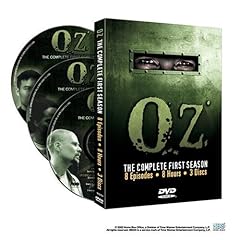
I read this article at a time where I've been re-watching old episodes of Oz, HBO's prison drama/soap opera from the early-00's, and what I find interesting is how mainstream the facts that Gawande discusses really are. During its first two seasons, the producers of Oz showed that the system didn't work, and also demonstrated quite nicely the negative effects of segregation. It's interesting to me then that no real progress has been made on this issue. I admit, HBO has never had a massive outreach into American culture, but you would think that people would be beginning to be more educated about some of these issues, and perhaps would start changing their view of what "being hard on criminals" really means (and costs).

Thursday, January 22, 2009

Generation Kill

by David Simon, Ed Burns, and Evan Wright

I started watching this mini-series with the following pre-conceived notions: i) that Simon and Burns have basically ruined all other television for me - their shows are just about the only things I enjoy now; ii) that the Iraq war was an absolute disaster of military planning and political will from the very beginning, with no real long-range strategy, exit plan, or purpose beyond showing how tough George W. Bush is; and iii) that the US military is one messed up group of organizations, and not really something to be proud of.

This series has completely changed my thinking about point three, while cementing points one and two in my mind forever. When the series starts, I found it very easy to identify with Lee Tergesen's character of Evan Wright, the reporter upon whose book the series is based. As the series progressed, I found that I really developed a respect, admiration, and awe of the different Marines portrayed. Sure some of them are severely damaged Whiskey Tango freaks, but for the most part, they are shown as highly intelligent, brave and determined individuals. The majority of the officers are a different matter however.

The series is about the actions of the Marine 1st Recon unit in the earliest days of the invasion of Iraq. It mostly centres on the Marines in Wright's Humvee, but it also encompasses their entire group (battalion?). We get to ride alongside these highly trained individuals as they move from pointless mission to being stuck behind trucks time and again.

At first, we see their frustration at not being at the tip of the spear to 'kill Hajiis', but as the show progresses, we see even more their frustration at how the war is being mis-managed. The Marines on view here are highly critical of their command, their support troops, and the entire effort. The beauty of this show is that it, while it deals with so much negativity, it also manages to elevate the individual soldiers, and to show them as remarkable people. I found that I started to really like them, and when I finished my week of watching these seven episodes, I found I missed them.

As with The Wire, the Simon/Burns masterpiece, the biggest draw for me was the dialogue. As expected, the Marines are a foul-mouthed, shit-talking group. At the same time, they are poets of a new breed - their rants and invectives flow with a terrible beauty and brutal honesty. Much of the dialogue, and the show itself, is darkly humorous and occassionally so funny that I found myself laughing out loud.

All in all, I think I preferred The Wire in terms of depth and breadth, but this was a highly entertaining series, which caused me to re-think some of my positions on the American military.

Tuesday, December 2, 2008

The Corner

I first watched this when it came out years ago, but following my recent discovery of/obsession with The Wire, I thought it would be worth tracking this down and watching it again.

In a lot of ways, I think it might be better than The Wire. It is definitely on common ground - it's produced by David Simon, and based on a book he co-wrote with Ed Burns. The setting is Baltimore, but in this 6-episode mini-series, the camera is planted firmly on the corner of Fayette and Monroe, instead of wandering throughout Charm City. The focus of The Corner is on Gary and Fran, and their son DeAndre.

Gary used to be the neighbourhood success story, but now he's a dope fiend full time. He's lost his wife, his son, and his home. Fran is also a junkie. DeAndre is not even 16 yet, but he's starting to creep out on the corner and sell the drugs that have destroyed his family and his community.

As the show progresses, we move beyond these three main characters to meet the other dope fiends, dealers, and denizens of the community. All of the characters are based upon real people, and the show does not flinch from the gritty reality of life on the pipe or the needle.

Like The Wire, this is a very political piece of film-making, but it is a quiet act of protest, reminding us that people live this way, and challenging us to do something about it.