Showing posts with label Top Shelf. Show all posts

Friday, March 18, 2016

Nemo: The Roses of Berlin

Written by Alan Moore
Art by Kevin O'Neil

Nemo: The Roses of Berlin is the second of the Nemo graphic novels, building on the world Alan Moore and Kevin O'Neil created in The League of Extraordinary Gentlemen.  Compared to the previous book, Nemo: Heart of Ice, I enjoyed this one more, but still had some problems with it.

Janni Nemo and her consort, Jack, discover that their teenage daughter Hira has been captured by the Germans (it's roughly World War II), and they head to Berlin to rescue her.  Like with Heart of Ice, we got tossed very quickly into the story, without taking any time to care about the characters at all.

Berlin has become a dystopian nightmare out of Fritz Lang's Metropolis, and we quickly learn that Maria, the robot from the movie, is as much in charge of things as Herr Hynkel (Charlie Chaplin's stand-in for Hitler).

There is a brothel, a rescue, sleeping soldiers, and a fight with the woman from the last volume.  It's all handled well, but it also feels like Moore and O'Neil are going through the motions, as if the clever references to literature and film are sufficient replacements for compelling story.

I liked it, and as always, enjoyed puzzling out some of the references (while knowing that way more of them went over my head), but never felt invested in the story at all.

Thursday, March 17, 2016

Pistolwhip: The Yellow Menace

Written by Jason Hall
Art by Matt Kindt

I enjoyed the first Pistolwhip book, and was a little surprised to see that Matt Kindt was not credited with any of the writing on the second one, The Yellow Menace, despite the fact that the story feels very much like a Matt Kindt story.

Like the first book, this one is steeped in radio dramas, but also incorporates film, comic books, and pulp novels.  Our private detective, Pistolwhip, becomes embroiled in a weird plot involving a "Yellow Menace", basically a serial killer going around murdering people in manners influenced by baser popular culture.

At the same time that this is going on, a travelling lecturer, Roderick Loom, is warning of the dangers of this type of entertainment, especially on children.  He is clearly based on Frederick Wertham, the guy who wrote Seduction of the Innocent and became ultimately responsible for the introduction of the Comics Code Authority.

Opposing the Yellow Menace is Jack Peril, a character popular in the pulps, movie serials, radio dramas, and comics, who seems to be real.  He first appears after an explosion at the radio station where his adventures are broadcast.

Pistolwhip is usually a pretty clueless character, and Hall builds on that with this volume.  The story can be hard to follow in places, but is ultimately entertaining.  Kindt works on some cool transitions between scenes.  I particularly like the way he moves the camera into a character's ear, and then shifts to something else.  In one place, suggesting that a character is not mentally stable, we see a loose screw inside that character's ear, which then becomes part of a moving vehicle, establishing the next scene.

Reading this, you can see the growing talent in Kindt (this came out in 2002), and it's cool to compare to his more polished work of today. These stories have recently been collected as The Complete Pistolwhip, and that is probably the best way to interact with them, although I do like the oversized format of this book.

Monday, January 18, 2016

Blankets

by Craig Thompson

I can't really explain why it's taken me this long to read Blankets, especially since I read Thompson's incredible Habibi as soon as it came out, but I read a lot of comics, and there are a lot more that I've never read, so it happens when it happens.

Blankets is a beautiful, beautiful book.  It's a very honest look at Thompson's early days, living in a remote farmhouse in Wisconsin as a child, and it follows him through his first love in his final year of high school.  More significantly, it looks at his evolving ideas about religion, and how he eventually walks away from the harsh, unforgiving Christianity of his parents.

As a kid, Craig is an true outsider.  He's artistic and sensitive, uninterested in sports, drinking, or drugs.  He does not easily fit into large groups, but also at home, is not all that interested in spending time with or getting to know his younger brother.  Craig is not mean or snobbish, he's just pretty self-sufficient.

In high school, as he's forced to attend yet another Christian camp during his winter break, he meets Raina, a girl from Michigan who is just about a perfect match for him.  They have a lovely (chaste) time together at camp, and then begin a relationship held through the mail.  Eventually, Craig is invited to stay at her house for two weeks (it says a lot about how trusting both kids' parents are that they never even assume there could be problems with this), and we get to see their relationship grow.

I'm not sure to what degree Thompson chose to fictionalize some of these events, but what we get to see is one of the more touching coming of age stories I've ever read.  Craig is the type of kid who feels sad sitting next to the girl he's in love with because he knows that soon he won't be.  Raina, on the other hand, is dealing with a lot at home - her parents are divorcing, her sister keeps using her to babysit her baby, and her other two (adopted) siblings have intellectual disabilities of differing severity.  She's looking for someone to make her feel less alone and overwhelmed, but is not exactly after the level of commitment that Craig is.

Woven through all of this is the austere Christianity that Craig's been raised in.  He's been taught forever about the rewards of heaven (which, to be honest, sounds pretty terrible, even if you like to sing), and has been singled out as a good candidate for seminary school from an early age.  He reads the Bible nightly, but, as we see, begins to question a lot more than word choice in the various translations.

This is a very good read.  Thompson's art is lovely, and he plays with layout and design in interesting ways.  He is able to convey a great deal of emotion in pretty simple facial drawings, and makes great use of white space (the snow that blankets Craig's life so often) to help focus the narrative.  I can easily understand why this is such an acclaimed graphic novel.

Monday, July 15, 2013

Infinite Kung Fu

by Kagan McLeod

I've never been a huge fan of the Shaw Brothers style of kung fu movies (although I did become somewhat obsessed with Crouching Tiger, Hidden Dragon when it came out), but I loved Kagan McLeod's Infinite Kung Fu, a nice chunky graphic novel love letter to that genre.

This book is set in the martial world, where the dead have started reanimating recently deceased bodies as thinking zombies.  Much of the martial world is ruled by an Emperor who is himself dead.  He has five armies, each controlled by a former student of one of the eight Immortals (there are others).  These students turned on their masters and learned Poison Kung Fu.

Now the Emperor is trying to put together his mystical armour so that he can come back to life and destroy the world for all time.  The Immortals have left the world and have vowed not to interfere in worldly affairs, except through the actions of their agents, and so they send a young deserter from the Emperor's army, Lei Kung, on a mission to learn powerful kung fu and save the day.

McLeod fully embraces the tropes of Chinese kung fu movies, but adds just the right amount of 70s blaxploitation to the mix, in the character of Moog Joogular, an afro-sporting fighter with the ability to remove and regrow his limbs.  Moog lives in a village that looks like Harlem, while the rest of the book is set in a more traditional Chinese countryside.  It's an odd addition to the book, but it's exactly the kind of thing that makes me like it.

McLeod's story is long and rambling, in an epic way (the book is about 450 pages) that circles back upon itself.  I enjoyed the flow of this story, and liked how complicated things got towards the end, as different factions competed for similar goals.

McLeod's art is very fluid, and his fight scenes are choreographed beautifully.  He captures the variety of time periods he's looking to capture (i.e., a 70s depiction of ancient China) very well, and propels the story perfectly.  McLeod's approach to this story is highly creative and never dull.  Recommended.

Saturday, July 6, 2013

The Lovely Horrible Stuff

by Eddie Campbell

There's a point in the first half of this rather odd graphic memoir where Eddie Campbell laments the fact that, where he and his wife used to discuss sex over their meals, now they talk about money.  When one is young, money is largely celebrated in its absence, but as one gets older, it raises in its importance.

That's kind of the point of The Lovely Horrible Stuff, which is split into two very different sections.  The first is a personal memoir, with Campbell examining his relationship with his money.  He discusses the amount of time and energy independent artists have to expend to get paid for their labour, and then goes on to talk about how, flush with his share of the spoils from From Hell, he lent money to his father-in-law, who then proceeded to tie the money up in a number of improbably lawsuits against the retirement village to which he'd moved.

Campbell's point here seems to be that money is complicated, and best left to others to manage, but that where money is concerned, no one can be complicated.  Campbell's long-time travel agent had constructed her own little Ponzi scheme, resulting in the Campbell's losing their plane tickets.

In the second part of the book, the Campbells travel to the island of Yap, a small part of Micronesia.  Historically, the people of Yap had placed their wealth in Rai, large stone disks that were carved from limestone on a neighbouring island.  Yapese society developed around the value of these disks, which were rarely moved.  Campbell gives an overview of the economics of the island, and how it was used to prove various points by Western economists over the years, but really, this is a travel memoir that has little more than tangential connections to the first half of the book.  I also found it to be the more enjoyable half.

Campbell's always been an interesting and singular cartoonist.  For most of this book, he mixes photographs with his own drawings, which is a little jarring at times.  This is an interesting read.

Monday, July 1, 2013

Harvey Pekar's Cleveland

Written by Harvey Pekar
Art by Joseph Remnant

I didn't start reading Harvey Pekar's comics until just before he died a few years ago, and has slowly been dipping my toes into his brand of crotchety autobiography.  Harvey Pekar's Cleveland is kind of an odd book - it's as much a history of the city that he's so closely associated with as it is his own memoir of the city and how it shaped him.

The book meanders quite a bit - it opens with a history of the fortunes of the Cleveland Indians baseball team, before giving us a condensed story of how the city grew (and then began to shrink).  In between, Pekar shares some of his own memories of growing up, and living in the city through its roughest moments.

Like many an industrial city in the US, Cleveland has seen better days.  It has lost its manufacturing base, and has seen its population shrink (Pekar is especially interested in charting the exodus of white people; I often forget how obsessed Americans are with their racial divide).  Still, Pekar has remained, working as a career civil servant, and writing for comics and music magazines.

This book doesn't really make the reader want to visit Cleveland (although I'd love to hang out at John Zubal's bookstore, which Pekar devotes a fair amount of space to), but it does humanize the place.  Much of the material in this book is familiar - it seems that Pekar spent a lot of time revisiting the same themes and events in his life - but it kept my interest.

Monday, June 24, 2013

Shadoweyes

by Ross Campbell

I consider myself a big fan of Ross Campbell's work, but at the same time, I have to say that the cartoonist confounds me sometimes.  Campbell is best known (aside from his recent work on Glory at Image) for Wet Moon, a sprawling late teen drama about punk kids who have trouble navigating their relationships, and who are dealing with a killer in their midst.  It's a strange series of graphic novels, but there's something about it that makes it almost impossible to put down.

Shadoweyes is Campbell's newer OGN series (two volumes have been released so far), and it contains a number of the features one would expect from a Campbell comic - physical deformity, gender ambiguity, and girls and women shaped like real girls and women, in all their diverse splendour.  It's also unlike his other work (predicting the evolution that brought him to Glory), as it has a much more frenetic pace, and the art is much more hurried.

Scout is a young black girl living in a dirty, crowded metropolis in the future.  She is vegan, and very politically conscious.  She likes to patrol the city as part of a neighbourhood watch initiative with her best friend Kyisha (who is, of course, intersex).  After taking a knock on the head while helping a homeless man, Scout later turns into a blue creature with a tail.  At first, she can control the transformation, and uses her new abilities as a chance to help others, but does that according to her own moral code.  For example, when she stops a guy from robbing a store, she then stops the cops from arresting him, since he didn't actually do anything.

Scout rescues Sparkle, a girl from her high school, from a weird kidnapping scene, and they begin to get very close to each other.  It's at this point that the series most begins to resemble Wet Moon, as Campbell suggests that the two girls fall for one another (the next volume is called Shadoweyes in Love), and as Sparkle is missing fingers and toes.

At times, I found myself frustrated with the pacing and lack of clarity in some scenes, but at the end of the day, this is a very good book.  Campbell tells stories that no one else in comics tells, and you have to admire the consistency of his artistic vision and gender politics.

Monday, July 9, 2012

The Underwater Welder

by Jeff Lemire

The introduction to Jeff Lemire's new original graphic novel, written by Damon Lindelof, talks about the similarities between this book and The Twilight Zone.  Personally, I find that to be a little facile, because while there are definite points of comparison on the surface, I don't think that the Zone ever got so deeply into the mind of the characters that it featured as Lemire does here.

Setting aside Lemire's more commercial work at DC (Superboy, The Atom, Animal Man, Frankenstein, and now Justice League Dark), it's easy to see a clear progression from his earlier (and still best) Essex County, through The Nobody and Sweet Tooth, to this piece of work (in fact, Gus and the two main characters in those other books have a bit of a cameo here, although its easily missed).

The Underwater Welder is about Jack, a man on the cusp of fatherhood who has never been able to reconcile with his own father's disappearance when he was ten years old.  His father used to dive for treasure and salvage in the area around Tigg's Bay, a small fictional town on the Atlantic in Nova Scotia, and Jack has always felt connected to the sea because of this fact.  After leaving town to go to university, he felt the need to come back, bringing his pregnant wife with him, and getting work as an underwater welder on the oil rig that is just a half-hour's boat ride away.  Being under the water makes him feel close to his father, and he's always happiest when completely alone.

This is beginning to cause some strain on his relationship with his wife, who is not from the area and doesn't know anybody.  On a more or less routine dive, Jack experiences some strange things - he hears voices, and comes across a familiar pocket watch.  He comes to on the surface, and is sent home pending some medical tests.  This sends him into a bit of a spin, as he no longer feels sure of what exactly happened to him, and feels a growing compulsion to both return to the deeps, and to connect with his father.  It is here that the Twilight Zone comparison is most apt, especially when everybody else in town disappears, but this remains an intensely personal book, as Lemire dives ever deeper into Jack's psyche and his wounds.

Lemire has often played around in terms of layout and design in his work on Sweet Tooth, and here he does similar things, having Jack morph into his younger self and his father at different places, and in one case, sit down and have a conversation with himself.  It's the type of thing that only works in comics, and Lemire does it very well.

His art looks thinner than it has in his other black and white books, being much closer to what he's done on Sweet Tooth, and different scenes are shaded very differently.  The look of the book is such an integral part of the story, and Lemire demonstrates a very tight control over what is shown, and how the different approaches inform the story.

This is one of the best new graphic novels to be released this year.  Lemire remains a very exciting creator to watch, and I like that while he is becoming increasingly better known for corporate 'for hire' work, he is also able to find the time and freedom to put together something as personal and insightful as this book.  Highly recommended.

Sunday, July 1, 2012

The League of Extraordinary Gentlemen: Century #3 - 2009

Written by Alan Moore
Art by Kevin O'Neill

I don't know.  Maybe it's just me, but I'm not all that impressed with this latest appearance of the League of Extraordinary Gentlemen.

In a nutshell, this issue jumps some forty years since the team was last seen.  Orlando has been in the army, fighting in Q'Mar (a stand-in for Iraq?).  Mina has been in a mental institute, and Allan Quartermain has fallen off the wagon, and is living on the streets. Orlando is called upon to put the band back together to fight the Anti-christ, so that's what happens.  There's a little more going on, but not much.

And therein lies the problem with this series, as it moves closer to the present day.  When Moore first started writing the League, what made it work was the use of so many different literary characters (Mr. Hyde, the Invisible Man, Captain Nemo, etc.) in a shared universe.  When the story was set in Victorian England, that was easily done; all the characters were in the public domain.  When setting a story in 2009, when copyright laws are still in effect, causes Moore to spend more time being cute with his references (it's pretty clear that the Anti-christ is Harry Potter, but it's never stated) than with actually developing his characters and story into something very interesting or exciting.

I'd expected this issue to be a little easier to read, as many of the references would be more obvious than the ones set in 1969, a time where I wasn't alive.  I didn't really find that to be the case - instead, I felt that each and every time a name was mentioned, or someone walked through the foreground of a frame, that there was some sort of easter egg that I was supposed to decipher, making this the literary comic book equivalent of Where's Waldo?.  I know there is an audience for this sort of thing, but it's not me.

On the up-side, Kevin O'Neill continues to impress.

Saturday, June 23, 2012

A Complete Lowlife

by Ed Brubaker

Quick quiz:  What's the first thing you think of when you hear Ed Brubaker's name?  I automatically associate him with crime comics, such as Criminal, or his other genre explorations like Incognito and the currently-running Fatale.  I imagine a number of people would think of Captain America first, as he's been writing that character for a number of years, and is responsible for some of the best Cap stories of the last twenty years.  I doubt very many people would associate Brubaker with semi-autobiographical cartooning along the lines of a Chester Brown or Joe Matt, but that's what A Complete Lowlife is.

Brubaker wrote and drew the comics collected here in the early 90s, before he broke into mainstream comics.  His stories feature Tommy, a guy in his early twenties who lacks ambition, preferring to work in dead-end service industry jobs, drink, and generally waste time.  He has problems with women, and thinks nothing of stealing from his employers.

I'm not sure if Tommy is a complete lowlife, as the title suggests, but he's not all that nice a person.  Brubaker pieces together a not uncommon figure - an American male trapped in a cycle of adolescence that is extending way too long into adulthood.  Still, those figures are kind of funny at times, and Brubaker has always known how to tell a good story.  His art is a little stiff, but more than serviceable.  This is an interesting window into the mind of one of the most influential writers working in comics today.

Sunday, May 13, 2012

Lost Dogs

by Jeff Lemire

In Timothy Callahan's introduction to this new edition of Jeff Lemire's first published graphic novel, Lost Dogs, he talks about how when he saw the first edition at MoCCA just after it came out, he almost passed on it due to the roughness of Lemire's art.  This reminded me of a time a few years back, right before Sweet Tooth began, but after I'd read the Essex County books, when I was in a complete hole in the basement comic book store (we've all spent too much time in places like that) in Toronto's north end, looking for some back issues.  They had a copy of Lost Dogs, I think priced at $10, but for some reason I don't recall, I didn't buy it.  Reading today that there was only a 700-copy press run for that book (it won a Xeric grant), I definitely regret not picking it up.

Anyway, thanks to Top Shelf, the chance to read the book, now with legible lettering, has come around again.  Lost Dogs is a pretty rough piece of work, but it's not hard to see the seed of Lemire's later brilliance in this very heart-felt graphic novel.

The book is about a gentle giant of a man who wears a red and white striped shirt, set some time in the late 19th or early 20th century.  He lives in a rural setting with his wife and daughter, and shortly after the book opens, they take a trip into a big city.  When the daughter begs to look at the boats in the harbor, the family is attacked by ruffians.  The man tries to fight back, but is overwhelmed and dumped in the water.  Later, he is found by some fisherman, and through a strange course of events, he ends up being used in some bare-fist boxing match to defeat the unstoppable Walleye Thompson.

As I said, the book, and Lemire's art, are both very rough.  Lemire slops ink all over the place, and that creates a very distinct look for this comic.  Some of his panels and figures are awkward, but his better pages look very much like what we are used to seeing from him today.  I enjoyed this book as a piece of comic book archaeology, and as the only published piece of work by a creator that I admire a great deal that I have not read yet.

Thursday, April 19, 2012

Liar's Kiss

Written by Eric Skillman
Art by Jhomar Soriano

While I would almost never sit down and read a 'noir' crime novel (there have been a few, but they tend to be more literary, like Seth Morgan's Homeboy), I often find myself drawn to noir comics, such as Criminal.  Way back on Boxing Day (I'm falling further and further behind with my graphic novel reading), I picked up this Top Shelf book for half price by two creators I was not familiar with simply because I liked the design of the cover (the lesson here?  when comics and graphic novels are cheap, people are more likely to take risks on a book on a whim - too bad people can't make a living off that).

Liar's Kiss stars Nick Archer as your typical layabout of a PI who fell into the job because he couldn't really think of anything else to do with his life.  He's not particularly good at his job, but he has managed to land himself a very rich client - Johnny Kincaid - who wants him to make sure that his younger, beautiful wife, is being faithful.  Kincaid regularly photographs Abbey Kincaid sitting around reading, to prove that she is staying at home all night while Kincaid sleeps.  What Kincaid doesn't know though, is that the PI and the woman stage the photos, and then go to Archer's place where they conduct an affair.

This whole set-up seems to be working well for Archer, until Abbey goes home one night to discover that her husband has been murdered.  She is immediately seen as a suspect, and when Archer's batch of photos get mailed by mistake, they both realize that he has more or less sealed the case against her.  From here, the story follows Archer's efforts to keep his lover out of prison, as he deals with suspicious cops and Kincaid's assistant, who has an agenda of her own, which leads back to the art gallery that Kincaid once owned, and the scandal that killed one man and sent another to prison.

The book has a nice pace to it, and a successful twist at the end that I did not see coming completely (there were some hints that something was up).  Skillman avoids the overblown narration of a Raymond Chandler novel, which is a nice change of pace for this type of book.  Jhomar Soriano, the artist, does a very nice job of telling the story, switching from his Eduardo Risso-esque pencils to a more fully rendered style for flashbacks.

This is an effective book from two creators I would be interested in reading more from.

Thursday, January 19, 2012

Any Empire

by Nate Powell

There are some stories that can only be told in comics, and Nate Powell's Any Empire is a perfect example of that.  His story, about childhood in the outer fringe of suburbia in the 80s, is about as impressionistic as a story can be.  I feel like I missed out on some of the nuance, but still enjoyed the originality of Powell's vision a great deal.

Lee is a solitary, self-absorbed child with a fascination for GI Joe and warfare.  He fills his days imagining daring assaults on the backyard barbeque or picturing helicopters circling overhead.  Powell shows his imaginings as taking place within the same frame as the real world, so while Lee walks one way through a field of tall grass, we see a patrol of grunts coming the other.  We see his slightly-altered Snakeyes and Lady Jayne going through the motions of attacking Cobra bases all over the backyard. 

In Lee's circle is a kid named Purdy, who is a vicious little guy.  He too shares some of Lee's interest in war, but he also always has to be the alpha male in any group; this leads to problems for him with The Twins, a couple of thugs in his age group who like to torture the box turtles that live throughout the area.

Sarah is a girl who lives around there as well, who is fixated on helping small animals, especially the turtles she keeps finding with cracked shells.  She fancies herself a young Nancy Drew, and so investigates the mutilations, and keeps a slightly disturbing journal.

As with most childhood acquaintances, these three kids circle each other without actually becoming friends.  As people move away, they drift apart, although eventually they all meet up in the book's conclusion, which I'll be honest, I'm not too sure of.  Powell's incorporation of fantastical visions makes his plot a little hard to trust; the reader is left asking if what he's reading is really happening, or is one character's flight of fancy.  Powell used similar techniques in his first graphic novel, Swallow Me Whole, which dealt with issues of mental health.  The two books work well together.

Any Empire is a solid read, even if I am coming away from it with more questions than answers.

Saturday, December 31, 2011

Swallow Me Whole

by Nate Powell


Swallow Me Whole is a pretty surprising and powerful book, that leaves itself open to interpretation in a number of ways.  The book revolves around Ruth, an adolescent girl who lives with her mother, stepfather, stepbrother Perry, and her infirm grandmother, who everyone calls Memaw.

Mental illness runs rampant in this family.  Memaw is kind of senile, although she hints at having had some of her problems for her whole life.  Perry sees a little wizard, who commands him to draw for hours on end.  And Ruth has a thing about insects.  She's been stealing bugs preserved in jars from her school for ages, and constantly rearranges them on her shelves and in her room.  They speak to her, and she tries to make it through each day without stepping on any living thing.

Since much of this book is seen from Ruth's perspective, it becomes very hard to gauge where imagination is giving over to compulsion or delusion, which seems to be Powell's intent.  The story progresses in fits and starts, jumping over chunks of time, and leaving much for the reader to puzzle out.

Powell's art works well in this book.  He makes good use of negative and empty spaces, letting the art swirl in places like Ruth's thoughts do.  In the end, I'm not sure what this book tells us about obsessive compulsive disorder or schizophrenia, but it does portray these illnesses in a manner much less over-blown than most media.  This is recommended.

Saturday, October 15, 2011

The Homeland Directive

Written by Robert Venditti
Art by Mike Huddleston

This is the second time I've been impressed by Robert Venditti.  The first was with his Surrogates graphic novel, which later became a movie that I've never bothered to watch, because as a movie, the story doesn't interest me at all.

Actually, as I was preparing to write about this book, I started to think about how it would have worked with a more conventional artist, and I think I've stumbled on the secret of what makes Venditti's books work so well.  In a lot of ways, his stories are kind of standard fare, but he's always been paired with a more experimental artist, who has helped elevate the material to a more sophisticated level (Brett Weldele drew The Surrogates).

The Homeland Directive is about a plot at Homeland Security to help increase their powers of surveillance and access to the lives of all American citizens.  Their plan is complicated, but it involves a bio-weapon, the end of paper money, and the death of a scientist at the Center for Disease Control.

The only problem is that the scientist, Dr. Laura Regan, is rescued by a trio of government agents (who only met because of the new era of post-9/11 inter-governmental cooperation) who have gone rogue, and are attempting to put a stop to the plot.  What follows is a pretty interesting twist on the standard thriller movie, as the three agents have to keep a step or two ahead of their agencies, and try to figure out just what is going on.

As I said above, what really makes this book work is the fantastic art of Mike Huddleston, who has also been wowing me on Butcher Baker the Righteous Maker.  Instead of playing this like a straight thriller, Huddleston mucks around with the art a great deal, incorporating collage and a variety of drawing and colouring styles.  Just about every page looks different from the one before, as he adjusts his style to the setting and content of each new scene.  I found this level of inventiveness really heightened my enjoyment of the story, which has some pretty interesting things to say about the level of 'protection' the American government offers its citizens.

Sunday, July 31, 2011

The League of Extraordinary Gentlemen: Century#2 - 1969

Written by Alan Moore
Art by Kevin O'Neill

It's hard to believe that it's been over two years since the last issue of LOEG: Century came out (I reviewed it in May 2009), but there you have it.  Any time there's a new comic by Alan Moore, there's a cause for some celebration, and this was easily the best and most impressive thing I picked up this week, but at the same time, I will admit to being a little disappointed.

First a recap:  Mina Murray, Alan Quartermain, and Orlando have returned to London after an absence of many years, because they believe that their nemesis for this series, Olive Haddo, has returned and is at work preparing for the birth of an anti-Christ or some such.  The trio are tasked with hunting down Haddo, who has been jumping bodies for a while now.

The twist is that our trio is not particularly prepared for life in 1969 London..  Mina's been around recently (apparently with a team of super heroes), but the others are not prepared for the free love and copious amounts of readily available drugs.  Nor are they prepared for Mina's desperate need to fit in, and not appear as 'square' as her companions.

That's what I found most interesting about this book.  Sure, it's fun to hunt Easter eggs (more on this soon), but what interested me was watching a trio of immortals (two of whom are relatively new to that status) adjust to the tempo and social revolutions of the twentieth century.  Quartermain and Orlando aren't particularly interested in staying relevant, while for Mina, it seems to be a necessity.

The rest of the book was secondary to me, as I find the relationship between these three characters most interesting.  Not being British, and not having lived through the '60s, many of Moore's clever plays on names and literary allusions were completely lost on me.  Having skimmed Jess Nevin's annotations, I am both awed and humbled by how much is in here that has escaped me.

Thus, I'm happy that Moore and O'Neill manage to keep things so interesting and fresh while still playing their own little reference games.  I think this book succeeds much better than The Black Dossier did because the focus is on the people, whereas that book got too caught up in the construction of its story.  With this book, it's not necessary to know that Oliver Haddo is supposed to be Aleister Crowley, or that the Purple Orchestra is a stand-in for the Rolling Stones to enjoy things; it does take things another level if you know that though.

Sunday, December 19, 2010

Super Spy

by Matt Kindt

This graphic novel is amazing.  I picked it up before I read Revolver, Kindt's recent book from Vertigo, but only got around to reading it this week.  As much as I enjoyed Revolver, this is a vastly better book.

Super Spy is made up of many short chapters featuring spies during the Second World War.  Each chapter is short - rarely more than ten pages, and many of them appear unconnected until the second half of the book, when they begin to intertwine and overlap in unexpected ways.

Kindt uses these characters and their situations to explore themes of betrayal, love, and the necessity of duplicity in war time.  Many of his characters act out of a desire to find safety for themselves or a loved one, while others have complicated and unknowable motivations.  We return again and again to codes and ciphers, and children's books and comic strips are used to send messages across enemy lines.

At times, it's hard to recognize some characters, as Kindt's art can make it hard to differentiate characters who aren't marked by a large facial scar or some other distinguishing feature, but that didn't much matter to me, as I got swept up in both the mechanics and the poetry of the spy lifestyle.

Kindt works in a number of different styles and approaches over the course of this book, very effectively creating the correct mood or feeling for each different story.  His writing is very lyrical and perceptive, and I loved some of the visual tricks he used, like when he arranged the wreckage around a person hiding from a sniper to resemble the snowflakes falling all around him.

This is a very impressive piece of work, and I'm definitely going to track down more of Kindt's work, including his sequel to this book.

Saturday, October 2, 2010

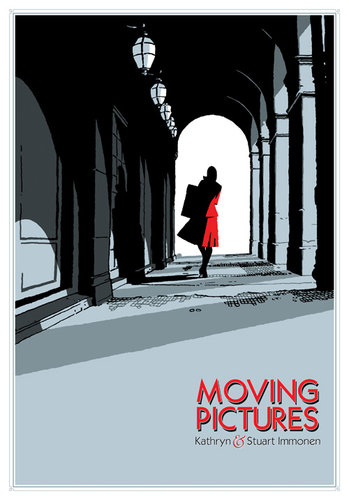
Moving Pictures

by Kathryn and Stuart Immonen

I found this graphic novel from the Immonen's to be a big surprise.  I wasn't sure exactly what to expect from this book going in to it, as the creators are best known for their work in superhero comics (Patsy Walker: Hellcat and New Avengers, respectively).  Moving Pictures is a very literary book, concerning a young Canadian girl who had been studying abroad when the Second World War broke out.

Ila Gardner now works as a curator in occupied France, attempting to categorize and protect priceless works of art.  Rolf Hauptmann is with the German Military Art Commission, and he is also interested in these same works, although he is there to do the bidding of his masters in Berlin.  The two develop a conflict-ridden and largely unspoken relationship, their desire for one another smoldering beneath the constraints of their relative political and societal positions, the reality of their unequal footing, and their non-demonstrative personalities.

The story is told across two timelines, and the reader is left to draw his or her own conclusions about exactly what is happening between the two, as they each pursue their own agenda.  Paris is eerily peaceful, although Ilsa regularly reports on the sudden disappearances of her neighbours.  In many ways, the book reminded me, with it's unspoken emotions and temporal confusions, of Michael Ondaatje's The English Patient.

Stuart Immonen takes a cartoonist's approach to the art with this book, rendering the story in minimalist figures and simple backgrounds (except for the scenes wherein works of art are discussed; in these cases, they are displayed behind the central figures).  Kathryn Immonen's writing is similarly stripped to the bone, leaving much more room than usual for the reader's imagination and musings.

I would much rather see the pair continue with works like this than their ventures at Marvel, and I appreciate the level of craft that was put into this book.

Saturday, September 4, 2010

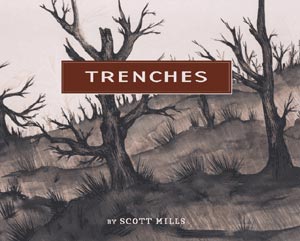
Trenches

by Scott Mills

I've been very tempted a couple of times over the years to purchase this 2002 graphic novel by Scott Mills, a cartoonist I am completely unfamiliar with.  As I've written about before, I'm a bit of a World War One nut, and have always felt that there should be more comics portraying the Great War.  I never bought this before because I was turned off by Mills's minimalist cartooning.  Then, Barnes & Noble had an on-line sale a couple of months ago, and I figured that at $2, it was worth the risk to get this.

It Was the War of the Trenches this is not.  Where Tardi's fantastic graphic novel concerned itself with the grittiest aspects of the war, Mills glosses over historical fact in the service of a story that barely needed to be told.  Trences is basically about two brothers, Lloyd and Davey, their commanding officer, Hemmingway, and how they get along during the war.

Lloyd is a nervous, gentle individual, while his brother is loud, brash, given to impulse, and irreverent.  Davey is often dismissive of Lloyd.  Hemmingway, on the other hand, is meant to be the picture of the British officer, keeping a stiff upper lip, dispensing platitudes, and yet standing by his men.

Now, I've studied the First World War, so perhaps the discrepancies in historical fact and interpretation are more jarring to me than to a casual reader, but there are a few things that I felt Mills got absolutely wrong with this book, and they kept me from enjoying them:
1.  Hemmingway doesn't seem to have a rank.  Davey calls him Officer Hemmingway, like he's a cop.
2.  Davey takes out a stationary flamethrower that looks like a machine gun (it's hard to tell with Mills's art).  What would be the point of a stationary flamethrower?  I've never come across any accounts of the German's using them.
3.  The chaps undergo what is supposed to be the first gas attack of the war.  The story makes it seem like the gas was coming in shells, an innovation that didn't come along until later.  Also, Hemmingway gets a good few lungfuls of the gas and collapses.  Luckily, he's perfectly fine after a little rest.  That would not be possible.
4.  Also, I'm not a doctor, but I'm pretty sure that someone who has had their leg ripped off would bleed out long before they'd be able to hobble back to their lines, especially since no one even bothers to tourniquet the wound.  And this happens twice!
5.  Class distinctions were pretty strict at this time.  I doubt that Hemmingway would have had his former subordinates over for Christmas dinner after the war, especially the two women that one of the soldiers sleeps with at the same time.

Mills acknowledges one of John Keegan's books as reference material.  I'm thinking maybe he only looked at the illustrations.  Were the story of the two brother's and their relationship more compelling, I'd be able to overlook the lack of understanding of the setting, but since that story is not worth spending time on, I can't.  Avoid this one, even at $2.

Monday, August 2, 2010

The Surrogates: Flesh and Bone

Written by Robert Venditti
Art by Brett Weldele

I really liked the first Surrogates collection, and although I knew that this volume was pretty much only created to tie in with the movie (which I haven't seen), I figured it was worth checking out nonetheless.

This story, structured as a four issue mini-series, even though it was only released in this collected format, serves as a prequel to the original comic.  As such, it covers the backstory of many of the key players in that book, while telling the story of the Hayes case and how it was used to build the power and profile of the Prophet.

Had I read these two books close together in time, I'm sure I would have found this story rather unnecessary and frustrating, as it would have been going over familiar ground.  Since it's been almost a year since I read the other book, I was able to enjoy this on a more individual level, although I did always have a sense of knowing what was going to happen next.

Venditti makes good use of this retroactive opportunity to lay the groundwork of the world he's constructed, I just don't know how essential it really is.  To read this followed by the other book might be a better way for a new reader to experience the story.

As is increasingly the case, Weldele does a great job on the art, turning in some of his clearest and most easily followed work to date.  This has been an interesting property, but I think there is little more to say on this subject or about these characters.