Showing posts with label Manga. Show all posts

Monday, May 30, 2016

Nonnonba

by Shigeru Mizuki

It's kind of strange reading Nonnonba so soon after I completed Mizuki's first Showa book, as it covers much of the same material.  That book is a mixture between personal autobiography and straight history book, examining Mizuki's childhood in a small town in Japan in the 1920s and 30s.

In Nonnonba, Mizuki focuses on his childhood, his relationship with the old woman who often worked for his family in a domestic capacity, and their shared belief in the rich spirit world of Japanese mythology and folk tradition.

Young Shige gets up to some pretty usual boyhood stuff, fighting with the kids from a different neighbourhood, visiting a 'haunted house', and drawing about his experiences.  He does terribly in school, and often exasperates his mother.

Nonnonba's familial relationship to Shige or his family is never made very clear, but it is obvious that the two care very deeply for one another.  She teaches him about the various spiritual creatures that live all around them, and as the book progresses, Shige gets to know a few of them on a personal level.

This is an interesting book.  It shows a touching example of inter-generational friendship, and helps document a way of life that is now gone.  I feel like Showa, which is supposed to be a broad examination of Japan's history, does a better job of explaining minute details about the mangaka's life, but this book is much more affecting and charming.

Wednesday, December 30, 2015

Showa: A History of Japan 1926-1939

by Shigeru Mizuki

I really don't know a lot about Japanese history, and since I liked Shigeru Mizuki's Onward Towards Our Noble Deaths, his account of his own involvement in the Second World War, I thought it would be interesting to read his broader take on the country's history.

Showa is a multi-volume look into the era that began when Emperor Hirohito took the throne.  This also coincided, roughly, with Mizuki's birth.  The first volume of this series covers the start of the era through to the Second World War, and this was a time of great turmoil throughout Japan.

A devastating earthquake created economic instability, which was made worse by the Great Depression.  Following that, a number of 'incidents' in China, and a shocking level of independence in the military, plunged Japan into many years of militaristic expansion into other countries, notably Korea and China.

The larger history of the country is told a variety of ways.  We get straight narration, we sit in on discussions among regular men on the street, and are directly told what's going on by Nezumi Otoko, a magical character from Mizuki's other work.  These sections of the book are interesting, but often became a string of names and faces to me.

Of more interest were the sections that juxtaposed Mizuki's own life with the events of the time.  We see young Shigeru move from being a small child through to his early adulthood.  This provides some context to the larger events, and remind us that at every point of history where major events have happened, there have been people just going about their day.

This is a hugely ambitious project from a much-loved cartoonist who sadly passed away this year.  I look forward to reading the rest of this.

Saturday, January 11, 2014

Good-Bye

by Yoshihiro Tatsumi

I'm pretty sure that, with Good-Bye, I've now read all of Drawn & Quarterly's collections of Yoshihiro Tatsumi's manga that have been published so far.  Tatsumi really is a marvel, and I consider myself lucky to have been able to have read so much of his work.

Lucky, and kind of depressed, as his stories are all about people who have been brutally isolated by modern, post-war Japanese society.  In one story, a man mourning his upcoming retirement decides to spend all of his money so that his cold and controlling wife doesn't get any of it, and even manages to end up in bed with the girl he's had a crush on, only to find the entire thing so incredibly sad and empty.

Another story has a young man become the only resident of his apartment building, after a corpse is discovered in the adjoining apartment.  In another tale, a young woman decides to prostitute herself out to American soldiers stationed nearby, mostly because she doesn't know what else to do with herself.

This is a very bleak book, and with its frank and sometimes explicit approach to sexuality, not at all what I would have expected to have been published in Japan in the 70s.  These are very literary and mature stories, and reading them in quick succession is a little numbing, but ultimately in a good way.

Tuesday, August 13, 2013

Fallen Words

by Yoshihiro Tatsumi

Compared to the rather dark and brutal stories of Tatsumi's Abandon the Old in Tokyo, which I read recently, Fallen Words is an absolute delight.  Tatsumi, the father of gekiga manga, a sub-genre analogous to alternative comics in North America, experimented with this book.  Each story told here comes from the Japanese storytelling tradition of rakugo, which features moral fables that end with a punchline or joke.  Tatsumi decided to fashion these classic stories in the gekiga style, and see where it took him.

These are old stories from mostly the Edo period, and as such are all set during that time.  They play with themes of marital deception, and many of them involve prostitutes or the lengths people will go to to escape poverty.

The lightness of the stories is carried over into Tatsumi's storytelling and art, which feels a little looser than his earlier work.  I didn't find it difficult at all to relate to these characters, despite their being from a distant time and culture, and that is a credit to the ease with which Tatsumi weaves his tales.  Now, not being familiar with rakugo at all, I can't really assess how closely he stays to the source material, but that doesn't really matter.  What does matter is that this is a fun read.

Thursday, August 1, 2013

Abandon the Old in Tokyo

by Yoshihiro Tatsumi

I'm not sure I was prepared for the utter bleakness of the stories collected in Abandon the Old in Tokyo.  I've read a few of Tatsumi's books now, most notably A Drifting Life, but I still didn't expect that his work would be quite this dark.

Tatsumi uses these stories, which originally saw publication in the 1970s, to explore the growing sense of isolation in Tokyo's cities, and the pressures placed on young men to be successful and happy.  His protagonists usually look the same in each story, giving the impression that we are seeing the same poor sap again and again.  His protagonists are also often silent or men of very few words; they allow others to shape their existences, be they demanding fiancés, infirm parents, creditors, or unfriendly editors.  Again and again we see these poor guys get beaten down, until they make some questionable life choices.

The most disturbing story in this book is 'The Hole', in which our protagonist is tricked into falling into a hole on a mountain, where a woman with a burned face and chest holds him captive for reasons that are never made clear.  Things get really twisted when the man's wife shows up, but insists she will only help him if he gives up his plans to divorce her.

Often when reading manga, I feel a cultural disconnect with the characters.  That's not the case here, as Tatsumi focuses on the problems of the modern condition; in many ways, this work is as relevant in post-recession North America as it was in post-war Japan.  This is a disturbing book, but it has been made by a master of the art form, and for that reason, it is a worthy read.

Friday, March 29, 2013

20th Century Boys Vol. 3

by Naoki Urasawa, with Takashi Nagasaki

Naoki Urasawa's 20th Century Boys is a very addictive manga series.  I pretty much burned through the entire third volume in one sitting, despite my intention to make it last a little while.  I just find, once I start reading the book, I am faced with a great number of compelling reasons to not put it down again.

This volume has Kenji continuing to work to discover the identity of The Friend, a leader of a cult that has been showing up all over Japan.  Kenji has evidence that The Friend is behind some biological attacks on San Francisco and London, and that the group is plotting some attacks against Japan.  Kenji knows this, because The Friend is basing his actions on a story that Kenji and his friends made up while they were children, although none of them remember all of the details now.

The central concept of this book is pretty preposterous, and some of the scenes that show Kenji trying to figure out The Friend's identity come off as a little amateurish (like when, at a class reunion, he and his classmates have their former teacher ask them who bent spoons one day years earlier, but they all close their eyes during this investigation, so no one knows who was responsible).

What makes this book work so well are a couple of things.  First, the characters feel very realistic, and are pretty believable.  Second is the notion that who we were and what we did as children is important to our character later in life.  Urasawa shows that the course of living one's life causes them to lose touch with the things that were once important to them, but that people's true identity changes very little.

I know there are about twenty volumes of this thing left for me to read, and that feels very daunting (how long can a mystery like this be drawn out?), but I also look forward to the next volume I can sink my teeth into.

Sunday, March 17, 2013

Onward Towards Our Noble Deaths

by Shigeru Mizuki

Take a moment and think about how the West has portrayed Japanese soldiers of the Second World War in films, novels, and other media.  The image that immediately comes to my mind is of tenacious fighters who attack suddenly, and who never give up an inch of ground.  I can't think of a single movie I've seen or book I've read that gets into the Japanese perspective though.

That's why I was excited to crack open Sigeru Mizuki's Onward Towards Our Noble Deaths, the collection of a manga story that was originally serialized in 1973.

This book is, according to the author, 90% true.  Mizuki was stationed on New Britain, an island in the Papua New Guinean archipelago, and was home to some fierce fighting between the Japanese and the Americans.  Mizuki introduces us to a number of characters of all ranks, and shows the boredom of the soldiers awaiting an Allied attack.

Much of this book is given over to portraying the officers as dehumanizing the men under their command.  Barely a page goes by where someone isn't being slapped or beaten simply because of their lower rank.  The men have their time wasted by officers looking to keep them busy, and the men slowly lose all sense of respect for the war effort in general.  When it becomes clear that the soldiers holding an area around Baien have no hope of success, their leaders decide that the appropriate course of action is to attack the Americans in a frontal suicide charge.

Some of the men survive this, and make their way to their larger forces, far to the rear of the fighting.  That they survived is seen as something between an inconvenience and a complete insult.  Their deaths have been reported to military command, and so it is necessary for them to attack again, ensuring their fate is what their commanders expect.

This book lays bare the problems of Japan during the war.  The need for honor, and for keeping up appearances sent men to needless deaths, while doing nothing to halt the Allied advance.  Mizuki does a terrific job of humanizing this senseless slaughter, and portraying it in a light, enjoyable fashion.

Mizuki's art is very interesting.  His backgrounds and establishing shots are exceptionally detailed and photo-realistic, while his figures are drawn in a very simple, cartoonish style.  Many of the characters look like the racially stereotypical drawings of the Japanese seen in American comics of the war period, which kind of surprised me.

I enjoyed reading this book a great deal.  None of the characters, with the possible exception of the doctor, stuck with me, although that is something that often happens to me when I read war comics; all of the characters are usually so similar that as individuals, they don't matter.  Which was more or less the point of the Japanese command.

Monday, March 11, 2013

MW

by Osamu Tezuka

I wish I knew more about the history of comics in Japan.  I would be particularly interested in knowing how MW, a twenty-six chapter story originally serialized between 1976 and 1978, was received by the public.  In this book, by the universally acclaimed master of Japanese comics, Osamu Tezuka, we are given a story that involves gay sex, child molestation, sexual torture, and images of corrupted members of the clergy.

I know that these days, all bets are off in terms of what can be depicted in Japanese comics, but I figure this must have caused a stir at the time, being written and drawn by the man who created Astro Boy.

MW tells the story of Michio Yuki, a beautiful and feminine young man who was kidnapped and molested by a group of thugs at the age of twelve.  While being held captive by one of the thugs on a remote island, Yuki was exposed to MW, a deadly nerve toxin being stored at an American military base.  He and his captor are the only people to survive the attack, but Yuki's brain is forever altered, making him an inhuman sociopath.

When the book opens, Yuki has achieved a position of some prominence at an important bank, a position he uses to blackmail clients for his own gains.  In short order, we see him seduce and kill the bank's manager, and then impersonate her to rob the bank on his own.  Yuki is working towards his grand plan, which is to find the location of the remaining stores of MW, and then use them to kill all life on the planet.

The young gangster who first kidnapped Yuki has, in an attempt to atone for his sinful ways, become a priest.  That doesn't stop Father Garai from keeping Yuki's murderous secrets, and having regular assignations with him.

This story is as much about Garai's wrestling with his own guilt as it is about Yuki's evil deeds.  I was surprised by how dark this story got, and how sexual, without being completely explicit (at least in its visuals - Tezuka tends to blur the lower half of his couplings, but he also suggests that Yuki makes love to his dog).

This is a very compelling read, and quite liberal for its time.  When a lowlife photographer tries to sell compromising photos of Garai to a muck-racking newspaper, they refuse to run them because the city editor is herself a closeted lesbian.

One thing I didn't understand was why the United States was constantly referred to as Nation X, despite the fact that we knew one Lt. General who falls afoul of Yuki's charms is from Kentucky.  Perhaps some explanatory notes would have been helpful...

Tuesday, January 29, 2013

The Kurosagi Corpse Delivery Service Vol. 9

Written by Eiji Otsuka
Art by Housui Yamazaki

Not being a big manga reader, and not knowing a whole lot about Japan, I think this series has really coloured my perception of that whole country, and its culture.  In this ninth volume of the brilliant series The Kurosagi Corpse Delivery Service, the writer Eiji Otsuka shines the spotlight on one of the stranger aspects of Otaku culture, the stranger air-defence techniques used in the Second World War, and the theme of suicide in Japanese culture.  Along the way, as always, he makes the book a great deal of fun to read, and completely unpredictable.

The first story in this volume deals with "solo hide-and-seek", a game that somehow involves imbuing a doll or stuffed animal with the spirit of a dead person, so that it will come find you when you hide it.  This game is being played on a beautiful young television personality, with bizarre results.

The second story involves urban myths of headless motorcycle riders and an invisibility suit.  The third involves an old man who could hear the voice of heaven, who as a young man was made to sit in a shallow bunker listening for American bombers.  Apparently this really happened.  The final story is the quietest and most personal, as the two most over-looked members of the Service's staff, Yata and Keiko, bond a little over stories about their childhood, and how their parents died.

This series really is remarkable.  It is grounded in a pretty absurd idea for a serial - that the people of the Service help deliver unclaimed and unidentified corpses to their final resting place - yet it is surprisingly personable and affecting.  The ideas that go into this series are always bizarre, but there is a comforting sitcom-like quality to the book that makes you want to overlook any amount of implausibility.  I can't recommend this series highly enough. 

Friday, January 4, 2013

20th Century Boys Vol. 2

by Naoki Urasawa, with Takashi Nagasaki

Partway through this second volume of 20th Century Boys, the very popular manga series by Naoki Urasawa, I was hit with the somewhat unwelcome realization that I would have to get all twenty-five or so volumes of this series, because I think I'm hooked.

This is a strange story, unfolding in a manner that is pretty unconventional, at least for Western comics, and which really adds to the mystique and wonder of the series.  A strange cult has popped up in Japan (I'm not sure when this series was begun in relation to the Aum Shinrikyo attacks) led by a mysterious 'Friend'.  The cult has members throughout society, and many connections to a group of friends who grew up together.

Of that group, one member was killed in the first volume.  Now Kenji, who was the leader of the group as children but currently tries to keep a struggling convenience store afloat while caring for his missing sister's baby, is trying to figure out what happened to his old pal.  The series is arrayed in a bit of a kaleidoscopic fashion, as each chapter frequently features new characters or events that then become connected to the main story, sometimes unexpectedly.  We get to know characters like the only girl from Kenji's group, and a homeless man who seems to be able to predict the future in his dreams.  We also learn a fair deal about Kenji's missing sister, which only adds to the mystery.

Urasawa, in addition to being an excellent artist, is a strong writer of character.  We meet an older detective in this issue, close to retirement, and in the span of two chapters, come to care about him and his life's struggles.  There are hints of bigger problems to come, as we get glimpses of germ warfare using an ebola-like virus, and of course, the threat of giant robots rears its head.  Still, this is a series that is very grounded in the day-to-day life of its characters, and therein lies its greatest strength.

Sunday, December 16, 2012

Black Blizzard

by Yoshihiro Tatsumi

I really enjoyed reading A Drifting Life, manga legend Yoshihiro Tatsumi's gigantic manga memoir a couple of years ago.  It portrayed his early days in the manga industry, a business that he helped shape with his resolve to write darker, more adult stories for a more adult audience.

In that book, the act of his creating Black Blizzard is a watershed moment for the young Tatsumi, and I was curious to read this book.  Luckily, the fine people at Drawn & Quaterly decided that this book was deserving of a North American edition, and so I was able to get the chance.

Black Blizzard is a Japanese noir story set in the late 1950s.  It opens with a young pianist showing concern that he may have murdered another person, although he was drunk at the time, and does not remember what happened.  He is arrested, but while being transported alongside another prisoner, to whom he is handcuffed, the train derails.  The two men make good on this chance for freedom, and end up spending hours together in a forest ranger's cabin, hiding from the police and trying to get warm (they've just walked through the titular blizzard).

The young man tells the hardened criminal his story, one of love, music, and the cruel ringmaster father of his circus performing girlfriend who does not want them to be together.  Later, desperate to be free, the older criminal contrives to drug the younger, and cut off his hand.

The story is pretty simple in its design and execution, but for all that, it is effective.  This is a classic noir story, and it illustrates how little that genre has changed in sixty years.  Tatsumi's early art is much cruder than what was in A Drifting Life, but there is a charm to this work by a young man looking to stretch the possibilities of an entire medium.  As a story, this is entertaining.  As a historical document, this book is essential.

Sunday, November 11, 2012

The Kurosagi Corpse Delivery Service Vol. 8

Written by Eiji Otsuka
Art by Housui Yamazaki

Eight volumes in, it's hard to describe how much I love The Kurosagi Corpse Delivery Service in a new way, but my affection for this book remains undiminished.

In this issue, the crew, who usually busy themselves delivering deceased bodies to where they want to go, address a couple of social issues in modern-day Japan.  The first story is a pretty simple one about the group trying to recruit new members so they can maintain their status as a school club.

After that, though, they become embroiled in a story about 'afterlife weddings' - marriages conducted between two people who are deceased, as a way of placating their souls.  Things turn a little weird though, when a company that offers this service start marrying the dead to the living, with the end result being that both bride and groom end up dead.

The next story has to do with the practice of 'baby drop boxes' at Japanese hospitals - a way for women to safely deposit unwanted newborns without facing criminal charges or public shame.  Of course, this being Kurosagi CDS, the babies keep turning up dead, and there is a supernatural explanation.

This series always blends humour and horror perfectly, and I find that I like the characters more with each new volume I read.  There's not a lot of individual development in this volume, aside from the introduction of a possible love interest for Karatsu, but this is still a very enjoyable read.

Friday, August 31, 2012

The Kurosagi Corpse Delivery Service Vol. 7

Written by Eiji Otsuka
Art by Housui Yamazaki

I never get bored of the Kurosagi Corpse Delivery Service, the manga series that follows the adventures of a group of young university graduates who use their various skills (corpse dowsing, channeling, mortuary make-up) to locate corpses and take them to where they wish to be.  It sounds like the type of concept that would get old, but seven volumes in, I find that the series still feels fresh and exciting.

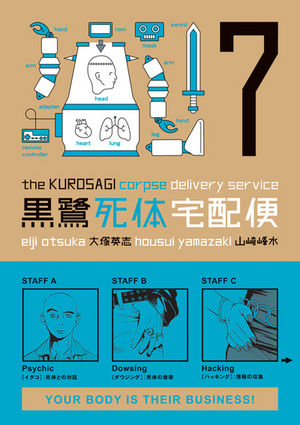
This volume tells three stories across its six chapters, which all deal with themes of obsession.  The first story involves the Japanese love of robots, as a group of university students try to build a mechanized suit, and then a robot, to help with heavy lifting.  The Kurosagi crew, broke again, agree to test the equipment when they take on a job delivering heavy tombstones.  It's not long before corpses are involved.  Japanese otaku culture is major component of this story, and that leads to endnotes by editor Carl Gustav Horn that would make David Foster Wallace jealous.  I learned a lot from this story.

The second tale involves the Japanese fixation on Audrey Hepburn (although the famous actress here is given a different name), and their predilection for cosmetic surgery.  A clinic is offering revolutionary surgery that gives its customers pointy ears like their idol.  The problem is that these ears often sport a jinmenso, or ghostly face of their own.  As the Kurosagi group get involved in this case, they discover that their sinister counterparts, the Shirosagi, are also involved, and have a plot to capture Karatsu.

The final story involves the ambitions of a long-time assistant to a famous Japanese director, who decides that he needs to take some drastic steps to move out of his boss's shadow.

All of these stories deftly blend humour with horror, and all feature strong characterization.  I find that I am always surprised by just how much I enjoy this book.

Sunday, August 5, 2012

Kurosagi Corpse Delivery Service Vol. 6

Written by Eiji Otsuka
Art by Housui Yamazaki

I think this is the strangest volume of The Kurosagi Corpse Delivery Service that I've read so far.  A usual volume has four to six chapters, which are usually self-contained stories, but occasionally a story will take up two or three chapters.  This volume has six chapters, and tells a total of three stories, one of which doesn't feature any of the regular characters in this comic.

The first story has the group, which carries out the last wishes of the recently deceased, and takes their corpses where they want to go, return to their roots, in Japan's famous Aokigahara Forest, where many people go to commit suicide.  The problem is, there aren't many corpses to be found, as the local postal office has begun branching out into the Kurosagi's territory, by offering their own corpse delivery service.

In the next story, a woman's body is discovered in an apartment.  When the Kurosagi group show up to offer their services, they discover that a new rival, the Shirosagi Corpse Cleaning Service has beaten them to the scene.  There's something odd about these Shirosagi people though, as we learn when another body is found in the attic to the apartment (found only after Numata, the KCDS's dowser, moves into the apartment for its cheap rent).  This leads to a long story which is not fully resolved in this volume, a first for this series.

After that, there are two chapters of a gaiden story.  This is translated as a 'side story', something peculiar to Japanese comics.  This one is set in the past, around the beginning of the 20th century, and involves a killer murdering women in Tokyo.  It is especially notable for two reasons - it brings the Jack the Ripper myth to Japan, and it features a young boy with some strange abilities who has facial scars matching those of the ghost that is always protecting Karatsu.  It's a good story, but it only makes me more curious to find out what the connection between this child and Karatsu is.

This book is always a good read, and that has not changed with this volume.  I love the way that Otsuka blends humour into his horror, and continue to appreciate the editor's notes in the back, which cover most of the cultural references that don't otherwise translate into English.

Wednesday, July 18, 2012

Kurosagi Corpse Delivery Service Vol. 5

Written by Eiji Otsuka
Art by Housui Yamazaki

I can't express enough how much I enjoy The Kurosagi Corpse Delivery Service.  This manga series is pretty bizarre in its subject matter and characters, but I find it an effortless read (thanks in no small part to the helpful and informative notes by the editor, Carl Gustav Horn).

The KCDS is a group of underemployed Buddhist Studies graduates who have either an interest in, or abilities pertaining to, the dead.  They seek out corpses, and then communicate with them to help them achieve their final wish.  They hope that there will be some sort of profit in this, although there usually isn't.

This volume has four stand-alone stories.  The first has to do with a small village that was left abandoned after a killer murdered all of its inhabitants.  The second story has to do with a professor of Egyptology who has been manufacturing mummies as a way of paying off his debts.  The third has the crew working as professional mourners at funerals, and stumbling upon a mystery.  The final story addresses the shadier sides of the cryogenics industry in Japan.

All of these stories work as examples of Otsuka's ability to blend creepy horror with a sharp sense of humour and a lighthearted approach to writing.  It's a difficult balance to maintain, but he does it well.  He also does a great job of showing the growth of the characters, and deepens the mystery of just where Karatsu's abilities come from, and who the figure we see appearing around him at times really is.

This series is highly recommended.

Tuesday, June 12, 2012

Kurosagi Corpse Deliver Service Vol. 4

Written by Eiji Otsuka
Art by Housui Yamazaki

Once again, I'm surprised by how much I enjoy the The Kurosagi Corpse Delivery Service.  With each new volume I read, I'm more convinced that the creators have stumbled on a winning formula - the horror sitcom comic.

KCDS is about a group of Buddhist graduates who have formed a business designed to help the dead complete their final wishes, which usually involve having their corpse returned home for them.  While it's not a winning business formula (I'm not sure if they've ever received more than one payment from their clients), it works very well as a structure for stories.  Among the employees of the service are a medium who channels a distant alien consciousness into a sock puppet, a guy who can speak with the dead, and another who has the ability to dowse the location of corpses.

This issue has four stories in it.  The first involves the discovery of an 'alien' body.  The second involves a conspiracy centred around a Bodyworlds-like exhibit, where some evil scientists are 'plastinating' the bodies of the dead.  The third story features the haunting of a baby-killer (and features a guest appearance by a character from one of Otsuka's other manga series), while the fourth is a weird story about parasitic slugs and a traveling American student.

All of these stories are deeply weird at their core, but are played lightly.  Otsuka's characterizations are strong, and very consistent.  One would think that there are only so many ways to tell stories that involve wronged corpses, but with each additional volume I pick up (so far there are twelve available in English), I'm surprised by how fresh the concept feels.  This is good stuff.

Wednesday, May 23, 2012

Pluto: Urasawa X Tezuka Vol. 8

by Naoki Urasawa, with Takashi Nagasaki, after Osamu Tezuka

It's taken me a little while, but I've finally worked my way through Naoki Urasawa's classic manga series Pluto, which he modeled on an Atom (in America, Astro Boy) story by Osamu Tezuka.  Urasawa has expanded on, and I imagine, improved upon the original story.

This final volume is all about wrapping up the action that has carried the various characters through the series, and about revealing some of the secrets that have been hinted at since the beginning.

When this book opens, things don't look so good for the good guys.  Bora and Pluto, two enormously powerful robots with evil intentions (and very complicated senses of themselves) are poised to destroy the Earth, and it looks like Atom may be the only robot left who can stop them.  The problem is, Atom is filled with hate and anger.

There is a lot of stuff here about the ability of robots to feel, and it gets a little heavy-handed in places, but when read within the context of the entire series, it's necessary in order to complete the character arc that Urasawa intended for them.  The story wraps up very neatly (it's really hard to talk about this without spoiling things), and there are lots of examples of how great an artist Urasawa is.

This series is highly recommended, even to people who are not fans of manga.  I feel like this is my gateway series, and now I'm interested in checking out Urasawa's 20th Century Boys...

Thursday, April 12, 2012

Kurosagi Corpse Delivery Service Vol. 3

Written by Eiji Otsuka
Art by Housui Yamazaki

As impressed as I've been with Naoki Urasawa's Pluto, I think that Kurosagi Corpse Delivery Service is my favourite manga.  It doesn't really have any literary pretensions, but the sheer weirdness and inventiveness of this comic, coupled with its strong sense of character, has me coming back again and again.

The entire concept of the KCDS is that the five employees of the Service (six if you count the space alien that is channeled through a hand puppet) track down unclaimed and lost dead bodies, and work to fulfill the spirit trapped in the body's last wishes.  They do expect that at some point this business will begin to make money, but that hasn't happened yet.

In this volume, which has four chapters, there are three separate stories.  The first, and longest, involves transplant failure, and the wishes of necrotic donor organs.  Soon, the group discovers that many recent deaths are caused by acute rejection of organs that all came from the same donor, who was in turn an illegal immigrant from Iraq.  This story is set against the rather tepid anti-war protests that Japan was barely able to muster during the beginning of America's war in that country.  It contains some interesting insights into Japanese culture, and is also an interesting story.

The second story involves bodies that are being discovered in homes that have Onis, or demons, painted outside of them.  This leads to a rather complicated tale involving the Japanese salesman's version of hobo graffiti.  It's a strange story that doesn't hold up to its own internal logic, but it gets points for originality.

The final story is about a rash of train track suicides that seem to have a strange genesis.  The suicides don't plan to kill themselves, but are being influenced by an outside source that again shows that Otsuka is approaching his stories from a direction that is not often used.

This volume introduces a new recurring character to the series - Sasayama, a social worker that is apparently an ex-cop, although the main characters all believe he is yakuza.  This is a series that is always interesting, and works very well.

Sunday, April 8, 2012

Pluto: Urasawa X Tezuka Vol. 7

by Naoki Urasawa, after Osamu Tezuka, with Takashi Nagasaki

This is the penultimate volume of Naoki Urasawa's modern classic Pluto, which reworks and reimagines a classic Osamu Tezuka Atom/Astro Boy story into a much longer manga series, which is really quite excellent.

In this volume, the focus is very much on Epsilon, the incredibly powerful robot pacifist who refused to fight in the Central Asian War, and instead has been spending his time raising and caring for many of the orphans of that conflict.  Epsilon is pretty much the only powerful robot left after the gigantic robot Pluto has been rampaging around the world destroying them all.  Now it's Epsilon's turn to face Pluto (twice), and the consequences for this story are pretty huge, especially when it starts to become clear that Pluto is a reluctant player in this drama.

Urasawa has done a very good job of humanizing these strange characters, and making it easy to care about them.  As is often the case, he introduces a new character into the story - an orphan named Wassily who, ever since the war, only speaks one word - Bora - which is tied in with the other victims of Pluto's campaign of terror.

I'm very excited to see how this story ends in the next volume.

Sunday, March 11, 2012

The Kurosagi Corpse Delivery Service Vol. 2

Written by Eiji Otsuka
Art by Housui Yamazaki

The second volume of The Kurosagi Corpse Delivery Service is quite different from the first.  Where the first one introduced the characters and the concept of a group of Buddhist students who have opened a business to help lost and unclaimed corpses find peace over the course of a number of short stories, this book contains a book-length story.

Basically, the group has been having a hard time finding paying clients for their service, which makes sense since to be their client, one must be dead.  They advertise on the internet, and quickly become embroiled in a plot by a rival organization, called Nire Ceremony.  What they do is revive the corpses of murderers, and then let the families of their victims have at them with knives. 

Ao, the boss of the Kurosagi Service is contacted by her sister when they learn that the man who murdered their parents and sister has been executed.  Through strange circumstances, the KCDS has the man's corpse, but they deliver it to Nire Ceremony.  Later, they discover that Ao's sister's fiance has some secrets of his own that are connected to everything that is going on.

What follows is a pretty densely plotted horror story, which hinges on some pretty unbelievable coincidences and some very strange concepts, but is overall a very compelling and readable story.  Otsuka is doing a good job developing these characters, and I appreciated the longer story in this volume.