Showing posts with label Darwyn Cooke. Show all posts

Tuesday, October 27, 2015

Richard Stark's Parker Book Four: Slayground

Written by Donald Westlake
Adapted by Darwyn Cooke

The latest of Darwyn Cooke's Parker books, Slayground, is immediately gripping, but is also the slightest entry in the series so far.

Parker, the master criminal, has participated in the heist of an armoured car in Buffalo in winter, but things went bad when his driver ended up flipping their getaway car.  Hurt, Parker runs with the loot, and takes shelter in Fun Island, an amusement park that has been closed for the winter.

He hasn't gotten into the place unobserved though, as a pair of crooked cops and their criminal accomplices see him get into grounds of the park, and more importantly, see him with a large bag of cash.  Once they learn about the heist, they decide to go in to Funland and help themselves to Parker's score.

Parker has some time to prepare for them though, and we sit back and watch him go about his business.

This set-up gives Cooke a lot of opportunity to do some cool things with the visuals in this book.  There is a fold-out map of Funland, and Cooke uses a number of interesting layouts, as Parker runs around setting up traps.

Cooke's retro-stylings always make his Parker books a treat.  We really don't know Parker as a character (and I have no reason to believe you learn more about him from reading Westlake's original novels), but he works well as a cipher in these kinds of situations.

Saturday, December 20, 2014

Richard Stark's Parker: The Score

Written by Donald Westlake
Adapted by Darwyn Cooke

As I've said before, I have no connection to Richard Stark's writing, or to the character of Parker, a gruff master thief.  I am, however, a big fan of Darwyn Cooke's art and writing, and so I am always happy to pick up one of his Parker graphic novels.

The Score is the third in his series of adaptations, and I think it is the best one I've read to date.  Cooke (or Stark; I'm not sure if he's taking liberties with pacing) wastes no time setting up the plot of this story.  A man has gathered a group of criminals to help him execute a really big job.

This guy, Edgars, wants Parker to organize a heist which will take out an entire town - Copper Canyon, North Dakota.  The entire town is surrounded by cliffs, and is attached to a large mining operation.  Edgars has it all figured out - the group can take the mine's payroll, and knock off the two banks and the various stores in one night, and take off with a large score (at least for the time - the notion of doing all this for only a quarter of a million dollars is a little laughable now).

I like stories that concern themselves as much with the set-up of jobs like this as they do the actual mission itself, and Cooke balances the story nicely.  When the job goes down, it goes without saying that something goes wrong, but Stark doesn't seem all that interested in including moral lessons in his work, so the town has a pretty bad night.

What really makes these books work is the great period detail in Cooke's art.  The story has moved beyond feeling outdated to feeling vintage.  A story like this could never be told in our modern time, and Cooke wallows in nostalgia for a simpler, better-looking time.

Wednesday, August 14, 2013

Before Watchmen: Minutemen

by Darwyn Cooke

When the Before Watchmen books were first announced, despite my general opposition to the project, I was most interested in the idea of Darwyn Cooke writing and drawing the Minutemen series.  I have always loved Golden Age characters, even ones that didn't actually exist in that time period.  I figured that Cooke was the perfect person to look at the original team, given the success he had with The New Frontier, his love letter to the Silver Age, and the superior sense of design he brings to his Parker adaptations.

Really, this miniseries disappointed me.  It feels like Cooke was being told what to do with the book, and it takes about three issues before any sense of story arc kicks in.  The book is narrated by Hollis Mason, the Nite Owl.  It's framed in the early 1960s, after Mason has written his tell-all biography, and is getting some serious push back from his surviving friends from their period of dressing up to fight crimes.

Mason flashes back through his entire career, showing us the high and low points as he goes.  A number of the main events are explained in Watchmen, and these points are glossed over here, although we do see how they affect Mason and his friends.  This makes reading this book as a prequel before someone reads Watchmen (there are a few people left who haven't read it yet, mostly children I assume), as the narrative stays jerky and lacking in enough exposition in places.

Cooke's art is always great, but aside from the visual trick he pulls on most of the first pages, which have repeated design elements, much of this book looks rushed.  In the final analysis, Cooke doesn't make me care about any of these characters any more than Alan Moore did, and this series adds little to nothing to the 'mythos'.

Wednesday, July 31, 2013

Before Watchmen: Silk Spectre

Written by Amanda Conner and Darwyn Cooke
Art by Amanda Conner

Before I begin to discuss this comic, I feel it's important to first acknowledge some of the controversy that has surrounded the Before Watchmen project.  I did not support the notion of DC Comics making prequels to the Watchmen series, not so much because I view that book as a 'holy text' of modern comics, as I feel that DC did and continues to knowingly cheat original creators Alan Moore and Dave Gibbons out of their rightful ownership of the property.  To that end, I felt that making a bunch of prequel comics, against the express wishes of the original creators, to be shady business.  That is why I did not buy these comics when they came out, and have no intention of buying any of the trades that are currently being released.

That said, I love me some comics, and there are some very impressive writers and artists involved in the Before Watchmen project (and some I don't care for).  So, how to satisfy my curiosity about, say a four-issue mini-series written and drawn by Amanda Conner, while still sticking to my morals, such as they are?  I could take the book out from the library, but instead, I found a complete set of this comic in a used bookstore, and figured that my purchasing it does not count as a monetary vote in favour of the project.

Anyway, regardless of whether you think this is a comics universe that needs revisiting (and I think it isn't) or not, this is one hell of a good comic.  Conner's art is fantastic, and with Cooke's help, she writes a very good story.  The young Laurel Jane, who will grow up to be the second Silk Spectre, is chafing under her mother's parenting skills.  She's in her last year of high school, and wants nothing more than to make friends, land a boyfriend, and enjoy herself.  Instead, her mother has her studying constantly, and training to be a fighter.  In one scene, her mother dresses up as an intruder and tries to attack her in her own home.

Laurie runs away to San Francisco with the boy she likes, and they find themselves in the middle of the growing hippie and drug culture of the 60s.  They also manage to find themselves some trouble, as the Chairman (i.e., Frank Sinatra) is not happy with the anti-consumerism that has become so popular among young people, and with the help of a guy called Gurustein, begins pumping a particular brand of LSD into the market which leaves its users full of the urge to shop and consume.

Laurie deals with heartbreak, beautiful kung fu henchwomen, and the irritating thought that her mother might have manage to prepare her for the world.  Laurie and her boyfriend's character arcs are handled very well, and Conner excels at depicting the hallucinogenic time period.

One thing that surprised me about this series was the extent to which Conner took it into the 'mature readers' world.  I questioned the likelihood that a female high school student in 1966 would make a joke that revolved around male ejaculate being on a girl's face, and was also a little surprised by the amount of nudity in the book, simply because I'd expected DC to try to be able to market this to as wide an audience as possible.  Given the crassness of this book's genesis, I would have thought that marketing would have had a stronger say in the actual content of the book.

In the end, this is a very solid comic.  I didn't bother reading the Crimson Corsair back-up pages, as that strip appeared in a number of different titles, but I was otherwise impressed with this book.  Too bad I wouldn't buy a sequel...

Friday, January 18, 2013

Creator-Owned Comics #8

Written by Steve Niles, Darwyn Cooke, Jimmy Palmiotti, and Justin Gray
Art by Scott Morse, Darwyn Cooke, and Jerry Lando

I would have thought that perhaps the time had come for a book like Creator-Owned Heroes, but seeing as this is the series's last issue, I guess it hadn't.  It's easy, and very tempting, to play armchair quarterback and talk about why this book didn't last (in fact, Jimmy Pamiotti mentions how many websites seemed to revel in doing that when the news of the cancellation was announced), so I'm going to refrain from that sort of thing.

Instead, I'd like to focus on how much this book was starting to do correctly.  Each issue was anchored by two serials, one written by Steve Niles and the other by Palmiotti and Justin Gray.  These varied in quality (something's never really clicked for me in Niles's writing), but they were consistently non-traditional.  Recently, Darwyn Cooke was added to the mix, and given space for his own stories month after month, which really raised my interest in the book.  As well, the magazine-content had become much more focused on independent and creator-owned comics, which was a much better fit for the title than say, another interview with Jimmy Palmiotti's personal trainer (which really did appear in an early issue).

As for this list issue, it closes out the series in style.  Steve Niles finishes off his 'Meatbag' story in a completely unexpected way.  The first chapter, drawn by the incredible Scott Morse, was a pretty standard-seeming gumshoe kind of thing, but this chapter takes the story into some otherworldly territory, and that genuinely surprised me.

Darwyn Cooke had to abandon a three-part story because of the cancellation (although I hope we get to see it as a one-shot some day soon), and so instead included a very personal little story he'd made for the woman he recently married.  It's sweet.

Palmiotti and Gray closed off their 'Killswitch' story in a way I wouldn't have expected, as Brandon tracks down the person who tried to kill him, only to trick her into falling in love with him and marrying him (which I'm sure many would say is greater revenge than murder).  There's a lot of nudity in this chapter, as if the writers were enjoying the freedom cancellation brings.

In closing, I think I'm going to miss this book more for the potential that it had than what it ever actually was.  I was really looking forward to new monthly work by Cooke that didn't feel amoral (like his Before Watchmen work that I've avoided), and with artists like Morse joining the stable, to see who else may have been published here.  Palmiotti and Gray are always entertaining writers, and I wanted to see where they would have journeyed on a book that allowed this much freedom.  I do want to say that I admire all of these creators for trying something new.

Friday, December 7, 2012

Creator-Owned Heroes #7

Written by Darwyn Cooke, Jimmy Palmiotti, Justin Gray, Steve Niles, Jeffrey Burandt, Seth Kushner, Chris Miskiewicz, and Dean Haspiel
Art by Darwyn Cooke, Jerry Lando, Scott Morse, Dean Haspiel, and Seth Kushner

With the news breaking this week that Creator-Owned Heroes, the comics anthology/self-publishing 'zine being produced by Jimmy Palmiotti, Justin Gray, Steve Niles, and a group of other people being canceled next month despite the ninth issue already being solicited, it's hard not to read this new (now penultimate) issue without a tinge of sadness.

I've been a little critical of this title in the past, finding its non-comics content amateurish, self-serving, and ultimately uninteresting, but I have been supportive of the goal of the book - to champion creator-owned work.

The saddest part of the cancellation is that the folks involved in this book have really begun to fine-tune what this book does.  They've added more creators (most notably Darwyn Cooke), and have given over more of the book's space to comics pages.  Also, instead of interviewing people like Jimmy Palmiotti's personal trainer, or cosplayers, they've focused the editorial content on creating creator-owned comics, offering advice to those starting out, and interviewing independent legends like Evan Dorkin.  Still, I buy this for the comics, so let's talk about those.

Darwyn Cooke's 'The Deadly Book' is a terrific tale, about a book that kills anyone who reads it, and thief who tries to steal it from his collector grandfather.  The story combines Borgesian conceits with the type of crime comic that Cooke does so well, and it tells a complete story in a short number of pages.  It's great.

Palmiotti, Gray, and Jerry Lando's 'Killswitch' story continues in fine form, as we learn a lot more about the title character and his upbringing, just as the collected mass of the world's assassin community come gunning for him.  I like Palmiotti and Gray on these types of stories best.

I don't always care for Steve Niles's writing, but when you pair him with artist Scott Morse, I'm going to be there for it.  Their new story, 'Meatbag' is about a private investigator who finds his contracted help ripped to ribbons (although his clothes are perfectly intact) on what was supposed to be a routine cheating wife case.  Morse paints this book in full-page panels that are gorgeous.

This issue also has a couple of shorter pieces.  'Blood and Brains', written by newcomer Jeffrey Burandt and pencilled by Dean Haspiel, shows us what happens when two fan-favourite horror concepts collides.  'The Complex' is a fumetti-style story about a video jockey who uses holograms and drugs to seduce women; I think it's a preview of a longer piece, but there is no explanation provided.

It is sad that as the quality of this book increases, it's publication is set to finish.  I believe there is a place for a book like this, and hope that something else will come along.

Saturday, November 10, 2012

Creator-Owned Heroes #6

Written by Darwyn Cooke, Steve Niles, Jay Russell, Jimmy Palmiotti, and Justin Gray
Art by Darwyn Cooke, Andrew Ritchie, and Jerry Lando

I've complained a few times that Creator-Owned Heroes, the comics 'magazine' put out by Jimmy Palmiotti, Justin Gray, and Steve Niles, which is designed to showcase and promote the creator-owned cause, needed more comics and less second-rate editorial content.  Perhaps someone was listening...

This issue debuts a new section, which will feature the work of Darwyn Cooke.  Cooke is best known for work like The New Frontier, and now Before Watchmen, as well as his excellent adaptations of the Parker novels.  Now, Cooke is going to begin offering up some of his own, new creations in this space.  That is something to be excited about.  For this issue, he reprints a piece he did a few years ago (published in the Free Comic Book Day book put together at The Beguiling, the incredible comics store where I shop).  The piece is a tribute to Alex Toth, although, with its architectural theme, it could almost be read as being about Gaudi.

The rest of this issue is pretty decent.  Palmiotti and Gray's new serial, 'Killswitch', is an engaging read about a hitman who is now himself being chased.  It's rather standard, but the writers toss in a few interesting twists, and lots of violence, to keep things moving.

Steve Niles, Jay Russell, and Andrew Ritchie's 'Black Sparrow', which concludes here, ends with a nice little twist that almost redeems what has been a clumsy attempt at American Gothic horror.

In the backmatter, there is some improvement, as there is a nice interview with Bernie Wrightson about his Frankenstein work, as well as a page wherein the various creators recommend some good comics.  The rest of the material, save for a couple of pages by or about Cooke, still are pretty skippable.

To end on a positive note, though, Darwyn Cooke!  And next month, Scott Morse!

Saturday, January 14, 2012

Richard Stark's Parker Book Two: The Outfit

Written by Donald Westlake
Adapted by Darwyn Cooke

When I started reading The Outfit, the second of Darwyn Cooke's adaptations of Richard Stark's (really Donald Westlake's) crime novels, I couldn't for the life of me remember what happened in the first one, The Hunter.  I remember enjoying Cooke's work, but storywise, nothing stayed with me.

Reading this volume, I can see why.  Westlake's stories are pretty effervescent.  This one is about Parker wanting to take on The Outfit - a mob-like group of career criminals who run large swaths of gambling and prostitution houses.  The man running The Outfit has beef with Parker, who has had surgery to change his appearance, and Parker is looking for payback.  Or something like that.

Truthfully, I'm reading this book for Cooke's wonderful artwork; the story is secondary.  Cooke loves that late 50s/early 60s period, as we learned with The New Frontier, his love letter to the early days of DC comics.  The sense of design and iconography used in this book is terrific, and Cooke has a good sense of the correct pace to use in adapting Westlake's writing.

The best parts of this book have Parker or his friends planning and carrying out various heists and robberies of Outfit businesses.  Cooke uses a variety of styles for these pages, drawing some of them like newspaper comc strips, and presenting one in an 'illustrated novel' format.  The look of this book is where the fun is; the rest is pretty inconsequential.

Sunday, July 3, 2011

Catwoman: The Dark End of the Street

Written by Ed Brubaker
Art by Darwyn Cooke, Cameron Stewart, and Michael Allred

Somehow Ed Brubaker's run on Catwoman escaped my notice when it originally was published, and I've only now gotten around to looking for any of the trades, starting with this first one.

Really, I missed out on something very good, as Brubaker is joined by the always-brilliant Darwyn Cooke, who was in turn inked by two artists who are better known as pencilers - Michael Allred and Cameron Stewart.

The book opens with a four-part Slam Bradley story that was originally used as a back-up in Detective Comics.  Bradley's been hired to prove that Catwoman is still alive, and he investigates the mysterious death of Selina Kyle as part of his search, not knowing that the two women are one and the same.  This story was alright, but ultimately reminded me of something I've read before, although I'm not sure where (I suppose it's possible I read the original comics, but I would have to check to see if I own them).

After that, we get the first four issues of the newly-relaunched Catwoman series (circa 2001).  Selina comes out of retirement when she learns that someone is killing prostitutes in Gotham City.  She hunts down the perpetrator, although things are not what she expected, and the guy is not a garden-variety psychopath.

The story is well-told, but the real star of the show is Darwyn Cooke, and his unique way of setting up pages of story.  The art in this book is incredible, as it always is with Cooke's work.  Now I need to find the rest of Brubaker's run, because I like his take on Catwoman as someone who wants to do good, but will use whatever means she deems necessary.  I also like the way Brubaker uses Dr. Leslie Thompkins in this comic; she's an under-utilized character.

Saturday, December 11, 2010

Catwoman: Selina's Big Score

by Darwyn Cooke

I've been playing catch up on Darwyn Cooke's work for the last little while, and had overlooked this graphic novel (as well as his and Ed Brubaker's work on the monthly comic).  Cooke gives us a rare thing - a superhero comic (okay, maybe a villain comic), without any superheroics.

Selena's Big Score is a heist/crime comic, which just happens to be set partially in Gotham City, and which features a character who gets involved with a man in a bat suit.  This is an intelligent, tightly plotted and beautifully illustrated comic, which is set squarely in the DC Universe, but is not really of it at all.

Selena has the inside line on a potentially very lucrative train robbery, and goes about assembling a team to help her pull it off.  This involves going to a former partner and lover, Stark, who falls into the traditional role of the mysterious and brooding criminal.  Their associates include a demolitions expert, a call girl, and a pawn shop owner.  While all this is going on, Selena is being hunted by the classic DC gumshoe, Slam Bradley.

The plot moves quickly, while it jumps back and forth to Selena's past, and the entire book is as beautiful as anything Cooke has ever done, although it is probably the darkest work I've ever seen from him.  Recommended.

Saturday, September 25, 2010

DC: The New Frontier

by Darwyn Cooke

I was surprised it's taken me this long to get around to reading this comic, and have found it to be a real treat.  Basically, Cooke writes an almost total reboot of the DC Universe, set between the end of the Second World War and the early 60s.  It's the time when the new heroes of the Silver Age begin to emerge, and it respects and honors as canon the work of the Golden Age.

The story begins with the last mission of The Losers (the Kirby version, not the Vertigo crew), as they end up on the Island That Time Forgot, searching for Rick Flagg.  From there, the story mostly follows Hal Jordan as he flies missions in Korea, and later becomes a test pilot for Ferris Airlines.  We also follow J'onn J'onnz as he becomes a Gotham police detective and sometimes partner to Slam Bradley.  As the books progress, we check in with a number of different heroes, although little is seen of the Golden Age crowd, with the exceptions of Superman (who is working for the government), Wonder Woman (who is fired by the government after expressing her opinions), and Batman (who is operating in Gotham against federal law).

The storyline seems very scattershot and random for the first of the two volumes, but in the second book, it begins to pull itself together as we learn of the type of threat that the Island that Time Forgot (now called the Centre) poses to life.  The various heroes, government agencies, and science-based militias (Challengers of the Unknown, Sea Devils, etc.) have to work together to defeat it, and perhaps usher in a new age of heroism.

I like the consistent approach Cooke takes to these characters.  He works hard to have them, and the people around them, react believably to the fantastic things they are or are seeing.  I also like that he integrates so many corners of the DCU in a way that could never have happened when they were first being published.

The art in this book is, of course, amazing.  What I like most about Cooke's work is the way he pays so much attention to architectural detail.  While I'm sure many are attracted to his shiny rockets and experimental jet planes, what I love the most is the air traffic control tower at Ferris.  It's the way he draws people's offices and high-tech bases that make this such a wonderful comic to me.  He employs the same aesthetic sense he used in his Parker comic, and it makes the book very satisfying. 

What really makes this project work is the way he taps into the reader's nostalgia and love for a certain era of comics history, but also manages to tell a contemporary and compelling tale.  This is some great stuff.

Saturday, September 11, 2010

Weird War Tales #1

Written by Darwyn Cooke, Ivan Brandon, and Jan Strnad
Art by Darwyn Cooke, Nic Klein, Gabriel Hardman, and Steve Pugh

What a shame that this is only a one-shot.  I love war comics, and have been eying the recent single issues that DC has been putting out.  I've ignored the others because of their price, but when I saw the line-up of creators on this one, I decided it was well worth buying.

The comic opens with a story by Darwyn Cooke set in some form of afterlife for soldiers, where their skeletal remains gather each year to engage in some Olympic-style games and some debauchery.  It's a funny little story, gorgeously drawn.

Brandon and Klein (the Viking team) have a story about a submarine crew that is close to running out of fuel in the Second World War.  It's an interesting tale, with great art.  Strnad (there's a name I haven't seen in a while) and Hardman have a pretty standard, but still effective, story about the loyalty of friends during a war.  As expected, it also has great art.

I would gladly buy a mini-series or anthology graphic novel of stuff like this.  I'm sure the recent rebirth of the various old war titles is a copyright-related thing, but I would like to think that DC is testing the market for material like this.  The other one-shots have not had the same caliber of artist and writer attached to it, but this one is a gem.

Saturday, July 3, 2010

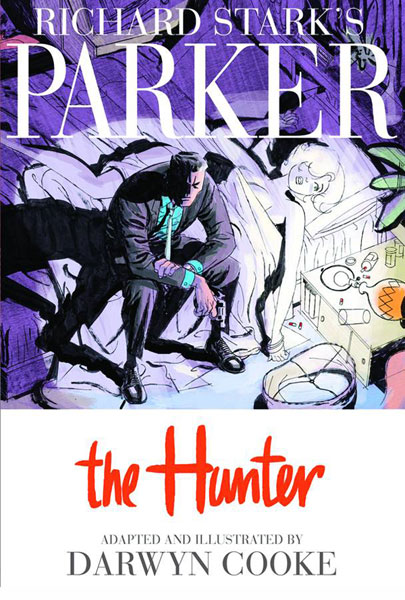
Richard Stark's Parker: The Hunter

Written by Donald Westlake
Adapted by Darwyn Cooke

I've never been one to read a lot of crime novels, especially ones that are in a series, like the Parker books written by Donald Westlake under the pen-name of Richard Stark, but I am a fan of Darwyn Cooke and his approach to depicting the middle of the last century, so it was a sure thing that I would read this graphic novel eventually. 

Cooke has an understanding of the early 60's and its design aesthetic that suggests he should really be much older than he is.  His lush penthouse suites are spacious, and filled with low-lying couches and chairs, and futuristic-looking coffee tables.  He is able, in drawing a room, to convey the optimism of the time, in the last stretch of years where nothing could touch the superiority of white male America.

Entering into that is Parker, an angry thief who was double-crossed in his last big job, and is now looking for revenge on the man that crossed him, his wife who betrayed him, and the syndicate that has employed them.  Parker is a brutal man who thinks nothing of wading through bodies to get what he wants.  One particularly chilling scene involves him casually tying up a woman in a hair salon that provides him with a good vantage point on his prey.

The book begins with difficulty.  It shows Parker arriving in New York, but there is no real explanation as to what is going on.  It's not until the second quarter of that book that Cooke starts to fill us in on who the characters are and what their deal is.  It is at that point that the book began to pick up for me.

Of course, the story in a Cooke book is almost secondary to his wonderful art.

Sunday, December 27, 2009

Solo #5

by Darwyn Cooke

Cooke, like the series Solo itself, is something I've grown to appreciate now much more than I did a few years ago. This is an amazing anthology of Cooke's work.

The stories in this book are framed by short pieces featuring Slam Bradley, the hard-nosed DC P.I., drinking at a place called Jimmy's. Between these short pieces, are a number of different stories, in a few different genres. This book features King Faraday, the Question, Batman, some guy who loves vacuum cleaners, and the young Darwyn Cooke himself.

It is that piece, an autobiographical tale of how he came to develop his passion for art, that stands out as the strongest in this comic, but each story has its own merits, and its own artistic style.

Cooke is a mercurial and talented artist. I really need to go get a copy of his Parker the Hunted...

Saturday, December 5, 2009

Jonah Hex #50

Written by Justin Gray and Jimmy Palmiotti
Art by Darwyn Cooke


Jonah Hex hits issue fifty (which is nothing short of miraculous in and of itself) in style, with a double-sized issue featuring art from Darwyn Cooke.

Cooke's style is an odd choice for Hex - his clean, open faces and cartoonish background characters create a sense of dissonance when paired with the dark, almost mean story that Gray and Pamiotti deliver this month. That dissonance is, I think, what makes this issue so jarring and memorable.

Hex and Talullah Black go their separate ways, and Hex is hired to track down a large gang. While he goes to work hunting the different bounties, Talullah settles down in a small town. Of course, the outlaws end up in the same town, and her and Hex come across each other once again. Mixed in here is a large dose of personal tragedy for our stars, although I'd rather not spoil that.

This is a very good issue of this comic.