Showing posts with label Graphic Novels. Show all posts

Wednesday, January 1, 2020

Bad Girls

Written by Alex De Campi
Art by Victor Santos

I think that Alex De Campi must be one of the most underrated comics writers in the business.  She rarely writes the same kind of book twice, and has shown great diversity and originality in her output, demonstrating equal skill at depicting dystopian science fiction in Smoke, riveting teen relationships in No Mercy, spy thrillers in Mayday, romance stories in Twisted Romance, and cheesy genre exploration in Grindhouse.  Bad Girls is her take on a crime thriller, and it's a real treat.

The story is set on New Year's Eve in Cuba, the night that Castro took power.  It focuses on four women, and is centred around El Edén, a casino that caters to wealthy Americans, and has connections to the mob.  It's run by a sociopath, whose girlfriend wants to leave him, but has so far been frozen by terror (although she's happily sleeping with his driver).  Two other women from the club are main characters.  One is a single Cuban mother trying to decide where her loyalties lie, while the other is a singer who is not going to let a visiting mobster take advantage of her.  The fourth "bad girl" is an American who is simply looking for the best time possible, and becomes an easy stand-in for the traditional ugly American character, more interested in finding a better party than noticing how many people are fleeing the country.

As the night progresses, things get wild, especially when one of the women figures out how to get away with suitcases full of money amidst the chaos.

Victor Santos is the perfect artist for this book.  His choice of layout helps propel the more suspenseful moments forward, but he also manages to give each of these women a strong sense of character.

This is a very cool graphic novel, and it's beautifully produced.  I recommend checking it out.

Tuesday, December 24, 2019

The Pitiful Human-Lizard Season 4: Setbacks

Written by Jason Loo, Fred Kennedy, and Meaghan Carter
Art by Jason Loo and Meaghan Carter

I've been reading the Pitiful Human-Lizard's adventures in a few different formats over the last few years.  First, I bought some of the self-published comics directly from Jason Loo at TCAF, and then when the book was picked up by Chapterhouse Comics, I enjoyed getting them from my local comics store.  After Chapterhouse hit some difficulties, the series moved online, and I lost track of it, because I hate reading comics on the computer.  Recently, I saw that Chapterhouse had pulled things together a little, and were releasing most of their catalogue in trade, including this Season Four trade which physically collects the issues that were only published online.  I got the trade direct from Loo (taking things full circle) at a show recently, which is why I'm talking about it before it's actually officially published.

The Pitiful Human-Lizard tells the story of Lucas Barrett, an amateur superhero with the ability to regenerate from any injury.  When we last saw him (in the monthly comic, I'm not counting the special that Loo made to end the title that I got at TCAF last year), Lucas was in space helping Mother Wonder deal with some cosmic stuff. 

Now he's back, but he's lost his job, and the girl he was talking to is not interested in pursuing things.  Lucas has always been a down-on-his-luck kind of character, and things are starting to look bleak here.  His friend The Majestic Rat has moved away from the superhero world since settling down with his boyfriend.  He manages to get another friend captured by the company that's been producing, and losing, monsters at a rapid pace. 

This book has always had a lot of charm, and that continues here, but these four chapters feel a touch tired compared to the energy of the earlier issues.  Lucas is worn out, but also, maybe, is Loo?  The characterizations continue to be spot-on, but the collaborations with other creators cause this volume to lose some momentum, and the inclusion of Minuit, a Montreal-based hero, feels very random.

What's missing the most from this volume is the Toronto-centric storytelling that made the first couple of years of this book special to me.  Loo, however, is a very strong emerging talent, and I found that his final PH-L book, Some Heart Left, had everything that this volume was missing.  I look forward to seeing what Loo's next project (I know he has something online with Chip Zdarsky) is like.  I believe he's going to go far.

Tuesday, November 19, 2019

Sentient

Written by Jeff Lemire
Art by Gabriel Walta

I've yet to be disappointed with an offering from TKO Studios, the up and coming publisher that offers their books as both a trade paperback and as a handsomely slipcased six-issue miniseries.

I was pleasantly surprised last week when I got my copy of Sentient, one of their second wave books, in the mail last week, having given up hope of it arriving this calendar year.

Like the previous ones I've read, I was immediately impressed with the production quality of the book, which has nice heavy paper, and a really good feel to it.  My pleasure only increased when I started to read the book.

Sentient is set on the USS Montgomery, a colony ship delivering a small group of families to a distant colony.  Things have gotten bad on Earth, and so it is time to start establishing families on the colony, even though it is being plagued by separatist unrest.  The journey involves passing through a radiation belt that makes communication with either Earth or the planet impossible (making me wonder how the two places communicate with one another).  As the ship passes into the silent zone, one of the women on board enacts her plan to kill all the other adults, and to take the large group of children living there to her separatist compatriots.

The plan doesn't work, as Valarie, the AI that runs the ship, kills the woman to protect the children (her safety protocols are shut off at the moment).  After that, Valarie has to continue her plotted trip, while also looking after the kids.  Lil, the oldest child, is more or less in charge of the kids, and she does not trust Isaac, the son of the murderess. 

This alone would make for an interesting story, as the AI has to figure out how to exceed her parameters, but Jeff Lemire tosses some other threats, from preteen rage to other separatist vessels, at her.  I found this book pretty suspenseful, and was impressed with the character development achieved in limited space.

Gabriel Walta's art is terrific on this book.  His muted colours work great on this paper, and he packs a lot of emotion into his characters' faces.  I find it interesting that in his first big work since the excellent Vision miniseries, he is again having to give life to robotic characters. 

I want to check out more of TKO's second wave, as this is the only book that I ordered from it.  I'm hoping they announce more titles soon, as everything they've done so far has been great.

Tuesday, August 13, 2019

The 7 Deadly Sins

Written by Tze Chun
Art by Artyom Trakhanov
Coloured by Giulia Brusco

The 7 Deadly Sins is the third TKO Studios book that I've read and loved (out of three).  I was immediately attracted to this book because I've become a big fan of Russian artist Artyom Trakhanov (Undertow and Turncoat were both brilliant).

This story is set in Texas in 1867, and focuses on life along the border of Comanche territory.  Threadgill, a priest, runs a station filled with orphans of the region, but we learn that he's not exactly an honest man of god.  One of his associates, Antonio, believes that the brutal attacks on American settlers are a response by the Comanche chief, Black Cloud, to Threadgill's actions, and resolves to take steps to correct the situation.

A prison transport comes through town, filled with a small group of people headed for execution, and in them, and the recent capture Jericho Marsh, a black former Union soldier hated in these parts, Antonio sees the opportunity that he needs.  He frees them, and offers to pay them handsomely for helping him to take him and his daughter to the Comanche.  Of course, they have to face outlaws, pursuing Rangers, and then, eventually, the Comanche themselves.

What follows is a brutal and dirty take on the Dirty Dozen/Suicide Squad model, set in a Western directed by Quentin Tarantino.  The character work by Chun, a writer and producer on the Gotham TV show, is excellent.  Most of these characters are given backstory to varying degrees, as some of the nastier ones make choices that can lead to redemption.

I was pleased with Chun's writing, but I was, as expected, very impressed with Trakhanov's art.  He, along with colourist Giulia Brusco, make it possible to really feel the dirt and squalor of this time period.  He is sometimes a confusing artist, storytelling wise, but his characters ooze empathy, and he has a cool approach to laying out a story.

I've really enjoyed these first three TKO Studios offerings (including Sara and Goodnight Paradise) I've read, and am beginning to think I should order the rest (I'm hoping that the second wave comes out soon, as I've already paid for the Lemire/Walta one).

Wednesday, July 31, 2019

Sara

Written by Garth Ennis
Art by Steve Epting
Colour by Elizabeth Breitweiser

TKO Studios is two for two with me now, as I found Sara to be as impressive as Goodnight Paradise.

In Sara, Garth Ennis returns to the Second World War, looking this time at the female Russian snipers deployed to slow the Nazi advance into Russian territory in 1942.  The group of women, all of whom have distinguished themselves at their task, form a kind of family, inhabiting a building left unstable from a tank collision, and going out during the day to hunt, well past the protection of the Russian Army.

Among the group, Sara stands out as the most accomplished, but also the least patriotic, something that her squad leader has noticed, and is working hard to hide from Raisa, the political operative assigned to the girls.

Ennis's best war stories tend to feature female protagonists (I'm thinking of the first wave of Battlefields books here), and this one is no different.  Sara is a layered and complex character, fighting for her own motives, and holding on to most of her opinions.  She's not blind to the use of propaganda, and the corruption and evil on her side of the war.  Still, she's made a vow to kill every German she sees.

TKO's books are published on very nice paper, and that helps Steve Epting's pencils and Elizabeth Breitweiser's gorgeous colours really stand out.  This book is beautiful, and the characters begin to feel very real.

At this point, you start to wonder if Ennis could possibly have more to say about war, but he always manages to surprise with a solid, meticulously researched story that leaves you thinking and caring about a perspective you might not have considered before.  I recommend this book, and am starting to think it's worth checking out everything TKO Studios is publishing.

Tuesday, July 9, 2019

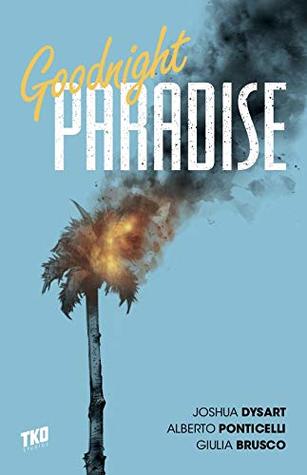
Goodnight Paradise

Written by Joshua Dysart
Art by Alberto Ponticelli

Joshua Dysart and Alberto Ponticelli collaborated on one of my all-time favourite Vertigo comics, Unknown Soldier.  In their telling, they shifted the general idea behind the classic character to war-torn Uganda, and gave us one of the freshest and most interesting war comics I've ever read.  After that, Dysart made himself the backbone of Valiant's relaunch, writing Harbinger, the excellent Imperium, and The Life and Death of Toyo Harada.

Recently, Dysart and Ponticelli reconnected to create Goodnight Paradise for new publisher TKO Studios (more on them in a bit).  This brilliant and gorgeous graphic novel (or, if you prefer, six-issue miniseries) is set in Venice Beach, an area that is rapidly gentrifying and changing from the down-and-out haven for the homeless and lost that it's always been to the new home of Snapchat and hundreds of Airbnb units.

The main character is Eddie, an aging drunk who sleeps in the yard of a house near the beach, and spends his days drinking beer and hanging out with some of his friends.  News that his estranged son, Jeronimo, might be coming for a visit, sends Eddie spiralling a little, and it becomes apparent to us that he might not be the most mentally stable of people.  At the same time, we see that he cares deeply about his community and the people who make it up.  He shows concern for Tessa, a young woman who isn't doing well, and later, ends up finding her body (and her dog's) in a dumpster.

From here, Eddie takes it on himself to try to figure out what happened to the girl, which takes him down a rabbit hole of shady real estate dealings, drug dealers, and the kind of people looking to exploit young homeless women for money.

This is a very intelligent book, which works hard to not reduce any of these characters to stereotypes or archetypal portrayals.  It feels like Dysart understands these characters and the challenges faced by communities like this, and was careful to be fair to them.

Ponticelli, for his part, kills on this book.  The art is a mix of drawn and painted pages (with colour art provided by Giulia Brusco), and it captures the look and feel of Venice Beach, based on my memories of a day spent there a few years ago, beautifully.  The juxtaposition of the beach, sun, and surf with the squalor of the homeless encampments is poignant, but like in Dysart's writing, Ponticelli gives everyone great dignity.

This is the first book I've read from TKO Studios, a new publisher that is testing out some unconventional practices.  They are not distributing their books through Diamond, but instead through their own site.  Readers have the choice to purchase the trade paperback (which is slightly oversized and on high quality paper) or to buy the six-issue series as individual comics, packaged in a slipcase.  I'm not sure how I feel about that model.  I love serialization, but if I'm reading the story all at once, I'd prefer it be in one book.  Anyway, I've picked up two more of their first wave titles, and have preordered one of the upcoming releases.  They have some high quality creators working with them, and I'm excited to see what else they are going to have for us.

Saturday, May 25, 2019

Tet

Written by Paul Allor
Art by Paul Tucker

I'd thought about getting Tet when it was first published by IDW as a miniseries, because I'm a big fan of stories set during the Vietnam War, but held off because the creators, Pauls Allor and Tucker were unknown to me.  Recently, Tucker started working on the Black Mask series Nobody Is In Control, and I was intrigued by his Paul Azaceta/Tommy Lee Edwards-like art.

When I saw him at TCAF this year, I figured it was time to finally get my hands on this story. It is the story of an American lieutenant who fell in love with a Vietnamese woman while he was stationed in Huê City.  He was partnered with a Vietnamese detective when a friend of his was killed, but their investigation was cut short by the Tet Offensive.

From there, the story picks up in 1984, where we see that Eugene, who was injured badly, never got past what went down.  He ended up losing his girl, but when he receives word that Báo, the cop he worked with, has finally tracked down someone who knows what happened to his friend, he returns.

This is a dark and moving story, that is told very well.  Tucker's thick lines add real weight to things, as we get to know these characters, and understand how war wrecks just about everything it touches.  I recommend this book.

Tuesday, January 1, 2019

Best Wishes

Written by Mike Richardson
Art by Paul Chadwick

I consider Paul Chadwick to be one of the best straight-up comics artists in the business, so of course I wanted to read Best Wishes, his collaboration with Dark Horse president Mike Richardson.

This is a slightly odd magical realist series about work and relationships in New York City.  An old and ornate fountain is moved from Italy to New York's Central Park, but no one is aware of the fact that it might have some magical properties to it.  Cal is a struggling graphic designer who can't seem to break into the industry.  Mary is a struggling young woman who can't shake the feeling that her boyfriend, Josh, a famous quarterback, doesn't really love her.  When Cal and Mary make wishes in the fountain at the same time, their desires get mixed up.

In no time, Mary's random napkin doodle gets chosen as the new symbol of New York City, propelling her to the recognition and job that Cal wanted for himself.  When Cal meets Josh in an elevator while on his way to a job interview with Mary, Josh is not sure how to deal with the feelings that he starts to develop for the young man.  In no time, these three characters find themselves in a weird triangle of envy and desire.

I like the way that this book portrays the difficulty of simply living in New York City, as the characters struggle to make ends meet, and even acts of generosity don't extend further than the closest Ikea.  These characters, and the people that surround them, are very well-realized, and the implausible aspects of this story don't get in the way of enjoying their travails.

Of course, this book is so capably drawn that I'm sure it inspired the kind of envy that Cal shows throughout the book.  Chadwick is a treasure - he makes emotionally complex scenes clear and easy to understand.  I'm glad that Richardson is able to make sure that stories like this get told.  This was a quiet book that didn't make much of a splash, but is really worth taking a look at.

Sunday, December 16, 2018

My Heroes Have Always Been Junkies

Written by Ed Brubaker
Art by Sean Phillips

There is no better partnership in comics today than the one between Ed Brubaker and Sean Phillips.  Their collaborations are always great to read, and push the boundary of whatever genre they choose to work in, be it crime, horror, or any combination of the two.  They are probably best known for their crime book, Criminal, which they are going to be returning to on a monthly basis very soon.

First, though, they published this Criminal novella, My Heroes Have Always Been Junkies.  It's the story of Ellie, a young woman who has spent her life on the margins of society.  Highly intelligent, she's always been drawn to the subculture of street drugs, idolizing musicians and writers who used heroin to fuel their creative fires.

In this slim hardcover, Ellie has been sent to a rehab clinic, where she meets and falls for Skip, a young man who is serious about getting clean, and who is holding on to a few family secrets.  Ellie knows that she is going to be trouble for Skip, but she can't quite help herself, and soon the two of them are on the run, and trying to figure out their next steps.

At least, that's what it all seems like on the surface, but because Ed Brubaker is writing this book, there's a lot more going on than just that; I just don't want to spoil things for anyone.

As is always the case, this book is a great character study, and examination of the mind of people who live on the edges, and have to live with the harm they cause.  There is a reticence to Ellie from the first page that makes her a very interesting character, and maybe not the most trustworthy narrator.

Phillips and Brubaker work beautifully together, complimenting one another's strengths perfectly.  This book is coloured by Jacob Phillips, not their usual collaborator Bettie Breitweiser.  Phillips uses more pastel watercolours, and especially in the daylight, gives the book a more optimistic feel.

This was a great comic.  I'm excited to see what the duo has in store for us with their new Criminal run, and I'm curious if we will see Ellie again.

Saturday, August 11, 2018

Nanjing: The Burning City

by Ethan Young

I have always loved war comics.  Unlike war movies, they often allow space to understand characters, and while many of them are steeped in easy cliché, there are a lot more that try to dig into the strength of character it takes to survive military conflict.

Ethan Young's Nanjing: The Burning City, is a very effective war comic.  It focuses on two Chinese men, a Captain and one of his men, who have somehow managed to survive Japan's taking of their city, and after their command structure fled, find themselves stuck in a ruined and occupied city.

They have some difficult choices to make.  Lu wants to make for the Safety Zone, a space reserved for refugees and watched over by Germans who are working with the Japanese Army (this happened in 1937, during the 2nd Sino-Japanese War, before the madness of WWII absorbed this conflict).  The Captain does not think they should do this, and instead wants to try to make his way out of the walled city through a particular gate.

The two men have to continue to make difficult choices as they make their way through the ruins.  They hear some soldiers attack a mother and her daughter, but have to deal with the fact that they can't do a thing to help.  Likewise, they have to turn down an old man's request for help, knowing that to leave him is to kill him.

Young, with his large panels, quiet scenes, and excellent facial expressions, makes this story tense and kind of horrible.  The Captain is a typically stoic military man who is doing all he can to hold it together, although when the pair meets a young family, they have to change their plans.

I really enjoyed this book, which helps to bring this story to a larger audience in North America, where the Nanjing story is not really taught or discussed often.

Wednesday, August 1, 2018

Violent Love Vol. 1: Stay Dangerous

Written by Frank J. Barbiere
Art by Victor Santos

I will admit that I hadn't been very impressed with the work of Frank J. Barbiere up to this point.  It's not that I thought he was a bad writer, it's just that nothing that I'd read by him had really clicked for me, and I was pretty indifferent to seeing his name on a project.  I do like Victor Santos's art though, so when I saw that their Violent Love began with a $10 trade, I felt that it would be a good idea to get it.

The book begins with a framing sequence that has a retired US marshal watching a young girl for her mother.  The girl shows interest in one particular case of the marshal's, that of Daisy Jane and Rock Bradley, a kind of Mickey and Mallory of the early 1970s.  The girl gets the man to tell the story, and it's at this point that Barbiere started to play with my expectations.

I think I expected a pretty straightforward romance and crime story, and found it interesting when the male part of this pairing barely appears in the first half of this trade, and doesn't really show much character until the very end of it.  Daisy is the real star of this book, and we learn what has led her to a life of using crime to fund a mission of vengeance.  She is with another man when she first meets Rock, while she hunts for the guy who ruined her life.

This mission leads to a bloody conflict with La Jauria, a cartel that employs some very colourful assassins.  Santos is great at both character work and at portraying some pretty mayhem-filled violent scenes.  I never really grew to like Daisy all that much, and found the revelation that closed off the book to be a little predictable (if probably difficult to explain), but I was completely drawn in by the plot, and now want to get the rest of this series so I can see how it all ends.

Tuesday, July 31, 2018

Displaced Persons

Written by Derek McCulloch
Art by Anthony Peruzzo

There are just so many good graphic novels out there that it's almost impossible for them to make enough of a splash.  I don't remember ever seeing this 2014 album-sized book being solicited by Image, but did see it on a sale table a while back and figured, because of writer Derek McCulloch's Gone to Amerikay OGN, I'd give this a chance.  It's really pretty good, so I'm glad I did.

Displaced Persons is a multi-generational family drama set in San Francisco.  It tells the story of the Price/Abramowicz family, focusing on three eras, with a few forays into other times and places.

The first third of the book is more or less a straight-forward private eye story, as Garland Price is hired to look for a missing heiress, and discovers some weird goings on in the 1930s.  After that, we move into the late 1960s, as Garland's two grandsons, one a cop and the other a little shady, find themselves in conflict with one another.  Later still, in the 1990s, we check in on one of Garland's great grandchildren as she deals with an abusive relationship.

There are some constants to this story - the family has remained in the same house throughout the century, and there is a recurring theme of people disappearing.  Much of this book is about examining the way the people left behind cope with those losses.

McCulloch very lightly uses a magical realist touch in this story that helps link the various strands together, and provide it with its odder moments.  The plot fits together nicely by the end, explaining the slightly confusing opening, and the characters stand out as being distinct.

The art, by Anthony Peruzzo, is fine, but not terribly memorable.  I like the way the book is coloured monochromatically, with each era being given a different tint.  Beyond that, Peruzzo's work is a little unfinished looking, but still manages to tell the story well.

This book worked very well overall, and I'm saddened that I didn't hear more about it when it was first published.

Monday, July 23, 2018

Sally Heathcote Suffragette

Written by Mary M. Talbot
Art by Kate Charlesworth and Bryan Talbot 

I'll be the first to admit that I knew almost nothing about the struggle to gain women the vote in Great Britain.  I'm a little more familiar with the Canadian struggle, which to my knowledge, was neither so protracted, nor so bloody.

In Sally Heathcote, Suffragette, Mary M. Talbot uses a fictional character to explain and explore the various and fractious groups that fought for decades to get the vote, and the beginnings of some respect as equals, for women.  We meet the upper class women who threw themselves into the movement, as well as some of the lower class women, like Sally, who joined them and sacrificed much to gain enfranchisement.

Beyond demonstrating and publishing newsletters, the women used violence to further their cause.  I was surprised to see campaigns of window smashing and even the firebombing of the Prime Minister's unoccupied home.  As well, I was surprised to learn about how these women entered into a revolving system of imprisonment, hunger strikes, torturous force feedings, and eventual release, only to start all over again at the next possible demonstration.

Talbot's Sally has a strong narrative voice, and reports as much on the internecine rifts within the movement as on the advancement towards their goals.  Of course, it is the coming of war that led to increased opportunities for women, as men were either away or killed in such numbers that women needed to take on many of their social roles.

The art team of Kate Charlesworth and Bryan Talbot works great.  The washes of colour on high quality paper make this book really stand out, and the artists (I'm not that clear on who did what) imbue each character with a great deal of personality.  No one radiates displeasure like Mrs. Pankhurst.

This was a great book shining a light on a topic rarely seen in comics.

Friday, July 13, 2018

The Private Eye

Written by Brian K. Vaughan
Art by Marcos Martin

When Brian Vaughan and Marcos Martin started serializing The Private Eye on their website, panelsyndicate.com, I started to read it there, and loved it, but my deep aversion to reading books online left me downloading chapters but never actually getting around to reading them.  Luckily, the series was eventually printed as this lovely landscaped hardcover, and I finally got the time to sit and pore over Martin's art the way I prefer to - on paper.

The Private Eye is a pretty cool science fiction detective story.  At some point in the future, the cloud will burst, and everyone's secrets, photos, and search histories will come pouring out, ruining a whole lot of lives.  A while after that, all of American society will become obsessed with privacy, to the point where people adopt 'nyms' and walk around wearing masks all the time.  There will no longer be an Internet, and most interestingly, policing and journalism will meld, with the 4th Estate investigating and prosecuting crime as well as reporting it.

The series is centred around P.I., a paparazzo (independent private investigator) who, when a former client is killed, ends up getting swept up in a conspiracy involving teevee.

The mechanics of the plot are fine, but not that important in a lot of ways.  Vaughan's idea of the future is bizarre but always believable, and his characterizations are spot on, as always.  P.I. is an interesting character, with great t-shirts, and his Internet loving, tattoo sleeved grandfather is a wonderful addition.

Martin is the big hero here though, as he gets to design some incredible looks for people, and is given plenty of opportunity to do some wide-screen action sequences.

This is a very good series, and if you aren't looking for the book, I strongly suggest you hunt down the comics online.

Friday, July 6, 2018

The Pervert

Written by Michelle Perez
Art by Remy Boydell

I was a big fan of Island, the comics anthology edited by Brandon Graham and Emma Rios that Image put out a few years ago.  Each issue was guaranteed to have something interesting in it, but one strip that really stood out to me was one about a transgendered sex worker by Michelle Perez and Remy Boydell.

I was pretty happy to see that strips were being collected and added to the rest of this character's story, as The Pervert.
To that end, this book does a lot to normalize, in a wider publics' minds, trans people and sex work.  The main character has friends, sexual partners, and clients, and sometimes those people can be all three things.  She also has to deal with awkwardness at her work when she decides to come out and begin living as a female, and with a level of harassment on the street that is hard to understand.

The story jumps around some, and that works as a way to slowly build up the character and help us better understand her situation.  Boydell's work is simple and straightforward, but often more affecting because of that.  This is a good book.

Sunday, May 20, 2018

The Grave Diggers Union Vol. 1

Written by Wes Craig
Art by Toby Cypress

I love Wes Craig's artwork, especially on Deadly Class, but when I saw that this new series was being published by Image with him writing, and the consistently interesting Toby Cypress drawing, I was intrigued, but also decided to tradewait the book, as I've been trying to cut down on my pullfile list.  Last week, Craig was at TCAF, so I was happy to buy the book directly from him, and get it signed.

The Gravediggers Union is kind of a poor man's BPRD.  In this world, the men (because they are pretty much always men) who dig graves in cemeteries are also the people who guard the living from zombies, vampires, and other forms of undead malfeasance.  The thing is, lately, things have been getting a lot worse than anyone can remember, with attacks happening with greater frequency and intensity, and with deadly ghost storms showing up all over the place.

This has something to do with an ancient cult called the Black Temple, some elder gods, and a storyline that digs back to mankind's earliest days.  Things don't look good, but the Union itself is more concerned with following protocol, which frustrates Cole, a veteran grave digger who has a family connection to what's going on - his estranged daughter is possibly the prophet that the Black Temple has been waiting for.

I enjoyed the story, and the way that Craig built up some of the characters in the GDU, and established the animosity between Cole and his superior in the union.  I particularly enjoyed Morphea, the witch who Cole turns to for help, despite the fact that it is forbidden for the Union to communicate with witches.

Cypress's art is always a bit of an acquired taste, but I've always liked it.  The colourist, Niko Guardia uses digital washes to denote movement or atmosphere, and that's something that annoys me.  Like the paint splatters in Wytches or the weird lines all over Supreme: Blue Rose, I find it detracts from the story more than it adds, but maybe that's just me being old and traditionalist.  It does seem to be catching on lately, so I'm going to have to deal with it.

This was a good book, and I look forward to checking out the second volume some time.  That's the problem with trade-waiting - it's going to be forever before I get back into this series...

Brass Sun Vol. 1: The Wheel of Worlds

Written by Ian Edginton
Art by INJ Culbard

I became a fan of INJ Culbard's work when he drew The New Deadwardians, one of the last good Vertigo series, and I've always been aware of Ian Edginton's writing, enjoying things like his Hinterkind series, also at Vertigo.  When Titan started publishing Brass Sun as a miniseries, it looked interesting, and then I came across this beautiful oversized hardcover at a good price, and was happy to grab it.

Brass Sun: The Wheel of Worlds is a very interesting piece of work.  It's set in a clockwork universe designed and set in motion by a very powerful being, populated with humans.  The various planets circle the titular brass sun, which has been slowly losing power, threatening all life.

The problem is that a great war broke out between the various planets generations ago, and since it ended, they've been left to develop in isolation, denying even the existence of life in other places.  There is a way to fix the sun, using a "key" that has been divided among the different spheres, but the knowledge of it is more or less lost.

On one planet, Hind Leg, a young girl named Wren is given the knowledge that her grandfather has been compiling in secret, and when he is arrested and killed, she has to set out to try to save everyone.  Along the way, she meets one of the priests who live and toil in the spars between the planets, and he assists her.  Together, they begin to travel to the different strange worlds, gaining allies and enemies as they go.

INJ Culbard's minimalist art works well here, as he creates strange and interesting cultures, all sharing the clockwork, steampunk aesthetic that the universe was designed with.  There's obviously a lot that doesn't make sense here, because the mechanics behind this world are impossible, but it's still a very enjoyable read.  The different worlds that Wren passes through feel like they could sustain a number of different stories, and the character work is impressive.

I'm always a sucker for an overly developed fictional world, and Edginton has done a wonderful job of building this universe.  I was a little disappointed to realize that this is just the beginning of a longer story, but I do see that Volume 2 is supposed to be published this month, although I can't find any actual proof of that having happened yet.

Sunday, March 4, 2018

Get Naked

Written by Steven T. Seagle
Art by Mads Ellegård Skovbakke, Fred Tornager, Thorbjørn Petersen, Sim Mau, Rebekka Davidsen Hestbæk, Emei Olivia Burell, Andrada-Aurora Hansen, Erlend Jhortland Sandøy, Ingvild Marie Methi, Thomas Vium, Christoffer Hammer, Aske Schmidt Rose, Silja Lin, Angelica Inigo Jørgensen, Tina Burholt, Hope Hjort, Bob Lundgreen Kristiansen, Cecilie "Q" Maintz Thorsen, Patricia Amalie Eckerle

As I've mentioned recently, I've long been a fan of Steven T. Seagle's comics work.  Also, confession time, I love a nice soak in heated water, and don't often care if there are other people around while I do it.  Therefore, Get Naked, Seagle's new book of "graphic essays" about coming to terms and experimenting with social nudity appealed to me.

Seagle has described this book as being in the style of Spalding Grey or David Sedaris's autobiographical essays, and while that's a fair comparison, what makes this book incredibly interesting is the way in which his massive list of mainly Nordic collaborators have chosen to interpret and present his words visually.

Every essay in this book is set in a different city, and concerns a time when Seagle ended up getting naked in front of other people (mostly physically, but occasionally emotionally).  We see him have touristic mishaps in a small Czech town, find his way into a mixed-gender nude swimming complex in Berlin, enjoy a nude celebrity encounter in a Korean spa in LA, and stress out about having to get naked with some comics fans in the showers after a soccer game in Spain.

Many of these stories are pretty funny, especially as they deal with a very common form of neuroses that just about everyone can relate to at some level.  It's interesting that Seagle is determined to become more comfortable in his own skin, despite some awkward experiences.  For a while, I was confused as to why he keeps returning to his fear of nakedness, but then it's revealed that he has to take up swimming for health purposes, and things become a little more clear.

In the final analysis, this book can also be seen as an exploration of one of the ways in which America is so different from the rest of the world, in terms of its discomfort with nudity.  In the countries that Seagle visits (Japan, Korea, Germany, Denmark, Spain, Australia, Estonia, Czech Republic, and others), no one is too hung up on their appearance, nor are they as terrified of having someone catch a peek at them as Americans (and, often, Canadians) seem to be.  Seagle, who travels extensively for his animation work, and to appear at conventions, never seems to miss an opportunity to experience local customs, and that's pretty cool.

This book feels liberating in a number of ways, and features some terrific artwork by such a large number of collaborators.  Some of the chapters are very detailed artistically, while others are loose and very cartoony.  At times, the writing and art styles didn't exactly match, but in most cases they were very complimentary to one another.  Each chapter opens with a "travel poster" by Emei Olivia Burrell, and these were gorgeous.  I could easily see them framed and hanging in spas all over the world.

Saturday, February 24, 2018

Genius

Written by Steven T. Seagle
Art by Teddy Kristiansen

Steven T. Seagle and Teddy Kristiansen are a favourite comics pairing of mine, almost on the same level as Ed Brubaker and Sean Phillips, if not as prolific.  They've worked on some incredible comics together, such as House of Secrets, It's a Bird..., and The Red Diary, but I somehow never learned about Genius, this slim graphic novel that came out in 2013.

Genius is the story of Ted, a theoretical physicist who has gone years without an idea worthy of publication, a prerequisite for him continuing in his job.  At the same time that Ted worries about his employment, things are starting to get out of control at home.  His wife is getting sick, and needs to be able to access his health care.  His teenage son is becoming ever more interested in girls, and his daughter feels more and more out of place.

Ted's father in law, who suffers from dementia, has been holding onto a secret of Albert Einstein's ever since he worked as a guard for the great man after the Second World War.  Ted becomes obsessed with the notion that this knowledge could put his life back on track, but is unsure how he can extract it from the bitter and confused old man.

Seagle and Kristiansen tell a quiet and muted story in this book, aided by Kristiansen's muted colour palette, and his minimalist art.  These characters come alive, and much of the story stuck with me after reading it.  Middle age is portrayed as a reckoning, a coming to terms with the extent of personal limitations, and the story feels very timely in an era where even middle class employment feels as precarious as everyone's health.  It's not a cheerful book, but it is kind of affirming.

Sunday, February 4, 2018

Eternal

Written by Ryan K Lindsay and Eric Zawadzki
Art by Eric Zawadzki

Black Mask has become one of the most exciting and interesting publishing house over the last couple of years, and one that is very hard to pin down.  I somehow didn't know that Eternal was coming out, and so its appearance on the shelf at the comic store this week was a nice surprise.

Eternal is a Northern European story in the tradition of Northlanders, Black Road, or Viking.  A small settlement is populated only by women and children after the men left and never returned.  As such, they've become the target of brigands and an evil sorcerer named Bjarte.

Luckily, they are protected by Vif, a shieldmaiden and leader who has honed the women into an effective and aggressive fighting force.  They take the fight to Bjarte, although the consequences of that are not what they were looking for.

The writer of the original story, Ryan K. Lindsay, had envisioned this as a smaller story, but the artist, Eric Zawadzki, of the exceptional Black Mask book The Dregs, expanded the story, adding longer scenes and many rich visual elements, really making the story his own.

And it is because of Zawadzki that you would want to buy this affordable OGN.  He excels at grizzled and dirty characters, and portrays the landscape beautifully.  Dee Cunniffe's colours add so much to this book.

I really liked this comic, and look forward to reading it again and poring over Zawadzki's art.  I would love to see him collaborate with Brian Wood on another book like this again soon.