Written by Roger Stern, except for #280 (written by Bob Harras) and #286-287 (scripted by Ralph Macchio from a plot by Stern)
Breakdowns by John Buscema, finishes by Tom Palmer, except for #280, pencilled by Bob McLeod and inked by Kyle Baker (!)
During the summer, I felt the urge to start re-reading some classic comics, and as the longbox with my Avengers comics was closest to hand, that's where I started (you can read about it here). I was enjoying myself, and decided to keep reading. I decided that this particular run of issues are worth discussing for a number of reasons.
To begin with, these are the comics that I still consider to be my personal definitive run of the title, at least until Brian Michael Bendis came along and blew everything up, or perhaps until Jonathan Hickman's current tenure directing the team, where he seems to determined to really examine the mechanics of the Avengers concept on a larger scale. To me, these are mostly definitive because they were published between 1985 and 1988, which is my own Golden Age (being between the ages of 10 and 13), giving my memories of these comics the same sepia tone that the paper in some of them has yellowed to.
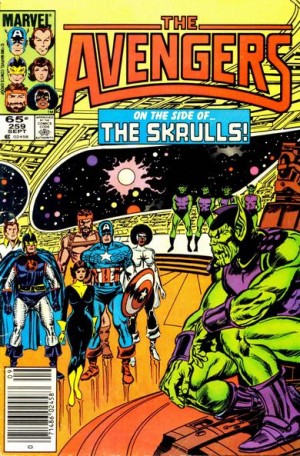 I remember being home sick from school, and my dad bringing me a copy of Avengers #259 that he picked up at a corner store, not knowing I already had it. I remember reading #273 a few times in a row, as I was stuck on a long road trip, with my grandmother crammed into the backseat of the car with my sister and I, and it was all I'd brought with me to read. Going through these books brings back some good memories.
This run also stands out because every one of these issues save one was drawn by Buscema and Palmer. That's thirty-three issues with only one fill-in! To be more accurate, these two talented, iconic artists continued with the book even longer, but I chose Roger Stern's departure from the book after many years as my point to stop reading for this column. Imagine an artist team today being able to put out that many issues, and in an era when comics were two pages longer than today's. They also drew more panels than current artists, although sometimes backgrounds were lacking. Their work is never stunning, but it is exceptionally good at telling a clear story, and to my mind, their portrayals of Captain Marvel, the Black Knight, the Wasp, and Hercules are classic.
This run is notable for a number of reasons in terms of story as well. Let's run through some key moments in bullet-form:
- Captain Marvel becomes trapped on Thanos's vessel, the Sanctuary II, by Nebula and her crew (this was Nebula's first appearance).
- The team fights Terminus in the Savage Land, and the whole thing gets destroyed and covered by ice (I'm not sure how it ever came back).
- Firelord joins the team in travelling to rescue Captain Marvel, and gets all angry when he has to help Skrulls.
- The Beyonder shows up a few times, as Stern had to make the ridiculousness of Secret Wars II work in his storyline.
 The Avengers lease Hydrobase from Stingray after losing their security clearance, and receiving notification that they can't fly their Quinjets out of their mansion anymore. Eventually, they move the whole mansion to Hydro Base (I don't remember when it was moved back to Manhattan).
- Namor joins the team, which makes a lot of the general public very angry, because of his status at that time as a villain.
- The Avengers discover the weird pod-thing in Jamaica Bay which eventually turns out to be holding Jean Grey, in a tie-in to the new title X-Factor.
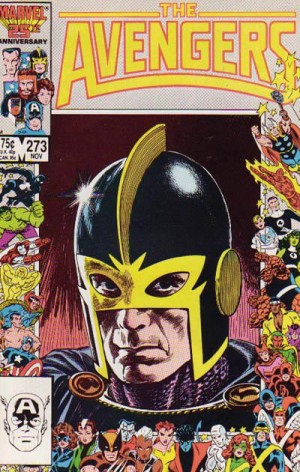
- Baron Zemo gathers his Masters of Evil in the slow set up to an epic story.
- After vanquishing the Beyonder, the Avengers and Fantastic Four need Molecule Man to fix the entire Earth so it's not destroyed.
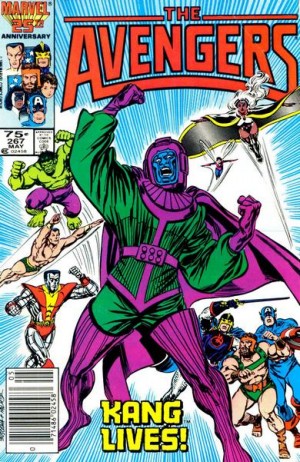
- Kang embroils the Avengers in a complicated plot to eradicate his other selves.
- Alpha Flight and the Avengers help Namor fight off Attuma, who has kidnapped his wife and taken over Atlantis.
- The Masters of Evil infiltrate Avengers Mansion, beating the hell out of Jarvis and Hercules in the process. Eventually they are taken care of, but it's a pretty dark tale for that time.
- Dr. Druid joins the team, Thor wears some truly hideous armour, and Captain Marvel becomes the leader after the dust of the Masters of Evil story settles.
- We get to see some of Jarvis's history with the team as he contemplates leaving, after recovering from his injuries. This is the fill-in issue, and it's really weird to see Kyle Baker inking an artist as straight as Bob McLeod. You can see hints of where he has ended up as an artist.
 Zeus gets angry with the Avengers for allowing Hercules to be hurt (he's in a coma), and brings them to Olympus (by way of Hades) for revenge.
- The Super-Adaptoid, in the guise of the Fixer, starts gathering robots and artificial beings to help him with a plot.
The team's line-up is interesting during this time, consisting of:
- Captain Marvel
- Black Knight (these two are the only ones to be in almost every issue in this stack)
- Captain America
- Hercules
- The Wasp
- Starfox
- Namor the Sub-Mariner
- Thor
- She-Hulk
- Dr. Druid
Stern's writing during this period became less focused on the mechanics of running a team, although he did show that both the Wasp and Captain Marvel suffered a number of doubts and self-recriminations over their decisions. Hercules is portrayed as being a little misogynistic, as he keeps complaining (if only 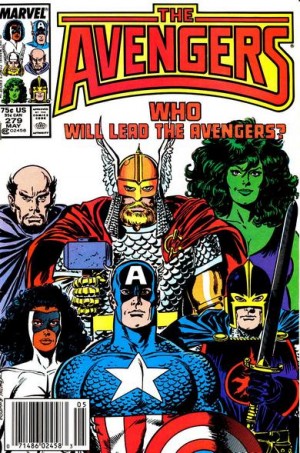 to himself) that the Wasp should not be giving him orders, mostly because she is a small woman. From the beginning, Stern shows that Dr. Druid has designs on taking over the team, but does almost nothing else to develop his character aside from taking every opportunity to show his arrogance.
I noticed that the Avengers get attacked in their mansion or on Hydro Base a lot in these issues. They almost seem to be sitting around waiting for the bad guys to come to them, and they don't ever appear to be very proactive in their work. It's interesting that the issues around their security clearance are just left dangling for ages, but, unlike the last pile that I reviewed, there are no subplots that never really go anywhere (like the Quicksilver storyline I talked about before).
One last thing that I found notable about these comics came in the issue after Stern left (wherein Ralph Macchio is given only a scripting credit, but no credit is given for the plot), in the form of a column by series editor Mark Gruenwald. In it, he talks about why Stern left the book, citing irreconcilable differences about where the editor wanted to take the book, especially in relation to two other series, Thor and Captain America (which Gruenwald was writing - this was the era of The Captain and John Walker in the usual Cap uniform). There is a fair bit of hubris in Gruenwald's description of events, and it made me wonder what plotlines Stern had planned that were left abandoned.
I did notice that, after the Masters of Evil storyline, my enjoyment of these books took a bit of a down-turn, with the Olympus and Super-Adaptoid stories running a little too long, and being a bit dull. Still, that Masters of Evil story is a classic, and one of the best Avengers stories ever told (might make a good plot for movie #3 or 4).


