Monday, September 6, 2010

Proof #28

Written by Alex Grecian
Art by Riley Rossmo

This is the last issue of Proof.  At least, until it re-launches in December as Proof Endangered, in a mini-series format.  I think it's probably a good thing that the creators of this book are taking it on a bit of a hiatus.  While they were incredibly consistent with a monthly schedule for the first twenty-odd issues of this comic, they've really fallen off in the later part of the book (this issue was solicited for January), and it sounds like they could use the rest for a while.

The lateness has really hurt this book during this Countdown arc.  Proof has always been more complex than a casual reader would realize, but with the sheer number of revelations, twists, and surprises that the last few issues have brought, the book has become downright confusing.  This issue particularly so.  It's full of secret conversations and half-sentence dialogue that appears to signify a great deal, but somehow consistently eludes me.  Put simply, I'm not sure I know what's going on in this book any more, and even worse, I'm not sure how much longer I'll care.

And so my hope is that when the comic returns, the first issue is going to explain some stuff, and draw me back in to the story, because I really like Proof (both the character and the book).  One thing that struck me as I read this, especially at the end, is how much Proof is like Hellboy.  I think it odd that I never noticed that before.

Sunday, September 5, 2010

Black Metal

Written by Rick Spears
Art by Chuck BB

I had a feeling when this graphic novel came out back in 2007 that it wasn't really my thing, but I usually like Rick Spears's work, and I'm tired of waiting for Pirates of Coney Island to end (if it ever will - any news on this?), so I thought I'd give it a chance.

Black Metal is about the Stronghand twins - Shawn and Sam - a pair of orphaned junior high misfits who speak in long, faux-Elizabethan sentences and listen to black metal music.

After getting expelled from yet another school, they listen to a record by a band named Frost Axe, and learn that they are the resurrected spirit of a demon named the Roth, yet split into two bodies.  This means that they have to fight their enemy Von Char, another demon.  To do this, they have a giant sword called the Sword of Atoll.  So they fight.

That's about all there is to this story.  It approaches funny in places, but it just feels like stuff we've read before.  BB's art is suited to this type of story - his goth manga approach works for this kind of thing.  I see that there is supposed to be a second volume, but I guess it's in the same place that the final issues of Pirates of Coney Island (which is worth picking up even though it's not finished) are.

Saturday, September 4, 2010

Madame Xanadu #24 & 25

Written by Matt Wagner
Art by Marley Zarcone and Laurenn McCubbin

I gave Madame Xanadu a couple of chances, and the book never really held my attention, which surprised me because I usually enjoy Wagner's work (admittedly moreso when he also draws it), and regular artist Amy Reeder Hadley is amazing.

Anyway, I'd heard some good things about this new Extra-Sensory arc, and since the books were half-price, I thought it would be worth checking them out.  This new arc is made up of a series of done-in-ones set in 1963 (which may or may not all be connected), each issue focusing on a different channel of perception.

The first story, with art by the terrific Marley Zarcone, tells the story of a young girl in Harlem who, while being one of the few 'coloureds' working in a downtown department store, starts to see people walking around with hideous injuries.  Basically, she's seeing how they will look when they die.  This knowledge doesn't sit well with her, and she seeks out Madame Xanadu for help.  It's a pretty straight-forward plot, but it's nicely written and very well-drawn.

The second story is about an 'ad man' in New York (I haven't seen Mad Men, but I feel like it has inspired this issue) who starts to hear the people around him saying the most vile things.  This time around, Madame X has to seek him out.  The writing in this one is less compelling, but McCubbin's art is interesting.  She has made heavy use of sixties-style patterns, and this issue quickly became all about the wallpaper to me.  Her figures feel stiff, and the art has the effect in places of looking like cut out paper dolls.

In all, there's still not enough going on in this book to make me want to buy it on a regular basis (plus, it's getting canceled anyway), but I think I'll be back for issue 28, which will have art by Marian Churchland.

Heroes of the World: Legend of the Earth Conduit #1 & 2

Written by Vincent Galvez
Art by Joe Bonsu and Mark Williams

I'm a big fan of the work done by the Heroes of the World guys.  They are running a business that can pretty much only exist in a city like Toronto.  They design super heroes for a living - a team of four for every country on the planet.  Their designs are wonderful.  All of their teams are built on a family model (think The Incredibles), with an adult male and female, and a juvenile male and female.  It's a simple approach, which then gets modified based on design elements from the countries flag, symbols associated with that country, and sometimes cultural stereotypes (one of the Canadian heroes uses a hockey stick with metal blades).  Their work is a lot of fun, and quite inclusive.  I have seen kids from usually underrepresented or negatively portrayed countries look at their work with awe.

And now the guys at Heroes of the World have a couple of comics under their belt.  The comics are a fun read, but definitely not my usual thing.  The stories are modeled on manga, video games, and 80s cartoons like GI Joe.  In the comics, all of these superhero teams are part of UNITE, a global protection organization, designed to keep the world safe from the forces of FIST.  The teams of UNITE are run by the Journeymen (the singular of which is somehow still Journeymen), and they seem to have a complex training system that involves three-year windows, battle challenges, the use of a world guide, and, of course, legendary prophecy concerning something called the Earth Conduit.

The villains have been in hiding for some twenty years (not that UNITE stood down at all), but have now returned just as a young boy named Oreh Gaia fails his trials and is not sure if he can ever become a Journeymen.  Of course, he's the Earth Conduit, but no one knows that yet.

The art is as manga-inspired as the story, and is quite cute.  This story has a nice flow to it, and an internal logic that, while I couldn't understand it, would appeal to kids with a lot of video game experience.  The folk at Heroes of the World should be commended for the fine work they do, and the slightly amateurish nature of their comic (offset by very nice production values) should be overlooked.

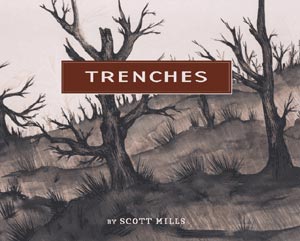
Trenches

by Scott Mills

I've been very tempted a couple of times over the years to purchase this 2002 graphic novel by Scott Mills, a cartoonist I am completely unfamiliar with.  As I've written about before, I'm a bit of a World War One nut, and have always felt that there should be more comics portraying the Great War.  I never bought this before because I was turned off by Mills's minimalist cartooning.  Then, Barnes & Noble had an on-line sale a couple of months ago, and I figured that at $2, it was worth the risk to get this.

It Was the War of the Trenches this is not.  Where Tardi's fantastic graphic novel concerned itself with the grittiest aspects of the war, Mills glosses over historical fact in the service of a story that barely needed to be told.  Trences is basically about two brothers, Lloyd and Davey, their commanding officer, Hemmingway, and how they get along during the war.

Lloyd is a nervous, gentle individual, while his brother is loud, brash, given to impulse, and irreverent.  Davey is often dismissive of Lloyd.  Hemmingway, on the other hand, is meant to be the picture of the British officer, keeping a stiff upper lip, dispensing platitudes, and yet standing by his men.

Now, I've studied the First World War, so perhaps the discrepancies in historical fact and interpretation are more jarring to me than to a casual reader, but there are a few things that I felt Mills got absolutely wrong with this book, and they kept me from enjoying them:
1.  Hemmingway doesn't seem to have a rank.  Davey calls him Officer Hemmingway, like he's a cop.
2.  Davey takes out a stationary flamethrower that looks like a machine gun (it's hard to tell with Mills's art).  What would be the point of a stationary flamethrower?  I've never come across any accounts of the German's using them.
3.  The chaps undergo what is supposed to be the first gas attack of the war.  The story makes it seem like the gas was coming in shells, an innovation that didn't come along until later.  Also, Hemmingway gets a good few lungfuls of the gas and collapses.  Luckily, he's perfectly fine after a little rest.  That would not be possible.
4.  Also, I'm not a doctor, but I'm pretty sure that someone who has had their leg ripped off would bleed out long before they'd be able to hobble back to their lines, especially since no one even bothers to tourniquet the wound.  And this happens twice!
5.  Class distinctions were pretty strict at this time.  I doubt that Hemmingway would have had his former subordinates over for Christmas dinner after the war, especially the two women that one of the soldiers sleeps with at the same time.

Mills acknowledges one of John Keegan's books as reference material.  I'm thinking maybe he only looked at the illustrations.  Were the story of the two brother's and their relationship more compelling, I'd be able to overlook the lack of understanding of the setting, but since that story is not worth spending time on, I can't.  Avoid this one, even at $2.

Friday, September 3, 2010

iZombie #5

Written by Chris Roberson
Art by Michael Allred

This issue finishes the introductory arc of I, Zombie (or is it iZombie? - the cover and the indicia disagree on this), and I am now definitely sticking with this title for the long haul (even if Allred moves on at some point).

With this month's chapter, Amon and Gwen finish their conversation, and Amon makes an offer off-screen.  After that, Gwen runs in to Horatio again, and they sort of have a date, until she realizes just who he works for.  The vampire paintball girls start to look for revenge for their killed comrade, and Spot and his friend go out for coffee.

I, Zombie is a nice mix of character-driven plot and fantastic Michael Allred art.  I've really taken a liking to a number of these characters, and look forward to seeing what's in store for Gwen and her friends.

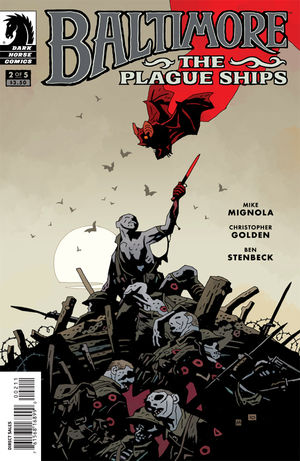
Baltimore: The Plague Ships #2

Written by Mike Mignola and Christopher Golden
Art by Ben Stenbeck

There's a lot to like in this issue of Mignola and Golden's first Baltimore comic, as the backstory to the character starts to get explained, as Lord Baltimore and his new friend give chase to the scarred vampire that eluded him last issue.  I originally expected that this whole comic would be set during the Great War, and was surprised when I learned last issue that the war had ended (in 1916 no less).

With this issue, we see Baltimore's experiences in the war, and his first encounter with the vampires who fed on the battlefields.  We also learn why he has a wooden leg.

Much of this story is told without dialogue or with minimal writing, giving Ben Stenbeck plenty of opportunities to show off his gloomy, atmospheric art.  I'm sure that a lot of research would go into drawing a book like this, and the attention to detail really shows through when reading this.  I'm eagerly looking forward to the next issue.

Sweet Tooth #13

by Jeff Lemire

With this issue, Sweet Tooth enters its second year of publication, and it continues to be an interesting and compelling comic month after month.  This is the first part of the new arc, 'Animal Armies', and a lot happens.

The cover does a lot to show that this issue is almost evenly divided by the main characters in the comic.  Gus is still trapped by the militia, but Johnny, the guy that helped Jeppard escape a while back, is beginning to show him and the other hybrids some kindness, at least until he is discovered.  Abbot, the leader of the militia, and Dr. Singh, have arrived at Gus's cabin, and are looking for clues to what has caused the plague.  Jeppard, meanwhile, has gone to a city to meet with those animal-masked guys that we've been seeing since the book started, to lead them to the militia's headquarters.

It feels like a lot is going to be taking place in this arc, as each character (aside from Gus) is in the process of getting things done.  As much as I love this comic, sometimes it's pretty decompressed (which works better for Lemire than for most), so it's exciting to see so much plot advancement in one issue.

Hellboy: The Storm #3

Written by Mike Mignola
Art by Duncan Fegredo

This issue wraps up The Storm, which is not really a complete story on its own, but is instead all build up to The Fury, which looks to finish off most, if not all, of the long-running plotlines in this comic.

In this issue, Hellboy turns his back on the army that has congregated around him since he found Excalibur, and takes a walk through the woods, where he comes across most of the characters that have been behind his problems over the last few years, or who have been trying to manipulate him from the beginning.  It's strange how often HB runs into these figures while walking in the woods...

Anyway, it's exciting to be coming to this point in the story.  There are a lot of things that were started years ago and are only now coming to fruition, which is also satisfying.  As well, Hellboy says that when this stuff is over, he plans on returning to the BPRD, which would be very cool, and interesting to see how the characters react to each other after so much time.

As always, Fegredo's art is awesome in this book.

Scarlet #2

Written by Brian Michael Bendis
Art by Alex Maleev

I was impressed with the first issue of Bendis's new series, but was even more impressed with this one.  Scarlet is narrated by a girl who, with her boyfriend, was shot by a crooked police officer without cause (other than that the cop was under the influence at the time).  She survived, but the boyfriend didn't.  Now she is completely healed (physically at least), and is hunting the officer who was exonerated of any wrong doing.

What I like about this story is that Scarlet's original intent of revenge has changed into one of revolution.  She is driven, but also in a little over her head, although her cool demeanor never shows that she knows this.

The real attraction of this book comes from the art though.  Maleev's always been an artist I like, but he's really going all out on this book, carefully representing the city of Portland, and making each page glow with a level of authenticity that is rare in comics.  His figures are always wonderful, but it's nice to see him spending so much time on backgrounds as well.

This is a great comic.  Highly recommended.

The Last Days of American Crime #3

Written by Rick Remender
Art by Greg Tocchini

There's nothing quite like a good heist story. Usually, tales like this one are told in movies and not comics, and so Remender's The Last Days of American Crime is pretty unique, especially since it is as much a science fiction story as it is a good crime book.

In this issue, Graham and his untrustworthy crew finally do the job they've been planning for the first two issues.  They must complete their heist of a computer that charges pre-paid credit cards before the government begins broadcasting a signal that makes it impossible for a person to commit a crime.  This has led to an absolute outbreak of chaos, as Americans indulge themselves in behaviour that they will not be able to do ever again.  Of course, nothing goes as planned, as Graham has to decide if Shelby, the beautiful woman that he is working with, is legitimately interested in him or is simply playing him.

Tocchini's art looks a little rough at the beginning of this book, but by the end he has regained his stride, and draws some very beautiful pages.  Remender's writing is always at its best when he is working on a title of his own creation, and it's nice to see him do projects like this while doing so much work at Marvel.

Stumptown #4

Written by Greg Rucka
Art by Matthew Southworth

I had hoped that Greg Rucka's leaving DC would lead to a lot more of his independent comics, and most of those hopes were based on seeing the end of Stumptown come sooner than it has.  Of course, reading this comic, it's apparent that it was well worth the wait.

Stumptown has been a particularly good entry in the standard female PI genre (which I think exists more in comics than the male PI story).  Dex Parios is a tough investigator who, despite her almost constant stream of bad luck, demonstrates in this issue that she is a solid planner and good judge of character.

The story in Stumptown has worked really well.  Dex is trying to find a young woman who has run afoul of a West Coast mob family, and has had to try to figure out who to deal with between the traditional mob father, the wannabe thug son, or the manipulative and ambitious daughter.  All three want something from Charlotte, the young lady in question, and all three have very different methods of approaching their problems.

The series ends in a terrific scene set on the coast at night, and lit only by flashlights.  It's a very powerful way of drawing this series to a close - both Dex and the reader have been kept in the dark for much of the series anyway - and demonstrates Southworth's ability to innovate.

At the end of the book, Southworth states that another Stumptown story is coming, which is very good news.

Thursday, September 2, 2010

King City #11

by Brandon Graham

There's one thing that I really don't like about this issue of King City, and that's the fact that it ends with the next issue.  And really, with only one issue remaining, I have no idea what's going to happen next.

This series has never been overly concerned about plot - it's been pretty stream of consciousness from the start, and every time I think I know what the book is going to be about, that aspect of it seems to die away (I vaguely remember some Owl freedom fighter thing going on for a while). 

The closest thing to an on-going plot element we have has been involving Pete, the Cat-Master's friend, and his desire to rescue an alien girl sold into slavery.  That's what this issue is focused on, as the two friends make good the rescue, only to be surrounded by bad guys.  The coolest aspect of this book are the other cat masters that show up at the end.

As always with this title, the art is incredible, and the plays on words and visual gags are pretty thick.  I hope when it's done, we'll see something more from Graham (like the next Multiple Warheads).

Wormwood: Gentleman Corpse Vol. 1: Birds, Bees, Blood & Beer

by Ben Templesmith

It's pretty easy to describe this book accurately with only one sentence:  A corpse-possessing worm, his clockwork robot drinking buddy, the ghost of a police officer, and a hired exotic dancer/interdimensional gateway guardian have to figure out why people who use erectile dysfunction medication are being ripped apart by demonic monsters.

See - it's a pretty straight forward concept.  Basically, Templesmith just goes nuts with this book, creating a few interesting and memorable characters, and then rolling with the situation.  It's by no means a brilliant or particulary thoughtful comic, but it is a lot of fun.

The big draw to any Templesmith comic is his art.  His brand of digitally coloured and manipulated pencil drawings works well here.  I'd recommend this book for people who have gotten bored with Hellblazer.

Wednesday, September 1, 2010

Farscape: Scorpius #0-4

Written by Rockne S. O'Bannon and David Alan Mack
Art by Mike Ruiz and Gordon Purcell

Having been won over to the regular Farscape comic, I thought I'd check out the Scorpius spin-off trade when it comes out soon.  Then, at Fan Expo, I realized I could get the original issues for less than the trade will cost, and I dove right in.

The series is tied very closely to the parent book, although the events taking place in this have not yet had any bearing on that book.  Throughout the Farscape universe, an alien race called the Grennij have been attacking worlds on behalf of another, older race called the Kkore.  This series opens on a remote ice planet, where Scorpius, exiled by Rygel, has crashed.  When a Grennij fleet lands to repair a ship, Scorpius gets up to his usual tricks, ingratiating himself to the Grennij commander, and then insinuating his way into command of the fleet.  A meeting with the Kkore leads to a new purpose for Scorpius, who perceives his opportunity to finally get the power and revenge he's always wanted.

The writing on this book is tight.  Scorpius always had a certain pattern of speech on the TV show, and that has been continued here.  It's easy to hear his voice when reading this.  The art on the first four issues (#0 is really the first issue, and not an introductory story, like #0s used to be) is by Mike Ruiz, and it's great.  It has a sinister quality to it, and I especially like the way, in flashbacks, all characters other than Scorpy are rendered in a scratchy, hazy way.  Gordon Purcell, the artist for issue 4 is decent, but I much preferred Ruiz's work.

I'm impressed with what I've found here, and am now concerned that I'll have to add this title to my pull list as well, which I did not want to have happen.