Thursday, July 29, 2010

CBGB #1

Written by Kieron Gillen and Sam Humphries
Art by Marc Ellerby and Rob G

I didn't pick this up when it came out last week because of the price.  I figured I'd trade-wait it or get it at a con some day, but then the manager at my comic store encouraged me to take a second look, and I'm glad he did.

I couldn't care less about punk or the history of punk music, but I do like it when Kieron Gillen makes comics about music, and I've liked Rob G's stuff for a long time (although I think it's a shame they didn't work together on this comic).  I also like comics that have a strong sense of time and place, and that is something this new anthology series has in spades.

There are two stories in this issue.  The first has a punk wanna-be experience a Dickensian moment, and get visited by the three ghosts of punk - two ghosts of punk past (one giving the romantic side of things, the other more actuarial in his focus) and the ghost of punk future.  It's a nice primer on the history of the famous New York club, and it's a cute story.  The second story is set in the late 70s, and tells us about a punk kid who discovers that his recently deceased uncle once played CBGB.

This is an odd little project, and very much a labour of love, which makes it deserving of some support.

Unknown Soldier #22

Written by Joshua Dysart
Art by Alberto Ponticelli

I really don't want this title to end.  With each issue, I find myself almost completely immersed in Dysart's portrayal of Uganda, and I recognize how much I'm going to miss this title when it's gone.

With this issue, Dysart starts 'Beautiful World'.  Moses is in the custody of the US army, and we see his meeting, years ago, with the original Unknown Soldier.  I expected that this issue would be about his past and whatever it was the government did to him, but I was wrong.  The rest of the issue is centred around Sera, Moses's wife.

She is still hunting for her husband, and spends most of the comic in the company of Momolu, the reporter she hired to help her track down the 'bandaged man'.  Instead, Momolu takes her to an Acholi wedding, and Sera begins to return to herself.  Of course, this idyll is shattered when she learns that Moses has been spotted in the North, and when she runs into Jack, the former-CIA agent who has been hanging around for some time.

With this issue, Ponticelli returns to a traditional pencils and inks approach to the art, although in some panels (one of Momolu's photos, Sera's drive through the countryside) he returns to the more burnished look he's been employing over the last few issues.  One surprise was the different paper stock this month.  This issue is printed on the kind of glossy paper that is usually seen on DC's superhero books, instead of the paper (Baxter?  Mondo?  Do those still exist?) usually used for Vertigo titles.  I have no idea why this was done, and while it made the colours much brighter, it didn't really add to my enjoyment of the book.  It seems like a strange decision to put more expensive paper in a comic that has been canceled for low sales.

Crate Digging: Party Music

by The Coup

The Coup are pretty remarkable in hip-hop.  The group, made up of rapper/producer/front man Boots Riley and DJ Pam the Funkstress, come from a tradition of protest and resistance, and their politics informs their songwriting, although they are not as deadly serious as this sentence makes them sound.  Their work is highly critical of government, church, and corporate America, but is also frequently funny, irreverent, and above all else, funky.

High points on this album, which had its September 2001 release delayed because it's original cover showed the band blowing up the World Trade Center, are frequent.

'5 Million Ways to Kill a CEO' is exactly what it sounds like, a humourous rant about corporate greed and power, as Boots provides some suggestions to deal with these issues.  The Coup are joined by the spiritual brothers, Dead Prez, on the song 'Get Up', a typical call to arms.  Boots lays out his political views on 'Ride the Fence', where he comes across as anti-just about everything.  'Nowalaters' is a story about the time he thought he got a girl pregnant.  Again, it is funny, and very honest in its telling, showing that he has, as a writer, more than a few topics to talk about.

There are two songs that really stand out on this album, and are the ones that I have used as examples of thoughtful, intelligent hip-hop.  Both are lovely and touching.  'Wear Clean Draws' has Boots giving advice to his young daughter.  It is an anthem of female empowerment and self-respect.  'Heven Tonite' is a call for action, specifically calling out the church for its emphasis on the next life, to the neglect of the current one.  His idea is to 'make heaven right here, just in case they wrong'.

This is a classic album, which has inspired and entertained me.  The Coup deserve a lot more attention, and a place of prominence in classrooms and radio stations.

Northlanders #30

Written by Brian Wood
Art by Riccardo Burchielli

I always get excited when a new arc of Northlanders gets underway.  What I like most about this title is the way each arc is set in a different place and time, this time around being in 8th Century Norway, where a group of Christians have commissioned the local Vikings to build a church.

This is a huge opportunity for the town.  There is the promise of employment and wealth, which many locals are willing to trade away some of their culture and spiritual autonomy for.  This does not extend to Erik, the gigantic unskilled blacksmith who is fired from the construction project at the beginning of the story.  Erik communes with the old gods (through hallucinogens; this hasn't become a traditional Vertigo book with gods and goddesses wandering around), and takes umbrage at the actions of the arriving Christians - particularly a young girl that they have brought with them.  He decides to make his objections known one night, setting off 'Metal' in a big way.

I like the way Wood is showing these two conflicting religions and cultures.  One can read a lot into the scene where the one Christian demands that the Norsemen divert the river so it runs next to the church so that the priests and monks don't have to travel far to urinate.

Wood is joined on this arc by his DMZ collaborator Burchielli, and as usual, the two work very well together.  I'm not sure how long this story is set to run, but I look forward to seeing this cultural conflict continue.

Hotwire: Deep Cut #1

by Steve Pugh

I loved the first Hotwire mini-series, Requiem for the Dead, and am very happy to see that the title has returned for another three issues.

Alice Hotwire is your typical smart-ass recalcitrant anti-social Warren Ellis female lead character (Ellis wrote the original treatment for the story).  In this case, she's a Detective Exorcist in a world where the dead have been returning in the form of 'blue light' electro-magnetic ghosts.  There are a number of scientific ways in which these blue lights can be dealt with, and Hotwire is the best at taking care of them.

When the book opens, she's been off the job for six months, recovering for the events of the first arc.  She is finally pulled back to work after her replacements bungle a blue light capture, causing a massive accident.  Her first day back on the job doesn't go well for her.  Also, she's been seeing an old boyfriend again, despite the fact that he died a few years ago.

The writing on this title is sharp and smart, although it pales in comparison to the incredible painted artwork provided by Pugh.  He's an artist I've respected since his run on Animal Man in the nineties, but his more recent work here and on Shark-Man has been very impressive.  I can not recommend this title enough.

American Vampire #5

Written by Scott Snyder and Stephen King
Art by Rafael Albuquerque

This issue wraps up the introductory arc of this title which means a few things.  1.  Stephen King has finished his back-up feature, and one would presume, his continued involvement in the title.  2.  Subsequent issues will now have 22 pages of story, not 32 like the first five, although the price will remain at $3.99.  I imagine that these changes may have a detrimental effect on sales.  I know that I'm not happy about the price point, especially after this book has trained me to expect a thicker story, but I intend to stick around for a while, as I've really liked what Snyder has done with the comic.

This issue has Pearl finish her quest for revenge in the main story, while the narrator of the back-up story finishes off his tale of Sheriff Book and Skinner Sweet.

This title is poised to go a number of places.  From the solicitation text for the next issue, it appears that the story will be jumping forward ten years, and moving to Las Vegas.  I like that, as it means that there will be plenty of opportunity for Snyder to fill in some gaps as he sees fit, as this issue kind of made things feel like they were finished.

As always, Albuquerque's art on this title is nothing short of phenomenal, and I can't wait to see him draw Vegas in the thirties.

The Doomtree Standards Mixtape

mixed by Paper Tiger

I love Doomtree, so this is the type of project that I feel was created just for me.  Paper Tiger, in advance of his upcoming new album, has put together this half-hour mix made up of the best of Doomtree's catalogue, but with a twist.

The twist is that this is a mash-up project, where he has combined the instrumentals for songs with different a capellas.  This makes listening to this project pretty disorienting - a beat comes on, and suddenly the lyrics aren't what I expect.  However, it's disorienting in a good way, as I find that I'm hearing things in some of the songs that I've never noticed before, and I'm appreciating them on a different level.

The entire Doomtree crew is represented on this disk.  Now I can't wait for the Paper Tiger album.

Time Bomb #1

Written by Jimmy Palmiotti and Justin Gray
Art by Paul Gulacy

This is a can't-miss comics project.  To begin with, Palmiotti and Gray have been doing amazing things lately, especially on their independent projects (check out The Last Resort and Random Acts of Violence).  Next, we have Gulacy on art, which is never a bad thing.  Finally, this is one of those 56 page square-bound Radical comics, which is a format I love.  Add all these up, and we have a definite purchase.
This book completely lived up to my expectations.  The story revolves around an underground Nazi missile complex that is discovered in the middle of Berlin when some repair work is done on a section of subway.  The exploration of said complex triggers the launching of a missile, which carries a strange bioweapon payload, which has left humanity with only 72 hours of existence.  A team of operatives is tasked with riding a 'time bomb' into the past to stop anyone from ever opening the bunker.  Of course, the 'time bomb' is not very accurate, and there is no way of knowing when the operatives would be sent, providing us with the next two issue's worth of story.

Much of this issue is taken up with the necessary exposition and character development, which is unfortunate but needed.  It may have gotten boring with a lesser artist, but Gulacy is more than up to the task of making talking heads interesting.  This whole thing reads as much as a treatment for a movie as a comic, but I have no problem with that when the book is this good.

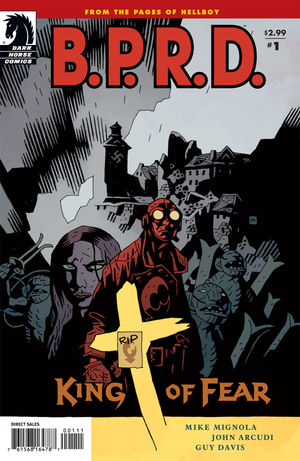
The Hellboy Project: B.P.R.D.: King of Fear #1-5

Written by Mike Mignola and John Arcudi
Art by Guy Davis

This is a huge BPRD arc in so many ways.  We get the last major confrontation between the Bureau, the Frogs, the subterranean dudes, and the Black Flame, which looks to have massive repercussions for future story arcs.  We get some really interesting character moments, like the ones between Kate and Bruno that happen in the first issue, as they work to lay Lobster Johnson to rest and hopefully restore Johann.  There's also some very cool stuff happening with Abe Sapien.

As usual, this is an excellent comic, but this arc is extra special because of the way it finishes off so many storylines and sub-plots, some of which had been running for sixteen years.

As often happens in stories like this, the actual final confrontation feels quick and anti-climactic, but I read this book for the characters, and in that sense, this story didn't disappoint at all.

Wednesday, July 28, 2010

Fear Agent #28

Written by Rick Remender and Hilary Barta
Art by Mike Hawthorne, Tony Moore, John Lucas, and Xurxo G. Penalta

It's been a year since we last saw or heard of Heath Houston, and in that stretch of time, I kind of forgot about the guy.  I loved the earliest issues of Fear Agent, back when it was being published by Image and each issue was an insane joyride of sci-fi weirdness.  The book got more serious as it progressed through Heath's backstory, around the same time that it made the shift over to Dark Horse, but I still enjoyed it.

The last arc started to feel like it was stretching things a little too far, but I thought it was worth sticking around for, and now it's nice to see that it's on it's last arc, as Remender intended the story to be written.  The problem is that it's a hard title to pick up after a year's absence.  Reading this, I feel like I should have dug out the last arc and looked over it again, because I'm feeling a little lost.  At the same time, I trust Remender (when writing his own creator-owned titles), and was able to just get lost in the craziness of the comic.  And Fear Agent is crazy.

It seems that Heath's actions have once again changed the timestream, and he, with his remaining two companions, have to try to fix things.  As always, the art is nice, and the 'Tales of the Fear Agent' back-up is an amusing story.  Is the artist's name really Xurxo G. Penalta, or is that a pseudonym?

Rasl #8

by Jeff Smith

One of my favourite things about Rasl has been the way that Smith has employed a non-linear method of telling the story.  Most of this issue is spent on Rob's relationship with Maya in the days leading up to his being fired from the science project on which he worked with her and her husband.  She's been a bit of a cipher up to this point, so it's nice to see a little more of her personality, and her optimism is a little heartbreaking knowing what we already know.

After that, the story moves to Rob's present, where he is again visited by the creepy Munchian girl pictured on the cover (I figure with Rob being an art thief, and there being a focus on art and symbolism in this series, that her sometime-similarity to the person in The Scream can't be completely coincidental).  We learn a little more about her too, although it's too early to say how much truth there is in anything we've been told.

I've been enjoying this book, although I did like the longer issues better.  I thought the trade-off was going to be that the shorter issues would be bi-monthly.  It's all good though, this is a title worth waiting for.

Tuesday, July 27, 2010

Ace-Face: The Mod With the Metal Arms

by Mike Dawson

This would be a good example of a convention impulse buy, based on the fact that I like Adhouse books, the publishers of the amazing Johnny Hiro.  I'm not sure if the stories in this book were published before in the Project: Superior anthology or if this is the first they've appeared, but this work was new to me.

Colin Turney was born without arms, and his strange scientist uncle crafted a pair of metal, super-strong arms for him.  Of course, he gave adult-sized arms to a baby, and so Colin had a rough time of it growing up.  Once he became fully grown, he fought crime in 60s London, before moving to the US and becoming a college professor.

Ace-Face gives us a few different stories from Colin's life, and they are charming and interesting examples of indie superhero comics.  The book also has a couple of stories about 'Son of Ace-Face', Colin's indecisive and easily frightened son, and his exploits dealing with the noisy stoop dwellers of Park Slope.  There are also two stories featuring Jack and Max, a pair of super-powered brothers who always fight.

This is a quick, fun read.  There's nothing here that is going to stick with me, but it was a nice diversion on a summer's afternoon.

Monday, July 26, 2010

The Hellboy Project: Hellboy Weird Tales Vol. 2

by too many people to list

It's always cool when new people get to play with someone's toys, especially when a character or property is so tied to one particular style or aesthetic.  The first volume of Weird Tales was pretty exciting, but this second one felt a little less satisfying.

There are some really good stories in here - I liked Kev Walker's Johann Kraus story (really, I like Johann a lot), and Jim Starlin's take on Hellboy, as well as JH Williams's amazing homage to teen slasher flicks.  Scott Morse, Jill Thompson, and Evan Dorkin provided amusing or whimsical tales, and the Will Pfeiffer/P. Craig Russell contribution is of course beautiful, but I found I didn't really get into many of the stories.  It seemed to me more like a bunch of exercises that are technically very skilled, but emotionally vacant.

I good example of that would be the John Cassaday Lobster Johnson story.  It's written in the form of a Sunday paper strip, with yellowed paper and dates that place it in the 1930s, but it works in bondage gags.  I found myself skipping over it; it just seemed a little too precious for me.  I felt similarly towards the Tommy Lee Edwards story - I just didn't really get it.

Oh well, this was never meant to be canon, and was a pretty cool concept, even if it didn't always work out in execution.

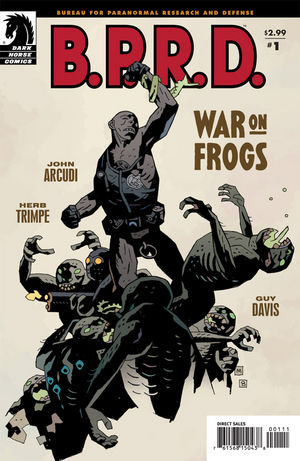
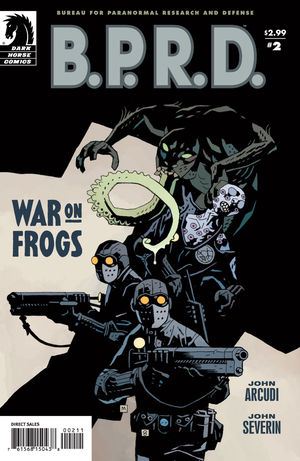
The Hellboy Project: B.P.R.D. War on Frogs #1-4

Written by John Arcudi
Art by Herb Trimpe, Guy Davis, John Severin, Karl Moline, and Peter Snejbjerg

I'm getting very close to the end of my Hellboy Project, where I've been reading one or two Hellboy or Hellboy-related story a day, in their original order of publication, the vast majority for the very first time.  I've gotten to the point where I've mostly bought individual issues instead of trades, and am beginning to think about the long view when I talk about these series.

War on Frogs was a mini-series that came out between other BPRD arcs, each issue focusing on one of the core BPRD characters who don't usually get much play, and fills in some of the things that happened during the BPRD's string of operations against the Frogs, the creatures that have been plaguing them since their title's inception.  This series was also unique because it is the first that doesn't give Mignola a writing credit, and for the wide stable of artists that it brings into the fold. 
The first issue has a Roger story, drawn by Herb Trimpe.  It's nice to see Roger in action again, and it reminds us of his humanity.  The third issue spotlights Liz Sherman, although it's told from the more interesting perspective of a female BPRD operative who looks up to her, but finds her impossible to relate to.

The best issues of the series are the second and fourth.  The second issue, with art by the legendary John Severin, doesn't really feature any of the main characters in an important role, and instead tells us what happened to a squad of operatives who were checking a boat for Frogs.  This story borrows heavily from Alien, as the single Frog picks off the soldiers.  Arcudi writes with the same suspense and tension of that famous movie, and Severin's more realistic art style helps add to the level of terror and believability.  The final issue, about Johann Kraus, is drawn by Peter Snejbjerg, and it looks fantastic. The story, about some Frog spirits that don't depart when their bodies are killed, is interesting. 

I like the way this series sort of reminds us of what the stakes are as we move into the big King of Fear arc.

Sunday, July 25, 2010

Ocotea

by Georgia Anne Muldrow as Jyoti

Increasingly, I find that the artist that is easiest to compare Georgia Anne Muldrow to is Madlib.  Like him, she is an exceptionally prolific musician, having released a large body of work in a very short amount of time, and like him, she is a jack of all trades.  People are familiar with her slightly spaced-out soul/funk/r'n'b/hip-hop albums, either alone, with frequent collaborator Dudley Perkins, and as a guiding light to other artists, as well as her hip-hop production credits for artists like Mos Def.

Her newest album, Ocotea, is slightly different though, and is what permanently moves her into Madlib territory.  For this album, she takes on the persona of Jyoti, which has something to do with spiritual light, and has created an instrumental jazz album.  As there are not artist credits, it's safe to assume that she has done all the music herself.  The album is lovely, if incredibly spaced-out.  It works well as background music, and is something that I find quite soothing after a rough day.

Georgia Anne Muldrow is staking out some serious territory for herself as an artist, and is definitely someone to keep an eye on in the future.