Tuesday, January 6, 2009

Yancey Boys

by Illa J

Hip-hop has often been the home to blatant nepotism. Big rappers always have to help their boys get a record deal - whether they can sing or not. There's always a protege or a crew waiting in the wings, and their releases always get a little radio play, even if it is just the single with the Big Name featured on it.

Illa J is no Memphis Bleek. He's not a Braveheart, doesn't Disturb tha Peace, nor roll with G-Unit. He may be the little brother of J Dilla, the god of hip-hop production, but he is also an artist in his own right. I think the fact that Dilla only blessed him with beats posthumously is proof that he does not fall into the Killa Bees category. This is not so much a case of nepotism as it is the debut of a new artist, who happened to be lucky to get his hands on some unused Dilla gems, and do his own thing over them.

If I were to compare Illa J to another artist, I think it would be Phonte. Like Tay, Illa J (how do you shorten that - J? Illa?) raps, but also sings his hooks. His singing is often nicer than his rhymes, which are occassionally weak-sounding. Really, I didn't love Dilla's rhymes a lot of the time either - he was only ever a mid-level rapper.

The material here is nice. The album plays with some fairly standard themes - there are love songs, and songs about family. In the first track, Illa J makes it clear that it's time to try something new, and it's implied that he is talking about his entry into the music industry. There are some songs better left off the album - 'Swagger' has nothing to say really - but for the most part, he sounds great over some laid-back, sample-less Dilla beats, reminiscent of some of his earlier, head-nodding work.

The album contains a strong guest shot from Guilty Simpson, and a couple of very annoying skits. I know I wouldn't have bought this album were it not for the Dilla production (which actually proves the nepotism factor can be profitable), but I would definitely check out any subsequent releases from Illa J.

Too Cool to be Forgotten

by Alex Robinson

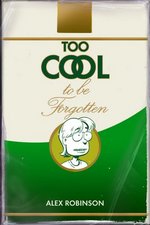
Andy Wicks goes to a hypnotist as a last-ditch effort to quick smoking, and finds himself transported back into his fifteen-year old body, before he developed the habit in the first place. The concept doesn't make sense, and isn't explained in the least, but it becomes the gateway through which Robinson is able to tell a funny and touching story about youth, getting old, and the wonder of 1985.

Robinson has a knack for writing young characters - from the speech patterns to the irrationality, the self-centredness, and the moral clarity that they feel. His high school world is one of triumph and humiliation, all acted out in a very public theatre. It's interesting to watch Old Andy experience again the things he experienced as Young Andy, but from the perspective of someone who knows where it's all going. I especially liked Andy's reflections on his teacher and principal, as he realizes that they are about the age he is now.

The book is very well-designed. I love the cover, and the format of a small hardcovered graphic novel. It fits nicely in the hand, and begs to be read. Top Shelf are really starting to impress me as a publisher - it's only been in the last year that I've become interested in their output, but if they keep putting out work like this, I'll be buying a lot more from them.

Monday, January 5, 2009

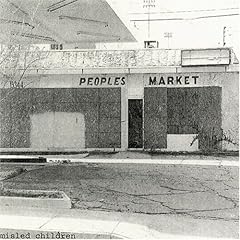
Peoples Market

by Misled Children

I don't know the slightest thing about the Misled Children. A careful reading of the cd packaging provides no idea of who the Children are, or how many of them there are. All that it tells us is that the album was made 'Under the supervision of Clutchy Hopkins,' which of course clears everything up. Except for the fact that no one knows who Clutchy Hopkins is either.

The myth of Clutchy is that he is a vagabond musician, roaming deserts and deserted places, and occassionally gifting people with some incredible music, that somehow always finds it way to the good people at Ubiquity, and now, I suppose, Porter Records. The rumour is that Clutchy is a well-known hip-hop producer trying something new under a pseudonym.

In the absence of personality, ego, and even track names, all that is left to do is focus on the music. This cd is very nice. The tracks on this album sound very much like the last two Clutchy Hopkins releases - a melding of instrumental jazz and hip-hop, with repetitive structures. The different tracks tend to bleed into each other in my mind, even though they have finite endings. This is a funky little album, and I enjoy it more each time I play it. The Clutchy Hopkins/Misled Children music machine is a prolific one - I made five purchases this year (although I think that one is a year or two old), and I think I have the complete oeuvre, but I wouldn't be surprised if I'd missed something along the way.

Sunday, January 4, 2009

The Activist

by Nick McDonell

I've been trying to get caught up on magazines that have piled up on me, so I grabbed this today, and serendipitously found another article on Sudan and Darfur, which, when read back-to-back with the New Yorker article I wrote about below, gives a much more complete picture of the conflict.

This article is about Alex de Waal, a British professor at Harvard who is most likely the world expert on Sudan. The article is written by a former student of his, who accompanies him on a trip to Ethiopia and Sudan, including a visit into Darfur.

De Waal meets with people involved at all levels of the conflict, and this article is barely able to scratch the surface of the complexities of the situation in Sudan, made all the more complicated by the International Criminal Courts recent request for a warrant for the arrest of Omar Hassan al-Bashir, the president of Sudan.

This article is an essential primer for anyone wanting to learn more about this issue.

Lives of the Saints

by Jonathan Harr

Harr spent time a year ago among the international aid workers that are assigned along the Chadian border with Sudan. He describes the history of the UNHCR efforts in that region, as refugees from Darfur have flooded into Chad, and as Chadian rebels have been active in the same region for a number of years.

The stories from this part of the world are always brutal. These aid workers, mostly it would seem from other African nations or from France, live lives of great hardship, separated from their families for six-week blocks of time, and are required to stay there for two years. Reading the article, you really begin to gain an appreciation for the sacrifices that they make, and how much their lives are lived at the mercy of corrupt governments, rebel activity, and climate and weather patterns.

One thing that I think is worth comment is that it has been a year since Harr left the region, and really very little has changed in that time, none of it for the better. Darfur has been a cause celebre for a few years now, and yet there has been so little action beyond toothless condemnations and denouncements from the UN and the richer nations of the world.

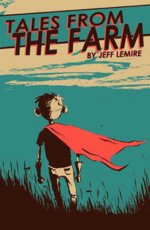
Essex County: Tales From the Farm

by Jeff Lemire

It took me a while to get around to buying this, but I'm very glad I finally did. Tales from the Farm is about Lester, a young boy who has been sent to live with his uncle after his mother's death. He is your typical small-town comic book reading social pariah - he walks around with goggles and a cape, and prefers to spend his time by the creek battling alien invaders. He builds a strange friendship with Jimmy Lebeuf, a gas-station owner and former hockey player - he played one game for the Leafs before being injured and becoming 'different'.

Lemire's story is told minimally. His characters don't talk much - especially Lester and his Uncle Ken. In this way, they are part of a long literary tradition of mostly silent rural men; actions are what convey emotions. Uncle Ken's offer of going "up to the Dairy Freeze for some burgers" speaks volumes of trying to bridge a gap that neither have the words for. The big revelations in Lester's life are left for him, and the reader, to put together; nothing is ever said.

Lemire's thick, chunky lines set in a wide landscape help to convey the loneliness that the three characters feel. The pages are taut with emotion and longing. This short book is a masterpiece of comics.

Saturday, January 3, 2009

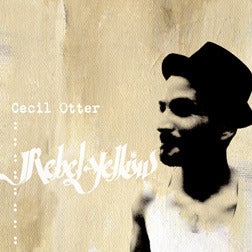
Rebel Yellow

by Cecil Otter

"I've got a closet full of broken legs
And not a one to stand on...."

This year has been about my discovery of the Doomtree collective. Their album was easily one of my favourites of the year, and then I started picking up the solo efforts, and this one blew me away.

Cecil Otter wrote and produced (or co-produced) every track on here, and it's a very consistent and interesting album. It sounds like Doomtree throughout - they have heavy drums and great lyrics, even if there is only one appearance by another rapper - the incredible POS lends a hand to 'Traveling Dunktank'.

The songs meld seamlessly into one another at times, making this an album to be appreciated as an album, not a collection of singles. The songs are poetic and beautiful, and Otter's voice matches the beats perfectly. In songs like 'Box Car Diaries' and 'Rebel Yellow', we get a sense of a marginal artist. In 'Black Rose' the chorus ends with "My name is Cecil fucking Otter/ not Dylan goes electric", and that pretty much sums up the album for me.

There are two instrumental tracks that owe more to drum and bass than hip-hop, yet fit very nicely with the overall atmosphere of the disk.

There are a lot of projects dropping from Doomtree. Mictlan & Lazerbeak have an album out. The new POS is being released soon, as is Dessa' poetry book. People should be checking these guys out - their output is incredible!

Thursday, January 1, 2009

Shooting War

Written by Anthony Lappe
Art by Dan Goldman


This is a terrific read. Shooting War is about Jimmy Burns, a liberal video blogger who just happens to be filming a Starbucks when it explodes from a suicide bomb. Burns video propels him into media stardom, and soon he is hired by Global, a sensationalistic 24-hour cable news channel (not to be confused with our own Global TV here in Ontario) and sent to Iraq.

This is not the Iraq of today - this is Iraq in 2011, after two years of a McCain administration. Early into his time there, Burns meets Abu Adallah, the leader of The Sword of Mohammed, a jihadist organization that is trying to create a modernist, non-secular approach to killing Americans - mostly through the use of Iranian equipment.

What follows is an exploration of warfare, in which no side is innocent or noble. Americans shoot unarmed civilians, and use robotic weapons that kill indiscriminately. Journalists report what they are told to report. Iraqi children carry suicide bombs. Dan Rather is more than a little clueless. There is nothing in this book that is implausible really, and it makes no suggestions on how things can be improved. Instead, it's an entertaining and amusing look at where things might end up (and probably would have had McCain actually been elected).

The story moves quickly, and the characters are well developed. In a lot of ways, Jimmy Burns reminds me of Matty Roth in Brian Wood's excellent series 'DMZ'. They are similar in that they are tossed into a conflict they don't understand, and are often used for their fame to promote a certain message.

The art in the book is different. Most of the backgrounds are photographs, with the central characters digitally drawn over them. In more than a few places, the characters look stiff and out of place, but in others, this method is very effective. The American soldiers with their strangely glowing face masks look amazing and terrifying at the same time.

This book comes highly recommended, especially at the relatively inexpensive price of the softcover.

Scalped #24

Written by Jason Aaron
Art by RM Guera


I can't stop stressing enough how much I love this book. Aaron has created such a complex web of relationships and obligations with Scalped, and with each issue, I find that I am enjoying the book even more.

This issue resolves 'The Gravel in My Guts', and I'm not sure who got off easier - Dino or Red Crow. Both ended up losing in this issue, as Red Crow's hopes for redemption melt away. What is most interesting is the monologue with which the issue ends - and we see Red Crow as he sees himself.

Also of interest in this issue is Shunka; up until now he's been portrayed as Red Crow's yes-man, but in this issue, he shows some real stones of his own. I hope he gets a little more time in the spotlight, as I'm now curious to know a little more about him.

Looking back over the last few issues, I have to say that Jock is submitting some of the best cover work he's ever done - I think I like these better than the work he did on The Losers.

Finally, the next issue is the start of a new arc. I urge anyone who is reading this that is not already reading Scalped to pick it up and give it a try. Aaron is getting press all over the place as a writer to watch in 2009, but everyone focuses on his Wolverine, without realizing that his Dash Bad Horse kicks Logan's ass every time.

Incognito #1

Written by Ed Brubaker
Art by Sean Phillips


Brubaker and Phillips are an amazing team. Their series Sleeper was incredible, and Criminal is without doubt the best book that Marvel publishes.

Incognito is their new work - a story about a super-villain in the Witness Protection Program, who is having a hard time adjusting to a normal, 9 to 5, powerless existence.

The concept is not exactly original - books about super-villains have become very common lately - but their execution of this concept is very interesting. The first issue is mostly about setting up characters and settings, and you learn very early on that Zack is not a nice guy. Neither is his handler though. Nor is the hot girl he works with. Actually, there are no nice people in this comic.

This series is Brubaker's homage to the conventions of the pulp novel, and, as Criminal does with film noir, it will have articles about the famous pulp series of the day. I never knew that The Shadow in the books was not the same as the one on the radio.

Murs for President

by Murs

So Murs is finally on a major label. Sadly, I'm not sure that's such a good thing, as it has caused a large amount of this album to sound vaguely generic, and lacking in the energy and humor that has attracted me to his work.

There are some nice songs on here though. 'The Science' fills us in on some hip-hop history, and places it in the context of African-American history in general. This song could be on a Nas album. 'Can It Be (Half A Million Dollars and 18 Months Later)' is another nice piece of work, focusing on the need for positive hip-hop. Murs spits lines like: "Trying to save youth from the way of the gun/And if I only save one, then my job is done", which is admirable, even if it doesn't match up with the content of most of the other songs on the album. 'Can It Be' features production by Scoop DeVille, as does 'Everything', one of the other highlights on the disk.

There are about three songs with production by 9th Wonder, and while they are fine, Murs and 9th have not re-captured the chemistry they created with the 3:16 album. In fact, the song 'Break Up (The OJ Song)' most reminds me of 3:16, but doesn't feature production by 9th. Nottz also provides beats for a couple of songs, but they aren't that memorable.

In all, this is a good start for Mur's major label career, but I prefer his work with the Living Legends, and would love to see him work with Slug on another Felt album.

Northlanders #13

Written by Brian Wood
Art by Ryan Kelly


We are halfway into 'The Cross + The Hammer', and it's a very good arc. Wood is not so much interested in the forensics here, as he's more focused on having our two protagonists meet for the first time. Increasingly, we are seeing Magnus, the Irishman who is working so hard to drive the Norse out of Ireland as a madman, unable to control his own violent urges, while Ragnar, who is meant to represent the Viking hordes, is the civilized and controlled one.

This arc feels more decompressed than most of Wood's work. I usually prefer more story, but at the same time, when the art is as good as what Kelly is doing here, I don't really mind that it will stretch out over a few more issues than might be necessary.

Jack of Fables #29

Written by Bill Willingham and Matthew Sturges
Art by Tony Akins and Jose Marzan Jr.


The Battle of the Golden Boughs heats up, as Bookburner's army pushes their advance, and meet up with Jack's army. Jack, of course, is off somewhere else eating tacos and supplying a gripping narrative on what is expected of true heroes and leaders during war.

This comic is as good as always. Willingham and Sturges have set a huge story in motion, and it feels, as the stakes get higher, that it's reaching its denouement. This issue features the return of a character not seen since the original escape from the Golden Boughs, and the mighty war prowress of the Moose with the Juice.

My only other thought is that the Knife-Johns look like they would better belong in the Grant Morrison era Doom Patrol.

The Winter Men Winter Special

Written by Brett Lewis
Art by John Paul Leon


Well, this is a book I never thought I'd see come out (and on time at that)! This comic first came out back in 2005, and was supposed to be eight issues long. As it continued, slowly, it got squeezed down to six issues, but the sixth comic was never solicited until a couple of months ago, when it became this issue here.

What with Wildstorm's history of just canceling titles before they complete (Stormwatch: Team Achilles), it is a huge surprise to me that this book ever saw the light of day. And I'm very happy that it did.

This series is about a group of ex-Soviet superheroes, who wore mechanized armor very similar to DC's Rocket Reds, and how they are making a life for themselves in the post-Soviet Russia of corrupt oligarchs and mafioso. It is also about strange weapons being produced in secret cities, the black-market organ trade, and the difficulty of staying married. It is an excellent series. The early issues had a different voice to them - the dialogue was Russified, and the entire series was structured very much like a Russian novel, with long asides and a tapestry-like plot.

In this issue, Lewis and Leon have to finish things up quickly, and so have to trade off some of their Russian novel style for the quicker bang of a Hollywood movie, but with their own peculiar sensibilities showing through. The first page serves as a slight re-cap, mostly just showing us names and faces, but it has Kalenov, the protagonist, say, "My little friends, I thought I would have more time to tell you how things ended up. But perhaps for now... I will just tell you the good parts..." before launching us into the story.

I'd meant to re-read the first 5 issues before getting to this, but never got the chance. Regardless, I got caught up quickly, and really enjoyed seeing this story through to the end. Leon's artwork was perfect for this book - bleak and dirty, like so much of the world he portrays, yet also beautiful. The lettering of John Workman Jr. also stands out in this comic, matching the incredible work he did on Simonson's Thor run years ago.

If you haven't been reading this series, I strongly recommend you pick up the inevitable trade. It's one of the best comics of 2005!

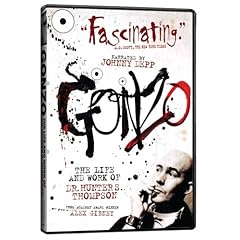
Gonzo: The Life and Work of Dr. Hunter S. Thompson

Directed by Alex Gibney

While watching coverage of the McCain campaign, and specifically the way in which the press was spotlighting Sarah Palin, I thought about how Hunter Thompson might have written about things. I would have loved to have been able to read one of his accounts from one of her rallies - I'm sure that he would have exaggerated only a little - and we would have gotten a more truthful glimpse into the bizarre world that she inhabited.

Sadly, Thompson took his life a few years ago. This documentary explores his life, featuring interviews with his family, his editors at Rolling Stone, his collaborator Ralph Steadman, fellow writers like Tom Wolfe, and some of the politicians that he covered over the years. It also features readings from his work by Johnny Depp, who really did nail his voice in 'Fear and Loathing in Las Vegas', and was therefore the perfect choice for bringing his words to life here. The film also makes generous use of other film and tv appearances Thompson made, and the hours of audio recordings he left behind.

What emerges is a very clear portrait of a man haunted by his own rage (fear and loathing being the perfect way to summarise his mental state a lot of the time), but also a man who was hopeful of a better world. Thompson is viciously funny - his suggestion that Ed Muskie, a candidate in the Democratic primaries of '72, was being proscribed the drug Ibogaine by a mysterious Brazilian doctor became a news story of its own - and the film shows clearly that he was responsible for creating a new approach to journalism.

This film is a loving tribute to a great writer, but it is also careful to show the darkness and anger that consumed him. It ends with the elaborate funeral that Thompson had planned for himself - especially funny is the footage of him and Steadman explaining the plans to a mortician.