Friday, September 3, 2010

The Last Days of American Crime #3

Written by Rick Remender
Art by Greg Tocchini

There's nothing quite like a good heist story. Usually, tales like this one are told in movies and not comics, and so Remender's The Last Days of American Crime is pretty unique, especially since it is as much a science fiction story as it is a good crime book.

In this issue, Graham and his untrustworthy crew finally do the job they've been planning for the first two issues.  They must complete their heist of a computer that charges pre-paid credit cards before the government begins broadcasting a signal that makes it impossible for a person to commit a crime.  This has led to an absolute outbreak of chaos, as Americans indulge themselves in behaviour that they will not be able to do ever again.  Of course, nothing goes as planned, as Graham has to decide if Shelby, the beautiful woman that he is working with, is legitimately interested in him or is simply playing him.

Tocchini's art looks a little rough at the beginning of this book, but by the end he has regained his stride, and draws some very beautiful pages.  Remender's writing is always at its best when he is working on a title of his own creation, and it's nice to see him do projects like this while doing so much work at Marvel.

Stumptown #4

Written by Greg Rucka
Art by Matthew Southworth

I had hoped that Greg Rucka's leaving DC would lead to a lot more of his independent comics, and most of those hopes were based on seeing the end of Stumptown come sooner than it has.  Of course, reading this comic, it's apparent that it was well worth the wait.

Stumptown has been a particularly good entry in the standard female PI genre (which I think exists more in comics than the male PI story).  Dex Parios is a tough investigator who, despite her almost constant stream of bad luck, demonstrates in this issue that she is a solid planner and good judge of character.

The story in Stumptown has worked really well.  Dex is trying to find a young woman who has run afoul of a West Coast mob family, and has had to try to figure out who to deal with between the traditional mob father, the wannabe thug son, or the manipulative and ambitious daughter.  All three want something from Charlotte, the young lady in question, and all three have very different methods of approaching their problems.

The series ends in a terrific scene set on the coast at night, and lit only by flashlights.  It's a very powerful way of drawing this series to a close - both Dex and the reader have been kept in the dark for much of the series anyway - and demonstrates Southworth's ability to innovate.

At the end of the book, Southworth states that another Stumptown story is coming, which is very good news.

Thursday, September 2, 2010

King City #11

by Brandon Graham

There's one thing that I really don't like about this issue of King City, and that's the fact that it ends with the next issue.  And really, with only one issue remaining, I have no idea what's going to happen next.

This series has never been overly concerned about plot - it's been pretty stream of consciousness from the start, and every time I think I know what the book is going to be about, that aspect of it seems to die away (I vaguely remember some Owl freedom fighter thing going on for a while). 

The closest thing to an on-going plot element we have has been involving Pete, the Cat-Master's friend, and his desire to rescue an alien girl sold into slavery.  That's what this issue is focused on, as the two friends make good the rescue, only to be surrounded by bad guys.  The coolest aspect of this book are the other cat masters that show up at the end.

As always with this title, the art is incredible, and the plays on words and visual gags are pretty thick.  I hope when it's done, we'll see something more from Graham (like the next Multiple Warheads).

Wormwood: Gentleman Corpse Vol. 1: Birds, Bees, Blood & Beer

by Ben Templesmith

It's pretty easy to describe this book accurately with only one sentence:  A corpse-possessing worm, his clockwork robot drinking buddy, the ghost of a police officer, and a hired exotic dancer/interdimensional gateway guardian have to figure out why people who use erectile dysfunction medication are being ripped apart by demonic monsters.

See - it's a pretty straight forward concept.  Basically, Templesmith just goes nuts with this book, creating a few interesting and memorable characters, and then rolling with the situation.  It's by no means a brilliant or particulary thoughtful comic, but it is a lot of fun.

The big draw to any Templesmith comic is his art.  His brand of digitally coloured and manipulated pencil drawings works well here.  I'd recommend this book for people who have gotten bored with Hellblazer.

Wednesday, September 1, 2010

Farscape: Scorpius #0-4

Written by Rockne S. O'Bannon and David Alan Mack
Art by Mike Ruiz and Gordon Purcell

Having been won over to the regular Farscape comic, I thought I'd check out the Scorpius spin-off trade when it comes out soon.  Then, at Fan Expo, I realized I could get the original issues for less than the trade will cost, and I dove right in.

The series is tied very closely to the parent book, although the events taking place in this have not yet had any bearing on that book.  Throughout the Farscape universe, an alien race called the Grennij have been attacking worlds on behalf of another, older race called the Kkore.  This series opens on a remote ice planet, where Scorpius, exiled by Rygel, has crashed.  When a Grennij fleet lands to repair a ship, Scorpius gets up to his usual tricks, ingratiating himself to the Grennij commander, and then insinuating his way into command of the fleet.  A meeting with the Kkore leads to a new purpose for Scorpius, who perceives his opportunity to finally get the power and revenge he's always wanted.

The writing on this book is tight.  Scorpius always had a certain pattern of speech on the TV show, and that has been continued here.  It's easy to hear his voice when reading this.  The art on the first four issues (#0 is really the first issue, and not an introductory story, like #0s used to be) is by Mike Ruiz, and it's great.  It has a sinister quality to it, and I especially like the way, in flashbacks, all characters other than Scorpy are rendered in a scratchy, hazy way.  Gordon Purcell, the artist for issue 4 is decent, but I much preferred Ruiz's work.

I'm impressed with what I've found here, and am now concerned that I'll have to add this title to my pull list as well, which I did not want to have happen.

Tuesday, August 31, 2010

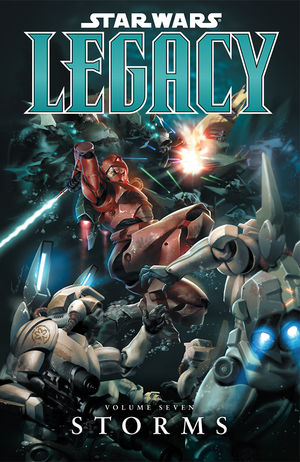
Star Wars Legacy Vol. 7 - Storm

Written by John Ostrander and Jan Duursema
Art by Jan Duursema, Omar Francia, and Dan Parsons

I'm starting to worry that all of my reviews for this series are going to be completely interchangeable, as the book is so consistently impressive, that I find it hard to say many new things about each subsequent volume that I read.

The seventh book in this series checks in on three (or four, if the state of Darth Krayt and the Sith count as their own story, instead of being a part of Cade Skywalker's) running stories in separate chapters.  I much prefer this approach to having each individual chapter check in on each separate story for a couple of reasons.  First, it allows for time to pass in Cade's story, which is the main one, and it allows the different series artists to work on their own set of characters and settings.

This book opens with a story set on Dac, the homeworld of the Mon Calamari, who are currently being hunted to extermination by Krayt's Empire.  A group of resistance fighters are working with an Imperial Knight, and their story features some amazing design work by regular fill-in artist Omar Francia.  One of the appeals to me of the Star Wars series as a kid was the diversity and ingenuity of ship design (before I realized more stuff meant more toys), and so I thought the underwater AT-AT Swimmer was very cool indeed.

The second story checks in on the new partnership between the Alliance and Roan Fel's Imperial Forces.  The writing in this story is among Ostrander's best, as the two sides test the other.  The final story brings us back to Cade and his crew, none of whom are in a particularly positive place right now.

This series continually amazes me in its ability to like a Star Wars comic.  I'm really happy to hear that the title is not canceled after issue 50, but is merely getting rebranded, and that Ostrander and Duursema are staying with it.

Monday, August 30, 2010

McSweeney's Quarterly Concern #33

A year or two ago, I read Nicholson Baker's wonderful book Double Fold, which was about 'Libraries and the Assault on Paper', as the text beneath the title calls it.  In this book, Baker rails against recent library practice of disposing of tons of old and historic newspapers, replacing them with commercial (poorly) made microfiche, citing storage and space requirements.  Baker himself now owns a large collection of almost full early runs of such celebrated and wonderful papers as Joseph Pulitzer's New York World.  The descriptions that Baker furnished of large broad-sheet papers with detailed diagrams and loving illustrations, not to mention legendary comics sections, made me envious of people living in an earlier time.  We now live in a time of great newspaper poverty, as dailies suffer from endless cut-backs and diminished readership.

Into this dismal scene comes the 33rd issue of McSweeney's, Dave Egger's literary quarterly.  For this issue, Egger's et. al. constructed the San Fransisco Panorama, a one-time old-school newspaper of gigantic proportions.  The paper is a week-end edition, including two supplemental magazines, various sections, a generous and lovely comics section, and even a fold-up paper toy rocket ship.  The entire paper comes off as a labour of love and an almost forgotten sense of American journalistic craftsmanship.  It took me just about forever to read this thing.

The list of contributors to this thing is as impressive as the span of topics discussed and reported upon.  There is Baker himself (writing about paper mills in Maine); William T. Vollmann discussing mining issues in Imperial, an area about which he is most definitely an expert; Jesse Nathan on the marijuana growers of Mendocino; and J. Malcolm Garcia reporting from Afghanistan. 
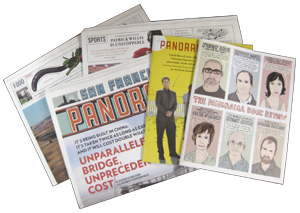
San Francisco is the main topic of the paper, with various articles examining the state of the city and its inhabitants.  There is an eight-page section devoted to the new Bay Bridge, and all of the problems associated with that project, which features stunning illustrations and makes good use of the large-size format of the pages (this thing is much wider than today's newspapers).  The Sports, Food, and Arts sections represent the Bay Area a great deal.  There are also tons of human interest articles and interesting charts throughout.

The two magazines are very impressive.  The Panorama Magazine is modeled after the New York Times Magazine, with many long-form articles, some of which I've already reviewed.  Were this a weekly or monthly magazine, I would gladly subscribe.  The Panorama Book Review Supplemental was also very impressive, containing some great short stories from authors such as Roddy Doyle and George Saunders, as well as an interesting conversation between Dave Eggers and Junot Diaz.  The book reviews were wonderful in their variety, and I liked the way each review reproduced the first page of the book so potential readers could sample its style.

Of course, I wouldn't be me if I didn't say something about the comics section.  Art Spiegelman, Dan Clowes, Michael Kupperman, Gene Luen Yang, Adrian Tomine, Chris Ware, Erik Larsen (!!), and many others contributed, and it was a very nice little compilation.  

It's a shame that this project is not to be repeated.  I doubt very much that there is a market anywhere in the world for a regular paper like this, and that is all of our loss.  Reading this allows you to imagine a time when people were very well informed (and not just up on the celebrities), and also had the leisure to read the damn things.  This is a truly unique and impressive work of art.

The Executor

Written by Jon Evans
Art by Andrea Mutti

I'm of two minds when it comes to this graphic novel.  The Executor is about an ex-NHL goon who retired early due to a knee injury.  He gets a phone call telling him that his old high-school girlfriend had died, and that she unexpectedly named him the executor of her estate, which forces him to return to Elora New York, the small town where he grew up, and where he is still seen by many as a local hero.

Shortly upon arriving in town, he begins to expect that the girl's death wasn't an accident, and he begins digging around for some facts.  Elora is a typical small upstate New York town, with a Mohawk Reserve on its border.  It seems that the ex-girlfriend was dating a member of the band, and was helping the tribe with some land claims thing (which is never elucidated upon).  As Joe, our hero, distributes her meager funds to her inheritors, he meets with Dia, a local Mohawk crime boss who lives in a guarded estate on Reserve property, and apparently smuggles stuff to and from Canada.  Dia had a little brother who was killed a long time ago, and Joe seems to know something about it.

From there, the book becomes quite intriguing, as Joe's secrets are cast into new light by other information, and the plot thickens to involve a missing man accused of kidnapping his daughter, a pedophile ring, an abandoned mine, and years of lying.  It's maybe more than the book can support, and there are many places where the writing feels illogical or the pacing is off.

Not helping matters is the art of Andrea Mutti.  He's very good at drawing figures, but I often found his storytelling to be a little confusing and unclear.  I know that Vertigo is increasingly relying on artists from Italy to draw their books (I always assume it's an economic thing), but I think that Mutti should have perhaps spent a little more time researching or referencing the things he's drawing.  The hockey players appear to be playing with field hockey sticks at times, and there's a scene where much is made about how good a pumpkin pie is, yet the pie shown has a layer of crust on top.  These are all minor quibbles, but they were enough to toss me out of the story a couple of times.

Still, this is a decent read.  I found that I got pretty absorbed in the story, and didn't want to stop reading until I knew the ending.  This is Evans's first comic from what I can tell, and it's always good to see a local writer get some attention.

Saturday, August 28, 2010

Dong Xoai, Vietnam 1965

by Joe Kubert

There was a point early into this book where I feared I'd made a mistake in starting to read it.  It seemed like a no-brainer to me - I love war comics, often feel the lack of good comics set in the Vietnam War, and I have the utmost respect for Joe Kubert.  What could go wrong?

The problem is that the book looks just like the cover.  Kubert didn't exactly finish his pencils, eschewed a panel grid in favour of having two or three illustrations spread across the page, and decided to print the book on the same grey paper you see on the cover.  All of that I could get past, except I found the writing at the beginning to be painfully amateurish, as he tried (not too hard) to establish some of the characters that made up Special Forces team A-313, without explaining much context for their mission, which at the beginning, involved training and supporting a variety of local forces in a remote outpost near the Cambodian border.

Now, I'm very willing to cut someone with Kubert's street cred a ton of slack, and I'm quite glad I did.  After the men of A-313 get transferred to Dong Xoai, and get their name changed to A-342 (does this have significance?  It gets mentioned a lot), the book seriously picks up.  Basically, these guys are in a poorly-defended base, filled with ARVN, Saigon 'Cowboy', Montagnard, and Cambodian forces.  They quickly realize that they face an invasion by VC and NVA forces, and rush to fortify their position.

When the attack comes, the book becomes pretty gripping, as Kubert shows time and again the resourcefulness and tenacity of the American forces (A-342 was joined by a small contingent of Seabees before the attack).

This book is based on the actual events that took place in Dong Xoai, and when one reads the lengthy notes and accounting of the battle provided by the surviving Marines (which takes up like 20 pages of minutely detailed writing), it becomes hard to see where things are fictionalized, aside from the changed names of our heroes.  Instead, Kubert has created a serious and accurate piece of war history, and his book stands as a strong testament to the bravery of the men involved.

Which brings me to my biggest issue with this book.  Was the battle at Dong Xoai important to anyone beyond the men who were there?  Was this an important turning point in the war, or a watershed moment that led to stronger US involvement in Vietnam?  I feel like I could have really used a little more context to put these events in perspective.  Don't get me wrong, the battle makes a very good story; the historian in me needs more guidance in interpreting its importance.

Friday, August 27, 2010

Cape Verde

by Super Chron Flight Brothers

To people who complain about the lack of innovation in hip-hop these days, the first group I would hold up as a counter-example is the Super Chron Flight Brothers.  This group, consisting of rappers billy woods and Priviledge, consistently push themselves to find new flows, or to rap over increasingly experimental beats.

On this twenty-song album, they work with their usual producers, Bond, Willie Green, and Nasa (only one track), and their sound has not so much improved or matured, as become more rich.

The album is peppered with TV clips and samples that fall into a few broad categories - 80s TV, infomercials (I'm pretty sure that's Vince, the SlapChop guy I hear on the third track), and post-Obama racial pride gone wrong ("The minute Obama became president?  I got the right to do the Hell I want to," proclaims a teenage girl who goes on to describe her activities in group sex and fighting on 'Strangers With Candy'). 

Lyrically, woods and Edge are as incredible as always.  They extend their verses long beyond the standard 8 or 16 bars, letting their material determine song length.  They are not as literary here as they have been in the past, but their lines are highly intelligent and usually need a couple of listens in order to catch every nuance.  The focus on this album is on how media-saturated we are, as they call out TV Republicans and bad hiphop.

The SCF Brothers are joined by long-standing allies like Zesto, MarQ Sekt, Vordul Mega, and HiCoup.  Less familiar collaborators include Masai Bey, Lord Superb, Pastense, Bigg Jus, and Johnny Voltik.  The liner notes are filled with notes from woods, Bond, and Green, explaining some of the work from behind the scenes on the album.

This is one of the best hip-hop albums of the summer.  Recommended.

A Box of Matches

by Nicholson Baker

When you're in the mood for a quick, introspective novel after reading a gigantic, excessive non-fiction book, there's nobody better to turn to than Nicholson Baker.

A Box of Matches is a pretty typical Baker book.  Emmett, the narrator, gets up early every morning, makes a cup of coffee in the dark, and then lights a fire in his fireplace.  While he enjoys the fire, his mind wanders.  That's it, on the surface.  There is no plot.  Some stuff happens, like Emmett gets a cold, but the appeal of this book is the sameness of the chapter structure (each chapter opens with 'Good morning, it's _:__ a.m.').

What makes this book a novel, rather than a collection of writing exercises, is that our understanding of Emmett as a character accretes with each new section.  He has a wife, two children, a cat, and a duck.  The duck probably gets the largest chunk of the narrative devoted to it, aside from Emmett thinking about himself.  Baker has gifted his character with a very good life.

Of course, it's not hard to read a book like this without viewing the protagonist as a stand-in for the author.  Baker, like Emmett, is married with kids, has a thick beard, and an amazing ability to focus on the smallest things in life and imbue them with great significance.  This is Baker's greatest strength as an author, and I lost track of the number of times I smiled in recognition of something that, Proust-like, he digs up from memory.

What are some of these Bakersian topics?  The way thermometers feel in your mouth.  Picking up underwear with your feet.  The sideways flame that comes from a newly-lit match.  Peeing in the dark.  The feeling of washing dishes.  The list continues.

This is a quiet little novel, and it served as the perfect tonic for the lack of good fiction in my life lately.  Recommended.

Lucifer Vol. 9: Crux

Written by Mike Carey
Art by Marc Hempel, Peter Gross, Ryan Kelly, and Ronald Wimberly

I started reading this book feeling a little bored with Lucifer in general.  I didn't enjoy volume 8 with the same degree that I did the earlier books, and didn't really feel like reading this.  I'm glad I stuck with it though, because this volume returns the book to the high quality of the beginning of the series.

This volume jumps around a fair deal.  The first story (with art by Marc Hempel, an artist we don't see enough of these days) is set in Hell, and has Christopher Rudd serving in a messianic role.  In fact, the story ends with him in a new, elevated station in Hell.

From there, we get to the main storyline of the book - the return of Lilith, as seen at the end of Volume 7.  We learn where she's been for the last few millennia, as she starts to plot against Heaven.  She's not happy with Mazikeen, for whom things go bad quickly.  Between these chapters is a story where Elaine Belloc, absorbing Michael's abilities, creates her own universe, and then tries to watch over it.  As well, we see more of Jill Presto, who is again pregnant from the Basanos.

There is definitely a feeling throughout this book that the story is coming to its close (two more volumes remain), and Carey is slowly ratcheting up the level of suspense and weight of events.  The strength of this book lies in its supporting characters - Elaine, Jill, and of course Mazikeen, and so the fact that Lucifer barely appears in this book is not a problem.

Thursday, August 26, 2010

Battlefields #9

Written by Garth Ennis
Art by Russ Braun

Battlefields has done a great job of satisfying my cravings for a regular dose of war comics, and so I'm sorry to see this second volume finish.

With this issue, Ennis concludes the story arc he began with the first Battlefields mini-series, The Night Witches, which focuses on (now) Captain Anna Kharkova, a female Russian pilot during the Second World War.  With this issue, Anna is put in charge of a group of six new female pilots, who have only barely been trained to fly.  She grounds them, but while she is on a mission, a new political officer arrives at the airbase and sends them out.  Anna and the Colonel (who she has been getting very close to) now must fly out and try to find them.

Ennis shows what things were like for the Soviet army quite effectively.  The most frequent Soviet technique in the war was to try to overwhelm a better trained and equipped force with sheer numbers, the only real asset the Soviets had.  This led to some brutal battles and massive amounts of losses.  The psychological toll of such a thing is shown here.

What I have enjoyed most about the Battlefields series is that Ennis has taken the time to examine some lesser-known aspects of the Second World War, and has enriched my knowledge of that time while providing some very impressive stories.  I sincerely hope there is a Volume 3 in the works.

Unknown Soldier #23

Written by Joshua Dysart
Art by Alberto Ponticelli

Now that I've read this, there are only two issues of Unknown Soldier remaining, and that makes me sad.  This book has been amazing since it started, and it's going to be a shame to not be able to pick it up each month.

With this issue, Moses is no longer Moses.  Instead, he's back to being Subject 9, and he's back to working for the CIA (or so they think).  He insists that, if he's going to work with them, they must bring Jack Lee Howl out of retirement to be his handler.  He is, of course, working a different plan, and it's not long before Moses/9 and Howl are on the run.

Most significantly, this issue has Moses/9 meet up with Sera, Moses's wife.  This is a scene that has been a long time coming, and Dysart works it perfectly, interspersing what's happening with scenes from their relationship together.

Now, with two issues left, Moses/Subject 9 is heading into the bush to attempt to kill Joseph Kony, while the flashback sequences that have been book-ending recent issues move towards revealing just what the original Unknown Soldier said to Subject 9 the first time they met.

Oh - if, like it has with me, this book has piqued your interest in Uganda, there's a terrific article in the new issue of Harper's about how right wing evangelical Christians in the US have influenced the Ugandan government into considering a bill that makes homosexuality a capital offense.

On the Prison Highway

by Ian Frazier

Since I was little, I've found myself drawn to abandoned places.  It's hard for me to drive past run-down and empty houses on the highway, without wanting to explore.  I would love to go to a place like Detroit, just to climb through some of the buildings there, except fear for my safety keeps me from doing it.  As a teen, my friends and I frequently explored a closed brickworks and quarry (since revitalized as a farmer's market and green-living experiment).

So, there's a lot I can relate to in Ian Frazier's latest article on his journeys in Siberia (there was a two-part article published about a year ago), this time specifically hunting for abandoned lagers, or what we would refer to in the West as Gulags.

He does come across one, and his descriptions of it are lovely, sad, and very evocative of a horrible period of Russian history.  He follows his experience with a description of the growing popularity or nostalgia for Stalin among modern Russians, a strange phenomenon.

What I think attracts me to the idea of traveling through sites like the one he found, is that they are not sanitized through the act of historical interpretation.  He imagines the site turned into a museum, but I feel like that would cause me to lose all interest in it.  I have no desire to visit a place like Auschwitz, Choeung Ek, or that church in Rwanda with all the skulls, as they have been put on display, no matter how much they were also left in their original state.  But to wander through an abandoned lager, covered in snow, and with no one around, one would feel the weight of the history of the place in a much more visceral way.  I envy Frazier the experience.

Apparently, he has a book being released soon about these trips.  I should probably check that out.