Wednesday, August 11, 2010

Daytripper #9

by Fábio Moon and Gabriel Bá

As I picked up this issue of Daytripper to read, I started reflecting on how much I've enjoyed this series, and how I wish that it wasn't going to end next month.  Then, as I read it, I got to the point where Brás, the main character, discusses life and death with his son, saying:

"Life is like a book, son.  And every book has an end.  No matter how much you like that book... ...you will get to the last page... ...and it will end.  No book is complete without its end.  And once you get there... ...only when you read the last words... ...will you see how good the book is.  It feels real."
It was a little like the authors had read my mind, and it amused me.

This whole issue spun me out.  Over the last eight installments, it has become clear what the established structure of each chapter of this series will be.  With each new comic, we are sent to another point in Brás's life, and they have all had a variation of the same ending (which I am reluctant to describe here).  This time around, the brothers have turned those expectations upside down, as Brás continually dreams of the different eras we've visited, and continually wakes from those dreams into other ones.

It's a conceit we've seen before, but it's especially effective here.  When Brás first wakes from his dream, he sits in his kitchen talking to his wife.  Slowly, over a number of panels, water spills from the sink, and fills the room.  This is handled well - I noticed the sink in an early shot on the page, but didn't catch on to its significance until a little later, the way we will suddenly notice something in our dreams that has been there for a while.  As Brás revisits different moments in his life, I felt small twangs of recognition and nostalgia.

What is strangest about this issue is that it feels for all the world like the last chapter.  It ends as all of these chapters have ended, except in this issue, Brás is the author of the last text boxes, and we feel like we have reached the last words that will tell you how good the book is, to paraphrase Brás himself.  I don't know what is going to happen in the last issue, except for two things - the art is going to be stunning, and I'm going to be very sad to see it all end.

BPRD: Hell on Earth - New World #1

Written by Mike Mignola and John Arcudi
Art by Guy Davis

It's been a few weeks since I finished reading through the entire back catalogue of BPRD and Hellboy comics, and I am finding it kind of exciting to be able to read these in 'real time', although it's also frustrating, because as soon as this issue finished, I wanted to read the next one.

This comic is the first with the new, permanent BPRD: Hell on Earth title, as the Bureau adjusts to the new, post War of the Frogs status quo.  The Bureau now operates under the aegis of the UN, and with that comes any number of bureaucrats and paper work, at a time when the world has changed significantly.

This issue doesn't dwell much on how the main characters are dealing with all of these changes, but it does set up hints as to where these characters are headed.  Kate is working too hard and trying to hold everything together, while Johann seems to be flaking out again.  Abe has become distant and takes off on a mission of his own, while Devon becomes increasingly suspicious, and maybe a little paranoid.

This is a great start to a new direction for this book, and while it might not be terribly easy for a new reader to jump on at this point, it's worth checking out where this book is headed.  Even if you don't understand everything, you'll get to see further proof of Guy Davis's genius.

Eddy Current

by Ted McKeever

It's hard to talk about Eddy Current.  This is a book that defies description on many levels.  It's easy to explain the premise - Eddy is a lunatic, locked up in an asylum until the 'dynamic fusion' suit that he ordered out of an issue of The Amazing Broccoli arrives, and Eddy blows out the power for the institution trying to charge it, allowing him to escape, and save the world.  Except he has to be back in twelve hours, before his absence is noted.

Eddy starts small, trying to help a bum getting beaten up by some local thugs.  This results in his getting tossed off a building, where he is found by a nun who believes him to be the second coming.  He gets taken to their storefront atomic science facility (see, not easy to explain), although later on, Eddy and the nun (named Nun) look up Eddy's old girlfriend, and have to stop a group of elderly and overweight women from broadcasting some sort of radio signal that will make all men docile and easy to control.

Sounds crazy, right?  And it is, but in a glorious way.  McKeever's art, which is such an acquired taste as to be in the same category as oysters, is terrifically abstract and toothy.  This comic was originally published in the 80s, and that era of sartorial excess shows, although the story stands up remarkably well.

To be honest, I feel as if there is a deeper social or religious commentary that has passed over my head.  The book is peppered with biblical quotes, but I'm not wired to extract any great significance from them.  I know that the follow-up series to this, Metropol (which I loved when it originally came out and would really like to read again) was very biblical in its approach to things (and at some point featured Eddy again).

I'm thankful to Heidi MacDonald and The Beat for giving me the opportunity to read this excellent new collection of these stories (I won the book in an on-line contest).  If you are reading Meta 4, McKeever's new Image series, it's worth checking out his roots.

Tuesday, August 10, 2010

Made Like Us

by Paper Tiger

"This is the first full length record I have ever made," Paper Tiger informs us in the liner notes, and I suppose he's correct, although at just under 40 minutes, I would have appreciated a fuller full length, although I'm quite happy with what we did get here.


The album starts with the appropriately named 'First Track', which is a standard piano-laced instrumental intro track.  This being a mostly instrumental album, it sets the tone for the whole project, which repeatedly returns to the same type of slightly spaced out, relaxed beat.

The second track introduces some chopped up vocals, which is another recurring motif.  On the seventh track, '5360', PT switches this up a little, by having a narrator - he sounds like a young British teenage boy - tell his story, although most of it is buried in the music and hard to hear; it reminds me a little of trying to listen to people talking on the subway while you're wearing headphones.

This is not a strictly instrumental album though.  'The Painters Arm' features singing by Maggie Morrison, and the song has a bit of an 80s pop feel to the hook.  It's good, but it is completely overshadowed two tracks later by 'Palace', which features the incomparable Dessa, in the first of her two appearances on this disk (the second is on 'And the Camera'.  Dessa is such a beautiful singer, and writes infinitely more thoughtful lyrics than most (check out her album!).

In all, this is a very successful full-length debut.  PT creates some lovely moods with this album, and ends with a terrific beat that I could listen to for another twenty minutes without complaining or getting bored.  It would have been nice to see a little more representation of the rest of the Doomtree crew, but I am happy with this as it is.

Sunday, August 8, 2010

Warlord of Io

by James Turner

There is nothing like a James Turner comic.  He works at a level of madcap creativity that is almost beyond description, and has just completed what has to be one of his craziest stories yet.

Warlord of Io tells the story of Zing, an adolescent 26 year old prince, who, due to his father's sudden abdication, is thrust into the role of Emperor of Io, a job he never wanted.  Zing's ambitions never extended past defeating video games and becoming an intergalactic rock star.  Now he has a gigantic empire, held together by a massive military industrial complex, to manage.

His close friend and potential love interest, Moxy Comet, encourages him to implement social reforms and to improve the lives of everyday Ions, at the expense of the military budget.  This immediately leads to a military coup led by the ambitious and ruthless General Grymak.  Grymak quickly pulls together support in the military when he lies about having the former Emperor's support, and things start to move quickly.

Zing and Moxy, accompanied by Urk the loyal bodyguard and a cutting off a wise philosophical plant, escape, and most of the book is concerned with their adventures trying to avoid Grymak's legions, as Grymak works to consolidate his power. 

The strength of this comic lies in the diversity of characters, races, and items Turner has created in building up his Ion Empire.  Hundreds of alien species, weird ships, guns, and ambassadorial protocols fill this comic, and that's before you get to the Tiki Space Pirates.  This comic is frequently funny, and politically very sharp.

It does lack the more literary and philosophical commentaries found in Rex Libris and Nil, but this is a consistently good book throughout.  Turner's computer-designed artwork can take some getting used to, as the panels are absolutely packed with details, but much of the fun of reading his comics come from exploring each frame of artwork.

Highly recommended.

Saturday, August 7, 2010

iZombie #4

Written by Chris Roberson
Art by Michael Allred

This new series keeps getting stronger and stronger.  Four issues in, Roberson decides it's time to explain what's going on with all the zombies, vampires, ghosts, wereterriers (seriously), and guys in white suits that have been running around since the book started.  All of this exposition comes from Amon, the guy that Gwen has been hunting down ever since she ate the brains of his murder victim.

As it turns out, Amon is a form of zombie as well, and all of these phenomena are linked to the Egyptian belief that each person has multiple souls.  The concepts of an oversoul and undersoul are put to very effective use here, in a way that makes perfect sense (in a comic book spirituality sort of way), and lays the groundwork for the future of the book.

I like that there is a strong sense of internal logic to structure this comic, and believe that a lot can be done with it.  Gwen proves herself to be increasingly likable (I like the undersold line), as do many of the other supporting characters.  Allred's doing some excellent work, with a few pages here showing his trademarked way of having characters walk through large panels.  Great stuff.

Friday, August 6, 2010

Murderland #1

Written by Stephen Scott
Art by David Hahn

Here's the solicitation for the first issue of Murderland:
Artist DAVID HAHN joins newcomer STEPHEN SCOTT to tell a story of doomed romance, bloodshed and the outer limits of human potential, all unfolding on the "complicated" streets of Baltimore, Maryland. The Arabber is a reformed killer bent on bringing peace to his hometown. Method is his lover and partner in crime, but she may not be long for The Arabber’s crusade. The first of many genre-bending stories in the MURDERLAND universe. 
 As someone who has had all other television ruined for him by Homicide: Life on the Streets and The Wire, seeing a comic set on the streets of Baltimore, and centred around an Arabber, is immediately attractive.  However, the Arabber in this comic doesn't seem to be an Arabber (there is not a single horse or even piece of fruit in sight), and apparently the streets of Baltimore now include lush penthouses and mansions with armed guards.

The main character appears to be a girl named Method, who seems to be an assassin (or possibly a serial killer) who likes to seduce her victims before garroting them with razor wire.  She is a 'master of disguise', and might be in a relationship with our Arabber.  The two of them go to some rich guy's house (surrounded by the aforementioned armed guards), where some other dude with an eyepatch is creeping around.  Method and Eyepatch (his name is Precurseur, and they know each other) appear to have superhuman strength and agility, and Method can grow bones outside of her skin like the X-Men Marrow.  The Arabber can't be killed.

Beyond that, I have no idea what's going on.  Is this a vampire comic?  Why are we treated to so many panels showing what the old dude is watching on TV?  What are the cops at the end talking about when they talk about Sesame Street, Barney, and Howdy Doody? Why does the back cover have a barbarian bikini chick and a sabretooth tiger doing an homage to old school Coppertone ads? Am I the only one that's lost/disappointed/not that interested? 

Hahn is a capable artist, but his style is too light for this type of story.  It needs a grittier look.  And some story coherence...

Sweet Tooth #12

by Jeff Lemire

If you've heard good things about this comic, and have been thinking about checking it out, this is a great issue to jump on with.

One of my favourite things about Lemire's Essex County Trilogy was the way in which he gave over a lot of real estate to show the quiet life on the farm.  Pages would go by with only a few panels and no words.  It was very effective, and easily done in a project where he had a lot of space to work with.  Writing and drawing a monthly comic doesn't afford a cartoonist with the same freedom; something has to happen every month (insert remark about decompression here) or the readers disappear.

With this issue, Lemire finds an interesting way to have a 'silent' comic, yet still cover a lot of story ground.  There are two narrative tracks in this issue.  Most of each page shows what's been going on with Gus, now that he is in captivity.  He gets showered and placed with some of the other hybrid children that he has met before.  Nothing is said in this section, but we are able to feel a great amount of empathy for Gus, who clearly doesn't understand what's going on.

At the bottom of each page, there is a narrow horizontal panel that focuses on Dr. Singh, the man that discovered Gus's lack of a belly button (with all that implies).  He is dictating an account of what is going on, starting with the emergence of H5-G9, the disease that started the world on the road to its current dire straits, and moving up to his discovery about Gus.  It gives him a more human side, helps to explain some deep background for the series, and slows down the comic, so it isn't a three-minute read.

Lemire's doing some very cool work with this comic, and this issue helps to build a lot of suspense for what is coming.  This feels like the freshest and most experimental thing that Vertigo has put out in years, and they should be commended for standing by a project like this which is so far outside of their usual style.

Kill Shakespeare #4

Written by Conor McCreery and Anthony Del Col
Art by Andy Belanger

This is another great issue of the adventure fantasy series that mashes up the different Shakespearian plays into a Lord of the Rings-style quest story.

This issue has Hamlet and Falstaff in drag, and introduces Juliet and Othello as being central figures in the Prodigal Revolution.  As King Richard's men track down Hamlet, Iago and Othello cross paths, which isn't pleasant.

This is a title that I'm enjoying a lot, and want to speak highly of, but at the same time, I don't really have anything new to say with this issue.  This is a remarkably consistent title, and deserves to be checked out.

Greek Street #14

Written by Peter Milligan
Art by Werther Dell'Edera

It's no surprise that Greek Street couldn't make more of a go of things (it's being canceled in two issues), but it is a bit of a shame.  I think, had Milligan started with more stories like the one in this issue, which finishes the three-part Ajax arc, the book may have had more success.

Ajax has told the story of Alex, a lower-class British soldier whose life fell apart in Afghanistan, where he was injured.  He has a pretty severe case of PTSD, although he has not been receiving any treatment for it.  He has fixated on the Minister for Defense, claiming that he has blocked him from receiving a medal, because Alex 'took the piss' out of him during a press conference.  In this issue, Alex takes the Minister hostage, and is forced to confront his messed-up reality.

Previous stories in this series have worked at integrating Greek myth into the story.  Characters are meant to be stand-ins or reincarnations of Greek heroes or legends.  If there is a precedent for this story, which does have Alex experiencing visions of a ghostly Ajax, I don't know it.  I think this looser interpretation of the structure of the series that has made this story work better.

Thursday, August 5, 2010

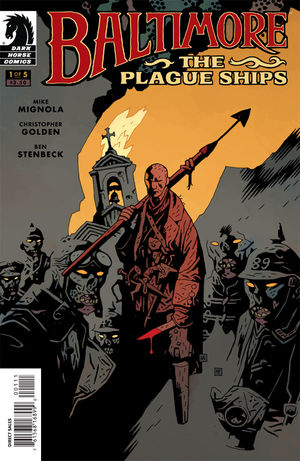
Balitmore: The Plague Ships #1

Written by Mike Mignola and Christopher Golden
Art by Ben Stenbeck

This new series tosses us into the story pretty quickly without explaining a lot of things, but here's what is made clear:  The Great War ended early because of a plague, and there are vampires feeding off the infected towns.  This Baltimore guy, who has a wooden leg (which doesn't slow him down at all) is chasing the vampires, specifically looking for one with a scar on his face.

He almost catches up with them, but lightning strikes the dirigible that they are using to escape, and he meets with an old woman who might or not be a witch, before being put in jail, accused of witchcraft his own self.

This comic is apparently a follow-up to a novel that Mignola and Golden wrote featuring the same character, and this is supposed to happen between the scenes of the book, which is a little annoying for people who haven't read it (like me).  However, this is a very cool comic, with vampires running around in Prussian helmets, and fantastic Ben Stenbeck art.  While a little more exposition would have been helpful, I'm definitely on board for the rest of the series.

Sparta U.S.A. #6

Written by David Lapham
Art by Johnny Timmons

David Lapham makes some very cool comics.  He has a unique approach to writing, and often peoples his books with duplicitous and immoral people, who usually get what's coming to them.  In Sparta USA, he examines some of his usual themes, but from a different perspective.

The town of Sparta is built on the two pillars of American culture: football and violent self-interest.  When the former Spartan hero, Godfrey McLaine returned to the town after years of absence, he upset the order of things.  The Maestro, the mysterious leader of the town, responded by attacking with an army of Nazis (yes, Nazis).

This final issue has the final battle between McLaine and his army, and the Nazi forces.  It reveals just about everything that I have been wondering about since the beginning of the book, and explains the source of The Maestro's power.  It also has a couple of twists I didn't expect, especially at the very end.

The art has been decent throughout the series, and the story, while frequently bizarre, was interesting and enjoyable.  I hope to see more work from Lapham soon (hopefully he'll draw something again).

Hellboy: The Storm #2

Written by Mike Mignola
Art by Duncan Fegredo

Now that I'm completely caught-up on reading all the old Hellboy and BPRD comics, it's nice to be able to follow all of Mignola's series in 'real-time'.

This issue has Hellboy finish his fight with the guy on the cover, as Merlin tells off the pig demon that's been plaguing our hero for a while now.

Most interesting in this issue is that Hellboy sees Kate Corrigan on TV.  I've wondered how he's managed to remain ignorant of some of the stuff that's been happening in BPRD.  It made sense that he wasn't aware of much when he was hanging out with ghosts, but now that he's back in the real world, and considering the immensity of what's been going on in the sister title, I'm glad to see that addressed.

The last page of this comic is very cool, and makes me look forward to seeing how this arc finishes off next month.

Shuddertown #4

Written by Nick Spencer
Art by Adam Geen

How often have you found yourself totally getting caught up into a comic without having a clue what's going on?  Okay, and now, how many times has it happened to you, and the book wasn't by Grant Morrison?

Basically, I'm very in to Shuddertown, but I'm also completely lost.  Perhaps it's the delay between issues that is messing with me.  Maybe it's the fact that characters get introduced in one issue, and then don't show up again until much later (like the reporter lady in #3, who has nothing to do with this issue).

At the end of the day, Spencer's created a very atmospheric and intriguing story, but it's hella hard to follow.  I want to see how it ends, but unless there is a ton of exposition in that last issue, I'm not sure that Spencer can pull this off.  I think I'm going to have to read all five issues at the same time, so that it's all fresh when I read the conclusion.

Supergod #4

Written by Warren Ellis
Art by Garrie Gastonny

It was a surprise to see that this book was released this week (it was originally solicited for February), and reading it after a a gap between issues of about four months, it becomes a good illustration of the limitations of Warren Ellis as a writer.

Now don't get me wrong, I have a lot of respect for Ellis.  He's written tons of comics that I love, but he is known as someone who returns to the same well a little too often.  That's not really my complaint with Supergod though.

Supergod is about artificial gods that have been created by the different nations, in a new twist on the superhuman cold war approach that we've seen many times before.  The gods are fascinating, and take many interesting and novel forms.  There is a British god made up of mushroom spores from space growing on the conjoined bodies of three astronauts.  How cool is that?

The problem is that the story lacks any emotional centre.  The whole thing is narrated by one of the scientists who worked on the British project, and he's narrating through a telephone to his American colleague.  The world is well and truly screwed at this point (the Iranian god was tossed through the moon, destroying it), and it's kind of hard to care.  The narrator could be writing a government report for all we care about him, and it becomes increasingly clear that Ellis is simply playing out these ideas without bothering to invest the story with any real human interest.

Had he structured this as a longer series, and had taken the time to develop the characters and the world, this could be quite fascinating.  As it stands right now, it's kind of cool, but heartless.