Wednesday, August 4, 2010

Star Wars Legacy Vol.4 - Alliance & Vol. 5 - The Hidden Temple

Written by John Ostrander and Jan Duursema
Art by Omar Francia, Alan Robinson, Jan Duursema, and Dan Parsons

I thought it would be a good day to read a big chunk of Ostrander's excellent Star Wars series, and polished off two trades, Alliance and The Hidden Temple.

This is basically the Star Wars that I wanted after I turned fourteen.  There is a rational attempt to understand galactic politics, and the droids and other cutesy creatures are kept to the barest of minimums.  Legacy is so much more than Cade Skywalker, and the Alliance trade is the best example of that I can think of.  I'm not sure that Cade is in it at all beyond in flashback.

Instead, Ostrander focuses on other goings on in the galaxy.  Most of Alliance is taken up with the plan of Admiral Gar Stazi, the commander of the final remnants of the Galactic Alliance to steal a new Advanced Star Destroyer from Darth Krayt, the Sith leader of the Empire.  To tell this tale properly, Ostrander develops a large number of characters, and fills in the story of what happened to the rest of the Alliance fleet.  There is also a story about the consequences of these actions on the Mon Calamari, and another one-off tale that has Darth Wyyrlok, Darth Krayt's aide de camp, as he tries to research new methods of healing his master.
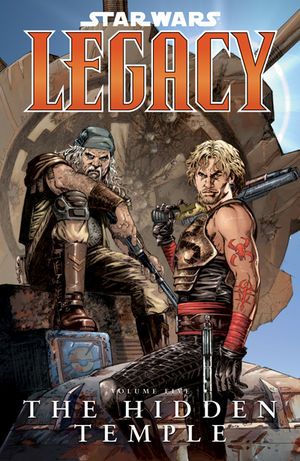
The Hidden Temple, on the other hand, is all Cade.  In it, Cade and his friends turn to Cade's uncle for help (yes, yet another Skywalker), and he in turn, takes them to a secret Jedi temple.  They get followed by some Imperial Knights, and all these factions sit down to discuss a course of action to put a stop to the Sith.  This gets a little heavy in terms of Force-based mumbo jumbo, as once again, the Jedi are portrayed as being reluctant to act.  These scenes may have become too much to handle, except that Ostrander wisely intersperses them between scenes that have some of the secondary characters interacting.  Most interesting are the scenes where Cade's friend Syn reveals the root of his hatred to the Jedi.

This series tells a massive, and very involved story.  It is science fiction just as I like it, with big space battles and really strong character work.  Duursema is always excellent, as are the other artists that provide work on this title.  I regret not having gotten on board with this sooner, but who knew that Star Wars comics could be this good?

Tuesday, August 3, 2010

Achewood Vol. 1: The Great Outdoor Fight

by Chris Onstad

I don't really like reading on-line comics, and I tend to avoid the 'funny animal' genre, but last Christmas Chris Butcher waged a guerrilla marketing campaign by posting links to the best Christmas-themed Achewood strips on his website, and I started to really like Onstad's work. 

This book tells the story of The Great Outdoor Fight, an annual competition where some 3000 men get into a giant arena and pound on each other until there's only one left.  On the second day, the two people with the largest followings get to have turkey and bourbon.

Ray, one of the main characters in the series, discovers that his father was the winner of the 1973 fight, and decides to enter the competition.  His friend Roast Beef enters as well.  The two plot and scheme their way to the top, and much hilarity ensues.

Onstad's art is very simple, but is effective here.  He pads the book with historical reference on the fight, including its history, biographies of past winners, and a helpful glossary of fight-specific vocabulary.  One of the best things about this book are the old posters that fill the inside covers.

Achewood is highly recommended.

Long Hot Summer

Written by Eric Stephenson
Art by Jamie McKelvie

I'm not sure that I can agree with the notion that a summer can be long - they seem increasingly fleeting, but this has definitely been a hot summer, so this seemed like an appropriate comic to read.  Stephenson and McKelvie put together this nice little twenty-something romantic comedy book back in 2005, while Stephenson was Executive Director at Image and McKelvie had not yet started working on Phonogram.

This is a quick, light read that is pretty enjoyable.  Steve is a pretty cool guy - he dresses well, and has a large group of friends who make up a 'scene'.  He's a Fred Perry-wearing indie rock twenty-two year old, who has a very strange relationship with his friend Ken.  Ken is a bit of a loser - he has no money or car, and constantly mooches off people, especially Steve, who always defends him to their other friends.  It's pretty clear from the beginning that, were it not for Steve sticking up for him, Ken would have no friends.

As the story starts, Ken has met Ashley, and they are maybe dating.  This all starts to change when Ashley meets, and falls for Steve, and the predictable begins to happen.  Friendships are tested, things are said, etc. etc.  The story may not be groundbreaking, but the enjoyment lies in the execution, and this is a very well-put together comic book.

Most of Stephenson's output before this book consisted of crappy 90s Image comics, and B- or C-list titles at Marvel, co-written with Erik Larsen.  It's nice to see that he can handle a more mature, well-balanced story.  McKelvie's involvement in this book makes it feel like a version of proto-Phonogram.  There are more than a few panels where Steve looks like David Kohl, the star of the first Phonogram story.  This, of course, is not a bad thing, as McKelvie is brilliant (read Suburban Glamour).

Monday, August 2, 2010

Fela Ransome Kuti and The Africa 70 with Ginger Baker Live!

by Fela Kuti, the Africa 70, and Ginger Baker

What a great album.  This five-track disk has four songs that were recorded live in 1971, featuring Fela, his Africa 70 band, and Ginger Baker, a drummer best known for his work with Cream and Blind Faith.  There is also a fifth track, which is a sixteen minute live recording of Ginger Baker playing with Tony Allen at the Berlin Jazz Festival in 1978.

The recordings with Kuti are incredible.  The shortest of these tracks is seven minutes, while the others hover around the twelve minute mark.  They have all the energy and sound one would expect from hearing the great man play.

These are mostly the classic tracks - 'Let's Start', 'Black Man's Cry', and 'Egbe Mi O'.  The drum solo piece that finishes off is impressive, if a little dull towards the end.

The Surrogates: Flesh and Bone

Written by Robert Venditti
Art by Brett Weldele

I really liked the first Surrogates collection, and although I knew that this volume was pretty much only created to tie in with the movie (which I haven't seen), I figured it was worth checking out nonetheless.

This story, structured as a four issue mini-series, even though it was only released in this collected format, serves as a prequel to the original comic.  As such, it covers the backstory of many of the key players in that book, while telling the story of the Hayes case and how it was used to build the power and profile of the Prophet.

Had I read these two books close together in time, I'm sure I would have found this story rather unnecessary and frustrating, as it would have been going over familiar ground.  Since it's been almost a year since I read the other book, I was able to enjoy this on a more individual level, although I did always have a sense of knowing what was going to happen next.

Venditti makes good use of this retroactive opportunity to lay the groundwork of the world he's constructed, I just don't know how essential it really is.  To read this followed by the other book might be a better way for a new reader to experience the story.

As is increasingly the case, Weldele does a great job on the art, turning in some of his clearest and most easily followed work to date.  This has been an interesting property, but I think there is little more to say on this subject or about these characters.

Crate Digging: Pick a Bigger Weapon

by The Coup

It's hard for me to believe that it's been four years since this album dropped; I find that it still gets fairly regular play, and many of the tracks on here have places of honour on my ipod.

Pick A Better Weapon is a classic album.  As with their previous offerings, Boots Riley and Pam the Funkstress work to convey complex political and sociological ideas in a manner that is fun and easily accessible, without sacrificing the clarity of their message.  I can think of no one else in hip-hop, and hardly anyone in any other form of media, who are as skilled at taking an idea that could be considered by many to be unpalatable, and turn it into something both thoughtful and entertaining.

Aside from a short intro track, the album begins with 'We Are the Ones', which has Boots rapping in a quicker, slightly hysterical voice, justifying a career in the drug game:  "now philosphically you'd be opposed to one inhaling coke via mouth or the nose, but economically i would propose that you go eat a dick as employment has froze."  From there, we go into 'Laugh/Love/F***', which makes the revolution sound like a lot of fun.

The fourth track, 'My Favorite Mutiny' is one of my all-time favourite songs.  It has appearances by Black Thought and Talib Kweli, although Boots outshines them both.  'Ijuswannalayaroundalldayinbedwithyou' is a lovely song about love, and the ways in which crappy jobs can ruin it.  'Head (of State)' is classic Coup - a bouncy song about the political (and perhaps sexual) relationship between G.W. Bush and Saddam Hussein.  Songs like 'ShoYoAss', 'Get That Monkey Off Your Back', and 'MindF*** (A New Equation)' continue the call for revolution.


A couple of skits and the irritating 'Ass-Breath Killers' weaken things in the middle of the album, but it picks up again with 'I Love Boosters!', Boots's tribute to the urban phenomenon of professional shoplifters.  Leave it to him to see them as soldiers of a Marxist revolution...

'Tiffany Hall' is an important song that examines the consequences of men discussing womens' bodies, told through the story of Tiffany, an activist and intelligent girl who died from complications with liposuction.  'BabyLet'sHaveABabyBeforeBushDoSomethin'Crazy' is a pretty little song sung by Silk E which helps remind us of the uncertainty of the Bush era.

The album finishes with my other favourite Coup song, 'The Stand'.  This is the only track not produced by Boots (instead the beat is done by Organized Elements), but in many ways, I think it offers the best example of his quiet rage and the indignity of being one of the working poor.

Pick A Bigger Weapon is a great album, and I hope that The Coup releases something new soon.  The age of corporate buy-outs and foreclosure needs someone like Boots to help interpret it.

Sunday, August 1, 2010

Lucifer Vol. 8: The Wolf Beneath the Tree

Written by Mike Carey
Art by P. Craig Russell, Ted Naifeh, Peter Gross, and Ryan Kelly

I found this volume of Carey's Lucifer series to be pretty inconsistent in its quality, which was unexpected for this title.

The first story included here is the double-sized 'Lilith' story illustrated by P. Craig Russell, and it tells of Lucifer's betrayal of heaven, although the story is mostly centered around Lilith and the early days of the Lillim, her children.  It also tells of the construction of Heaven.  Being illustrated by Russell means that every page is gorgeous, and it is a fantastic comic.

Next, we get a one-off story illustrated by Naifeh, which focuses on a man who gets possessed by a demon.  It's a fun, mean-spirited story, and Naifeh's art is excellent for it.

From there, we return to 'continuity', and get more of Lucifer and Michael dealing with the absence of God.  I could handle that, but found that the story involving Fenris wanting to destroy all creation, and using a schizophrenic murderer to help, a little tedious.  The art was great, but the story seemed to similar to the last couple of volumes, and I found my interest wandering.

Taddle Creek

Summer Number 2010

It's always a treat when a new issue of Taddle Creek, the Toronto literary magazine, comes out.  This summer, the people at the magazine did something a little different, breaking their injunction against non-Torontonian contributors, and decided to make an 'Out of Towner' edition, featuring a variety of work from places other than Toronto.

There is strong fiction by Michael Christie ('The Quiet' is about a teenage car thief),  Danielle Egan ('Strange Attractors' tells of a really bad trip a couple makes to the woman's parents' house, and the bizarre events that follow), and David Ross (who actually lives in Toronto).

There is a section of photographs depicting Saint John, New Brunswick in the sixties, before urban renewal made some drastic changes, and a cool profile of novelist Lee Henderson.  In addition to the usual comic page by Dave Lapp, there are comics by Jason Turner and David Collier.

My favourite part of the magazine was a series of short essays by Sarah Gilbert about the Mile End neighbourhood of Montreal.  Gilbert lives in the area, and has been writing about the people that make up this community, which is in the early stages of gentrifying.  She does a terrific job of portraying people from different ends of the gentrification spectrum.  We read about the owner of Maple Leaf Hat and Cap, a company that has been there since 1930; the artist who has worked to protect neighbourhood trees from bicycle lock damage by planting around them; a recently deceased gardener who grew lemons, olives, and grapes in his backyard (and was a fixture of the community); and about the woman who has turned a vacant lot into an example of land art.  These profiles are quick yet detailed, and when read together, really give a sense of the place.

There's some other stuff in this magazine too, but that's what I liked about it.

Saturday, July 31, 2010

And Then One Day #8

by Ryan Claytor with Dr. Harry Polkinhorn

Ryan Claytor is currently undertaking a lengthy tour of some 25 places across the Eastern US and Canada, and today made an appearance at my favourite comic store. 

Claytor creates these lovely little mini-comics around the concept of autobiography.  Originally, he was telling stories about himself, but the project changed as it progressed, and as he became more interested in literary theory and how it applies to autobiography.

This comic is the second of three that basically just recount a conversation between himself and Dr. Polkinhorn, who it is safe to assume is a professor of literature (although I'm not sure where).  It is unfortunate that this issue picks up partway through the conversation, as I felt I was missing some context to what these two are talking about, but I quickly found myself interested in their discussion.  Much of what they talk about is pretty academic, but is also kept interesting by the decision that Claytor made to include whatever conversational ticks, asides, and lulls the conversation endured.  I also like that it is set on the patio of a fast-food restaurant.

This is an interesting comic.  The fact that the entire thing consists of two people talking (and, at one point, walking) makes it a graphic update of the classical Socratic dialogue approach, which I think is pretty cool.  The production values on this book are high, with nice thick cover stock and a gilded quality to the cover's background.  I noticed that all of the books he had on offer were very well made.  Claytor's approach to comics is interesting, and worth checking out.

Seun Kuti + Fela's Egypt 80

by Seun Kuti and Fela's Egypt 80

As I've been listening to more and more African music, I've come to an understanding of how central Fela Kuti is to it all.  This isn't a surprise of course, as he has always been the only artist from the region I could name before the last year, but I did not know that his son is also a well-known musician and band-leader.

Seun Kuti's album is great.  It came out two years ago, and has seven tracks, clocking in at a total of fifty-three minutes.  Many of the musicians that make up 'Fela's Egypt 80' worked with Fela originally, some dating back to the earliest days of Afrobeat.

The album is politically charged, with songs like 'African Problems', 'Don't Give That Shit to Me', and 'Many Things', the album opener, discuss the issues faced by African nations today, albeit in a pidgin or creole that is sometimes hard to understand (but it's not like I'm the intended audience).

Most importantly, Seun carries forward the tradition of large, rich, big band sounds as a conduit for his message, making it danceable as well as edifying.  Great stuff.

Scourge of the Gods: The Fall #1-3

Written by Valérie Mangin
Art by Aleksa Gajic

I recently read the first volume of this series, and immediately wanted to read the second. 

Where the first volume was concerned with the war between the Huns and the Roman Empire, as carried out by two people believed to be gods, this volume deals with the Roman pantheon, and explains all of the strange coincidences or fantastical elements of the first story.

It opens with one of the best comics I've read in ages.  The first issue packs more story, excitement, and luscious art than a year's worth of a North American superhero series.  It shows the end of the war, as Attila tries one desperate measure after another to destroy the Roman forces.  Once he is taken prisoner, his status as an immortal is confirmed, and eventually both he and Favia/Kerkik are executed by being sent into the sun.

Seeing as there are still two issues remaining after that, you can be assured that is not the last you will see of them.  Instead, they wake up on Olympus, and meet the other 'gods', although they quickly learn that the gods were all once human, and Favia (now Venus), and Attila (now Mars), rebel against their creators.

The story, from this part, is much more fantastic, although grounded in strange comic book physics, and remains quite good throughout.  I really enjoyed this series, and recommend checking it out.  The writing is less dense or confusing in this volume, and the art is incredible.

Friday, July 30, 2010

Mondo Urbano Vol. 1

by Mateus Santolouco, Eduardo Medeiros, and Rafael Albuquerque

This is a very cool new graphic novel coming out of Brazil, drawn by three very capable cartoonists.  I picked this up because of Albuquerque's involvement in it, but once I started reading, I couldn't always tell what his contributions were.  The three artists appear to share pages almost at random, showing that this is a collaborative effort on every level.

The story is decidedly non-linear, and jumps all over the place, but is completely compelling and beautifully drawn throughout.  At the centre of this comic is a musician named Van Hudson, who has risen to stardom after purchasing a 'cursed' guitar.  This is not a new idea - ever since the legend of Robert Johnson was spread, writers have been making the connection between music and the devil - but it is played from a novel perspective here.  Hudson ends up dead in a bathtub, and there are all sorts of questions as to what really happened, and whether or not the stories about him were true.

This comic is not just about Hudson though.  There are vignettes about his fans and their own relationships.  There is a sequence about Hudson's drug dealer, and another story about an anxious young man embarking on a long bus trip without a refill on his Valium prescription.  Two things recur throughout the book - a new drug called Fuckdrine (which sounds a little like Ecstasy mixed with Viagra), and a burly music shop owner.

I have no idea when or how this story is going to continue, but I do know that I'm going to be picking up the next volume for sure.  This is not quite like anything else on the stands, with it's purple tones and kaleidoscopic story structure, and it's just the type of comic I love getting my hands on from time to time.

The Hellboy Project: Hellboy: The Storm #1

Written by Mike Mignola
Art by Duncan Fegredo

And with this issue, my Hellboy Project comes to a close.  Since April, I've read at the pace of one or two issues a day, every issue of Hellboy, BPRD, Abe Sapien, and Witchfinder, with the exception of one of the Free Comic Book Day issues, and a couple of back-up stories that haven't been collected in a trade yet.  I'll probably put together some kind of posting to discuss my thoughts on the work as a whole sometime soon.

For now, I'd like to talk about this comic.  It feels like much of the story that Mignola started many years ago is coming to a point of resolution, as Hellboy recaps his adventures of the last few years, as he prepares for a major confrontation with his enemies.  Hellboy is not the same character he's been throughout the life of this series.  He has received some news about his parentage and ancestry that has changed everything for him, and now the noble dead are rising out of their graves across England to follow him into battle with  the forces of darkness.  As usual, he's reluctant to to deal with this stuff, but has no choice.

This comic is beautifully drawn by Fegredo, who has quickly become my favourite artist on Hellboy, perhaps even more so than Mignola himself.  It's a hard place to jump into this story, but at the same time, the recapping Hellboy engages in makes the story new-reader friendly.

Gangland

by a whole lot of people

I love good anthologies.  A good comics anthology is one that provides you with a multi-faceted exploration of a theme or topic.  This one looks at organized crime, but doesn't limit itself to mafia-oriented Godfather knock-offs.  There are a few 'gangster' stories, like the one by Darko Macan and Kilian Plunkett that has a bored dentist sign up with some bootleggers in the Prohibition days for some excitement, or Simon Revelstoke and Richard Corben's creepy story of gangster love.

Most of the rest of the tales are merely riffing off the notion of organized crime.  Peter Kuper gives us one of his silent, mosaic-like stories.  Jamie Delano and Randy DuBurke give us a corporate tale, while Dave Gibbons explores post-Soviet Russian mafia business practices.  David Lloyd gives us a tale from the perspective of a drug lord's guard dog who gets recruited by the police (it's much cooler than it sounds).  Scott Cunningham and Danijel Zezelj take a look at the Men in Black as a form of the ultimate gangster.

Perhaps the best story here is the one by Ed Brubaker and Eric Shanower, which shows us how a group of bored suburban teens got turned into master cat burglars by the local life guard.  This story reminded me of their classic collaboration 'An Accidental Death', which I now really want to read again.

In all, this is a very skillful and interesting collection.  I know that it's long out of print, but it's worth hunting for on some comic store shelves.

The Hellboy Project: Abe Sapien: The Abyssal Plain #1&2

Written by Mike Mignola and John Arcudi
Art by Peter Snejbjerg

Reading this, I don't understand why it took so long for someone to realize what a perfect artist Peter Snejbjerg is for Abe Sapien.  This is a story set in the early 80s, which has Abe traveling on a salvage boat of questionable captaincy, looking for a potentially mystical artifact that was lost when a Soviet submarine sunk in 1948.

It follows the typical type of plot for a BPRD story.  In other words, the object is found, but it has a mystical defender, and so on and so on.  What I like about this particular tale is the way in which it shows Abe's human side, as his instincts tell him to handle this issue differently than his companions.

This is a good story, with fantastic art, and some very nice covers by Dave Johnson.  Recommended.