Thursday, June 10, 2010

Spider-Man: Fever #3

by Brendan McCarthy

This has been a terrific little series.  McCarthy's homage to Steve Ditko has been crafted with a great deal of respect and love, and while the story doesn't necessarily make a lot of sense, it is so full of great moments and amusing lines that it's nonsensical nature becomes its greatest strength.

It's really not easy to describe or summarize the plot of this issue.  Basically, Dr. Strange works to rescue Spider-Man's soul from the Arachnix demons that are forcing him to hunt the Soror Fly, which used to be a human being, while he wears the soul of the spider that gave him his powers as a hat.  There are talking dogs and an Aboriginal sorceress.

The comic is worth purchasing simply for the last couple of pages, where Strange and Spidey have some truly inspired dialogue on the nature of The Abyss ("Imagine that you are a wooden chair and the abyss is a termite.  There will come a moment when there is more air than chair."), the tendency of spiders to end up in the bathtub, and the similarity of the way they both hold their hands when they cast a spell or shoot a web.  It's funny how I never noticed that before.

This was a great series.  I'm glad to see Marvel publishing some more experimental and unorthodox stuff like this again.

A Sufi & A Killer

by Gonjasufi

This is a hard album to describe.  It opens to the sound of native drumming and chanting, creating a sinister feel to the album.  From there, we begin to hear a very distorted hiphop beat; it's a little like listening to rap music coming from a different floor of an apartment building, while a few units over another neighbour sings through a megaphone.  That's how 'Ancestors', the second track, sounds to me.

This aesthetic is the dominant one, but there are other tracks, such as 'Sheep,' a song about the differences between lions, sheep, and vegetarianism, which is very loving and delicate.

The production is mostly by The Gaslamp Killer, with other tracks provided by Flying Lotus and Mainframe (sounding nothing like his Johnson & Jonson album with Blu).  This disc constantly surprises as it moves through many moods and themes.  At times I detect a country influence, and I thought that 'Klowds' sounded a lot like Mos Def, circa The New Danger.

This works as a nice companion piece to the new Flying Lotus album, both musically and in terms of its artwork and design.
Myspace Dark Horse Presents Vol. 3

Various creators

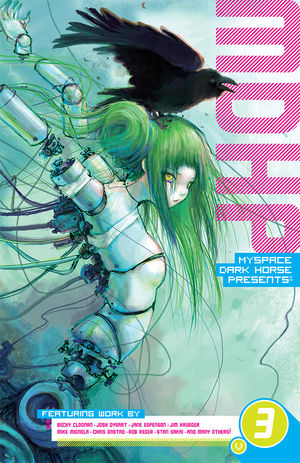
To be honest, there's not much to say about this volume that would be different from my thoughts on the first two.  Dark Horse appears to be using their Myspace digital platform as a way of advertising existing properties or upcoming series through short pieces that work as a sampling menu of the greater Dark Horse line.

Anything with a Beanworld story in it can't be too bad, and while this is a nice little bit about recycling, it doesn't add much to the Beanworld mythos.  I also liked Becky Cloonan's (I know, shocking that I liked this) short story about a man plagued by nightmares, Chris Onstad's Achewood piece, and the Serenity and Buffy the Vampire Slayer shorts.

Some other pieces had potential, but didn't go very far.  The Mister X piece and the Applegeeks story are good examples of this.  One piece that stood out for weirdness and originality was the Creepy: Om Nom Nom story by Andrew Mayer and Lukas Ketner.

Overall, this book is enjoyable, but not particularly memorable.

Wednesday, June 9, 2010

Madlib Medicine Show #4 - 420 Chalice All-Stars

Mixed by Madlib

The Madlib Medicine Show continues to be on the of the best things about 2010.  For this installment, the Beat Konducta mixes a pile of Jamaican songs, much like he did on his Flight to Brazil outing.  The disk is split into nine different tracks, encompassing the breadth and depth of Jamaican music.

Most of the items on offer are older reggae and dub gems, although there is some variety in terms of more recent-sounding dance hall (the one track I don't really like).  As I know very little about Jamaican music beyond the mainstays like Marley and Tosh, there isn't a lot that I recognize here.  It's easy to imagine that Madlib has been digging through some very obscure crates, especially when you glance at some of the different album covers reproduced in the liner notes.

Speaking of the liner notes, the people at Stones Throw use them to create a very helpful guide to medicinal marijuana dispensaries in the Los Angeles area, and provide a very handy FAQ containing most of what you would need to know in order to get yourself a prescription.  Once again, Madlib proves that music is not just good for the soul, it can also be beneficial to your health.

Monday, June 7, 2010

Strongman

Written by Charles Soule
Art by Allen Gladfelter

It's strange to me how luchadores have such a recent cachet in comic books.  There are the brilliant stories in the much-lamented Lucha Libre anthology series (which is in some way coming back from the new Humanoids series, but I can't tell from the solicitation if it's new material or stuff I've already bought), and the recent wonderful Hellboy in Mexico story.  And then there's this book, which features a down on his luck former luchadore/super hero named Tigre.

Tigre used to be a big deal, starring in movies and the ring, and fighting injustice.  Now he's just one step up from being a bum.  When an attractive woman who reminds him of a lost love appeals to his sense of heroism, Tigre begins to investigate a strange black market organ ring, with ties to cannibalism and local politics.  Tigre, who has never taken off his mask in front of anyone for years, feels like it's time to put on a clean mask (his version of putting back on the mask, I guess) and clean up the streets.

This book dances all over traditional genre lines.  At one point, it starts to suggest that Tigre's celebrated past is all in his head and on the small screen, while at other times, it feels like it could fit in a project like Rugg's Afrodisiac in the way it apes styles of the past and builds on a sense of nostalgia.  At the end of the day, this is a straight-up adventure story with some very amusing touches (I loved the pornographer's office).

The art is similar to Jim Rugg's classic style, although it looks a little cramped in this smaller, almost digest format book.  I feel like the story was originally intended for a regular-sized comic, and then shrunk, which might not have been the best decision.

In all, this book isn't groundbreaking in any way, but it is a satisfying superhero read featuring a new character.

Sunday, June 6, 2010

Afro-Rock Volume One

by Various Artists

According to the fine people at Slinky Music (my favourite music shop in the Toronto area), this is the album that started the whole recent interest in Afro-funk in North America.  This collection, originally put out by Kona Records, and recently re-released by Strut, gathers the best of the little-known of 70s African funk.

The album starts with Jingo's 'Fever', a brilliant funk track.  From there, it rolls into music from groups like Geraldo Pino & The Heartbeats, Steele Beauttah, the Mercury Dance Band, and others from that era.  The musicians are from all over Western Africa, predominately Nigeria and Ghana, with some other places represented.

This compilation works quite well, with tracks fitting together very nicely.  There are some nice long pieces, broken up by shorter ones.  Particularly memorable is 'Yuda', a pro-Mobutu Sese Seko song from Dackin Dackino, which is great to listen to regardless of its politics.

If you are going to purchase one cd to sample the brilliance of afro-funk, it should be this one.

Saturday, June 5, 2010

iZombie #2

Written by Chris Roberson
Art by Michael Allred

This book is still in the process of establishing itself, as Roberson moves the focus away from Gwen some, and lets us meet a few more of the townspeople in Eugene, where the old folks' home is the largest building in town, and where vampires operate a paintball arena.

I like how this is such an interesting town.  There are, in just a few pages, zombies, ghosts, werewolves, vampires, and now a mummy.  The mystery of who or what murdered Gwen's last meal is causing her to paint obsessively, and to chat up the recent widow of the deceased.  The two guys that were sitting in the car last issue are vampire hunters, and Scott/Spot has some geeky friends.

The ensemble cast approach is a good one for a book like this, and as always, Allred's artwork is fantastic.  I'm still kind of on the fence about committing to this book, but with a couple more issues like this one, I will add it to my pull-file gladly.

Sweet Tooth #10

by Jeff Lemire

This is one of the best issues of Sweet Tooth yet, as Dr. Singh hypnotizes Gus so that he and the other people at the Preserve can try to figure out the mystery of his birth and upbringing.  Gus is the oldest of the Hybrid children, and it has been discovered that his birth (or creation) predated, and possibly caused, the plague that has all but wiped out mankind.

Gus wants nothing more than to go home, and is therefore a willing candidate for hypnosis.  While 'under', he sees his cabin in the woods, and we get to learn a few things about his father and his upbringing that were not even hinted at beforehand.

The hypnosis scenes are visually stunning, as Lemire has Gus and Singh walk across a representation of Gus's head.  I love the way they crawl into his ear as a visual metaphor for getting into his mind.  This is such a cool title, and as some of Vertigo's other non-conventional titles like Air and the Unknown Soldier face cancellation, I hope that this book is safe until Lemire has finished telling his story.

Greek Street #12

Written by Peter Milligan
Art by Werther Dell'Edera

This issue of Greek Street marks a sudden turn in direction for the title.  This new storyline, 'Ajax', has (so far) none of the characters from the first year of the title, instead focusing on Alex, a young lower-class Brit who has returned from a tour in Afghanistan where he suffered some form of injury, and received no military decoration for it.

The story starts in the present, where Alex is bitter, disillusioned, and seeing visions of a skeletal Greek warrior.  The story quickly flashes back to Alex's tour, where he shoots an unarmed local man who he thought was reaching for a gun.

I love war comics, so I'm highly predisposed to a story like this, but I appreciate Milligan's approach to this story.  He's keeping most of the information close to the vest, and while he works in the Greek connection, I'm sadly ignorant of what myth or legend he is updating with this story.

Werther Dell'Edera is a good guest artist for this type of arc.  The Afghani landscape suits his sparse penciling style.  Is this arc a one-off before we return to Eddie and the usual crowd, or is Milligan structuring this book more like Northlanders, with rotating, unconnected arcs?

Demo Vol. 2 #5

Written by Brian Wood
Art by Becky Cloonan

Basically, with this issue of Demo, Wood and Cloonan reconstruct the old Freedom 55 commercials, however the young woman who goes back to visit herself in the past is not that concerned about her financial security (because she's already used her time travel abilities to deal with that issue).  With this, Wood and Cloonan tap into that very basic human wish: to know then what you know now.

Elisabeth is a seriously unhappy woman.  She has great success in business (because of her ability to travel through time somehow), but has not had a relationship that has lasted more than two months, and has great difficulty connecting with people.  Her teen years were pretty brutal, mostly due to her father's mistreatment of her, and her biggest regret has been that she let go of her first love, Evey, a classmate who was always there for her.

Demo is always a pretty interesting comic, and I'm sad that there is only one issue left in this volume.

Friday, June 4, 2010

Sparta U.S.A. #4

Written by David Lapham
Art by Johnny Timmons

With two issues to go, Lapham continues to keep most of the big picture to himself, and keeps readers as confused as many of the citizens of Sparta are at the end of this issue.

It seems most everyone in the town is scheming in one way or another.  Johnny Franks is after Godfrey's football records, and is probably planning on betraying the returned hero.  At the same time, Wanda, Godfrey's wife, seems to be chasing her own agenda, and has something to do with Johnny's girlfriend's suicide.  And then, at the very end of the issue, we learns something totally unexpected about the Maestro, who has remained hidden since the second issue.

This is a deeply strange series, as Lapham portrays a deeply strange image of an American small town set in isolation in a world that is very different from our own.  I've been enjoying his writing on this book a great deal, and like Timmons's artwork.

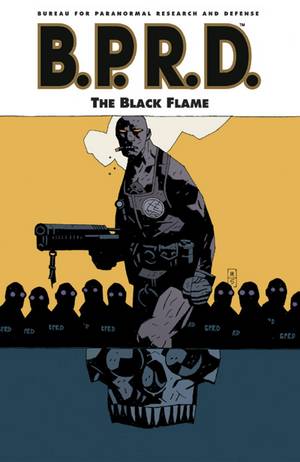
The Hellboy Project: B.P.R.D. Vol.5: The Black Flame

Written by Mike Mignola and John Arcudi
Art by Guy Davis

With this volume, Mignola and Arcudi make it clear that they are willing to really shake things up in the BPRD.  They kill off a pretty central character in their war on the Frogs, and then give another central character an expanded role and new importance, as Liz starts having strange dreams and visions involving an old Asian man who seems to have a lot of hints, clues, and cryptic suggestions for how to deal with the Frogs.

Meanwhile, the Frogs get a potential new boss in the form of the Black Flame. The Zinco Corporation CEO, in a very cool looking bad guy suit, helps bring about the coming of Katha-Hem, another gigantic Lovecraftian monster.

While the action goes pretty wide-screen here, the best parts of this book involve the different reactions to the aforementioned characters death from the other members of the team.  It is Johann's stubborn optimism that the character is not actually dead that I found most endearing.

Thursday, June 3, 2010

The Killer: Modus Vivendi #2

Written by Matz
Art by Luc Jacamon

This second Killer series seems more meditative than the first, which is perhaps the product of the Killer's having taken a few years off, and having returned to his profession with a more philosophical mindset.  I don't know many jobs more given to introspection than that of the hired assassin, and there were elements of that in the first series, but I feel this time around that Matz has the Killer questioning his motivations a little more.

As this issue opens, the Killer is still hesitating to kill a famous Venezuelan nun for his mysterious employers.  He knows that his actions don't matter in the long run.  If he refuses to do the job, someone else will.  Death in this case becomes inevitable for this nun.  These scenes are later balanced by a long scene where the Killer takes his four-year-old son hunting in the jungle with his grandfather, a traditional Guayapaqui.  In this part, the Killer meditates on living in balance with nature, something he recognizes that he does not do.

The jungle scenes are incredibly lush, as Jacamon layers shadows on the character's faces.  His art always reminds me a little of Tim Sale anyway, but these pages evoked the recently reprinted Amazon series that Sale did back in the day with Steven T. Seagle.

Anyway, I find that I am enjoying this Killer mini-series even more than I did the first one; of course, the apparently reliable printing schedule is helping immensely in this.

Wednesday, June 2, 2010

Crate Digging: Walking Backwards

by Clutchy Hopkins

The first official Clutchy Hopkins album was my introduction to this elusive and unique artist.  His method of constructing sonic landscapes using electronic and home-made instruments is an interesting one.  The aesthetic he places his work in is an interesting combination of hip-hop, jazz, and ambient techno.

This album is all over the place.  There are a couple of songs with vocals, such as 'Love of a Woman', but most of the album is instrumental.  At times, a Spanish influence is detectable, while other tracks are virtually crying out for an emcee to lay down some verses over them.

This disk comes with an accompanying dvd which is designed to heighten the "Who is Clutchy Hopkins" mystery aspect of the proceedings, and while it's kind of cute, it is secondary to the wonderful weirdness of the album.

Tuesday, June 1, 2010

Slave Riot

by Young Jazz Rebels

Continuing the 'Year of Madlib' is this jazz album featuring the Young Jazz Rebels, a group of eight musicians (all of whom I assume are Madlib playing under aliases), which have a completely different sound than Madlib's other recent jazz release, Miles Away.  Where that album, released under the Last Electro-Acoustic Space Jazz Ensemble name, was a more relaxing piece of work, this one is more challenging.

Some of the tracks on this are very pretty and enjoyable, while others are more experimental, discordant, or occasionally, ugly.  I find as the album progresses through its 18 tracks, it becomes most challenging in the middle and towards the end, before returning to a kinder, gentler sound.

Among the tracks I would categorize as 'Easy to Enjoy' are: 'Forces Unseen', 'The Sun', 'Newear', 'Theme from Illusion Suite', 'Nappy Headed History' (which is mostly bass lines, and really, who wouldn't love a piece with a title like that?), 'Young Day (Short Vers.', and the closing track, 'Black Freedom'.

Among the more difficult tracks are:'The Wind', 'Math/Love', 'Primal Sound (The Moon)', 'For Brother Sun Ra', and 'Nino's Deeds (Alt. Take)'.

One can't really discuss this album without talking about the title tracks, 'Slave Riot', which has six movements spread over two tracks ('Before' and 'After').  I assume that these tracks tell a story, and while they have some lovely moments, I will admit that their deeper meaning is lost on me.

Regardless of how you feel about experimental jazz, this album deserves recognition as an impressive piece of work by one man.  Let the Year of Madlib continue.