Showing posts with label Sets. Show all posts

Sunday, January 16, 2011

Sam and Twitch #20-26: The John Doe Affair

Written by Todd McFarlane
Art by Alex Maleev and Paul Lee

I didn't realize, when I first bought almost the entire run of this series (I had to hunt down the last three issues elsewhere) that this arc was written by Todd McFarlane, and not Brian Michael Bendis.  I probably wouldn't have bothered with them, as I've never been a fan of McFarlane's writing (like the rest of the world, I was caught up in his art circa Amazing Spider-Man, but was sick of it by the time the guest writers came on Spawn).

I'm glad I got these though;  they're actually pretty good.  Sam and Twitch get caught up in a bizarre case - a killer is videotaping himself abusing and killing his victims, and is sending the tapes too Sam.  This case quickly becomes a red ball, as City Hall gets involved, as does the FBI.  Suspicions are aroused when a young officer whose father has a lot of important political connections is assigned to the case, and more and more strange things happen, not the least of which is that Sam goes on a date.

McFarlane builds a creepy and suspenseful story, which ultimately doesn't live up to its promises.  The ending is done too quickly, and there is never a satisfying explanation as to why the killer, and his surprise accomplice, are doing what they are doing.  On the other hand, McFarlane did provide the one thing that I felt this book was lacking during Bendis's run, which is character development.  We get to know a lot more about Sam and Twitch with this story, as they both have to take a look at the relationships in their life (although Twitch's bit at the end feels tacked on and forced).

The art on most of this arc is by Maleev, and so it's terrific, and then Pat Lee was brought in to pinch hit (apparently there were delays of more than a year between issues because McFarlane is about as reliable as Rob Liefeld) on the concluding issues.  He did his best to be Maleev, but couldn't quite pull it off.

I have enjoyed my look through this series, and am now on the hunt for the follow-up title, Sam and Twitch: Casefiles, which was mostly written by Marc Andreyko.

Sunday, December 12, 2010

Sam and Twitch #1-8: Udaku

Written by Brian Michael Bendis
Art by Angel Medina and Jonathan Glapion

Having recently read the new Sam and Twitch: The Writer series, I became curious about the earlier S&T comics, which were written by Brian Michael Bendis before he became the superstar writer that he is today.  In fact, his stint on this book predates his starting Powers even.  I was lucky enough to find almost the entire run of the title at a recent convention, and will be working my way through it at the pace of one issue a day for the next little while.

The first story in this series, Udaku, has our two police detectives returning to the force after an unsuccessful attempt at becoming private investigators.  The department is rife with corruption, and as soon as they come back, they begin investigating a deeply strange case involving the murder of members of a local crime family, and the occasional dirty cop.  In the early issues of this story, each murder is marked by the killer leaving behind body parts from another person.  For example, the first murder scene has four severed thumbs lying on a table, and they're all from the same person.

The cloning aspect of the story disappears as the detectives are further embroiled in a very complicated plot that involves South African gangsters and a bunch of powered guys in white suits.  Things become kind of confusing quickly, but due to Bendis's ear for dialogue, the story seems very smooth throughout.

Medina's artwork makes the story a little difficult to follow.  He's working in a Todd McFarlane/Greg Capullo knock-off style that seriously detracts from my enjoyment of the story.  I think that the reason why I never picked this comic up back in the day is because I thought it was closely related to Spawn, and had I flipped through an issue, I never would have bought it.  Looking back at this story now, which is also collected in a trade, I can see why Bendis got snatched up by Marvel.

Monday, November 8, 2010

Sam and Twitch: The Writer #1-4

Written by Luca Blengino
Art by Luca Erbetta and Fabio Bono

I've never read any Sam and Twitch comics before I too a chance at this mini-series which as recently been collected as a trade.  I wasn't impressed by the characters when they first appeared in Spawn (around the same time that I decided I wasn't impressed by Spawn, and quickly dropped it).  The two runs by Bendis and Andreyko somehow stayed below my radar, and never caught my eye.

I picked up these four issues more or less on a whim, and I enjoyed them the same way I'm usually up for a competent police procedural on television.  There were the same loopy serial killers, bizarre coincidences, and malcontent cops that we have grown so used to on the small screen.  Basically, these two cops are on the trail of a serial killer who writes all over the bodies of his victims.  They are joined by a female graphologist, even though the alpha male cop (Sam) doesn't want her around, for reasons I don't fully understand.  Stuff happens, people die, the case gets solved.  Rinse, repeat.

The book is good though.  I think a lot of that can be attributed to the Italian sensibilities brought to it by its creative team.  There are no word balloons; instead, the typed and punctuated text floats above the characters, linked by faint white lines.  The words sometimes blend into the art, making them hard to read.  As well, there are places where it is easy to tell that the script has been translated from another language - the rhythms are off for English.

The art is very pretty though, and the story is serviceable (even if one of the title characters, Twitch, barely lifts a finger).  I don't know if I would buy this as a regular series, but I did enjoy it as a one-off kind of thing, and I'm thinking about tracking down the earlier two series (although it seems the Andreyko books were never collected).

Monday, October 11, 2010

Cinderella: From Fabletown With Love #1-6

Written by Chris Roberson
Art by Shawn McManus

I foolishly passed on this mini-series when it came out recently because I was trying to cut back on my comics purchasing, and was unfamiliar with Chris Roberson's writing.  Now that he's writing I, Zombie, which is becoming one of my favourite Vertigo titles, I figured it was time to check this out.

In this series, which has been collected recently, Cinderella sets off on one of her usual spy missions.  For this one, she's to track down the source of new magic showing up in the Mundy.  While it's a solo mission, she soon finds herself working alongside Aladdin, who has the same mission for his masters in the One, True Baghdad.

Cinderella and Aladdin have good chemistry, as they Mr. and Mrs. Smith their way through Dubai, the North Atlantic, and one of the Homeworlds, chasing down a trio of familiar Arabian Fables, and another Fable who had a huge impact on Cindy's life.  While all this goes on, there is also a subplot involving Cinderella's shoe store back in Fabletown.

This title restores some of the madcap fun that I got used to in the main Fables title, and the earlier Jack of Fables issues, which has been sadly absent of late.  Roberson's writing is witty and sharp, and Shawn McManus is always a fantastic choice for this type of book.  I'm glad to see that there is a new Cinderella series on the way, and this time I'll be sure to pick it up as it comes out.

Wednesday, September 29, 2010

Human Target #14 - 21

Written by Peter Milligan
Art by Cliff Chiang, Cameron Stewart, and Javier Pulido

It's taken me a while to track down the last few issues of this series, but I finally got it taken care of recently, and I've enjoyed these comics quite a bit.

Unlike the rather unspectacular TV series that shared a name with this book, the Human Target is a psychological thriller that actually tries to delve into the psyche of its main character,Christopher Chance, a man who takes on the appearance and traits of others in order to protect them from danger.

This run includes a terrific story involving a small cult that is centred around a young faith healer who is basically a fraud.  I believe this is the strongest story in the run, save perhaps the last one.  Next there are a couple of one-off stories featuring some fantastic guest artistry (Cameron Stewart and Javier Pulido).

The series ended (before its time I might add) with The Stealer, a three-part tale that has Chance's former assistant, Tom McFadden return on the scene, and eventually try to steal Chance's life and girl.  This story is, in places, wonderfully ambiguous, as the reader starts to wonder who the real Chance is.

Cliff Chiang provides the artwork for most of this run, and he is, as usual, stellar in his work.  Human Target was a very intelligent thriller series, and it's a mystery to me why Milligan's Vertigo run was not collected past the first two trades.  I'm sure there is a market for these comics these days.

Tuesday, September 14, 2010

Universal War One: Revelations #1-3

by Denis Bajram

It took me a while to track down all the issues of this French comic translated into English, but it was well worth the effort.  As much as I liked the first volume of this series, I enjoyed this one much more.

In the first series, the members of Purgatory Squadron, a group of misfits who were part of the United Earth Force (UEF) were sent to destroy a wormhole weapon (how Farscape!) operated by the Colonization Industrial Companies (CIC), an insurgent force fighting against the UEF.  The men and women of Purgatory emerged from the conflict three days into their past.

As this title opens, the Purgatory crew are rushing against the clock to destroy a wormhole station that is poised to destroy the Earth.  They are unsuccessful, Earth is destroyed, and they are again sent through time and space.  The story, as it plays out over three extra-sized issues, follows the ever-shrinking members of Purgatory as they try to stop the CIC for all time.

There is a lot of very hard science fiction in this title, involving time travel, wormholes, teleportation, and how foreknowledge can be used to influence societies.  Bajram uses some truly complex ideas, but integrates them into the story seamlessly, as the plot remains character driven.  The universe he portrays is very well-constructed and rich.  Each issue contains about as much content as a year's worth of a mainstream North American comic, and it is a treat to read a story so dense and yet so compelling.

Bajram's art is beautiful.  He does well with the human aspect of his story, but is also at his best when showcasing scenes of mass destruction or outer space.  This is a wonderfully designed comic.  I wish that there were more pieces of work of this caliber being produced in the US.

Wednesday, September 1, 2010

Farscape: Scorpius #0-4

Written by Rockne S. O'Bannon and David Alan Mack
Art by Mike Ruiz and Gordon Purcell

Having been won over to the regular Farscape comic, I thought I'd check out the Scorpius spin-off trade when it comes out soon.  Then, at Fan Expo, I realized I could get the original issues for less than the trade will cost, and I dove right in.

The series is tied very closely to the parent book, although the events taking place in this have not yet had any bearing on that book.  Throughout the Farscape universe, an alien race called the Grennij have been attacking worlds on behalf of another, older race called the Kkore.  This series opens on a remote ice planet, where Scorpius, exiled by Rygel, has crashed.  When a Grennij fleet lands to repair a ship, Scorpius gets up to his usual tricks, ingratiating himself to the Grennij commander, and then insinuating his way into command of the fleet.  A meeting with the Kkore leads to a new purpose for Scorpius, who perceives his opportunity to finally get the power and revenge he's always wanted.

The writing on this book is tight.  Scorpius always had a certain pattern of speech on the TV show, and that has been continued here.  It's easy to hear his voice when reading this.  The art on the first four issues (#0 is really the first issue, and not an introductory story, like #0s used to be) is by Mike Ruiz, and it's great.  It has a sinister quality to it, and I especially like the way, in flashbacks, all characters other than Scorpy are rendered in a scratchy, hazy way.  Gordon Purcell, the artist for issue 4 is decent, but I much preferred Ruiz's work.

I'm impressed with what I've found here, and am now concerned that I'll have to add this title to my pull list as well, which I did not want to have happen.

Saturday, July 31, 2010

Scourge of the Gods: The Fall #1-3

Written by Valérie Mangin
Art by Aleksa Gajic

I recently read the first volume of this series, and immediately wanted to read the second

Where the first volume was concerned with the war between the Huns and the Roman Empire, as carried out by two people believed to be gods, this volume deals with the Roman pantheon, and explains all of the strange coincidences or fantastical elements of the first story.

It opens with one of the best comics I've read in ages.  The first issue packs more story, excitement, and luscious art than a year's worth of a North American superhero series.  It shows the end of the war, as Attila tries one desperate measure after another to destroy the Roman forces.  Once he is taken prisoner, his status as an immortal is confirmed, and eventually both he and Favia/Kerkik are executed by being sent into the sun.

Seeing as there are still two issues remaining after that, you can be assured that is not the last you will see of them.  Instead, they wake up on Olympus, and meet the other 'gods', although they quickly learn that the gods were all once human, and Favia (now Venus), and Attila (now Mars), rebel against their creators.

The story, from this part, is much more fantastic, although grounded in strange comic book physics, and remains quite good throughout.  I really enjoyed this series, and recommend checking it out.  The writing is less dense or confusing in this volume, and the art is incredible.

Thursday, July 29, 2010

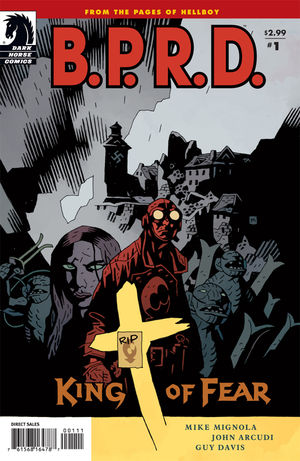
The Hellboy Project: B.P.R.D.: King of Fear #1-5

Written by Mike Mignola and John Arcudi
Art by Guy Davis

This is a huge BPRD arc in so many ways.  We get the last major confrontation between the Bureau, the Frogs, the subterranean dudes, and the Black Flame, which looks to have massive repercussions for future story arcs.  We get some really interesting character moments, like the ones between Kate and Bruno that happen in the first issue, as they work to lay Lobster Johnson to rest and hopefully restore Johann.  There's also some very cool stuff happening with Abe Sapien.

As usual, this is an excellent comic, but this arc is extra special because of the way it finishes off so many storylines and sub-plots, some of which had been running for sixteen years.

As often happens in stories like this, the actual final confrontation feels quick and anti-climactic, but I read this book for the characters, and in that sense, this story didn't disappoint at all.

Monday, July 26, 2010

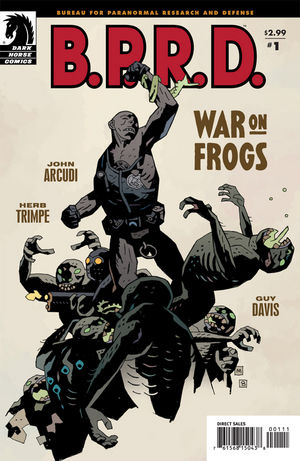
The Hellboy Project: B.P.R.D. War on Frogs #1-4

Written by John Arcudi
Art by Herb Trimpe, Guy Davis, John Severin, Karl Moline, and Peter Snejbjerg

I'm getting very close to the end of my Hellboy Project, where I've been reading one or two Hellboy or Hellboy-related story a day, in their original order of publication, the vast majority for the very first time.  I've gotten to the point where I've mostly bought individual issues instead of trades, and am beginning to think about the long view when I talk about these series.

War on Frogs was a mini-series that came out between other BPRD arcs, each issue focusing on one of the core BPRD characters who don't usually get much play, and fills in some of the things that happened during the BPRD's string of operations against the Frogs, the creatures that have been plaguing them since their title's inception.  This series was also unique because it is the first that doesn't give Mignola a writing credit, and for the wide stable of artists that it brings into the fold. 
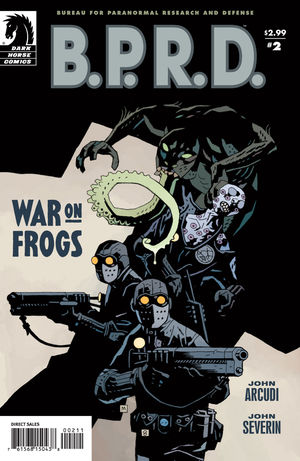
The first issue has a Roger story, drawn by Herb Trimpe.  It's nice to see Roger in action again, and it reminds us of his humanity.  The third issue spotlights Liz Sherman, although it's told from the more interesting perspective of a female BPRD operative who looks up to her, but finds her impossible to relate to.

The best issues of the series are the second and fourth.  The second issue, with art by the legendary John Severin, doesn't really feature any of the main characters in an important role, and instead tells us what happened to a squad of operatives who were checking a boat for Frogs.  This story borrows heavily from Alien, as the single Frog picks off the soldiers.  Arcudi writes with the same suspense and tension of that famous movie, and Severin's more realistic art style helps add to the level of terror and believability.  The final issue, about Johann Kraus, is drawn by Peter Snejbjerg, and it looks fantastic. The story, about some Frog spirits that don't depart when their bodies are killed, is interesting. 

I like the way this series sort of reminds us of what the stakes are as we move into the big King of Fear arc.

Monday, July 19, 2010

Farscape #5-8

Written by Rockne S. O'Bannon and Keith R.A. DeCandido
Art by Will Sliney

This series just keeps improving, with these four issues being the best of the Boom Farscape comics I've read so far.  In this arc, which has the crew of Moya responding to a distress call on Pilot's home planet, the creators have best captured the feel of the original TV show.

Issue five opens with four double-page splash panels, narrated by one of the five main characters on Moya (Jothee and Sikozu share their pages).  These pages are exceptionally well written, and help to establish some of the changes that these characters are experiencing as their stories continue.  The biggest change, as is usual in Farscape, is in Aeryn, who has been questioning many things since being exposed to ancient Sebacean religion in the last arc.

In no time, the crew gets the distress call from Pilot's homeworld, which he is prepared to ignore, but Moya overrules him, and soon our heroes are working with a group of deserter Peacekeepers to protect Pilot's race from an invading force of Grennij, strange aliens that came through a portal to this world.

Among all the action of these issues is a terrific sub-plot involving Pilot's shame surrounding how he came to be on Moya.  He does not want to face his family, and the scenes where this happens are handled beautifully.  I've been resisting buying this series on a monthly basis, but if it's going to stay at this level of quality, I feel I'm going to have to add it to my pull-list very soon.

Friday, July 16, 2010

Farscape #1-4

Written by Rockne S. O'Bannon and Keith R.A. DeCandido
Art by Will Sliney

I've been trying to pick up more of the Farscape series because I loved the show, and have enjoyed most of the Boom comics that have continued the stories of Moya and her crew ever since.

These four issues encompass the 'Tangled Roots' story arc that launched the on-going series.  In it, Crichton and Aeryn split up as they go on two separate missions, both related to their son Deke.  Crichton and Chiana try to track down Roiin, the bounty hunter that has been chasing them since the beginning of the Boom series.  To figure out who hired him, Chiana poses as a young woman that is interested in him, and the two of them spend some quality time together.  Unexpectedly, Chiana develops some serious feelings for him.

At the same time, Aeryn tracks down her former fellow Peacekeepers to see if she had ever been exposed to any nerve agents or gasses that may be accountable for the presence of a strange gland on Deke's spine.  She ends up on Prybella, a pacifist Sebecean colony, where she runs into Velorek, her former lover, and the parents of Captain Crais.  Things get a little weird here, as the story involves pure-blood Sebeceans (it is odd to me that a people so concerned with contamination would not have more pure-bloods), religion, and a deeply ingrained aversion to open conflict.

This is a good story, although some of the story elements don't feel completely true to the spirit of the original show.  It seems to lack the madcap spontaneity that I grew to expect from Farscape.  I hope that is something that develops as the book progresses.

That said, I enjoyed reading this story, and feel that Chiana's easily-conflicted nature is portrayed nicely.  I do look forward to finding out who hired Roiin eventually.

Sunday, June 27, 2010

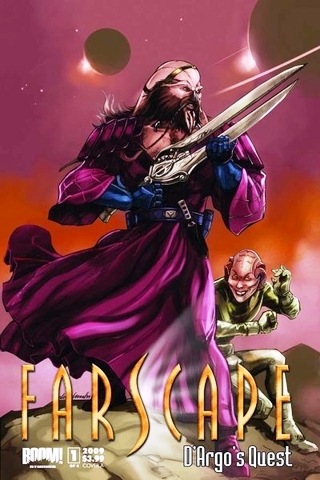
Farscape: D'Argo's Quest #1-4

Written by Keith R.A. DeCandido
Art by Caleb Cleveland

Set between the third and fourth seasons of Farscape, this story follows D'Argo as he heads out to track down Macton Tal, his brother-in-law and the murderer of D'Argo's wife.  Working off information he received from the Peacekeepers, he's arrived on the planet T'Lohrcate, where he's just chilling at a Sebacean bar, waiting for Tal to arrive.

Instead of finding his prey, he is instead found by Raxil, the annoying alien drug dealer that starred in the season three episode 'Scratch 'N' Sniff', which was one a huge cult favourite.

Raxil needs D'Argo to work for her as muscle in a Freslin sale, although they quickly end up in enforcement custody, before being used to infiltrate a criminal organization that holds the whole planet hostage.

This is a good, quickly-paced, amusing story.  DeCandido has a good ear for Raxil's speech patterns, and manages to capture the unique mix of anger, nobility, and humour that is Ka D'Argo.  Cleveland's art is very good; he manages to draw the characters convincingly, while avoiding the stiffness of most licensed comics.

Saturday, June 19, 2010

Hard Time: Season Two #1-7

Written by Steve Gerber and Mary Skrenes
Art by Brian Hurtt and Steve Bird

Having finished off 'Season One' of this series last week, I quickly dove in to 'Season Two'.  Gerber's teenage prison drama, featuring New Age style mystical powers, was a very interesting experiment in unconventional super powered comics.

Ethan continues to get by in prison, and in this season the adopted parents of his girlfriend try to mount a publicity campaign designed to free him, while a lot of the usual prison stuff also goes on.  Further complicating Ethan's already difficult life is the arrival of a new inmate, known as Cutter.  This guy experiments with scarification as an art form, and somehow has the ability to mess with Ethan's khe chara, his energy or astral form.

Like the previous parts of this series, Season Two gives us very strong character work, in both the writing and in the awesome artwork of Brian Hurtt.  It's a shame the series didn't last longer, but I did like the final issue, which shows us Ethan '49 Years Later', and wraps up all the relevant plotlines.

Sunday, June 13, 2010

Hard Time #7 - 12

Written by Steve Gerber
Art by Brian Hurtt,Rich Burchett, and Steve Bird

The second half of this series was never collected into trade, is not likely to be now.  The first volume caught my attention, so I've hunted down the rest of this title, along with the shorter Season Two. 

Gerber really had a good thing going with his story of young Ethan Harrow, a fifteen year old sent to prison for his role in a school shooting.  The prison is populated with a number of interesting characters, and Gerber has a good feel for penitentiary life, politics, and the effects of institutionalization on people.  This is not just Ethan's story, it's the story of everyone in that prison, although the focus remains on the protagonist, and his strange ability to leave his body in the form of an energy monster.

In this arc, Ethan learns the origins of his ability (it's pretty strange), and meets the granddaughter of his cell mate, who previously thought he had no family.  A number of sub-plots, including the conflict between the Aryans and the Latinos comes to its head.

Gerber was a gifted writer for off-beat comics, and this series stands up as being among his best work.  Hurtt's art works very well here.  It's a shame that this title didn't get more recognition while it was being published, even if it was the only Focus title to achieve any real success.

Tuesday, May 18, 2010

Angel: Blood & Trenches #1-4

by John Byrne

Like a lot of comics readers who grew up in the 80s, John Byrne was the first super-star artist whose work I could immediately recognize, and whose career I found myself following (almost to the point where I started reading Superman, but not quite).  And while he's done a lot to alienate himself from the major publishers and much of the comics-reading public, I do get the odd nostalgic twinge for his work.

So, when I hear that he has taken Joss Whedon's vampire with a soul character Angel, and placed him in the trenches of the first world war, I couldn't resist reading this.  I've written before about my massive interest in the Great War, which has often caused me to read some sub-par fiction or comics.

Anyway, this is a decent enough comic, although there is nowhere near enough trench action for me.  Angel, hearing rumors of vampires along the Eastern Front, travels to France and begins investigating.  He quickly finds some vampires preying on both sides, and he also crosses paths with a British Colonel who is a vampire hunter.  There is betrayal, trashed old convents, ice-covered rivers, and enough action to keep the book from getting slow.

Byrne penciled the book, but it seems no one has inked it, leaving the art scratchy and kind of faint in places.  The pages are in black and white, although as the story requires it, some panels are splashed in a lurid red.  It's not Byrne's best work, but he does still have what it takes, although his little gag on the last page is cringe-inducing.

Monday, April 5, 2010

Longbox Digging: Wildcats Version 3.0 #13-24

Written by Joe Casey
Art by Dustin Nguyen, Richard Friend, Sean Casey, Francisco Ruiz Velasco, Pascal Ferry, Sandra Hope, Duncan Rouleau, John Dell, Trevor Scott, and Eric Nguyen


A while ago, I read through the rest of Joe Casey's various WildC.A.T.S. trades, spread over two titles, and resolved to dig out my back issues, fill in any remaining gaps there might have been, and read the series through in its proper order, which was not how I first experienced it. I hit a bit of a snag, in that it took me a few months to track down an issue of number 16, but that was accomplished the other week.

The last twelve issues of Casey's run on the title were quite varied in their approach. The first six, which saw regular artist Dustin Nguyen get replaced by Francisco Ruiz Velasco (with a very cool semi-fill-in issue by Phillips) continued to focus on the daily operations of the Halo Corporation, and Jack Marlowe's (aka Spartan) plans to change the business model of the free world. These issues saw the introduction of the Halo car, Jack moving to take over the internet, and him catching the attention of Washington fat cats whose interests would be better served by continued reliance on fossil fuels.

Also during this half of the run, we saw Agent Wax deal with, and eventually replace, his long-time rival in the Parks Department, Agent Downs. Wax got more 'screen time' throughout these issues, and was shown to be a more morally complex man than before. Also, it is during these issues that Grifter figures out how to wirelessly control Maxine Manchester's (aka Ladytron) body.

Following these issues (which I imagine would have been volume three, had they ever been printed in trade), the series takes a definite turn back towards slightly more conventional superheroics.

This arc addresses Zealot's on-going war with the Coda, the female assassin army she created, which has gone rogue. She gets captured, and Grifter/Ladytron has to call in all sorts of chips to assemble a rag-tag team to go to her rescue. This arc also has Marlowe and Wax confront a government assassin. That's about it though, which is odd for a book that had previously been very compressed in its storytelling.

Of course, you can't discuss the end of this title without bringing up the summary cancellations of both this title and its sister book Stormwatch: Team Achilles. At the time, both titles were selling poorly (by the standards of the day) and the decision was made to terminate them, despite the regular high critical praise they were receiving. It makes me wonder if the book didn't become all action and adventure as an attempt to 'give the readers what they want' a little more, even if all that action did end up involving a transexual robot and a couple of large men in S&M gear...

Rouleau was a good choice as artist for these issues (with one issue by Pascal - shouldn't that be Pascual? - Ferry), as he has a large and open style that worked very well with these action sequences.

Casey's approach to the Wildcats was a very refreshing thing, as comics emerged from the darkness of the 90's. It is too bad that he didn't get to stick with the title, as I'm sure he had more plans for Marlowe and the crew. Also, whatever he wanted to do couldn't have been worse than where things ended up for these characters, and the Wildstorm titles in general...

Monday, March 29, 2010

Human Target #6 - 13

Written by Peter Milligan
Art by Cliff Chiang and Javier Pulido

I was going to continue reading this book in trade after enjoying the first volume so much, when I came to the realization that it was never collected past the tenth issue, and have instead started to hunt down the single issues. I recently came across a small sequential pile of issues at a nice price, and jumped at the chance to dive back in to Peter Milligan's take on the classic character.

These eight issues contain four stories, varying in length from one-off to three-parters. The first story involves Christopher Chance protecting a priest with some secrets in his past. It's kind of a brutal story, but very well told.

The second story, 'Which Way the Wind Blows' has Chance get involved in the problems of some ex-60's terrorist Weathermen. One of the would-be revolutionaries killed a cop back in the day, and has been hiding his identity ever since. The task of impersonating a person that doesn't really even exist is fitting for Chance, since he increasingly is questioning his own existence.

The next issue finds Chance being contacted by an old friend who has busted out of prison to meet up with his wife, and who needs Chance to run interference for him, staying in the media's eye, and helping to restore his reputation. This story has a nice twist to it which I didn't see coming.

All of the previous issues were drawn by Cliff Chiang, who is a master comics artist. His work is wonderful throughout, and I would usually be quite sad to see him leave the book, except that his replacement for the last three issues in this pile is Javier Pulido, who is probably even better than Chiang.

Pulido's first issue, which serves as both prologue to the next story and as a mostly self-contained character piece, does not have any panel borders. One picture bleeds into the next, and between that style and the brightness of the colouring, looks a little like an issue of Hawaiian Dick. It's great.

For the rest of the arc, about Chance's girlfriend's activities with illegal immigration and Mexican child traffickers, is more traditionally laid out, but still fantastic to look at.

The stories here tend a little towards the brutal, with the sheer quantity of abused children that Milligan keeps trotting out. That however, is the only note that bothers me, the rest of the series is incredible. It's a shame that the producers of the television series didn't bother to really understand the rich psychological possibilities of this comic, opting instead for yet another mindless action show.

Sunday, March 14, 2010

Destroyer #1-5

Written by Robert Kirkman
Art by Cory Walker


Robert Kirkman has a unique way of writing super-hero comics, that doesn't seem to translate well when he gets his hands on established, continuity-rich characters, but works amazingly well when he either creates his own world, or takes over a mostly-obscure one.

In Destroyer, he grabs ahold of the old Marvel/Timely Golden Age character, and gives us a story set in present day that supposes that the character has been working as a super-hero (and perhaps the world's only one) since the war. In this series, Keen Marlow (the Destroyer) is approaching his hundredth birthday, and suffering from a heart condition. He's still indestructible, and can be shot, bombed, or dropped from great heights with no ill effects, but his next heart attack is expected to be his last.

With the knowledge of his impending demise weighing heavily on him, he sets out to kill off any of his old nemeses that are still around, and to find the evil Scar, who had ripped off his wife's arm years before. At the heart of this book is Keen's relationship with his family. His wife wants him to retire, as does his daughter, who is married to his former sidekick (although she doesn't know this).

The creative team of Kirkman and Walker gives this book a feel very much like the earlier issues of Invincible, yet without Mark Grayson's youth and energy. The villains that are created (or updated?) for the Destroyer are as wacky and bizarre as the ones that regularly appear in Invincible, and the action plays out much like that series. Really, there's no reason why Kirkman couldn't have just made this a creator-owned series with a few simple cosmetic changes.

This is good stuff. It's nice to see a Kirkman story that has a clear ending, and his work on developing these characters and their relationships is very strong. It's also just nice to see some solid Jason Pearson covers.

Monday, March 8, 2010

30 Days of Night: Dead Space #1-3

Written by Steve Niles and Dan Wickline
Art by Milx

I've dabbled a couple of times now into the 30 Days of Night pool, and in each case I've come back with mixed feelings, except for David Lapham's awesome contribution to the line. They consistently seem to fall short of their potential, which I find frustrating.

This series is no different. The concept hooked me right away - a space shuttle mission with a vampire on board. It's a little like Aliens, except the creature can be a real character. What happens though, is that the entire crew of the shuttle is dispatched with off-camera, and the next two issues of the comic are all about the 'rescue mission' coming up to see what was going on, before they too get attacked.

It's a quickly-paced story that depends on a couple of things happening that are rather ridiculous. I'm willing to accept that vampires can survive in outer space, since I assume they don't breathe. What I can't handle is that vampires that burn up if they are exposed to sunlight on Earth would be able to happily float in orbit around the planet for a month, and never once catch a glimpse of the sun. This is never discussed in the story, and I found it made it impossible for me to suspend my disbelief (being fully aware that I'm reading a comic about vampires in space).

The characterizations in this book are handled very quickly and with little development. The one person that the authors take the time to flesh out is the astronaut that becomes a vampire, but I'm not clear how he became infected.

The art is different - it looks like it's all watercolours - but it works quite well for this type of story. I get the feeling like it might be time to abandon hope for this line, but I did pick up Templesmith's Red Snow at the same Comic-con, so I guess it gets one more chance.