Showing posts with label Gene Luen Yang. Show all posts

Saturday, May 13, 2017

The Shadow Hero

Written by Gene Luen Yang
Art by Sonny Liew

I've long been a fan of Gene Luen Yang, Sonny Liew, and the characters of the Golden Age of comics, so The Shadow Hero, a graphic novel that reinvents the mostly forgotten character The Green Turtle was right up my alley.

The Turtle experienced a very short publishing run in 1944, as a comics artist named Chu Hing tried to give America its first Asian hero, although he was coloured as if he were Caucasian, and his face was never shown.  The title didn't last past a handful of issues, but I suppose he made enough of an impression that Yang and Liew decided to revitalize him.

This is the story of Hank, the American-born son of two Chinese immigrants living in the fictional Pacific city San Incendio.  Unknown to everyone, before coming to America, Hank's father agreed to be the host to the Tortoise Spirit, which lived in his shadow.

After a run-in with some bank robbers and the Anchor of Justice, the local superhero, Hank's mother decides that she wants him to become a hero, which she views as better than becoming a meek grocer, like his father.  He's forced into months of training, but his first foray as a hero is a disaster.  Later, he discovers that his father is being mistreated by the local Tong, and that leads Hank on a series of adventures that will establish him as a true hero.

Yang's writing, from his own cartoons like American Born Chinese and Boxers & Saints, through to his work on DC's New Super-Man is always tight, and his love for his characters and his purpose in writing this book is clear.  He both avoids and embraces some of the racial stereotyping so inherent in the Golden Age, and provides us with a lot of depth.

Sonny Liew, who has most recently worked on Doctor Fate at DC, is a very talented artist (I loved his Malinky Robot comic).  There's a real chemistry between him and Yang in this book.

I would be very happy to see or read more of the Green Turtle's adventures.

Sunday, January 24, 2016

Saints

by Gene Luen Yang

I read Gene Luen Yang's Boxers a little while ago, and felt it was time to dig into Saints, its companion graphic novel.  Where the other book looked at the Boxers Rebellion from the perspective of a young Chinese man who played a key role in that conflict, Saints is concerned with the experiences of one girl who converted to Christianity and lived in a small Christian community.

Four-Girl is born to a difficult life, shunned by her family, and convinced of her own inherent devilry.  At the age of eight, she goes around making a face at everyone she sees to convince them that she is a devil, something she's been told by her family her whole life.  Her mother takes her to an acupuncturist, who introduces her to his Christianity.

Four-Girl, believing in her powers, places a hex on her aged grandfather, and then within days, he dies.  She feels guilt, and starts visiting the acupuncturist daily, mostly to eat cookies, avoid her chores, and nap through his stories, but the religion begins to stick.  When Four-Girl announces that she has converted, her family beats her, and she runs away, joining a French missionary as he moves to a new community.

She grows up there, taking on the name Vibiana.  Where before she imagined conversations with an old raccoon, as the story progresses, she begins having lengthy conversations with Joan of Arc, who often visits her in the evening and shares information about her life.  As Vibiana grows up, she becomes a little less religious, especially around the time that she starts to feel interest in Kong, a minor character from Boxers.

Vibiana sees herself as the new Joan of Arc, and as the person who is going to protect her community, as news arrives of the coming of the Society of the Righteous and Harmonious Fist, the group that has been killing Christians and foreigners.

Yang's work here is very nice.  He makes Vibiana a sympathetic character, while also making it completely okay to question her sanity and motivations.  I've personally always wondered about convert communities, and how 'pure' their faith must really be, or to what extent they are just looking to make substantive changes in their lifestyle, and their new religion becomes a means to that end.  Yang allows me to keep my cynicism with this book, as Vibiana really just looks out for herself.

I found it interesting that Yang kept the colours for this book pretty drab, while Boxers was brighter and more vibrant.  It's not hard to imagine which side in the conflict between traditional and missionary cultures Yang feels more sympathy towards.  I particularly like his portrayal of Father Bey, the priest whose strict devotion and judgemental ways landed him in China in the first place, where he really didn't trust even his closest followers.

This book, both on its own and with its companion title, belong as part of the larger conversation of post-colonial literature.

Saturday, August 22, 2015

Boxers

by Gene Luen Yang

I've been a fan of Gene Luen Yang's work since I read American Born Chinese a few years ago.  He has a simplistic approach that gives way to intelligent storytelling with great depth.  Boxers is one half of a two-book set (with Saints, which is on my to-read pile) that examines the Boxer Rebellion in China at the turn of the 20th Century.

Boxers focuses on Little Bao, an illiterate youth growing up in a small village in a remote province of China.  His area is isolated, and while the people are poor, they are able to eke out a decent living.  One day, during a spring festival, they are visited by a boorish lout who rightly gets his ass handed to him by Bao's father.  It turns out that this man is a Christian convert, and like good Christians everywhere, returns to exact revenge, bringing a white man with him.  This man smashes the statue of a much-loved god, and steals food from the village that he believes is rightful restitution.

As time goes on, we see how the influence of the missionaries and European governments are damaging traditional Chinese social structures.  When Bao's father goes to complain to a local government leader about how the village is being treated, he is set upon by foreign soldiers and beaten so badly he never recovers his faculties.

Into this tense setting comes Red Lantern Chu, a brother of the Big Sword Society.  He begins to help the locals to resist the foreigners and the secondary devils (what they call the converts).  He does not allow Bao to participate in his kung fu training, but then begins to teach the youth in secret.

Eventually, Red Lantern is killed, and Bao continues training under a different master.  Here the story veers towards magical realism, as Bao begins to channel a Chinese god when he fights, rescuing his older brothers from certain death.  From here, Bao begins to gather supporters for his fight against the foreigners, leading an ever-growing army towards Peking.

Along the way, Bao meets Mei-Wen, who herself begins to lead a group of female warriors.  We follow Bao and his people through the end of the Boxer Rebellion.

This is a very interesting book.  I don't know very much about this time period, and so don't know where Yang has diverted from established fact (somewhere before all the Gods show up, I imagine).  I do get the feeling that this book has been meticulously researched and is more accurate, in it's unique way, than it isn't.  I know that Saints tells a similar story, but from the perspective of a 'secondary devil', and I'm curious to know that interpretation, especially since my own inclinations lean towards seeing things through Bao's eyes, in a post-colonial perspective.

Yang builds his story very nicely.  He invests a lot of time in developing Bao, who is bullied by his older brothers and then ends up leading them.  He makes Bao's relationship with Mei-Wen believable, as are the internal conflicts Bao needs to resolve to be a strong leader.

There is a sense of misogyny in this work that doesn't sit well with me, as male characters discuss how contact with females can dilute their concentration and power.  There is an attempt to balance this through Mei-Wen, but it's often not enough.  At the same time, this is a work of historical fiction, and I imagine that Yang is being accurate in his portrayal of how women were treated.

Yang's artwork is straight-forward, but very effective in portraying emotion and thought.  He uses a slightly drab colour palette throughout most scenes, but when the gods enter the story, things become brighter and a little garish.

This book is a remarkable piece of work, and I look forward to reading its companion.

Saturday, October 16, 2010

Strange Tales II #1

by various creators

I'm pleased to see that the first run of this title was successful enough for Marvel to do a second series of this anthology comic that showcases a wide variety of "indie" and comix artists playing in the Marvel sandbox.

Like the first run, there are a lot of stories in here that did absolutely nothing for me, but the stuff I liked made purchasing the comic worthwhile and rewarding none the less.

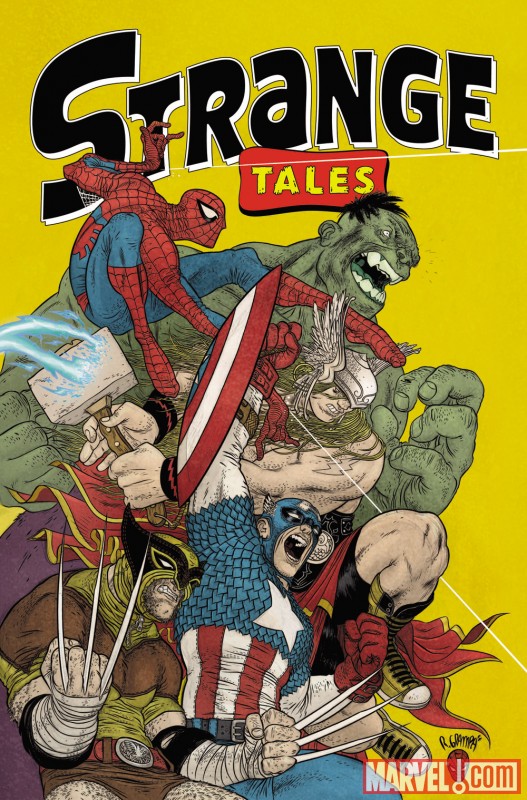
This issue has a number of strengths.  To begin with, Rafael Grampá's cover is phenomenal.  I love that Thor's hammer has a handle shaped like a bread knife, and that he's wearing lace-up high tops.  The first story is also by Grampá, and it's a gritty and nasty tale about Wolverine involving the extreme fighting circuit and very kinky sex.  It's also one of two stories in here that have Wolverine whining about how he can't heal a broken heart - it's cool in this story, and cheesy in the other.

Gene Luen Yang brings back the Frog-Man, a character I had forgotten about, but who seems to have been made for Yang.   I thought that Shannon Wheeler's story about a "gone native" Red Skull was pretty funny, and while I didn't enjoy the stories, I found Frank Santoro's Silver Surfer tale, Dash Shaw's Spider-Man story, and Nicholas Gurewitch's Galacatus piece to be very pretty.  I also liked Jeff Lemire's story of the RCMP, the Wendigo, and the Man-Thing.  That's a winning combination I'd read a twelve-issue maxi-series about.

This is by no means a perfect compilation, but it is pretty cool that Marvel is doing it.  I look forward to seeing who contributes to issue number two.

Monday, August 30, 2010

McSweeney's Quarterly Concern #33

A year or two ago, I read Nicholson Baker's wonderful book Double Fold, which was about 'Libraries and the Assault on Paper', as the text beneath the title calls it.  In this book, Baker rails against recent library practice of disposing of tons of old and historic newspapers, replacing them with commercial (poorly) made microfiche, citing storage and space requirements.  Baker himself now owns a large collection of almost full early runs of such celebrated and wonderful papers as Joseph Pulitzer's New York World.  The descriptions that Baker furnished of large broad-sheet papers with detailed diagrams and loving illustrations, not to mention legendary comics sections, made me envious of people living in an earlier time.  We now live in a time of great newspaper poverty, as dailies suffer from endless cut-backs and diminished readership.

Into this dismal scene comes the 33rd issue of McSweeney's, Dave Egger's literary quarterly.  For this issue, Egger's et. al. constructed the San Fransisco Panorama, a one-time old-school newspaper of gigantic proportions.  The paper is a week-end edition, including two supplemental magazines, various sections, a generous and lovely comics section, and even a fold-up paper toy rocket ship.  The entire paper comes off as a labour of love and an almost forgotten sense of American journalistic craftsmanship.  It took me just about forever to read this thing.
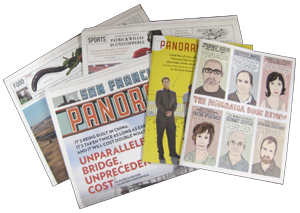
The list of contributors to this thing is as impressive as the span of topics discussed and reported upon.  There is Baker himself (writing about paper mills in Maine); William T. Vollmann discussing mining issues in Imperial, an area about which he is most definitely an expert; Jesse Nathan on the marijuana growers of Mendocino; and J. Malcolm Garcia reporting from Afghanistan. 

San Francisco is the main topic of the paper, with various articles examining the state of the city and its inhabitants.  There is an eight-page section devoted to the new Bay Bridge, and all of the problems associated with that project, which features stunning illustrations and makes good use of the large-size format of the pages (this thing is much wider than today's newspapers).  The Sports, Food, and Arts sections represent the Bay Area a great deal.  There are also tons of human interest articles and interesting charts throughout.

The two magazines are very impressive.  The Panorama Magazine is modeled after the New York Times Magazine, with many long-form articles, some of which I've already reviewed.  Were this a weekly or monthly magazine, I would gladly subscribe.  The Panorama Book Review Supplemental was also very impressive, containing some great short stories from authors such as Roddy Doyle and George Saunders, as well as an interesting conversation between Dave Eggers and Junot Diaz.  The book reviews were wonderful in their variety, and I liked the way each review reproduced the first page of the book so potential readers could sample its style.

Of course, I wouldn't be me if I didn't say something about the comics section.  Art Spiegelman, Dan Clowes, Michael Kupperman, Gene Luen Yang, Adrian Tomine, Chris Ware, Erik Larsen (!!), and many others contributed, and it was a very nice little compilation.  

It's a shame that this project is not to be repeated.  I doubt very much that there is a market anywhere in the world for a regular paper like this, and that is all of our loss.  Reading this allows you to imagine a time when people were very well informed (and not just up on the celebrities), and also had the leisure to read the damn things.  This is a truly unique and impressive work of art.

Sunday, April 18, 2010

Prime Baby

by Gene Luen Yang

This is definitely not the usual type of book that I like to buy, as it is written for a younger audience.  However, I really enjoyed Yang's other work, such as American Born Chinese and The Eternal Smile, and figured that since this is a relatively inexpensive book, it was worth taking a chance on.

The comic strips collected here (this book reminds me a lot of those old Garfield collections I used to read as a kid in it's formatting) at the pace of four or five panels a page were originally published in the New York Times Magazine, and tell the story of young Thaddeus, a third grader with dreams of world domination.  When Thaddeus's little sister Maddie is born, he suffers some serious sibling rivalry issues, and becomes convinced that she is an alien baby.

As it turns out, he's not far off the mark, as small slug-like aliens start coming out of her mouth.  Thaddeus prepares to go to war, figuring this is the opportunity for global takeover he's been looking for, but sadly, the aliens are emissaries of smiles and happy feelings.  Hilarity ensues.

Yang has a very charming style.  It is hard to resist the charms of his characters and his simple drawings.  This book is not anywhere near as good as American Born Chinese was, but it is a fun little read.

Friday, November 20, 2009

The Eternal Smile

by Gene Luen Yang and Derek Kirk Kim

I really enjoyed Yang's "American Born Chinese" earlier in the summer, so when I saw this at a reduced price at Word on the Street a couple of months ago (I need more time to read), I figured it was a safe buy.

The Eternal Smile is made up of three unrelated stories. They are all very well done, but I'm not sure that they really belong in the same book. The first two, by Yang, have a young-adult feel to them, while the story by Kim is much more mature in tone and content.

In 'Duncan's Kingdom', Yang is riffing on the old CBC series "The Odyssey," which I realize might be a spoiler for some. Duncan wants to be hero and marry the princess, but he can't keep himself from being entranced by a bottle of cola, with interesting consequences. Like in 'American Born Chinese', Yang pulls out a nice little twist at the end, and delivers a subtle and compelling story.

The second story can be summed up as 'Scrooge McDuck as a frog on the Truman Show'. It's a cool concept, especially in the way in which Yang plays with themes of faith, but I felt like it was aimed a little younger than I'm used to.

The story by Kim, "Urgent Request" is another subtle piece of storytelling. Sad, lonely Janet responds to an e-mail from a 'Nigerian prince' looking for money to help funnel millions into the US. She strikes up a correspondance with this prince, and enters into a rich, imaginary life with him. This story is touching and sad, and although Kim's tiny four-panel to a page format bothered me in the beginning, I grew to appreciate how he played with layout later in the book.

All of these stories hold up quite well on their own, but I still feel that they don't work that well together. As individual (longer) pieces in an anthology like Popgun, they would be some of the stand-outs in the book.

Saturday, August 8, 2009

American Born Chinese

by Gene Luen Yang

This is a charming, great book. Yang starts the book by telling three very different stories, although by the end of the book, he weaves them together in an unexpected, and masterful, way.

The first story is about the Monkey King, who wants more than anything to be recognized by the gods as an equal. To that end, he masters many different forms of kung fu, and ends up challenging Tze-Yo-Tzuh, the god of all things.

The second story is about Jin, the American born Chinese of the title. We follow Jin from early childhood through junior high, as he deals with being the only Chinese boy at his school, at least until Wei Chen arrives from Taiwan. Jin develops feelings for a girl in his class, but her friends don't want her dating a Chinese boy.

The third story is about a white boy named Danny, who is overly concerned with appearances, and who is visited every year by his Chinese cousin, Chin-Kee. Chin-Kee is as yellow as the cover, buck-toothed, pony-tailed, and embodies every other racial stereotype you can think of. He speaks in broken English (r's and l's are a problem), and has no understanding of social mores. This section of the book is designed like a TV sitcom, complete with applause and a laugh track.

As these three stories meld, the book takes on themes of identity, friendship, and self-esteem. Yang works with a light hand, and doesn't beat the reader over the head with any of this. The art in the book is very nice. It's quite simple and uncomplicated, and Yang, using a minimum of lines, achieves great effectiveness in conveying his characters' thoughts and emotions. I'm impressed by the quality of this book.