Showing posts with label John Severin. Show all posts

Saturday, July 27, 2013

The 'Nam Vol. 2

Written by Doug Murray
Art by Wayne Vansant, Michael Golden, John Severin, Geoff Isherwood, John Beatty, and Bob Camp

It's worth wondering how my reading and educational history might have changed had my twelve and thirteen year old self been wise enough to realize what a cool and special series Marvel's The 'Nam was when it was first being published.  Were a series like this being launched today, I would support it whole-heartedly and with great enthusiasm.

Still, kids are dumb, especially given that some of these comics were drawn by Michael Golden, whose Micronauts issues were among the ones I treasured the most.

Anyway, The 'Nam was structured to try to show how the Vietnam War worked in real time.  A month of history passed between each monthly issue, and efforts were made to align the events that the soldiers of the 23rd Infantry Division experienced in the comic with what happened in the actual war.  It's an interesting structure, causing characters to move in and out of the book as they are injured or they become 'short'.  At times it doesn't work - when an unpopular and possibly psychotic lieutenant meets an unexpected fate on the base, it's two months before that event is dealt with by the brass.  One would assume the reaction would have happened quicker.

This comic is not blind in its portrayal of the more questionable aspects of the war.  When our point of view character gets back home, he is surprised to see how the war is being portrayed and understood in the media and even by his own parents.  There's not a lot of time for politics however, as Murray prefers to focus on the tight relationships formed among the men.  Many issues lack strong narrative structure on their own, and instead work as vignettes in a war that lasted a long time.

The art in this book, which collects ten issues of the series, is superb.  Golden drew this with a much looser style than he was known for at the time, and Wayne Vansant, who drew the lion's share of issues, echoed his style quite well while maintaining his own approach.  John Severin drew an issue, which is alone enough of a reason to buy this book.

Reading this, I'm kind of surprised that we haven't seen a more modern attempt to do this same sort of comic, but set in Afghanistan or Iraq.  Enough time has passed that these stories are becoming more common on television and in movies, but with the exception of DC's short lived war comic corner of the New 52, we aren't seeing enough exploration of these conflicts...

Saturday, July 9, 2011

Longbox Digging: Semper Fi' #4

Written by Michael P. Palladino
Art by John Severin and Sam Glanzman

I picked this up last week for only fifty cents, based on my enjoyment of war comics, the John Severin cover, and the price.  I vaguely remember buying the first issue of Semper Fi', Marvel's love letter to the Marine Corps, when it came out back in 1988, because that was when I bought every first issue Marvel published (imagine if I did that now - it would double my weekly pile).  I wasn't interested in it then, but thought it might be more my thing now.

The comic is split into two stories.  The first is drawn by John Severin, and it is set in Beijing (Peking, at the time) in 1900, when the Marines were tasked with guarding the Legation Quarter - the walled compound of embassies and foreign homes, during the Boxer Rebellion.  A pair of marines get into a brawl at a bar with some Irish soldiers, which somehow sparks off a bit of a street riot.  Later, they are sent into the city to rescue a missionary and the families under his care.  There are plenty of scenes that show young Americans bravely holding out against a much larger Chinese force.

While I enjoyed Severin's art, the casual disregard that the Americans are showing having for the Chinese is a little uncomfortable.  We're a long way from the ingrained racism of comic books from an earlier era, but there is also no effort put into giving any context for the motivations of the Boxers or other Chinese.

The second story, drawn by Sam Glanzman, has a marine helping local police to capture a bank robber gang in Washington DC in 1932.  It's pretty sillly, really.

I'm not surprised that this series is barely-contained propaganda, but when you consider that Marvel's series The 'Nam was being published at the same time, this book comes across as being the least critical or historically informed of the two.  I am curious in tracking down some of the other issues of this series though, mostly for Severin's art.  I see from looking around the internet that Andy Kubert used to draw this book too - I'd be curious to see what that looked like.  The fact that the comic only lasted nine issues doesn't give me a lot of confidence that other issues will be much better...

Saturday, June 4, 2011

Sir Edward Grey, Witchfinder: Lost and Gone Forever #5

Written by Mike Mignola and John Arcudi
Art by John Severin

Three Mignola books in one week is quite a treat, although it probably would make more business sense were Dark Horse to stagger them so that Mignola fans would have a reason to go to the comic store each week.

Anyway, this second Witchfinder series ends very well, as Grey and his new friend Morg confront Eris, along with her army of zombies.  Stuff gets explained, and Grey finishes his mission.  What interested me most about this book was the way in which the final page explains the impact this mission had on Grey's entire career.

The highpoint of this series for me was John Severin's art.  He truly is a master of the craft, and at his advanced age, is as good an artist as he ever was.  I'm not sure how long we're going to have to wait before we see Sir Edward Grey again, but I hope it's not too long.

Saturday, May 7, 2011

Sir Edward Grey, Witchfinder: Lost and Gone Forever #4

Written by Mike Mignola and John Arcudi
Art by John Severin

There's been an ebb and flow to this series.  It started off very well, but dipped a little in the middle, almost as if Mignola and Arcudi were struggling to make sure that the book would last a full five issues.

This month's installment doesn't suffer from those problems much, as it has Grey and his new friend Kaler make their way to a mine that showed up in Grey's dreams, which they figure will be significant to their mission, which appears to be taking out a white woman named Eris, who has has led a group of Native Americans to a white man, who has been possessed by an Aboriginal spirit.  Got all that?  There's also the return of all the townsfolk that had disappeared in a church a ways back, except they have returned as zombies.  As I try to summarize what's been going on in this series, I realize how odd it all sounds, although the story telling has been very clear and easy to follow as I've been reading it.

Of course, with comics legend John Severin on the artwork, that's easily understood.  He does another terrific job in this issue, both with the chaotic action scenes and with the more pastoral images that are being recounted by the Aboriginal spirit.  I love the casual way in which he depicts Kaler brushing off a zombie hand that has a grip on his arm.  I look forward to reading the end of this series next month.

Friday, April 8, 2011

Sir Edward Grey, Witchfinder: Lost and Gone Forever #3

Written by Mike Mignola and John Arcudi
Art by John Severin

Often, with comics in the exact middle of their run or arc, it's difficult to find much to say about them in a review.  It's much easier at the start of a new series, as there is always plenty to talk about.  When a run finishes, it's always tempting to look back over the finished piece in its entirety.  But, when you're in the middle of the story, there's not always much to talk about.

That seems to be the case with this issue of Witchfinder.  I am enjoying the book a great deal (definitely more than I did the first volume), and I am absolutely adoring the art of John Severin.  There's just not much of note that happens in this issue, except for a few things that serve to advance the plot.
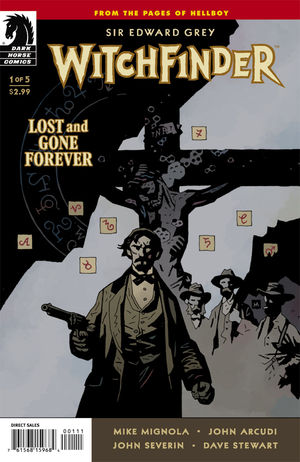
Grey and his new friend deal with the undead creature that attacked them before, and are later attacked by a strange dog-creature.  They are slowly getting to know one another better, although there is a lot of mystery still surrounding Morgan.  Also, the man that Grey has come to America to find finally turns up, in a strange scene involving a local Aboriginal tribe.  It's good stuff.

Friday, March 4, 2011

Sir Edward Grey, Witchfinder: Lost and Gone Forever #2

Written by Mike Mignola and John Arcudi
Art by John Severin

It's impossible to read this comic and not marvel at the artwork of John Severin.  Sure, he's always been a great artist, but to read this comic and realize that he's still drawing like this at the age of eighty-nine is astounding.

This volume of Witchfinder has been very different from the first.  It has Sir Grey tramping around the American Southwest looking for someone, and he's fallen in with a friendly man who seems only too happy to help him (although we as yet know next to nothing about this man, except that he helps take care of another man who is mentally challenged).

This issue has a witch ministering to an Aboriginal group, and a strange figure taking pot shots at Grey on the prairie.  Most interesting though are the scenes where Grey talks about hunting down a werewolf at the age of twelve.  Grey has often felt like a cipher in his own comics, so it's good that we're getting the chance to learn a little bit more about him and his background.  He's still a difficult character to get a solid hold on, which can be frustrating, but also makes the comic interesting.

Friday, February 4, 2011

Sir Edward Grey, Witchfinder: Lost and Gone Forever #1

Written by Mike Mignola and John Arcudi
Art by John Severin

In the letters column, it is mentioned that artist John Severin is 88 years old.  That blows me away, as his art is still so fresh and carefully rendered.  His work here looks terrific, and it definitely makes this book stand out.

With this series, Mignola and Arcudi return to the character of Edward Grey, about whom we still know very little.  It seems that Sir Grey has made his way to Reidlynne Utah, an older mining town (the story is set in 1880), on the trail of an Englishman named Lord Glaren.  Almost immediately upon setting foot in the town, Grey gets himself in trouble with the locals.

His questions at the tavern lead to a gunfight, followed by him being practically run out of town.  It is only the intervention of a mysterious stranger that gives him the chance to escape, and to learn the disturbing story of why the town's church is in ruins.  This issue opens like an issue of Jonah Hex, but quickly returns itself to familiar Mignola-verse grounds.  Even without the fantastic art, I'd be interested to see where this comic is going, but Severin's involvement guarantees that I'll be back for the rest of this run.  I do hope that we get to learn a few things about Grey this time out, as he feels like a total cipher to me, even after reading his first mini-series.

Monday, July 26, 2010

The Hellboy Project: B.P.R.D. War on Frogs #1-4

Written by John Arcudi
Art by Herb Trimpe, Guy Davis, John Severin, Karl Moline, and Peter Snejbjerg

I'm getting very close to the end of my Hellboy Project, where I've been reading one or two Hellboy or Hellboy-related story a day, in their original order of publication, the vast majority for the very first time.  I've gotten to the point where I've mostly bought individual issues instead of trades, and am beginning to think about the long view when I talk about these series.

War on Frogs was a mini-series that came out between other BPRD arcs, each issue focusing on one of the core BPRD characters who don't usually get much play, and fills in some of the things that happened during the BPRD's string of operations against the Frogs, the creatures that have been plaguing them since their title's inception.  This series was also unique because it is the first that doesn't give Mignola a writing credit, and for the wide stable of artists that it brings into the fold. 
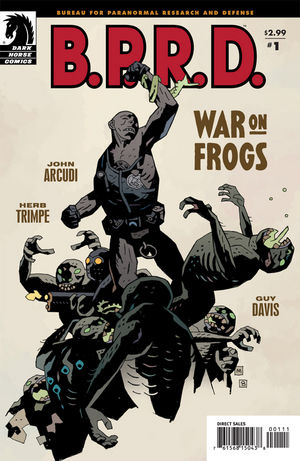
The first issue has a Roger story, drawn by Herb Trimpe.  It's nice to see Roger in action again, and it reminds us of his humanity.  The third issue spotlights Liz Sherman, although it's told from the more interesting perspective of a female BPRD operative who looks up to her, but finds her impossible to relate to.

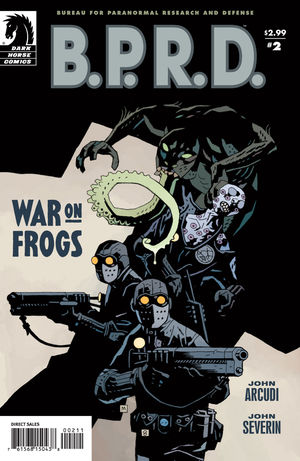
The best issues of the series are the second and fourth.  The second issue, with art by the legendary John Severin, doesn't really feature any of the main characters in an important role, and instead tells us what happened to a squad of operatives who were checking a boat for Frogs.  This story borrows heavily from Alien, as the single Frog picks off the soldiers.  Arcudi writes with the same suspense and tension of that famous movie, and Severin's more realistic art style helps add to the level of terror and believability.  The final issue, about Johann Kraus, is drawn by Peter Snejbjerg, and it looks fantastic. The story, about some Frog spirits that don't depart when their bodies are killed, is interesting. 

I like the way this series sort of reminds us of what the stakes are as we move into the big King of Fear arc.