Showing posts with label Joshua Hale Fialkov. Show all posts

Monday, August 5, 2013

The Bunker #1

Written by Joshua Hale Fialkov
Art by Joe Infurnari

My strong dislike of webcomics developed an exception when I learned that Brian K. Vaughan and Marcos Martin were publishing their wonderful Private Eye on-line only, and now this week, Joshua Hale Fialkov and Joe Infurnari were also able to convince me to purchase a digital file with the first chapter of their new series The Bunker.

I've been a fan of Fialkov's since I read the wonderful Tumor (which was also originally published as a webcomic), a became more fervent in my admiration of him after I read his brilliant Echoes and the very good Elk's Run.  His DC and Marvel stuff have not impressed me to the same degree, but I suppose that's to be expected.  With The Bunker, he feels like he's back at his fighting weight.

This book opens with a group of young people deciding to plant a time capsule as a way of celebrating their friendship and the fact that life is taking them in different directions.  Not all of them are into it though, and it becomes clear that while these are close friends, they are not above taking the piss out of one another.

While digging, they uncover a strange underground bunker with all of their names printed on the outside but for one.  Luckily, one of the characters makes the obvious reference to Lost herself, so the reader doesn't have to keep thinking it (that show has forever monopolized the old trope of finding a buried bunker in the middle of nowhere it seems - especially if it has a submarine-style hatch).  Inside the bunker are notes from their future selves, which depict a very bleak vision of where the world is headed, and explaining that most of the group are responsible for it.  One person doesn't have his name anywhere, nor does he get a note, but the reason why is pivotal to the issue.

Fialkov is setting up a pretty interesting story, with the suggestion that as bad as things get in the future, if the friends don't go about creating the things that got it that way, it's only going to get worse.  After reading these thirty-odd pages, it's hard to predict where this book is going to go.

Inurnari's art is suited to Fialkov's writing, just as his usual independent collaborator Noel Tuazon's is.  Both artists are a little scratchy and loose, and Infurnari does a great job of suggesting what the different friend's personalities are like just based on their appearance and facial expressions.

At just $2 a download, I highly recommend heading over to the Bunker website and getting this for yourself.  It's pretty good stuff.

Saturday, May 25, 2013

Occupy Comics #1

with contributions from Joshua Hale Fialkov, Joseph Infurnari, JM DeMatteis, Mike Cavallaro, Douglas Rushkoff, Dean Haspiel, Ales Kot, Tyler Crook, Ben Templesmith, Ronald Wimberly, Joshua Dysart, Kelly Bruce, Allen Gladfelter, Alan Moore, Matt Pizzolo, and Ayhan Hayrula

The timing of this new anthology comic is very odd.  I understand that the book was first funded through Kickstarter, and then solicited through Diamond by Black Mask comics, and that all of these things take time, but the Occupy Wall Street protestors were kicked out of Zucotti Park back at the end of 2011.  Sadly, the movement has appeared to have dissipated since then, which makes me wonder just what purpose this book, which promises to donate profits to "Occupy related initiatives", is really going to serve.

Still, I like anthology comics, and I like political discourse, so I thought this was worth picking up.  It's really a very earnest little comic, with a couple of nice pieces.  Joshua Hale Fialkov and Joe Infurnari's bit about the birth of the labour movement is nice.  I also enjoyed Matt Pizzolo and Ayhan Hayrula's strip about sampling Occupy and it's opposite, the Tea Party, and finding that they are neither of them accurately portrayed in the mainstream media.

Ales Kot and Tyler Crook have the best comic in this book, which shows the value of non-professional "citizen journalists".  It's the most linear and clear thing I think Kot has written yet.

I will admit to not really reading Alan Moore's lengthy piece on the history of political satire in comics. At least I think that's what it's about - I lost interest quickly, which also explains why I have a few barely read issues of Dodgem Logic lying around.

Reading this book, I couldn't help but think I was examining a historical document, which is kind of unfortunate.  There was a lot that needed to be said by the Occupy Movement, but that voice feels to be missing from our day-to-day discourse.  Maybe this book will inspire some of it to come back?  Perhaps a couple of years ago...

Sunday, January 13, 2013

Elk's Run

Written by Joshua Hale Fialkov
Art by Noel Tuazon

I really don't know why I've never read this book before now.  Creators Joshua Hale Fialkov and Noel Tuazon made Tumor together, an excellent detective graphic novel, and independently of each other, I've loved Fialkov's Echoes, and am very excited to see a new issue of Tuazon's Foster, whenever it's supposed to come out (issue three is very, very late).  I've seen Elk's Run numerous times, but it wasn't until recently that I decided to finally buy it and read it.

It's excellent.  Elk's Ridge is the name of a small former mining town in West Virginia.  When we first see it, it looks like any other idyllic small American town, but slowly the reader comes to realize that all is not as it seems.  The town was populated by Vietnam War vets who wanted a better life, and they've gravitated around John Kohler, a charismatic and firm man who has a vision for the town.

The area is completely cut off from the outside world, accessible only by a tunnel that goes through the surrounding mountains.  The rest of the area is surrounded by electrified fence, and supplies are brought in only occasionally.  Things sound great, but not to the teenagers who live in the town, are bored out of their minds, and a frustrated by a lack of young girls to get to know.  John's son, also a John, is our protagonist.

The story opens with John and his friends playing in the tunnel, a place that is forbidden for them to go, especially after dark.  The youngest of the boys is hit by a car, driven by one of the neighbours who has decided to flee the town.  This death leads to the execution of the man, and later of the police who come looking for him.  This is turn leads to John Jr. stepping up his rebellious nature, as he discovers new information about the father that he already hates so much.

Fialkov does a masterful job of combining usual teenage angst with the isolationism of a certain breed of Americans.  This story touches on events like those in Ruby Ridge and Waco Texas, while also tapping into post-9/11 fear of the wider world.  It's a very effective combination, and he uses the location well to create a very exciting climax.  Tuazon's art is never very detailed, and that works well here to help propel some of the uncertainty of this story.  This book is a very solid psychological adventure, and I recommend it.

Wednesday, August 1, 2012

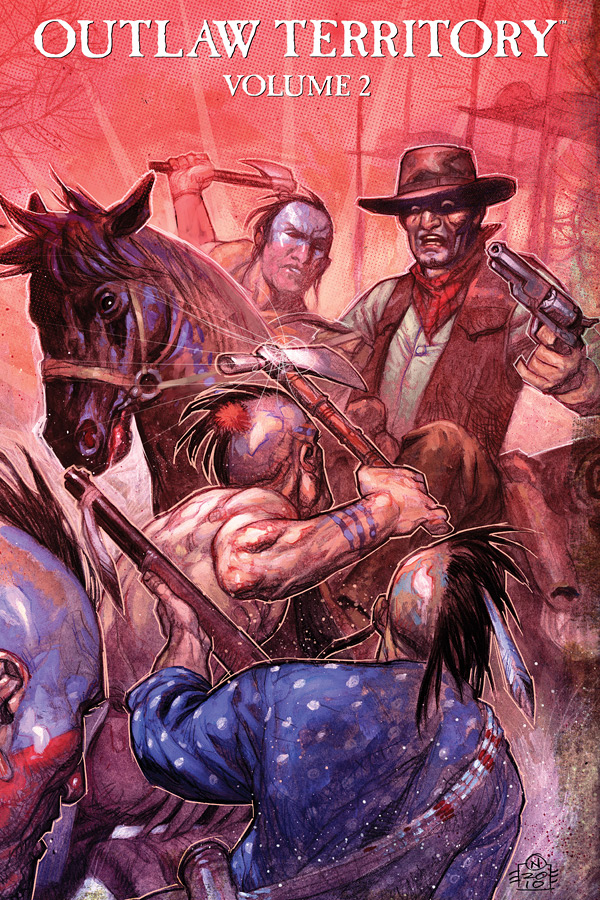
Outlaw Territory Volume 2

Edited by Michael Woods

Reading through this anthology of western comics, I started to wonder if such a thing could have ever existed were it not for the HBO show Deadwood, which treated cursing as Shakespearean oration, but also made it okay to portray the Old West in terms of gender, race and class.

Anyway, as with any anthology of this size (almost 250 pages), there is a lot of variety when it comes to quality in this book.  Some of the better pieces belonged to Rich Johnston and Tom Fowler, who started the book off on an amusing note; Michael Woods and Rafael Albuquerque; Jeremy Barlow and Dustin Weaver (whose art is incredible, and very European); A. Freeman, M. Bernardin, and D. Lafrance; John Whalen and Werther Dell'Edera; Josh Wagner and Jose Jaro (whose art I though belonged to Skullkicker's Edwin Huang at first, it's so similar); Robert Kirkman and Shaun O'Neil; Joshua Hale Fialkov and Jeff Lemire (that's an interesting creative team); Christian Beranek and Vivian Lee (exploring the contributions of Chinese workers to the railroads); Francesco Francavilla (probably the prettiest story in this book); Moritat (with what I assume is a tribute to Moebius's Lt. Blueberry comics, as the protagonist's name is J. Giraud); and Joshua Dysart and Paul Azaceta.

One reason why I enjoy these types of books is because they invariably expose me to an artist whose work I've never seen before.  There are a few people I'd like to see more from, including Rick Lacy, Jorge Coelho, Connor Willumsen (who has a bit of a Paul Pope thing going on), and Diego Tripoli.

In all, this is a successful anthology.  

Sunday, October 16, 2011

The Unexpected #1

Written by Dave Gibbons, G. Willow Wilson, Alex Grecian, Josh Dysart, Jeffrey Rotter, Mat Johnson, Joshua Hale Fialkov, Brian Wood, and Selwyn Seyfu Hinds
Art by Dave Gibbons, Robbi Rodgriguez, Jill Thompson, Farel Dalrymple, Lelio Bonaccorso, David Lapham, Rahsan Ekedal, Emily Carroll, and Denys Cowan

I really like that Vertigo has started putting out these random, slightly thematically-linked anthology books every few months, even if they are pretty expensive.  Like the last one, Strange Adventures, The Unexpected is a nice mix of stories by established Vertigo stars, and some up-and-comers.  This collection has a supernatural theme, but it's not one that is used in every story.

There is a lot to like in this book, but my favourite story is the one by Joshua Dysart and Farel Dalrymple, which tells the story of a Mexican laborer in 1950s or 60s Texas, who is accused of murdering the grandchild of his employer, although he knows the boy was killed by an ancient Aztec monster.  As with his Unknown Soldier series, Dysart makes good use of a particular culture's fears and legends, and Dalrymple's art is perfect.

I also quite enjoyed Alex Grecian (from Proof fame) and Jill Thompson's story about a female zombie who has retained enough of her faculties to use her feminine wiles as a way of attracting prey.  Dave Gibbons tells a great story of an escape artist who cheats on his wife, and Mat Johnson and David Lapham give us a deliciously twisted tale of a brother and sister trying to survive in post-apocalyptic America.

Joshua Hale Fialkov reunites with his Echoes collaborator Rahsan Ekedal for a story about a man who is recently deceased and finds himself haunting his wife.  Ekedal makes good use of layout in this story, and uses a pixelated approach to imply ghostliness.

Brian Wood and newcomer (to me) artist Emily Carrol contribute a nice short story about a woman who is raised in a post-governmental United States.  It's a similar vision to the one we've seen in Wood's DMZ, but this time he takes a nicer, gentler approach to the disintegration of a country.  It's pretty interesting, even if it ends a little abruptly.

I wanted to like G. Willow Wilson's story about dogs taking over a town, but Robbi Rodriguez's dogs were just a little too creepy and odd-looking for me.  To be fair, I think that dogs are among the hardest things to draw (check out how Dan Jurgens draws them if you need a laugh), which is why I have so much respect for Beasts of Burden.  The story 'A Most Delicate Monster' by Jeffrey Rotter and Lelio Bonaccorso (neither of whom I'm familiar with) was just a little too obvious to be successful.

Finally, Selwyn Seyfu Hinds and Denys Cowan provide a prelude to the upcoming Voodoo Child series, which really didn't work for me.  I'm not sure what it is, but I feel like they were trying to cram too much into too few pages, with the effect that I wasn't drawn into the story at all.  I'll probably give the new series a try still, because I like reading about New Orleans.

Saturday, April 30, 2011

Echoes #5

Written by Joshua Hale Fialkov
Art by Rahsan Ekedal

Echoes was an excellent little series.  Fialkov and Edekal put together a compelling and smart story about a man suffering from schizophrenia who starts to question his own actions and self-control after his father admits to being a serial killer on his deathbed.  The man, Brian Cohn, follows his father's request, and discovers a stash of dolls made of human flesh.  Later, Brian starts to see father everywhere, and starts finding evidence suggesting that he has done the same thing to a little girl.

As the series progresses, Brian and the reader continuously question what is going on, and as we see things from his perspective, we are just as confused as he is.  With this last issue, Brian is brought into custody, and while he now has figured out what has happened to him, there are questions of credibility and proof which he is unable to answer.

This book definitely kept my interest, and I appreciated the twists that Fialkov built into his story.  The portrayal of mental illness is an interesting one.  We can see how Brian tries to be a good person, but because of his disease, is ultimately not even able to have faith in himself.  It's rare to find a thriller that doesn't demonize mental illness.  Ekedal's artwork is very capable, while not really drawing much attention to itself.  This is a series people should check out when it's published in trade.

Saturday, March 26, 2011

Echoes #4

Written by Joshua Hale Fialkov
Art by Rahsan Ekedal

I'm finding Echoes to be a very tightly plotted thriller, and each issue seems to be better than the one before it.  The plot of this series is that Brian, a schizophrenic, learns from his father on his deathbed that he had murdered a large number of young girls, and had made effigies of them out of their skin.  Upon learning this, Brian investigates some and discovers the box full of dolls, and promptly starts to crack up.  Soon enough, he's beginning to wonder if he is doing the same thing, especially once a young girl goes missing, and a new effigy shows up on his doorstep.  The problem is, he has no memory of this happening.

What makes this book so interesting is the way in which the reader has to question each of Brian's perceptions, since we don't always know if he is seeing something real.  With this penultimate issue, the police start actively looking for him, showing up at his house with a search warrant while he is out, and Brian finally starts to piece together what is going on.  The issue ends with a pretty big revelation that helps confirm some of the suspicions I had (I don't want to spoil anything), but with a few twists that I didn't see coming.

I really like the way Fialkov is writing this series, keeping Brian and his questionable understanding of his environment in such a tight focus.  Ekedal's art works very well here, and I am very much looking forward to the end of this series.

Saturday, February 26, 2011

Echoes #3

Written by Joshua Hale Fialkov
Art by Rahsan Ekedal

Alright, this title is getting ever creepier, as Brian, the young man who only recently discovered that his father was a serial killer, descends deeper into his own madness.  Brian is pretty certain now that he has kidnapped and murdered a young girl, and made a doll out of her body.  He has no memory of it (at least, he's not admitting to any memory of it), but he knows it has to be true.

He decides to go to the police detective that he met last issue, but when he does, he instead describes a possible suspect that he's fabricated.  When that description ends up matching a brain damaged man that he knew in high school, he begins to go along with the detective, even going so far as to visit the man's house with him.

It's pretty clear that something strange is going on, and perhaps if Brian weren't so confused and lost in his own schizophrenia, he'd have recognized that this cop is really weird.  I feel like there's some sort of conspiracy going on, but I don't know how that's really going to play out.  Fialkov is definitely structuring an interesting plot, and Ekedal's art on this issue looks more finished and polished than previous issues.  This is a very cool little series.

Sunday, January 30, 2011

Echoes #2

Written by Joshua Hale Fialkov
Art by Rahsan Ekedal

Before I even begin talking about the comic itself, I want to talk about what a snake move it was to have the first issue be priced at $2.99, and then to raise the price to $3.99 on subsequent issues.  I never would have picked up this comic at $4, and would have instead trade-waited it, and snatched it up on Ebay in a couple of years.  But, since I thought the price was lower, I tried it, and got hooked.  Snaky, Top Cow, snaky.

But then, the comic is worth it.  Fialkov is quite the writer, as he plays with the main character's, and our, perceptions of reality quite nicely.  Last issue, Brian Cohn found out a few things about his recently deceased father that he never knew, that involved a box of small dolls made out of the bodies and clothing of young girls that he had killed.

Brian is not too sure what to do with this information, since Brian is schizophrenic, and is having a very hard time processing all that has happened.  Now, he is hearing his father's voice, and is feeling compelled to behave in the same way.  We're not too sure what is going on here, although the revelations of the last couple pages of this issue make it seem like Brian is in a bad place indeed.

Fialkov is not giving us many hints, but he is crafting a pretty compelling story.  Ekedal's art doesn't seem too special, but then he pulls off some interesting visuals that make you realize just how good an artist he is.  There's a very cool scene when Brian is taking a shower that is easily missed.

So, in conclusion, I am resentful of the price hike, but am also committed to seeing how this story ends.

Saturday, January 15, 2011

Outlaw Territory Vol. 1

Edited by Michael Woods

Now here's an example of a trade paperback that appeared without making any ripples.  This Western anthology book went pretty much unnoticed when it was published in 2009 - I don't remember seeing any reviews or promotion for it, although I do remember seeing it in Previews.  I know that there is a second volume due to be released soon, but know very little about it as well.

As someone who loves a good anthology, I was happy to settle down with this book, which contains a good thirty short stories by a ton of different writers and artists.  Most of the stories are very good, but the limited range of the Western did make many of them blend together in my mind.

Frequently the stories involved gunslingers looking for revenge, and it did become a little monotonous at times.  Still, the quality of work in this book is pretty high.  Creators whose work stood out included Moritat, Joe Kelly and Max Fiumara, Khoi Pham, Joshua Hale Fialkov, Greg Pak and Ian Kim, Christopher Mitten, and mpMann (such a treat to see his work again).  Some artists who were new to me, but who made an impression include Yeray Gil Hernandez, Christopher Provencher, Simon Fraser, and Chad Sell.

I felt like many of the stories needed more room to spread themselves out, but in all, I was pleased with this book.  Some contributor bios would have been a nice addition though...

Friday, December 31, 2010

Echoes #1

Written by Joshua Hale Fialkov
Art by Rahsan Ekedal

There's nothing better than going into a new comic with no expectations or preconceived notions, and being pleasantly surprised.  I only picked up the first issue of Echoes because I liked Fialkov's Tumor, and because it was otherwise a light week for comics.

Echoes is about a man named Brian whose father is dying in a hospital or nursing home of Alzheimers.  We quickly learn that Brian and his father had a difficult relationship, and that Brian is in therapy.  Slowly, we also learn that he must take Clozapine to avoid having hallucinations.

With his dying words, Brian's father tells him to return to their old house and to retrieve a box from the crawlspace.  He also mentions girls' bodies.  Now, Brian's not entirely sure that he heard this, and as he explores the long-abandoned and ravaged house, he begins to question his perception, since he has skipped his medication.  I don't want to give away what happens in the basement, but I do like the way Fialkov has established that we don't really know what is real and what is in Brian's mind.

This book has a nice creepy feel to it, and Fialkov wastes no time in getting to the meat of his story.  Rahsan Ekedal's art reminds me a little of Charlie Adlard's, and makes good use of the book's black and white format.  The scenes in the crawlspace are amazing and haunting.  I haven't bought a Top Cow comic since the Jonathan Hickman Pilot Season comic, but I'm going to be getting this.

Tuesday, October 5, 2010

Tumor

Written by Joshua Hale Fialkov
Art by Noel Tuazon

Tumor is yet another crime comic centred on a down on his luck private eye "with a twist."  The thing is, unlike many of the Vertigo Crime graphic novels, this particular twist works really well.

Frank Armstrong has a tumor in his head which is causing him to have intense flashbacks, or fall into short-lived comas.  Frank was never a particularly good PI (neither in terms of quality nor morality), and so at the end of his life, he has very little going for him.

He takes a job with a notorious drug lord, who is looking for his missing daughter.  As it turns out, the daughter had stolen money from him, and he is looking to have her killed.  When Frank meets the daughter, Evelyn, she reminds him of his deceased wife Rosa.  In fact, he frequently confuses the two, and he decides to help Evelyn in the one way he couldn't help Rosa.

The book is very tightly plotted, and Fialkov uses Frank's disease as a way of driving the plot, as it adds to his confusion, but also works to help us understand exactly what went down with Rosa in the first place.  There are some interesting tricks done with the timeline of the story at the beginning, but as the book progresses, that aspect of the storytelling calms down.

Tuazon's art is pretty nice.  It suits the story, and I like the way that the flashback scenes are drawn in what looks like charcoal (the book is black and white).  Tuazon makes Frank look old, and he seems to become more drained as the story progresses.

This story was originally sold as a webcomic on Amazon, but I think it works great in this nice thick little hardcover.  There is some supplemental material, including a prose story of Frank's first job as a PI.  This is worth checking out.

Sunday, June 13, 2010

The Cleaners: Absent Bodies

Written by Mark Wheaton and Joshua Hale Fialkov
Art by Rahsan Ekedal

This is a unique and disturbing comic, not at all what I was expecting.  I thought that this would be a little something like Vertigo's much-missed Exterminators series, except featuring crime scenes instead of bug-infestations.  Instead, this is the bleak story of Robert Bellarmine, a former surgeon who now obsesses over blood particles and their ability to contaminate and propagate disease.

A particularly messy operation leads Bellarmine to conclude that the supernatural is at work - what we would call a vampire, but what he refers to as a 'harvester', collecting the blood of a variety of victims and vaporizing it in a gas mask-type set-up.  This is a very bloody and creepy story.

Some of the finer plot points, such as establishing characters and their relationships to one another doesn't really happen.  I was never too sure of who Bellarmine's friends and colleagues were, or why one of them was collecting hair samples from dancers.  As well, Bellarmine's relationship with the local police was never explained, nor was the reason why he left (or got kicked out) of medicine.  I can tell that the authors were setting things up for future arcs, but a little more exposition would have been helpful.

I've never heard of Rahsan Ekedal, but I do like his art.  He reminds me a little of Paul Gulacy at times, and his cover designs are excellent.