Showing posts with label Donald Westlake. Show all posts

Tuesday, October 27, 2015

Richard Stark's Parker Book Four: Slayground

Written by Donald Westlake
Adapted by Darwyn Cooke

The latest of Darwyn Cooke's Parker books, Slayground, is immediately gripping, but is also the slightest entry in the series so far.

Parker, the master criminal, has participated in the heist of an armoured car in Buffalo in winter, but things went bad when his driver ended up flipping their getaway car.  Hurt, Parker runs with the loot, and takes shelter in Fun Island, an amusement park that has been closed for the winter.

He hasn't gotten into the place unobserved though, as a pair of crooked cops and their criminal accomplices see him get into grounds of the park, and more importantly, see him with a large bag of cash.  Once they learn about the heist, they decide to go in to Funland and help themselves to Parker's score.

Parker has some time to prepare for them though, and we sit back and watch him go about his business.

This set-up gives Cooke a lot of opportunity to do some cool things with the visuals in this book.  There is a fold-out map of Funland, and Cooke uses a number of interesting layouts, as Parker runs around setting up traps.

Cooke's retro-stylings always make his Parker books a treat.  We really don't know Parker as a character (and I have no reason to believe you learn more about him from reading Westlake's original novels), but he works well as a cipher in these kinds of situations.

Saturday, December 20, 2014

Richard Stark's Parker: The Score

Written by Donald Westlake
Adapted by Darwyn Cooke

As I've said before, I have no connection to Richard Stark's writing, or to the character of Parker, a gruff master thief.  I am, however, a big fan of Darwyn Cooke's art and writing, and so I am always happy to pick up one of his Parker graphic novels.

The Score is the third in his series of adaptations, and I think it is the best one I've read to date.  Cooke (or Stark; I'm not sure if he's taking liberties with pacing) wastes no time setting up the plot of this story.  A man has gathered a group of criminals to help him execute a really big job.

This guy, Edgars, wants Parker to organize a heist which will take out an entire town - Copper Canyon, North Dakota.  The entire town is surrounded by cliffs, and is attached to a large mining operation.  Edgars has it all figured out - the group can take the mine's payroll, and knock off the two banks and the various stores in one night, and take off with a large score (at least for the time - the notion of doing all this for only a quarter of a million dollars is a little laughable now).

I like stories that concern themselves as much with the set-up of jobs like this as they do the actual mission itself, and Cooke balances the story nicely.  When the job goes down, it goes without saying that something goes wrong, but Stark doesn't seem all that interested in including moral lessons in his work, so the town has a pretty bad night.

What really makes these books work is the great period detail in Cooke's art.  The story has moved beyond feeling outdated to feeling vintage.  A story like this could never be told in our modern time, and Cooke wallows in nostalgia for a simpler, better-looking time.

Saturday, January 14, 2012

Richard Stark's Parker Book Two: The Outfit

Written by Donald Westlake
Adapted by Darwyn Cooke

When I started reading The Outfit, the second of Darwyn Cooke's adaptations of Richard Stark's (really Donald Westlake's) crime novels, I couldn't for the life of me remember what happened in the first one, The Hunter.  I remember enjoying Cooke's work, but storywise, nothing stayed with me.

Reading this volume, I can see why.  Westlake's stories are pretty effervescent.  This one is about Parker wanting to take on The Outfit - a mob-like group of career criminals who run large swaths of gambling and prostitution houses.  The man running The Outfit has beef with Parker, who has had surgery to change his appearance, and Parker is looking for payback.  Or something like that.

Truthfully, I'm reading this book for Cooke's wonderful artwork; the story is secondary.  Cooke loves that late 50s/early 60s period, as we learned with The New Frontier, his love letter to the early days of DC comics.  The sense of design and iconography used in this book is terrific, and Cooke has a good sense of the correct pace to use in adapting Westlake's writing.

The best parts of this book have Parker or his friends planning and carrying out various heists and robberies of Outfit businesses.  Cooke uses a variety of styles for these pages, drawing some of them like newspaper comc strips, and presenting one in an 'illustrated novel' format.  The look of this book is where the fun is; the rest is pretty inconsequential.

Saturday, July 3, 2010

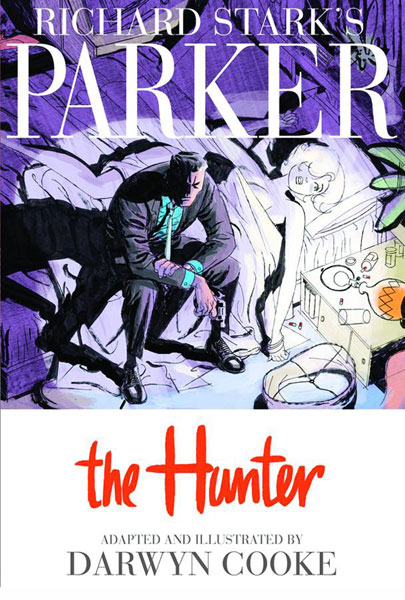
Richard Stark's Parker: The Hunter

Written by Donald Westlake
Adapted by Darwyn Cooke

I've never been one to read a lot of crime novels, especially ones that are in a series, like the Parker books written by Donald Westlake under the pen-name of Richard Stark, but I am a fan of Darwyn Cooke and his approach to depicting the middle of the last century, so it was a sure thing that I would read this graphic novel eventually. 

Cooke has an understanding of the early 60's and its design aesthetic that suggests he should really be much older than he is.  His lush penthouse suites are spacious, and filled with low-lying couches and chairs, and futuristic-looking coffee tables.  He is able, in drawing a room, to convey the optimism of the time, in the last stretch of years where nothing could touch the superiority of white male America.

Entering into that is Parker, an angry thief who was double-crossed in his last big job, and is now looking for revenge on the man that crossed him, his wife who betrayed him, and the syndicate that has employed them.  Parker is a brutal man who thinks nothing of wading through bodies to get what he wants.  One particularly chilling scene involves him casually tying up a woman in a hair salon that provides him with a good vantage point on his prey.

The book begins with difficulty.  It shows Parker arriving in New York, but there is no real explanation as to what is going on.  It's not until the second quarter of that book that Cooke starts to fill us in on who the characters are and what their deal is.  It is at that point that the book began to pick up for me.

Of course, the story in a Cooke book is almost secondary to his wonderful art.