Showing posts with label Francesco Francavilla. Show all posts

Sunday, August 31, 2014

Black Beetle Vol. 1: No Way Out

by Francesco Francavilla

I've been a fan of Francesco Francavilla's art for some time now, but had decided to hold off on buying his Black Beetle mini-series, because the serial in Dark Horse Presents didn't really do a lot to impress me.  Now, having read No Way Out in hardcover, which also collects the DHP story, I'm glad I waited.

The Black Beetle is a pretty typical costumed noir crime fighter.  He has some specialized equipment, and a tendency to prowl around at night.  When he goes to bust up a meeting between rival mob families, he is surprised when the meeting place explodes, apparently killing everybody there.  As he tries to solve the mystery of who is behind the explosion, he soon crosses paths with The Labyrinto, a costume villain who dresses in a maze-themed outfit.

In a lot of ways, this book reminds me of Mike Mignola's Lobster Johnson, as much as he does characters like The Shadow.  Both central characters are essentially ciphers, giving away nothing about themselves over the course of the story, but the Black Beetle works alone.  That means that this story is very plot-driven, as he attempts to infiltrate an inescapable prison, explores abandoned subway tunnels, and sneaks into a heavily guarded wooded estate.  It's hard to care about the Beetle, because we don't know anything about him (when he goes undercover into a nightclub, he wears a different mask), and so Francavilla's art is left to do all the heavy lifting in the story.

The thing about that is that Francavilla is an incredible artist, and his choice of story gives him plenty of opportunity to show off the amazing and innovative layouts he's known for.  This is a gorgeous book, and that alone makes it worth buying.

I like the way Francavilla has sprinkled some clues and subplots throughout this story, to help set up future adventures for the character.  There's something about a hollow lizard, which an occult figure with access to a high-tech group of Nazis is after, and I get the feeling that as the larger story progresses, we will eventually learn more about the Beetle.

In the meantime, I'm happy with stories that are this visual, although I think sticking to the trade format, and reading them in one sitting, is the way to go with tales like this.

Thursday, August 29, 2013

American Vampire Anthology #1

Written by Scott Snyder, Jason Aaron, Rafael Albuquerque, Jeff Lemire, Becky Cloonan, Francesco Francavilla, Gail Simone, Gabriel Bá, Fábio Moon, and Greg Rucka
Art by Rafael Albuquerque, Declan Shalvey, Ivo Milazzo, Ray Fawkes, Becky Cloonan, Francesco Francavilla, Tula Lotay, Gabriel Bá, Fábio Moon, and John Paul Leon

When American Vampire first started a few years ago, despite its coming out in the middle of the vampire-related glut of the post-Twilight world, it really stood out as a well-considered, and excellently-executed new approach to the genre.  I liked how Scott Snyder (and early collaborator, Stephen King) grounded the vampire, and other mythological creatures, in biology and history.  There was a strong emphasis on character, and under Rafael Albuquerque's pencil, the book looked terrific.

As the series continued, as new characters were added to the mix, and as spin-off mini-series became more exciting than the main title, I felt that things needed a bit of a shakeup to keep my interests.  I wasn't all that upset when I learned that the series was going on hiatus for a while, as I was considering dropping it.

Now, though Snyder and Albuquerque have headlined this anthology, which has gotten me excited about the property again.  First off, just look at the talent involved in this book, with names like Cloonan, Bá, Moon, Lemire, Francavilla, Rucka and Leon showing up on the cover.  In their numerous short stories, many of which were too short, they explored other aspects of this world, and I loved it.

Jeff Lemire and Ray Fawkes took us up to James Bay to see what the Canadian Vampire would look like, while Jason Aaron and Declan Shalvey revisited the early colonial days of the United States in a similar tale.  Regular series artist Albuquerque writes a story about a small town in Kansas, which is painted by the very interesting Ivo Milazzo.

Some of the stories feature characters we've met before, as in Gail Simone and Tula Lotay's 'Hattie' tale, and in Becky Cloonan's exploration of why Skinner Sweet came to Hollywood.  Skinner shows up in Greg Rucka and John Paul Leon's story too, which explains what happened to him after Las Vegas, back in the second or third arc of the series.

Francesco Francavilla looks at the vampires' influence in Hollywood, while Gabriel Bá and Fábio Moon take us into a seedy nightclub.

This is a very nice looking book, which has managed to whet my appetite some for the return of the series, which is what it's supposed to do I guess.

Wednesday, August 1, 2012

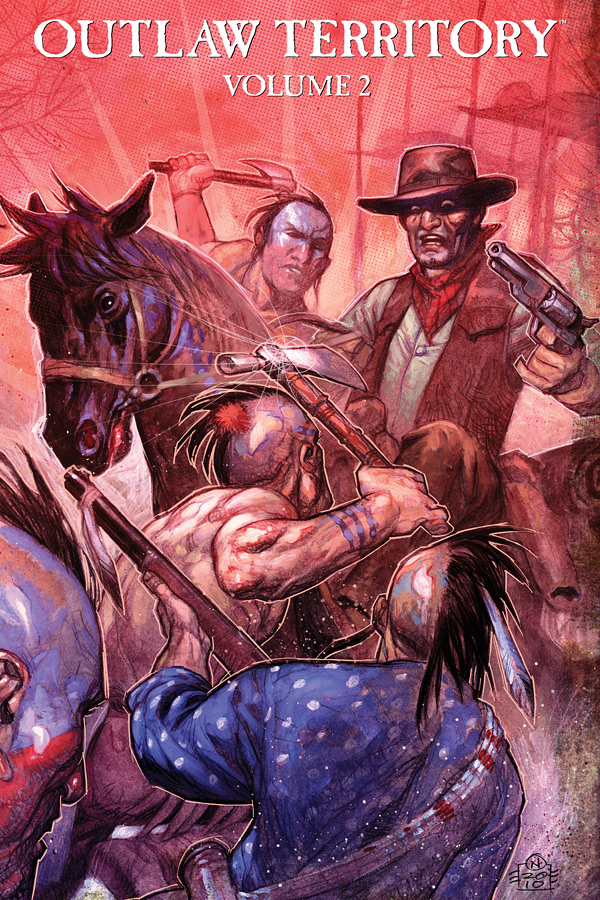
Outlaw Territory Volume 2

Edited by Michael Woods

Reading through this anthology of western comics, I started to wonder if such a thing could have ever existed were it not for the HBO show Deadwood, which treated cursing as Shakespearean oration, but also made it okay to portray the Old West in terms of gender, race and class.

Anyway, as with any anthology of this size (almost 250 pages), there is a lot of variety when it comes to quality in this book.  Some of the better pieces belonged to Rich Johnston and Tom Fowler, who started the book off on an amusing note; Michael Woods and Rafael Albuquerque; Jeremy Barlow and Dustin Weaver (whose art is incredible, and very European); A. Freeman, M. Bernardin, and D. Lafrance; John Whalen and Werther Dell'Edera; Josh Wagner and Jose Jaro (whose art I though belonged to Skullkicker's Edwin Huang at first, it's so similar); Robert Kirkman and Shaun O'Neil; Joshua Hale Fialkov and Jeff Lemire (that's an interesting creative team); Christian Beranek and Vivian Lee (exploring the contributions of Chinese workers to the railroads); Francesco Francavilla (probably the prettiest story in this book); Moritat (with what I assume is a tribute to Moebius's Lt. Blueberry comics, as the protagonist's name is J. Giraud); and Joshua Dysart and Paul Azaceta.

One reason why I enjoy these types of books is because they invariably expose me to an artist whose work I've never seen before.  There are a few people I'd like to see more from, including Rick Lacy, Jorge Coelho, Connor Willumsen (who has a bit of a Paul Pope thing going on), and Diego Tripoli.

In all, this is a successful anthology.  

Friday, June 22, 2012

Dark Horse Presents #13

Written by Kelly Sue DeConnick, John Arcudi, Carla Speed McNeil, Steve Niles, John Layman, Tim Seeley, Francesco Francavilla, Andrew Vachss, Mike Baron, and Dean Motter
Art by Phil Noto, Jonathan Case, Carla Speed McNeil, Christopher Mitten, Sam Kieth, Victor Drujiniu, Francesco Francavilla, Geof Darrow, Steve Rude, and Dean Motter

Sometimes I worry that this anthology is not always the best place for some of the comics that Dark Horse is presenting in it.  Lately, they've begun stories in DHP, and then spun them off into their own mini-series (such as Resident Alien) or on-goings (like The Massive).  In the latter's case, the stories were clearly serving an introductory role, and that was fine, but in the case of Resident Alien, the story was simply begun here, and then continued elsewhere, which makes it a tough story to follow for readers of this book, or for people who picked up the first issue, and would have had no clue what was going on (the DHP stories were printed again in a '0' issue).

I bring this up, because the 'concluding' chapter to Steve Niles and Christopher Mittens's Criminal Macabre story this month just stops; it doesn't really end.  At least the Occultist, which also concludes this month, more or less finished its story, while still setting things up to be returned to later down the road.

On the positive side, and worth the purchase of the book, is the new Finder story by Carla Speed McNeil.  She is continuing to examine the lives of Ascians in the region called Third World, as Jaeger and his new friend help an artist trying to sell her paintings.  At the contemporary museum, her work is too 'archaeological' and indigenous, but at the archaeology museum, her work is too contemporary, a trap which many indigenous and minority painters find themselves in.  There is a surprise return of an older character at the end of the story, which made me happy, but which would be utterly puzzling to a new reader.  I wish that McNeil was providing footnotes to these stories.

Also of interest this month is the continuation of Dean Motter's Mister X story, and John Arcudi and Jonathan Case's The Creep, which is excellent.  The Aliens story, by John Layman and Sam Kieth is a little better than its debut chapter, and Francesco Francavilla's Black Beetle is pretty, if also pretty standard.

The return of The Ghost, by Kelly Sue DeConnick didn't excite me too much, but it's an interesting story created by two very gifted comics creators; I'm going to see where it leads before I pass judgement. 

Andrew Vachss's prose story of child predators on the internet and the motley collection of freaks who hunt them down for profit was disturbing and weird, but not in a good way.  Nexus is boring.

Saturday, May 26, 2012

Dark Horse Presents #12

Written by John Layman, John Arcudi, Carla Speed McNeil, Steve Niles, Evan Dorkin, Tim Seeley, Francesco Francavilla, Dean Motter, Mike Baron, Harlan Ellison, and Mike Russell
Art by Sam Kieth, Jonathan Case, Carla Speed McNeil, Christopher Mitten, Evan Dorkin, Victor Drujiniu, Francisco Francavilla, Dean Motter, Steve Rude, Richard Corben, Mike Russell, and Geof Darrow

A few new serials begin with this issue of Dark Horse Presents, which is always a good thing, as it shows that this title is constantly evolving and trying new things, or as is more the case with this issue, returning to its roots.

One of the new series is Mister X, Dean Motter's classic examination of the effect of architecture on weak minds, set in a Deco-styled environment.  I've been a fan of this series for a long time, so it's very nice to see it come back, even if this first installment is mostly just set-up for a new story involving the kidnapping of an heir to a pyschotropic pharmaceutical empire.

We also see the return of Aliens to DHP.  This property is one of the ones that Dark Horse made its name by publishing back in the day, but this first chapter didn't do much for me.  John Layman's writing was fine (if miles away from the tone he uses on Chew), but Sam Kieth couldn't make up his mind between drawing beautiful and detailed images (the first three pages) or aping Kyle Baker at his worst (the rest of it).

Also showing up for the first time in many years is Mike Baron and Steve Rude's Nexus, which I've never read before now.  I wasn't too impressed, really.  This reads like an Adam Strange story, and while Rude's art is always lovely, I wouldn't pursue this story into its own title.

There is also a prose story by Harlan Ellison, with a couple of illustrations by Richard Corben.  I've always admired Ellison more in terms of reputation than his actual writing, and this story did not hold my interests.  Likewise, I had to give up on Evan Dorkin's story about zombie cosplayers, which was way too wordy for me.

The new chapter of Finder, however, was brilliant once again.  Carla Speed McNeil has Jaeger examining the region called Third World, and this leads to some interesting conversations about class distinction, 'First World' ego, and the place of nomadic tribes like the Ascians in the world.  I miss her detailed footnotes, but am extremely happy whenever another chapter of Finder shows up.

I also enjoyed the new chapters of Francavilla's Black Beetle and Seeley and Drujiniu's The Occultist.  Arcudi and Case's The Creep was also very good.  The Criminal Macabre story held my interests more than it usually does too.

In all, another successful issue for this meaty anthology comic.


Saturday, April 21, 2012

Dark Horse Presents #11

Written by Francesco Francavilla, Steve Horton, Carla Speed McNeil, Steve Niles, Evan Dorkin, Tim Seeley, John Arcudi, Andrew Vachss, Neal Adams, and Frank J. Barbiere
Art by Francesco Francavilla, Michael Dialynas, Carla Speed McNeil, Christopher Mitten, Evan Dorkin, Victor Drujiniu, Jonathan Case, Geof Darrow, Neal Adams, and Luke Radl

Once again, Dark Horse Presents delivers a variety of comics for your reading pleasure.  As always, it's a pretty mixed bag, with the good being discussed first:
  • Francesco Francavilla is an artist I've enjoyed for quite some time, and it's nice to see him finally doing some creator-owned work.  The Black Beetle is a pretty standard pulp hero, with a Spirit/Shadow/Lobster Johnson type character trying to protect a beautiful archeologist (or curator, or something like that) from a group of personal helicopter-wearing Nazis who want to steal a priceless artifact.  It's predictable, but pretty.
  • I'm always happy to get a new chapter of Finder, Carla Speed McNeil's long-running series.  She's making good use of the colour possibilities of this anthology, as she has Jaegar walk through a number of strange environments.  It's a short piece, but it's very nice.
  • I don't remember John Arcudi's old series The Creep, but this reintroduction to the character works quite well, as the title character receives a letter from an old girlfriend telling him that her son committed suicide, and that she thinks there's something more to it.  This is how you begin a new story told in short chapters; I'm looking forward to reading more.  I like Jonathan Case's art here.
  • Andrew Vachss's prose piece 'Pig' goes down quite easily, if it feels like it's from another era.  It's a story about a young gang-banger and the friendship he develops with an overweight kid who is not part of his clique.  Geof Darrows's illustrations are less Darrow-ish than anything I've ever seen him do, but they work with this story.
  • I don't know what the deal is with 'The Way Out', a story 'From the Pages of the White Suits', which is set in Moscow in the late 80s.  It's about a young female courier who gets caught up in some madness involving gangsters and soldiers.  I don't know if this is the beginning of a new series, or is a stand-alone story, but it has my interest.  Luke Radl's art is very nice in Frank J. Barbiere's story.
Beyond that, I found I didn't have much use for the rest of the book.  Steve Niles and Christopher Mittens's Cal MacDonald story still hasn't caught my eye, and I am still having trouble getting into the Steve Horton and Michael Dialynas 'Amala's Blade' series.  Tim Seeley's new series The Occultist was too like the Cal MacDonald and a hundred other comics to impress me.

I hate Neal Adams's Blood comic, and feel much the same about anything Evan Dorkin does that doesn't involve Jill Thompson and the Beasts of Burden.  Next month:  Aliens!

Saturday, November 6, 2010

24 Seven Vol. 2

Edited by Ivan Brandon

This anthology is the second of two graphic novels that contain only short stories featuring robots.  The trick, or the conceit, is that the robots are the only inhabitants (except, in one story which also has gorillas) of the planet, and they tend to live what we regard as normal lives.  The book is somehow connected to the NYC Mech series that Image put out in the middle of the decade, but these books feature a rich variety of talented writers and artists.

When I read the first volume, I complained that the stories were pretty ordinary, and didn't do much with the robotic concept.  People whined about their jobs or had break-ups, and the fact that they were robots seemed to exist solely in the visual aspects of the comic.  That is not the same with this volume.

Instead, many of the stories deal head-on with the notion that the protagonists are mechanical in nature.  There is a story by Carla Speed MacNeil and Bruno D'Angelo that has the main character slowly trading in his parts so that the he can become a dancer, although it means giving up his family's legacy.  Similarly, Kelly Sue DeConnick and Andy MacDonald tell a story where the hero literally carries his emotional baggage around with him, attached to his body.

There are lots of great stories here by a very impressive list of creators, including Gene Ha (who plays around with a homage to Little Nemo in Slumberland), Fábio Moon, Michael Avon Oeming, Francesco Francavilla, Gabriel Bá, Juan Doe, Rafael Albuquerque, Ben Templesmith, Dave Johnson, Jason Aaron, Fiona Staples, Jason Latour, and Frazer Irving.

This is a very coherent and enjoyable anthology, which covers a number of different genres.  Recommended.

Saturday, May 29, 2010

Garrison #2

Written by Jeff Mariotte
Art by Francesco Francavilla

I still don't feel like I know too much about what's going on in this series, but Mariotte's writing and pacing is very tight, and Francavilla's art is as wonderful as always.  I like his drawing because he manages to convey a very old school sensibility - his work reminds me of illustrators from the 70s - in a very modern and updated context.

What we do know about the story is that this man Garrison is on a killing spree in a near-future where surveillance is almost absolute.  There are a couple of government agencies looking to capture him, but after the events of the first issue, the NBS agent, Jillian Bracewell, is more interested in talking to him than capturing him, especially after he hinted that the HIA agent that he killed was planning on killing her.

Meanwhile, it is becoming apparent that Garisson doesn't know who he is either, although he does seem to be experiencing some flashbacks that may shed some light on that as the series progresses.

This is a pretty cool light sci-fi espionage story, and I'm enjoying it.  It's nice to see Wildstorm publish things like this and Sparta: USA again.  It was this willingness to experiment with unorthodox titles that made them a favourite publisher of mine a few years ago.

Saturday, May 1, 2010

Garrison #1

Written by Jeff Mariotte
Art by Francesco Francavilla

I picked this up because, while Mariotte can be hit or miss (loved Desperadoes, found Fade to Black was not my thing), I really like Francavilla's art.  He has a style that reminds me of a lot of older comics from the seventies (think Giordano a little), but still feels very fresh and new.  His work on books like Sorrow and Zorro has always caught my attention (disclaimer:  I did drop Zorro, but had wanted to keep with it for the art).

This new series is about a guy who has been going on a murder spree for about nine weeks.  It's set slightly in the future, and agents of the National Bureau of Surveillance have no idea who he is.  The NBS calls in support from the Homeland Intelligence Agency, and while the two agents in charge head out for dinner, the mystery man shows up and kills the HIA man, and identifies himself as Garrison, before taking off, leaving the female NBS agent with a ton of questions.

It would seem that our man has some kind of intuitive ability, but Mariotte is playing everything close to the chest in this issue.  I'm definitely intrigued, and will be picking up next month's issue.

Saturday, April 4, 2009

Scalped #27

Written by Jason Aaron
Art by Francesco Francavilla


This is another 'done-in-one' story focusing on a single member of the Scalped cast, in this case, FBI agent Baylis Nitz, who is Dash and Diesels' boss, and who has been largely operating in the background, with very little opportunity to date to show that he is anything other than a bastard.

This issues delivers his backstory, explains his motivations, and continues to show that he isn't really anything other than a bastard.

Aaron is joined on this issue by Francesco Francavilla, an artist whose work I have enjoyed in various places - Sorrow, Zorro, and Tales of the Starlight Drive-In - and who I hope will soon get a regular book. His sensibilities fit really well with the gritty feel of Scalped, and he'd be perfect to take the book over if Guera were to leave.

Another excellent issue of the best book Vertigo publishes.