 by William T. Vollmann
I have considered Vollmann to be my favourite writer for a very long time (I've been reading his books since I was in high school), and I've read every book he's written (with the exception of his newest,
Kissing the Mask
, which is on my bookshelf). Having finished
Imperial
, his massive book on Imperial County, and the area surrounding it, including the Mexicali Valley in Mexico, I'm beginning to fear that our relationship is becoming an abusive one.
Imperial (the book) is 1306 pages long, although the main body of the text only takes up 1125 pages (Vollmann likes his notes), and it is frequently painfully repetitive. Vollmann is the type of author who, if he interviews seven people about say the price of water in rural Mexicali, will include all seven interviews, instead of summarizing or aggregating, even though all seven people say just about the exact same thing.
The problem is, Vollmann is frequently a brilliant writer, and makes it worth the reader's while to wade through the duller portions of the book, hunting for the sections that confirm his talent and genius.
This book is as sprawling as the geography he describes. He covers (exhaustively) the history of the region, but this is not just a history book. He also goes to great lengths to portray the current state of Imperial, and meets with and interviews people from every station in life, although his sympathies and love remain with the people of Mexican descent, whether they work illegally in America or subsist in Southside (ie. Mexico).
The closest thing to a thesis statement I ever found in the book came on page 528, when he wrote "When I began to study the history of this period my mind remained unbiased by knowledge. All I knew was that somehow Imperial county had altered from being one of the richest bits of farmland in the United States to the poorest county in California, and I couldn't fathom how." Of course, the whole region is desert reclaimed by damning the Colorado River, and finding ways to bring and keep water in the area.
The book is at its best when Vollmann is in Southside. There is an excellent section that involve him searching for tunnels in Mexicali that had been built and inhabited by Chinese migrants. This involves page after page of investigation and pleading, before his is finally able to gain entry into some of the extant tunnels, and while they hold little more than Al Capone's famous tunnels did, this part of the book is fascinating. Also memorable is the section where Vollmann attempts to gain entry into some of the maquiladoras that fill Mexicali, as he looks to confirm rumours of sexual harassment and mistreatment of poor Mexican girls. These two sections, joined by a smaller segment on narcocorridos (ballads that lionize the actions of drug traffickers) are the most Vollmannesque, as is an early part of the book where he decides to raft down the New River to confirm reports of its feculence. In that instance, he developed a number of skin infections.
It's hard to figure out how to classify Vollmann's non-fiction writing. This book could work as a pretty straight-forward sociological history of the region, but for the fact that he will frequently include similes such as "as clean as a fifteen year-old Mexican whore", which I'm sure make academics incredibly unlikely to ever quote from him at length. Similarly, there is a part of the book that runs close to one hundred pages in which he mourns the death of his relationship with an unnamed woman. Frequent readers of Vollmann's oeuvre are used to things like this, but it must be quite off-putting to a casual reader (imagine if James Agee filled some of '
Let Us Now Praise Famous Men
' by whining about getting dumped).
In the final analysis, this book is about the death of optimism and perhaps the American Dream in its far south. The people that Vollmann interviews and profiles from the contemporary period feel beat down, and are happiest when life is simply 'tranquil'. The pioneer spirit that he describes at length in people like Wilber Clark has left the region, and things are not looking good. At the heart of this book lies Vollmann's love for this area and its people, as if his own personal optimism could prop up the whole area.
I enjoyed reading this book, but I'm damn happy I've finished it. I rather wish Vollmann would return to writing novels (ideally, I want him to finish his Seven Dreams books - they are among the best books I've ever read), but no matter how much he pushes, I know I'll always return to read his next book.
 by William T. Vollmann

 , a massive and self-indulgent exploration of Mexican California (and Californian Mexico), I commented on how I found our relationship as writer and devoted reader was becoming abusive. Wading through that book was an exhaustive experience, not at all like the year I spent plunging through his entire
  , a seven-volume set of books about the origins of violence. That book still has a place of prominence and pride on my bookshelf. Imperial was a little too much.
 , this meant that he almost died in one of the most desolate areas of Canada's Arctic. In
  , this meant that he risked his personal safety and the structural integrity of his bones jumping onto box cars. A recent Harper's article had him sleeping out on rainy nights in Sacramento's 'Safe Ground' homeless encampments. In Kissing the Mask, however, he has a couple different make-up artists do his make-up, so he can look like a woman. Sort of. There are pictures.
 , but I enjoyed reading it again, especially in the context of the latter part of the article that deals with Safe Ground. In all, this is a balanced piece of reporting, that does not pretend to have any solutions for the problem of homelessness.


 , which was about 'Libraries and the Assault on Paper', as the text beneath the title calls it. In this book, Baker rails against recent library practice of disposing of tons of old and historic newspapers, replacing them with commercial (poorly) made microfiche, citing storage and space requirements. Baker himself now owns a large collection of almost full early runs of such celebrated and wonderful papers as Joseph Pulitzer's New York World. The descriptions that Baker furnished of large broad-sheet papers with detailed diagrams and loving illustrations, not to mention legendary comics sections, made me envious of people living in an earlier time. We now live in a time of great newspaper poverty, as dailies suffer from endless cut-backs and diminished readership.
 , Dave Egger's literary quarterly. For this issue, Egger's et. al. constructed the San Fransisco Panorama, a one-time old-school newspaper of gigantic proportions. The paper is a week-end edition, including two supplemental magazines, various sections, a generous and lovely comics section, and even a fold-up paper toy rocket ship. The entire paper comes off as a labour of love and an almost forgotten sense of American journalistic craftsmanship. It took me just about forever to read this thing.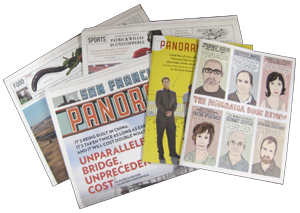


 is my favorite author, although searching back through my blog, it would seem I've never written about him before. I believe that when I last finished one of his
  , this blog did not yet exist, although it's hard to imagine going more than a year without reading something from him, seeing as he is so prolific. I am currently reading his newest book,
  . In it, Vollmann writes about his travels in Kirkuk, Sulaimaniya, and other places in the Iraqi part of greater Kurdistan, a nation that exists in the hearts of its inhabitants, if not on any recognized map. Kirkuk is too dangerous for an American journalist to stay in, so Vollmann repeatedly makes the journey there for the day, each time increasingly pushing his luck, especially as he continues to travel in the same car, and boldly, eat in the same restaurant. His fixer and his interpreter become increasingly nervous, and probably rightly so, as they have more knowledge of the kidnappings that occur in that region than Vollmann does.
 on Earth, and living to tell us all about it.

