Showing posts with label Bill Sienkiewicz. Show all posts

Sunday, February 8, 2015

Smoke/Ashes

Written by Alex De Campi
Art by Igor Kordey, Milton, Felipe Sobreiro, Carla Speed McNeil, Richard Pace, Dan McDaid, Mack Chatter, Colleen Doran, Bill Sienkiewicz, Alice Duke, Alem Curin, Jesse Hamm, James Smith, and RM Guéra

In 2013, Dark Horse published Smoke and Ashes in one volume, a nicely designed and chunky hunk of comics that has given me a lot of pleasure this week.  The two stories, both written by Alex De Campi, were separated by about seven years in their publication, with the second being the sequel to the first.

I decided it would be best to discuss each story separately, and to take a bit of a break between reading the two stories.

Smoke


I'd meant to pick this story up a number of times over the years, but I never saw more than the first issue, and didn't want to get swept up in a story I wouldn't be able to finish.  I'm glad I waited, as this was a very satisfying reading experience.

The story is set in a slightly into the future London (which, coincidentally, is more or less now, but would have been the future when De Campi wrote the story).  England is just about completely broke, and the IMF is poised to put their own measures in place to fix things.  A man named Lauderdale, who has the ear of the buffoonish Prime Minister, has a plan to fix things, and to profit for himself in the process.

His plot involves the kidnapping of the President of OPEC by an unwitting group of militant overweight people who want to use him as a bargaining chip in their quest for free plastic surgery in Argentina.  While the President is out of pocket, the plan is for OPEC to place England under a fuel embargo, which the government will be able to use to make a fortune on the futures market.

There are a couple of people who might be able to stop Lauderdale's plan, so he has them assassinated by a pair of freelancers who work for the government.  What he doesn't know is that one of his two targets is a close friend to Rupert Cain, the albino assassin he sent after the other target.  When Cain figures out what's happened, he makes it his business to avenge his friend.  Along the way, a journalist, Katie Shah, ends up working with him, at great personal expense.

The story is complicated, and I haven't mentioned the inclusion of a reporter who is covering the whole thing, the shadowy cabal that has been running England since the Second World War, nor the complicated relationship between Cain and his friend's daughter.  De Campi really packs a lot into the hundred and sixty pages that make up this story.

Things never feel complicated though, and Igor Kordey does a great job of helping keep things straight.  I've been a big fan of Kordey's work for a long time now (if all you've ever seen of his stuff is his New X-Men, you need to look at the rest of his body of work), so I really liked seeing what he did here.  Some of the action sequences, like the one where a group of killers try to take Cain out at a train station from the opposite platform, are incredibly impressive.

Ashes


Ashes is a very different beast than Smoke.  There was some sort of controversy about it involving Kickstarter and a falling out with the first artist De Campi worked with, but I don't remember what that was all about, and don't really see it as relevant to discussing the book.

It opens a few years after the events of Smoke.  London is not in great shape, but Katie Shah is even worse off.  After her involvement in the previous story, she's been effectively blacklisted in the field of journalism, and she's taken to drinking and sleeping with awful men.

In America, the body of No Face, the cyborg assassin from Smoke, is inadvertently given access to the Internet, and he transfers his consciousness just about everywhere.  All No Face wants is to get back at Rupert Cain, and when Katie calls him on a cellphone, Cain is back on the grid.

In surveillance-mad London, there is really nowhere to hide, so Cain and Shah go on the run, leaning on an old military connection of Cain's for help.  As the story progresses, we learn that Cain had a connection to No Face from one of his first missions.  We also learn, once again, that the people in charge of the world are pretty terrible.

This story felt less focused than Smoke, as De Campi develops characters in minor roles, like the pregnant widow of the first soldier killed by No Face.  She also builds up some interesting ideas, such as stem cell-grown pork farms that don't have any animals, which are tangential to the story at best.

This story was drawn by a very large number of talented artists.  It was cool to see an up-and-comer like Dan McDaid working alongside artists like RM Guera, Colleen Doran, Bill Sienkiewicz, and the fantastic Carla Speed McNeil (who has a series with De Campi coming at Image).  The transitions between artists could be jarring at times, but overall, this is a lovely book.

De Campi has not written a lot, but hers is a name that I'm seeing more and more often, from her upcoming Image work to her Grindhouse series at Dark Horse.  She's definitely a very talented writer, and I'm glad I've finally gotten around to reading her seminal work.

Monday, December 29, 2014

Hawken: Genesis

Written by Dan Jevons, Miles Williams, Khang Le, and Jeremy Barlow
Art by Fracisco Ruiz Velasco, Alex Sanchez, Kody Chamberlain, Sid Kotian, Bill Sienkiewicz, Bagus Hutomo, Michael Gaydos, Federico Dallocchio, Nathan Fox, and Christopher Moeller

I picked up two issues of Archaia's Hawken: Melee mini-series, because they featured work by Jim Mahfood and Nathan Fox, both of whom are on my buy-on-site list.  I was impressed with the depth of the Hawken world, and its celebration of war-suit pilots on a level we reserve for athletes, pop singers, and actors.

I don't play video games, and have no knowledge of Hawken outside of those two comics, but Hawken: Genesis caught my eye because of the lovely design work by Archaia, and because of the list of artists associated with the project.  It explains why the planet of Illal, a resource-rich colony planet controlled by various corporations, has become a blasted war zone, infected by a nano-virus that is taking over the surface.

The writers of this book focus the story around two men, Rion Lazlo, a ruthless corporate spy with unbridled ambition, and James Hawken, a brilliant scientist responsible for the best and worst advancements on the planet.  When the book opens, Hawkens is toiling away in obscurity for Sentium, one of the two big corporations that run everything on the planet.  Lazlo has defected to Prosk, Sentium's rival, and he manages to bring his friend over.

Eventually, Hawken develops the technology that allows for lightweight and fast mech devices, which are of course, immediately put into warfare.  As relations between the two corporations worsen, and as resource scarcity makes war more profitable, things just keep getting worse on Illal, although the depth of the problems take a while to be revealed.

This book follows these two characters over a few decades, setting up what I assume is the environment and rationale for the game to exist in.  The writers do a good job of covering the human and business reasons, and make good use of text pages to fill in some backstory.

The big draw to this book is the art, which is provided by comics artists as well as game design types.  Each chapter and interlude has been drawn or painted by somebody different, although there is decent visual stability throughout the book.  This was an impressive project, and I hope it's something that Archaia revisits.

Friday, May 4, 2012

Elektra Assassin #1-8

Written by Frank Miller
Art by Bill Sienkiewicz

I'm more than a little embarrassed to admit that I've never read Miller and Sienkiewicz's classic Epic comics mini-series Elektra: Assassin.  In my defense, I was eleven at the time it began, but was already a fan of Miller's writing on Daredevil and Sienkiewicz's crazy work on New Mutants.  I don't remember why I didn't read this book then (probably because I was a dumb kid), or why I never got around to reading it since.

This is a pretty insane comic.  The comic opens with Elektra institutionalized in San Concepcion, a small South American country that appears to be more or less run by the United States.  Within a short amount of time, she has escaped, assassinated an American ambassador, infiltrated a SHIELD base where work on creating cyborg agents is done, and has more or less exerted control over the mind of Dan Garrett, a SHIELD agent with a dubious past.

This comic has all sorts of things going on.  There is a devilish Beast who controls a Democratic Presidential hopeful (only in the 80s would it be the Democrats who are devilish), cyborg psychopaths, cloned blue dwarves, ninja, weirdly-shaped helicopters, big hair, and lots and lots of stream-of-consciousness text boxes.

It feels like Miller used this series to try out some new techniques and ideas about comics writing.  I'm not sure just how successful it was in terms of story, but this is the type of comic that gets judged more as an experience than as a linear story.  Sienkiewicz is at the absolute top of his game with this book.  His art is very 80s (just look at the character of Chastity McBryde), but also incredibly inventive and exciting. 

This is a canonical comic, even if it doesn't get discussed as much as Miller's other work. 

Wednesday, February 22, 2012

The Sandman: Endless Nights

Written by Neil Gaiman
Art by P. Craig Russell, Milo Manara, Miguelanxo Prado, Barron Storey, Bill Sienkiewicz, Glenn Fabry, and Frank Quitely

Back when it was coming out each month, like most readers who were looking for more from their 90s comics than shoulder pads and leg pouches, Sandman was one of my favourite titles.  In a lot of ways, it was Gaiman's series, alongside books like Starman and Sandman Mystery Theatre that kept me going through what I've come to recognize as comics' Dark Ages.  When the series ended, I felt like Gaiman had brought things to a nice, complete close.  A few years later, when the Endless Nights anthology was announced, I felt no need to dive back into his world (kind of like how I feel about Before Watchmen now).  I wasn't sure that there was any need to return to these characters, as anything new that would be said about them would be ancillary to Gaiman's original design and vision.

And then, I completely forgot that this project ever existed, until I saw a copy at a used book store a month or so ago.

While my original assessment, that the book wouldn't add anything necessary to the story of Dream or his siblings held true, it was really very nice to revisit some of these old friends, and to reminisce about how much this comic meant to me at a certain point in my life.

The book holds seven stories, one for each of the Endless.  It opens on a Death story, drawn by P. Craig Russell.  Like most people who read Sandman for the first time in their late teens, I always had a bit of a crush on Death, as she was shown in this series, so it was nice to see her again, in a story that is kind of predictable, but beautiful (thanks to Russell).

The best story in this volume is the Dream one (illustrated by Miguelanxo Prado).  It is set a very long time ago, and does more than any other issue of the series to remind us that the Endless exist in the DC Universe (at least, pre-New 52 they did).  Dream takes a mortal lover with him to a meeting of stars, who have taken human form.  We meet Rao, and the star of Oa, as well as our own sun, although he is still very young.  The story is full of interesting little Easter eggs for long-time readers, but also does a good job of reminding us what a bit of a tool Dream is.

This whole book has incredible art in it, from Bill Sienkiewicz's trippy Delirium story, to Barron Storey's haunting portraits of Despair.  Glenn Fabry's never been a favourite artist of mine, but his Destruction story works quite well, as does Milo Manara's story about Desire (who better?).  Frank Quitely's work on the Destiny story is beautiful, but the tale itself is just an epilogue to the book that isn't necessary at all.  I guess it's hard to write about a character like Destiny.

Anyway, I enjoyed this book quite a bit, and am now very tempted to re-read the entire Sandman series; something I've always wanted to do, but haven't been able to invest the time in.  I'm curious to see how they stand up now.

Monday, July 19, 2010

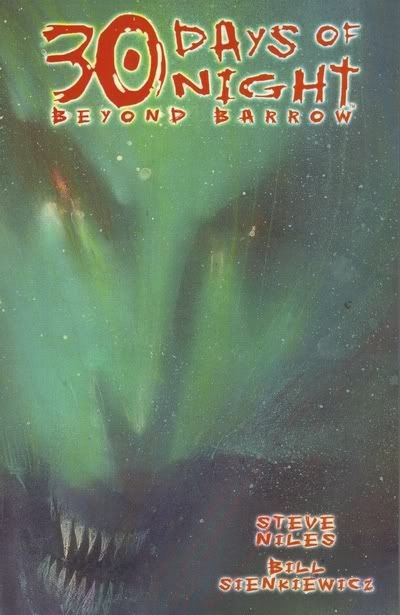
30 Days of Night: Beyond Barrow

Written by Steve Niles
Art by Bill Sienkiewicz

It's weird how I keep getting more 30 Days of Night collections, even though I'm generally unhappy with the series.  I know that the different series were really popular, and so I always assume that if I give the title another try, I'll be happy with it.  And I'm almost always proven wrong.

Here's what I've learned:  If it's a 30 Days of Night written by series creator Steve Niles, don't bother.  His writing is rushed and undeveloped, and he's really only capable of a couple of tricks, which get used over and over again.  If the book is written by someone else, like say Ben Templesmith or David Lapham, it's safe to buy.

So, knowing this, why did I buy this book?  Two reasons.  The first is that the art is by Bill Sienkiewicz.  I've been a Sienkiewicz fan since his run on New Mutants when I was a kid, and while his craft hasn't improved much since the Elektra: Assassin days, it's nice to see something new from him.  He has a few totally unreadable pages here, which is to be expected, but also some very cool images.

The second reason why I bought the book was because it was 75% off.  Good thing too, as it only contains three comics, and retails for $18.  That's $6 an issue, for anyone calculating.  Sure, there's a few pages of scripts, and some sketches, but really, what are they thinking at IDW?  I'm sure you can, with some hunting, get the original comics for a total of $3 on ebay.

As to the story?  It has a couple of nice moments, but it doesn't make sense.  Night has fallen in Barrow Alaska again, and some rich Hollywood types decide to fly in and see some vampires.  They piss off some townspeople, and then inexplicably drive off into the middle of nowhere to set up camp.  Then they get attacked by something other than vampires.  Then the book ends.  Blah blah blah.

That's it.  I swear I'm not going to buy any more of these - at least no more with Steve Niles's name attached.