Showing posts with label Jean-Pierre Pécau. Show all posts

Saturday, June 16, 2012

The Secret History Book 20: Watergate

Written by Jean-Pierre Pécau
Art by Igor Kordy

I was very surprised and impressed to see that the newest volume of The Secret History actually came out in the month that it was solicited for,something that I don't think has ever happened.  I was prepared to praise Archaia for finally getting their schedule in order, and figuring out their shortcomings.

And then I read the issue, and realized that for it to make complete sense, one would have had to have read The Secret History: The Games of Chance, a spin-off that was originally solicited as a five-issue mini-series, and then, after those books were ridiculously late, as a hardcover that has yet to appear.  According to Amazon, it was supposed to come out back in April...

Anyway, this is an interesting issue, as it incorporates the Vietnam War into the on-going struggle between the three remaining Houses of Archons.  The war brings with it a great deal of chance and unpredictability, which works wonders for the various players drawn to that conflicted zone.  We are introduced to a pilot named Chance, who appears to be flying for Air America, and doing a little drug running in and out of Laos on the side.  There is a German ex-SS officer there, playing Mister Kurtz.  Later, Stateside, Chance is involved peripherally in the Watergate scandal.

It feels like Pécau is using Chance to replace the character of Curtis Hawk, who would be too old to be of continued use in this series.  Now that the storyline has moved into a time that is more familiar, I find it much easier to follow, as it continues to jump all over the place, geographically and in terms of plot.

Thursday, April 26, 2012

The Secret History Book 19: The Age of Aquarius

Written by Jean-Pierre Pécau
Art by Igor Kordey

The second issue of The Secret History to come out this week is a much smoother read.  Perhaps it's just that Book 18 refamiliarised me with the world of the Archons and their centuries-long interference with human history, but I found that this is a much more balanced and readable volume.  It also checks in with more characters, and advances the plot much further.

This issue opens in 1968 with the assassination of Martin Luther King (all a part of Howard Hughes's plans), before moving over to check in with Reka, who is embracing the hallucinogenic potential of the time.  She finds that dropping LSD makes it possible for her to visit the lost city of Kor, and she plans a gigantic event that will let her tap in to the love energy and drug-fueled excitement of thousands of people to amplify her own trip (what is that event?  the cover makes it clear).

Curtis, now in his seventies, gets a tip as to the whereabouts of his enemy Kim Philby, and travels to Prague during the Prague Spring to take him out.  Dyo is also pulling strings in Prague, making sure that his Soviet Union gets what he wants.

Erlin, meanwhile, is trekking through the jungles of Mexico, searching for Mayan ruins, which predict the date of the end of the world, which also matches up with the predictions of his old friend Nostradamus.  As we all know, the date for this is set to take place this year, and unfortunately, the way things have been working at Archaia, we aren't likely to see another issue of this comic until after the world ends.

I have long enjoyed Igor Kordey's work on this series, and have used it as an example to counter-balance his vilification at the hands of American comics readers after his notoriously rushed issues of New X-Men, but was extra impressed by his work on this volume.  In addition to his usual pencils, he has also retouched photographs of Woodstock to fit with the needs of the story - I thought it was a cool change in the look of the book.

Wednesday, April 25, 2012

The Secret History Book Eighteen: The End of Camelot

Written by Jean-Pierre Pécau
Art by Igor Kordey

It's been four months since the last issue of The Secret History came out, and now this week, Archaia decides to release two issues at the same time - one that was supposed to come out in November of last year, the other December.  I know that sometimes companies that are trying to get caught up will release two issues of the same comic in the same week (Marvel did it a little while back with Captain America), but this book is $6 an issue, so that's a little rough on peoples' wallets.  Especially when it could be another four or five months before the next issue comes around - why didn't they simply warehouse it for three weeks or so?  I'm never going to understand the way Archaia does business.

Case in point:  This issue references things that happened in the Games of Chance spin-off mini-series, which was supposed to come out months ago, and then was canceled and resolicited as a single hardcover, which hasn't come out yet. This is especially egregious when you consider that this is one of the most continuity-drenched, complex comics published.

This particular volume has two points of focus.  It opens with the story of a mysterious artifact that has been lost in Lake Meade, near the Hoover Dam.  It causes strange happenings in Las Vegas, downriver, and later affects the behaviour of the Lake's most famous resident - Howard Hughes, who wants to assassinate JFK.

The other story that takes up most of this book is that of recurring character Curtis Hawk, who is still hunting St. John Philby, and his son Kim, who were responsible for the death of his wife.  Curtis has been the most accessible character in this book to date, so it's good to see him, at an advanced age, keeping up the good fight.

This book is always a dense and complicated read, but I enjoy it for that.  Kordey's art feels looser in this issue.  Now to go read the other one that came out...

Wednesday, December 14, 2011

The Secret History Book Seventeen: Operation Kadesh

Written by Jean-Pierre Pécau
Art by Igor Kordey

I really have no idea what's going on with Archaia, but it's nice to see that they are publishing books again, and it's always nice to see another issue of The Secret History.

This is probably the most sprawling and complex comic I've ever read.  This issue alone takes place in Egypt, Soviet Russia, Hungary, and the US, with further discussion of events in Lebanon, Korea, and Israel.  The series has followed the established events of human history, and worked them into an alternate history, founded on the existence of four (now three) Archons, powerful immortal beings that are able to use four rune stones to magical effect.

Now, in the post-nuclear world, the remaining Archons are losing their influence on events (Erlin even gets tossed out of the White House by Richard Nixon), but are still finding themselves involved in the course of history.

Much of this particular volume is confusing, as the story flits from location to location, without centring for very long on any one character or group of characters.  Once the comic decides to focus on the events of the Soviet takeover of Hungary, things improve considerably.  The introduction of Lizbeth, a Hungarian Roma player (in other words, a person with abilities) helps ground the story, and make things much more interesting.  I hope we see more of her in the next issue (whenever that gest published - there is as much chance of it coming out next week as next June).

As always, Igor Kordey does a terrific job of keeping this massive cast of characters straight, while still creating some dynamic pages.  This is a fascinating book, but sometimes reading it really feels like work.

Tuesday, August 23, 2011

The Secret History Book Sixteen: Zion

Written by Jean-Pierre Pécau
Art by Igor Kordey

What I like most about this title is that it asserts, with almost every issue, that history is important.  Now that the storyline has moved into the post-war, early Cold War days, Pécau is mining the events of earlier issues to help provide context for these current ones.

Now that the Archons have lost one of their number, they need to redivide the city of Jerusalem, which has always belonged equally to all four (each getting one of the historic quarters).  The problem now, is that humanity has moved beyond the Archons, and no longer feels the need to bow down to their guidance or counsel.  In other words, the 'American Century' is under way, and we all know what it's like to try to tell Americans something...

Actually, it's a little easier than trying to tell something to the Israelis, which is also documented through the actions of Adam and his band of fighters (who were introduced last issue).  They are now fighting against Jordanians, and require the help of their friend from the war, our recurring hero Curtis.  He is also in Israel, working as a mercenary, and he makes a pretty significant break with Reka.

As always, a lot happens in this issue, but it doesn't suffer from the occasional lack of coherence that often plagues this comic.  Of course, even when it's at its most confusing, I still enjoy it, because, as someone with a degree in history, I appreciate the importance it gives it.

Thursday, June 30, 2011

The Secret History Book Fifteen: The Amber Room

Written by Jean-Pierre Pécau
Art by Igor Kordey

Okay, is it a cash flow problem at Archaia that causes their translated, previously published books to be so late?  It's been ages since we've last seen an issue of The Secret History, and watch - there's going to be another one in two weeks or so; there would pretty much have to be, if they plan on catching up with their publication schedule, as they still solicit this book like it's a monthly, even though they are about six months behind schedule.

Anyway, it's The Secret History.  It's always good, if pretty confusing.  This issue is concerned with the beginnings of the Cold War, as the American and Soviet occupying forces continue to try to extract as many powerful artifacts out of Germany as they can.  This time around, the object of desire is an 'amber room', which does some stuff I didn't fully understand.  Among the players in this issue are a group of Jewish partisans who walked across Nazi Germany, fighting for their lives the whole way.

As always, Pécau does an incredible job of weaving his fictional world into our historical record, and Kordey continues to draw the hell out of the book.  I do wish that the pace would pick up a little, but I enjoy reading this series (when it's published).

Wednesday, January 19, 2011

The Secret History Book Fourteen: The Watchers

Written by Jean-Pierre Pécau
Art by Igor Kordey

This issue of The Secret History is vastly different from all the previous ones.  Usually, any given installment of this long story that spans the entirety of human history will contain a few sub-plots, as well as check in on the Archons or some of the major players that have been introduced since the second volume began.  The Watchers really only tells one story - that of Daniel Rosenthal.

The story is set in Paris in the days immediately following the end of the Second World War.  Much of Paris is rubble, and whole neighbourhoods stand empty, as very few people have returned to the city yet.  Rosenthal was a shady art dealer before the war, most of which he spent locked up in a German concentration camp.  While at the camp he met Robert Desnos, the Surrealist poet, who gave him a Tarot card, or 'blade' in the parlance of this series.

Now, Rosenthal, a morphine addict and generally hopeless figure, finds himself caught up in the usual drama that revolves around runes and taro in this comic.  There are a number of organizations, including Opus Dei, trying to track down any extant cards, especially the Surrealist deck we saw Reka commission a while back.

This issue is pretty interesting for the way it portrays Paris, wraps up a few plotlines from the rest of the second volume of this series, and starts to set up the new status quo for the next big story.  Reka and Erlin are being shunted to the side as the modern age gets under way, and I find myself more interested in this comic than I have been lately.

Thursday, December 16, 2010

The Secret History Book Thirteen: Twilight of the Gods

Written by Jean-Pierre Pécau
Art by Igor Kordey

A new issue of The Secret History is always a good thing, even as the story becomes ever more complex and self-referential.

This volume covers the end of the Second World War, as Sicilian cosa nostra try to get the Ark of the Covenant to the Americans, who at the same time are working on ways to shut down William of Lecce's weather weapons program.  We also get the bombings of Hiroshima and Nagasaki.

The coolest part of this comic has always been the way in which Pécau works real historical mysteries and oddities into his gigantic narrative in a way that more or less fits with the story's internal logic.

I look forward to seeing this run end with the next issue, as we get ever closer to modern-day events.  I feel like this series has gone a long way to redeem Igor Kordey in the eyes of fans who hated his work on Grant Morrison's New X-Men run.

Thursday, November 18, 2010

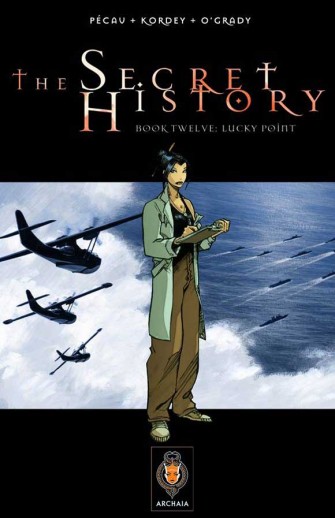
The Secret History Book Twelve: Lucky Point

Written by Jean-Pierre Pécau
Art by Igor Kordey

It's been quite a series of treats this week with so many overdue Archaia titles dropping at the same time.  This latest issue of The Secret History continues to impress, but I have a big complaint about this issue, which I feel I need to address before I can talk about the comic itself.

My issue is that Archaia has dropped the quality of the cover stock.  That in itself is not so much the problem, but they've gone with the type of cover that is easily marked with fingerprints on the black surfaces, which is most of the cover.  My copy was covered in prints, and although I was careful in reading it, I added more than a few.  I'm not all that particular about keeping my comics in hermetically sealed environments, but I do like to keep them looking attractive, and that didn't happen with this one.  Okay, rant over.

The comic itself is pretty good.  The Secret History is an exceptionally complicated title, and so it's hard to keep on top of everything when there are delays of many months between issues.  The story is still set in the Second World War, as the different Houses jockey for position.  With this issue we get the full story of the Battle of Midway, learn one of the true goals of the Holocaust, and get to see some bombers blow up a dam, while quoting Star Wars (a really nice touch, I thought).

This is a very cool series, which really should come out more often.

Thursday, July 8, 2010

The Secret History Book 11: Nadia

Written by Jean-Pierre Pécau
Art by Igor Kordey

It's been only two weeks since the last issue of this book came out, which is impressive.  I'm glad that Archaia's so on the ball these days, although I'm wondering what's up with Okko...

Anyway, the first few pages of this volume were, I think, written just for me, as Pablo Picasso visits a secretive brothel, the cost of admission to which is a card with a picture on it.  This is because Reka's putting together a new deck of cards, and to finish it, she has recruited a group of artists that include Klimt, Man Ray, Dali, and Egon Schiele (who didn't die of the Spanish influenza!).

The name-dropping doesn't end there, as Pécau uses this issue to explain a large number of strange events from the early days of the Second World War, such as the utter destruction by the Nazis of the village of Lidice, a bizarre meeting on the Isle of Man with Churchill, and the mysterious death of a person informing on Meyer Lansky.

The story jumps around quite a bit, but there are some seriously pivotal scenes in this issue, as both the War and the game continue.

Saturday, June 26, 2010

The Secret History Book 10: The Black Stone

Written by Jean-Pierre Pécau
Art by Igor Kordey

I love that Archaia has sorted out all of their production problems and that this book has become reliably monthly.

With each issue, I've been enjoying this comic more, as the time gap between issues has been shrinking, meaning that the same characters appear in multiple volumes.

This time around, Pécau has set his story in 1926, a year of revolution in many corners of the world.  The first half of the book deals with Saud's conquest of Arabia, with the help of Philby, the player from a few issues ago.  The second half returns us to Itzak, the former apprentice to a rabbi, who is now caught up in the conflict between various groups in early-Soviet Ukraine.  Everywhere around him are Reds, Whites, kulaks, and partisans.  He is following the path of the crooked cross (ie., the swastika), and is pursued by Baron von Sebottendorf, his long-time rival.

Interestingly, this issue didn't feature any of the Archos, the four central characters, instead choosing to focus on their 'players' and operatives, who are seeking new avenues of power.  I love this kind of meticulously researched historical comic, and look forward to seeing Pécau deal with the Second World War, an event he has been anticipating in the comic for some time.

Saturday, May 29, 2010

The Secret History Book 9: The Thule Society

Written by Jean-Pierre Pécau
Art by Igor Kordey

It was a huge surprise to see the newest volume of this series out so soon after the last one.  I guess this is definite proof that Archaia's got their stuff together again, which is great for us.

Now that The Secret History has moved into the twentieth century, the story is slowing down by quite a lot, which only makes sense in that most packed century of human existence.  The Great War is over, and the Archons are now trying to gather up the new rune stones discovered at Kor.  Three of the houses now stand together, while Dyo and William of Lecce unleash the Spanish influenza on the world and build up their semi-secret Thule Society into a pre-Nazi organization.

The Secret History has always been about the power of symbols, so it only makes sense that 20th-Century Germany be the main battleground for what comes next, and that Hitler be a major player, even if he is never mentioned by name in this issue.

Where before I was often unsure of this title, now that it's so firmly grounded in events that are more familiar to me, I find it am enjoying it more and more.  As the pace of the book slows a little, the secondary characters get developed a lot more, and this makes the book more interesting for me.  I hope it sticks to a schedule like this too...

Saturday, May 8, 2010

The Secret History Book 8: Seven Pillars of Wisdom

Written by Jean-Pierre Pécau
Art by Igor Kordey

I think it's cool that this new issue came out the same week that I finished reading through the entire run for the first time.  And I have to say, this is my favourite issue so far.

This time around, the focus in on the discovery of the ancient city of Kor in the Arabian desert by St. John Philby, a double agent allied with both Aker and Dyo's houses.  In Kor, he finds a new set of runes, just as powerful as the ones used by the Archons. This story is set during the closing days of the Great War, as Aker and her pilot from book seven join up with Lawrence of Arabia to hunt down Philby.  This issue also addresses the issue of William of Lecce.

What I like best about this is that the story takes the time to develop the ancillary characters a little more, and because it is much less Euro-centric than the previous volumes have been (not including the first).  I also like that the price has dropped, making this the best buy I picked up this week.

Tuesday, May 4, 2010

The Secret History Book 7: Our Lady of the Shadows

Written by Jean-Pierre Pécau
Art by Igor Kordey

I've written before about the depths of my interest in the First World War, and really, it was this issue that had me most interested in reading The Secret History from the beginning.  The Archons found their power base much diminished in the flight from monarchy that happened during the later 1800s, and had little influence left in Europe before the coming of war.  With the outbreak of hostilities though, all four Archons get involved, as does Dyo's partner William of Lecce.

The result is a bloodier and more vicious war than we are used to reading about.  In addition to the hideous new weapons man invented on his own, we have dragons and other creatures fighting on the side of the Germans.  Actually, the early scene where a dragon goes after a biplane reminded me a little of the Busiek/Pacheco classic Arrowsmith series, which I miss.

This volume suffers from the same fault as the earlier ones - it jumps around and never gives characters enough time to be developed.  It seems that the Archons are always making use of earnest young men who get paired up with mercenaries - there is an extended scene at the Somme that reminds me of the Nostradamus issue.

At the same time, setting a comic in some trenches is always enough to make me happy...

Monday, May 3, 2010

The Secret History Book 6: The Eagle and the Sphinx

Written by Jean-Pierre Pécau
Art by Igor Kordey

Much like the previous books, this issue is a mélange of characters, real and imagined, mashed into a story without enough backstory or identification for the casual reader to easily follow.  I feel like this series has been a disappointment to me, as I had expected a great deal from it.  I love the central concept - that four immortals have been guiding the hand of Europe over centuries as they war with each other.

The truth is though, the comic is a little boring.  The four main characters, the Archons, have never been developed to the point where a reader might care for them, or be able to distinguish between them by their personalities (with the exception of Dyo).  The other characters that flit in and out of the book are equally ciphers.

It's too bad, because like I've said a few times, the concept is killer.  This issue has Napoleon breaking from the Houses and trying to amass power for himself by traveling to Egypt and the site of the battle in the first issue.  The next issue is set during the first world war, which is a favourite topic of mine, so we'll have to see how that works.

Tuesday, April 27, 2010

The Secret History Book 5: 1666

Written by Jean-Pierre Pécau
Art by Leo Pilipovic


I'm enjoying this book still, but I find myself liking it more for its potential than for what I'm actually reading.  The idea of four immortal beings meddling with the totality of human (okay, European) affairs for centuries is not exactly a new concept, but it is a sound one.  That it is being handled with such meticulous research and care should make it much better than it is.


This issue has two immortals fighting against zombie creatures in the basement of the Hellfire Club, with the help of Isaac Newton, who has phosphorus guns.  How can that not be straight up incredible comics?  But it's a little dull.  There is a little too much emphasis on showing how well researched everything is, and the author has kind of forgotten to let the characters drive the story.  Each of the Archons, with the exception of the vampiric Dyo, are ciphers, and it's too late in the story for them to not be developed beyond simple labels like 'the angry one'.  (Maybe they should just wear coloured rings?).


Anyway, it's still an impressive comic because of the scope of what Pécau is trying to achieve.  The art is not as good as it was under Kordey or Sudzuku, but it's manageable.

Saturday, April 24, 2010

The Secret History Book 4: The Keys of Saint Peter

Written by Jean-Pierre Pécau
Art by Leo Pilipovic

I'm finding, as I'm getting closer to historical eras I'm more familiar with, my enjoyment of this title is going up.  Perhaps some more exhaustive footnotes or endnotes explaining some of the historical context would have been helpful; I don't know if that was done for the collected edition.

This issue has Nostradamus, a servant of Aker's House of the Sword, traveling with a group of  Swiss mercenaries to discover the identity of the person creating Ikons, symbols which represent the same powers as the Runestones, in Rome.  Of course, war is breaking out, as is plague.  The maker of the Ikons, Cellini, works with Nostradamus to fight off Dyo's soldiers, and there is the usual mayhem.  Add to this the possibility of a fifth Archon existing, and things start to heat up even more.

The art in this issue is handled by Leo Pilipovic, an artist I am unfamiliar with.  He works in what I've come to recognize as the standard French style, and the art is consistent with the issues that have come before.

Sunday, April 18, 2010

The Secret History Book 3: The Grail of Montségur

Written by Jean-Pierre Pécau
Art by Goran Sudzuka and Geto

This is a little more like it, after the confusion of the last issue.

This time around, the battle lines are much more clearly defined: Reka is tight with the Pope and is attempting to influence the development of most of Europe, while her sister Aker is hooking up with the Holy Roman Empire, along with her brother Erlin, in an attempt to usurp her power, and to keep the Chalice runestone out of Dyo's hands.

A lot more happens this time around too, as the Chalice stone is recovered, and the Cathar order, which has been charged with its protection, is wiped out.

As with the last issue, this is a period of history I know very little about, and so many of the casual references go right over my head.  Still and all, it's an exciting story, and I enjoy the high level of planning that has obviously gone into it.

The art this time around is by Goran Sudzuka instead of Kordey, although he is drawing in a style very similar to Kordey's, so the transition is barely noticeable.  There are two sequences set within a 'magical' woods, which are drawn very differently, which was a nice effect.

Thursday, April 15, 2010

The Secret History Book 2: Castle of the Djinns

Written by Jean-Pierre Pécau
Art by Igor Kordey

This issue was a little disappointing compared with the first volume.  I found that it was a little harder to get a sense of who the characters were, and in some scenes, I really didn't know who I was looking at.  That's not just a fault of the artist, it has a lot to do with the lack of exposition as the story unfolded.

Now, I'm freely admitting that some of that confusion may be blamed on my ignorance of the time period depicted; the extent of my knowledge of the crusades comes from reading Tariq Ali's "The Book of Saladin."  I don't know who Renaud of Châtillon is, nor do I know very much about the Knights Templar and the Grail quests of that time.  This book was originally published in France, where I would assume some of this is taught as part of the basic school curriculum.

The other issue I had with this book is the amount of time that has elapsed between volumes, and the incredulity of the concept that Djo's runestone would have remained hidden for such a long stretch.

Once I look past that, the story is still intriguing.  I see that the next issue stays in the same time frame and geographic location, so perhaps more will become clear.

Wednesday, April 14, 2010

The Secret History Book 1: Genesis

Written by Jean-Pierre Pécau
Art by Igor Kordey

This was a project that interested me right from the first time I'd heard of it, but for whatever reason, I never picked up the first issue, and then didn't want to read the rest of the series out of order.  Now that the series has been published in omnibus format, it seems that a few people are unloading the original issues on Ebay.

The premise behind The Secret History is that four siblings hold four runestones of immeasurable power.  They were given them by a dying tribal elder (this all happened five millennia ago), and this guy warned them that one person can never use the stones at the same time (regardless of the fact that he was wearing them all).  When they ignore his advice, they set off a minor cataclysm, and set humanity back some.

After that, the story jumps to Egypt in 1350 BCE, as Moses is having his conflict with the Egyptian Pharaoh.  Through reading this story, we learn that the two brothers from before are working behind the scenes, supporting the two sides, and manipulating events as the one attempts to gain power from the other.  It is through the power of the runes that the Old Testament miracles, such as the parting of the Red Sea, really occur.

I'm always a bit of a sucker for these types of alternate history books, where we learn the true cause of events.  I also like the idea that the series is set around the premise of revealing how the rivalry and distrust of these four siblings has shaped human history and politics.  It's a golden concept, and it plays out well here.  This volume reminded me very much of the earlier Archaia graphic novel The Lone and Level Sands, which also retells the Moses myth, although from a very different vantage point.

Pécau's writing works well, and I like Igor Kordey's art here.  I know he is an artist that gained a certain level of notoriety for his often-rushed work on Grant Morrison's New X-Men, but his stuff looks really good here.  I found in the preview that he was channeling some Barry Windsor-Smith kind of aesthetic, but the Egyptian scenes were much more in his own style.  Looking forward to Volume 2....