Showing posts with label Christopher Golden. Show all posts

Saturday, June 23, 2012

Baltimore: Dr. Leskovar's Remedy #1

Written by Mike Mignola and Christopher Golden
Art by Ben Stenbeck

As part of the continuing glut of Mike Mignola-written comics coming from Dark Horse this year is a new Baltimore mini-series, featuring the angry vampire hunter who is searching the world for the vampire who killed his family.

This two-parter opens in a small fishing camp in Croatia.  Baltimore crashes into the beach when his airplane comes under attack, and is recovered by the locals.  He learns that their village has fallen victim to the horrors unleashed by a Dr. Leskovar, who has been trying to cure vampirism.  Baltimore being Baltimore, he soon enough sets out for the village, looking to kill the monsters that Leskovar unwillingly created.

This is the third mini-series to feature Baltimore, and they all more or less follow the same formula (Baltimore shows up in a place plagued by monsters, deals with them, finds clues to the location of Haigus, the vamp he's pursuing, leaves).  This looks to be the same kind of thing.

I really enjoy Ben Stenbeck's art in this series.  He does a great job of capturing the bleakness of the Croatian coast, and manages to sneak some crabs onto just about every page.  I was a little surprised to see that Baltimore is fluent in Croatian, but otherwise, this is a good comic.

Thursday, November 10, 2011

Baltimore: The Curse Bells #4

Written by Mike Mignola and Christopher Golden
Art by Ben Stenbeck

The character of Lord Baltimore, the one-legged vampire hunter who is the star of this Mike Mignola title that is not set in the Hellboy continuity, has stayed more or less a cipher since he was introduced to comics with his last mini-series (I still don't know about how he was portrayed in the novel).  Sure, we've learned why he is on such a single-minded quest for revenge on the vampire Haggis, but we know very little about his character.

Some of who he is stands revealed with this issue, where he is given a choice.  He has the opportunity to kill Haggis, and thereby complete his mission, or he can stop the recently returned Madame Blavatsky from cursing the bells in the large church complex where this story is happening, and thereby save thousands of people from a life on ensorcelled servitude.  In most comics, the decision would be clear, but in this one it's not.

Mignola and Golden have built up a nice scenario for this character, and it helps the reader learn a lot about him.  The rest of the comic plays out like many Mignola comics do - it's heavy on symbolism, with a hint of pretension about it (especially when the guy trying to take power quotes Poe at length), but it's a very good read with nice, moody art.


Wednesday, September 14, 2011

Baltimore: The Curse Bells #2

Written by Mike Mignola and Christopher Golden
Art by Ben Stenbeck

When in the mood for melancholic, uber-gothic vampire comics, you can't go wrong with Baltimore.  In this issue, we are really treated by artist Ben Stenbeck to a number of fantastic visuals, as Lord Baltimore investigates a convent that had been taken over by his enemy, Haigus, although that's not the case anymore.

There are great scenes of Baltimore infiltrating the convent as the nuns stand sentry on the roof.  There's an even better scene, where Baltimore and his new companion, the journalist Hodge, attempt to consecrate their weapons at a church, only to learn that it has been taken over by another entity.  I also loved the shout-out to Madame Blavatsky.

In a lot of ways, I find that I prefer Stenbeck's brand of creepiness to Mignola's.  They are similar artists, but having seen Mignola work on much the same stock of images for so many years, Stenbeck's approach feels fresher and more interesting.

Despite having collected comics my whole life, I've never started collecting original artwork, and have only rarely felt the need to.  That said, I would love to own the last page of this comic.

Tuesday, August 23, 2011

Baltimore: The Curse Bells #1

Written by Mike Mignola and Christopher Golden
Art by Ben Stenbeck

I don't know that I was exactly clamoring for another Baltimore comic, but it seems that the Mignola comics machine is trying to maintain a greater output these days, with Baltimore and Witchfinder trading story arcs as the two outliers of the Mignola-verse (and yes, I know that Baltimore is not set in the same continuity as everything else, thank you).

I enjoyed the first comic arc (never read the novel) well enough, but appreciate the fact that I know what's going on, and who is who in this new series much more.  The first series didn't explain things until a few issues in, and it was confusing.
Lord Baltimore is still pursuing Haigus, the ancient vampire who ruined his life, and is still coming across traps the creature has left for him.  Some stuff happens in a small town in Switzerland, but of course, that's just the pre-credit action sequence.  Later, still on Haigus's trail, Baltimore meets an American journalist who knows a few things about vampires and the other creatures awakening on the Earth.  Baltimore needs this kind of character - the man barely speaks, so this new guy will provide most of the explication as we go along.

Ben Stenbeck's art looks different here.  It's looser and more open than before - it feels like he's less concerned with staying within the Mignola house style (which is pretty broadly defined), and is making the book a little more of his own.  Strangely, that sometimes means that Baltimore takes on a Munch-ian quality, but that would go away were he to allow his hair to grow.

Saturday, December 4, 2010

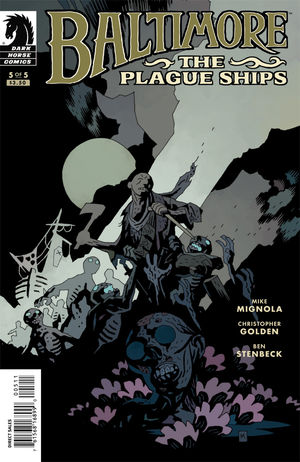
Baltimore: The Plague Ships #5

Written by Mike Mignola and Christopher Golden
Art by Ben Stenbeck

This first Baltimore series finishes very well.  These five issues have left us with a well-established character, threat, and environment, and have set the stage for (hopefully) many more stories, but have also told their own story quite well.

With this issue, we get the final pieces of Lord Baltimore's story, as he finishes narrating it to his young companion, and we see him square off against a ton of plague-risen zombies on an island filled with wrecked boats and submarines.

Stenbeck does a great job designing all manners of Victorian diving suits for his zombies to inhabit, and generally gives the comic a terrifically creepy feel.  I like that this series is set outside of the Hellboy/BPRD continuity.

Saturday, November 6, 2010

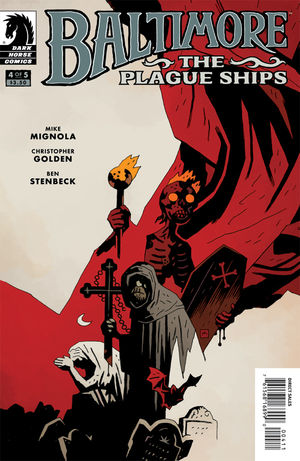
Baltimore: The Plague Ships #4

Written by Mike Mignola and Christopher Golden
Art by Ben Stenbeck

Mignola and Golden have taken an interesting approach to this comic.  Instead of starting the story with the character's beginnings, they have instead been portioning out Lord Baltimore's back story in small chunks, starting with the second issue.  I know this isn't necessarily a new technique, but I find that it is is a strange way of doing things with such a new character whose story has already been told in another medium (there is a novel), which I would presume most of the readership of this comic never read (like me).

It led to the first issue being confusing, although now I find the series to be much more compelling, as I feel more sure of the ground that we're on.

In this issue, Baltimore and Vanessa, his companion, are still stuck on the creepy island with a bunch of wrecked ships that we saw last month.  With no imminent rescue on the horizon, Baltimore continues to tell her his life story, this time talking about the events that took place when he returned home to his ancestral island.  The story is pretty predictable, but Mignola and Golden write it well, and Stenbeck's art is fantastic.

Friday, October 8, 2010

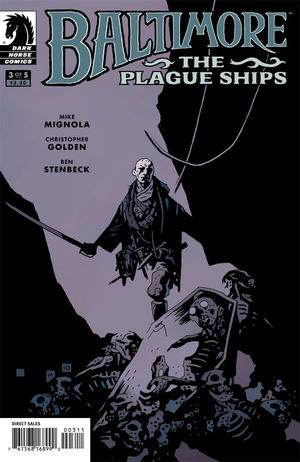
Baltimore: The Plague Ships #3

Written by Mike Mignola and Christopher Golden
Art by Ben Stenbeck

When this title started, I was impressed by the art and the strong storytelling, but I was pretty lost as to the character of Lord Baltimore, mostly because I'd never read the novel where he debuted.

Over the last two issues of this comic, the authors have filled in most of the important information about his character, and this issue contains a revelation about the genesis of the plague that has swept the world, effectively ending the Great War.

At first, I assumed that this comic would have Baltimore in conflict just with vampires, but Mignola and Golden are giving us a much wider range of creature than that.  This issue has strange floating jelly fish which are reminiscent of the War of the World Martian ships, as well as zombie-like creatures and creepy purple fungus.

Stenbeck's really hitting it out of the park with this title.  The scenes set amid wrecked submarines are seriously foreboding.  If you are not a reader of Mignola's other titles, this is a nice introduction to his aesthetic, as Baltimore is not a part of that shared universe.

Friday, September 3, 2010

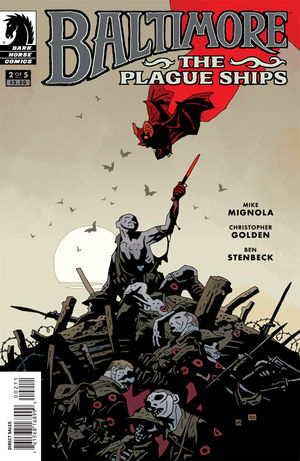
Baltimore: The Plague Ships #2

Written by Mike Mignola and Christopher Golden
Art by Ben Stenbeck

There's a lot to like in this issue of Mignola and Golden's first Baltimore comic, as the backstory to the character starts to get explained, as Lord Baltimore and his new friend give chase to the scarred vampire that eluded him last issue.  I originally expected that this whole comic would be set during the Great War, and was surprised when I learned last issue that the war had ended (in 1916 no less).

With this issue, we see Baltimore's experiences in the war, and his first encounter with the vampires who fed on the battlefields.  We also learn why he has a wooden leg.

Much of this story is told without dialogue or with minimal writing, giving Ben Stenbeck plenty of opportunities to show off his gloomy, atmospheric art.  I'm sure that a lot of research would go into drawing a book like this, and the attention to detail really shows through when reading this.  I'm eagerly looking forward to the next issue.

Thursday, August 5, 2010

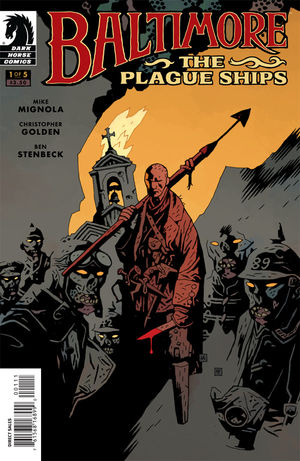
Balitmore: The Plague Ships #1

Written by Mike Mignola and Christopher Golden
Art by Ben Stenbeck

This new series tosses us into the story pretty quickly without explaining a lot of things, but here's what is made clear:  The Great War ended early because of a plague, and there are vampires feeding off the infected towns.  This Baltimore guy, who has a wooden leg (which doesn't slow him down at all) is chasing the vampires, specifically looking for one with a scar on his face.

He almost catches up with them, but lightning strikes the dirigible that they are using to escape, and he meets with an old woman who might or not be a witch, before being put in jail, accused of witchcraft his own self.

This comic is apparently a follow-up to a novel that Mignola and Golden wrote featuring the same character, and this is supposed to happen between the scenes of the book, which is a little annoying for people who haven't read it (like me).  However, this is a very cool comic, with vampires running around in Prussian helmets, and fantastic Ben Stenbeck art.  While a little more exposition would have been helpful, I'm definitely on board for the rest of the series.

Monday, February 8, 2010

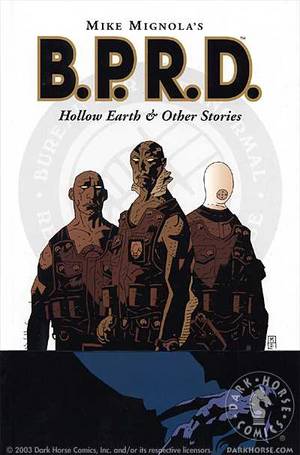
BPRD Vol 1: Hollow Earth & Other Stories

Written by Mike Mignola, Christopher Golden, Tom Sniegoski, and Brian McDonald
Art by Ryan Sook, Curtis Arnold, Matt Smith, Mike Mignola, and Derek Thompson


I've written before about how I have been curious about the Hellboy universe, and have dabbled in it over the last couple of years, with mixed results. I've come to realize that I'm more interested in the Bureau for Paranormal Research and Defense than I am Hellboy, so I picked up the first trade to see what I thought.

I found this book to be pretty enjoyable. The main story features Abe Sapien working with Roger the Homunculus and newcomer Johann Kraus to travel deep into the earth to rescue Liz the firestarter girl. The plot seems pretty standard for this comic, but it is the way that the three writers allow the story to be strongly character-driven that made me want to keep reading. Ryan Sook's art is very nice. This is early work from him, and that he was heavily influenced by Mignola is evident on every page.

Later in the book is an Abe Sapien solo story concerning strange possessions at sea, which is also well-written and very well-drawn. There are a couple of other short stories as well, which I also enjoyed.

In all, I'm afraid I might be a new convert to this series. I did pick up a few more single issues at a sale recently, so I'll see how they go before I start investing heavily in this book.

Monday, September 14, 2009

Blade Black & White

Written by Marv Wolfman, Chris Claremont, James Felder, and Christopher Golden
Art by Tony DeZuniga, Rico Rival, Gene Colan, Ladronn, Juan Vlasco, and Mark Pennington

Okay, this is a weird one. It's like Marvel was looking to cash in on the movies or TV show or something, and decided to take some uncollected Blade stories from their black and white 70s magazines, and then to make it a thicker book, a couple more random books from the late 90s, and print them together. There are some thematic similarities (aside from vampires, wooden knives and an ugly costume) across the stories, except for the Ladronn one, which contradicts what happens in the others.

The 70s stories are exactly what you'd expect. They make more liberal use of the word 'blackie' than my modern sensibilities are used to, and are incredibly heavy on the melodrama. The art is problematic - it's only lightly inked, if at all, and the reproduction looks like it's a photocopy of a photocopy on some pages.

The Felder/Ladronn story is downright strange. It doesn't fit with the rest of the book, and seems to end with Blade's death - a fact not explained in the subsequent story where he's fine.

The final story is the best of the bunch, and that's largely due to Gene Colan's beautiful (and fully inked) artwork. This is a conscious attempt to clean up dangling plotlines from twenty years previous, and it kind of reads like that.

This book came as a freebie from the guys at Labyrinth, and while I enjoyed reading it, I can see why most of these stories had not been collected before.