Showing posts with label History. Show all posts

Saturday, September 8, 2012

Tecumseh & Brock: The War of 1812

by James Laxer

It's not much of a surprise that this year would see a plethora of new books examining the bicentennial of the beginning of the last war fought on Canadian soil.  The War of 1812 was really a conflict between America and Britain, and between America and a loose confederacy of Aboriginal nations, but Canada became the setting for much of the conflict.

In James Laxer's new book, Tecumseh and Brock, he sets out to examine the two title figures - Tecumseh, the charismatic leader of the Aboriginal confederacy, and General James Brock, defender of Upper Canada.

The problem with the book is that both of these august men did not live too long once they entered into the conflict, and while they are both without doubt among Canada's greatest heroes, their influence on the war did not outlive them for long.

Laxer is at his best in the beginning of the book, when he writes about the world into which Tecumseh was born.  The Shawnee, his people, found themselves embroiled in the Endless War that began with Europeans arriving in North America.  Hounded and displaced, Tecumseh (and his brother) was one of the most influential leaders to unite his people and resist American expansionism.

I enjoyed reading this book, as it served as a good overview of the war, but the title does not match the content.  After Brock died in 1812, and Tecumseh a year later, the war and the book both carried on, through the Treaty of Ghent and the cessation of hostilities in 1815, which resulted in a reversion to original territorial holdings, a set idea of where borders would lie in the then-upopulated West, and a complete abandonment of the Aboriginal people south of the 49th parallel by England.

Laxer's writing is clear, if a little stiff in places.  He doesn't propose any new theories of the war, nor does he indulge himself in creative prose.  This is a straight-up history book, and there's nothing wrong with that.

Tuesday, April 17, 2012

Lewis & Clark

by Nick Bertozzi

As much as I enjoy learning and reading about history, I am pretty ignorant of much of American history, mostly because I'm Canadian.  For example, I knew that Lewis and Clark were two guys who traveled to the West, and who made first contact with a number of Aboriginal nations, but I didn't know much more than that.  Enter Nick Bertozzi's graphic novel, which renders their story in a palatable package.

In Lewis & Clark, Bertozzi shows these two famous and revered explorers as real people, and while he condenses both their journey and much of the historical context that surrounds it, he manages to deliver a chronicle that captures the sheer difficulty of their mission, and the substances of their character.

Meriwether Lewis was selected by Thomas Jefferson to find a river route across the American continent to the Pacific.  Lewis chose as a partner his old friend William Clark, and after a lengthy period of procuring resources and men, they set off.  The land they traveled through belonged to a variety of Aboriginal nations, with their own political agendas and varying degrees of understanding the extent of America's intent to expand into their territory.  With the help of some guides and translators, including the famous Sacagewea, they eventually reached their goal and returned home.

The book shows many of their difficulties, not the least those caused by Lewis's disagreeable personality.  There are a number of scenes that do not portray him in a very positive light, although Clark, as the calmer, more thoughtful leader, comes off very well.

Bertozzi's made very good use of the larger, almost European-sized pages of this book to put together some expansive double-page spreads.  He often uses the space on the page to suggest the length of the explorers and their companions' trip, set against the imposing Rocky Mountains.

This book belongs alongside some of the more accomplished recent Canadian graphic novels The Klondike, Louis Riel, and Northwest Passage, all of which deal with the encroachment of European civilization on the continent's West, and which form the nucleus of a sub-genre of cartooning that I am enjoying a great deal and am happy to support.

Saturday, January 7, 2012

The 14th Dalai Lama

by Tetsu Saiwai

A friend suggested that I read The 14th Dalai Lama: A Manga Biography and I'm glad I did.  I've always had a passing interest in Tenzin Gyatso and the struggle of his people, and I was familiar with his story, but I'd never read a biography of him before now.

Tetsu Saiwai's manga begins with the death of the previous Dalai Lama, and the search for his resurrected spirit.  Once he was recognized as the new Dalai Lama, Gyatso was moved to Lhasa where he began a life of study.  Unfortunately, world events did not allow the young Dalai Lama time to ease into his role, as at the age of fifteen, he had to begin to deal with the expansionism of neighbouring China, which was undergoing the Cultural Revolution, and set its eyes on Tibet.

This book follows the Dalai Lama through a period of attempting to appease and work with Mao's China, until the sad realization that were he to stay in Lhasa, he would surely be held prisoner or killed.  He and a small group of family and advisers escape to India, where they continue to act as the legal government of Tibet, although they have no say over what has happened at home.

The book covers its material quickly (it didn't take very long to read this), but with enough detail that the reader can walk away from this book with a good understanding of what has happened.  Saiwai tells his story simply, but very effectively.  This is a good place to start a study of the current, post-anti-Olympics demonstrations in Tibet, and raises the question of what will happen to Tibetans, and Buddhism in general, when the aging Gyatso passes.

Saturday, November 12, 2011

Louis Riel & Gabriel Dumont

by Joseph Boyden

There is a lot to like about John Raulston Saul's Extraordinary Canadians series, which consists of short biographies of important Canadians, written by novelists instead of academics.  When the series began, the one that I was most interested in reading was the co-biography of Louis Riel and Gabriel Dumont, the two Métis leaders who led a rebellion against the Canadian government in 1885.

Boyden manages, in a scant 180 pages, to distill the story of Métis mistreatment at the hands of the Canadian government, and the roles played by these two very different leaders, into a quick moving and fascinating portrait of resistance and strength in the face of an overwhelming tide of political will and demographic force.  Boyden juggles the narrative between the two leaders, highlighting their strengths and shortcomings, while still providing enough background for the motives and actions of the Canadian government, embodied in John A. MacDonald, to come across clearly, if unjustifiably, based on the standards of today.

Reading this, it seems that Boyden has more faith in the ability of Dumont, the last leader of the buffalo hunt, to organize his people and hold off the Canadian forces during the Northwest Rebellion.  Had Dumont led things, Boyden is saying, instead of deferring to Riel's will, things would have ended very differently for the Métis.

Boyden does not shy away from the question of Riel's mental state while running the Exovedate, the provisional government he established in Batoche.  Riel believed himself the Prophet of the New World, and acted accordingly, counting on negotiation with the government over the showing of force through violence.

Riel was a complicated man, while Dumont was not.  Both are heroes to their people, and should be held up as heroes to all of Canada.  They saw that the country's future lay in a pluralistic society, and not in the hands of Orange Order Ontario Protestants.  It is good to see that they are finally, over the last twenty years or so, receiving the recognition they deserve.  It has been 126 years since Riel was executed (as of this coming Wednesday), and nice to see that he is finally being recognized as one of the founders of this great country.

Sunday, August 28, 2011

A Fair Country: Telling Truths About Canada

by John Ralston Saul

It's not my style to read books of political commentary, but when I read a few reviews of Saul's latest book, I was interested in learning more about his vision of Canada as a Metis nation, which has adopted a middle way between European and Aboriginal values, lifestyles, and forms of government.  It is an interesting argument, and Saul backs his ideas up nicely, but I feel like there may be more than a few instances of him looking for something and massaging interpretations to fit his vision.  For example, while I can see how Lester B. Pearson's notions of Peacekeeping are in line with an Aboriginal or Metis view, I doubt very much that Pearson would have given that any credit.

The other sections of the book are also very interesting.  Saul calls out the Canadian elite for cowardice and lack of vision in a number of areas, and each of his arguments make a lot of sense.  When put as it is, it's not hard to question the direction this country is going.

I found this book to be very approachable, educational, and entertaining, in its own fashion.

Friday, April 22, 2011

The Listener

by David Lester

I want to start this review by thanking the nice people at Arbeiter Ring Publishing for sending me a copy of this dense and challenging graphic novel.

The Listener is an incredibly ambitious piece of work.  As it says on the cover, it explores the themes of memory, lies, art, and power through a parallel narrative.  In the story set in modern times, we follow Louise, a Canadian artist who is touring Europe in the wake of a tragedy inspired by her art.  Her story is interlaced with the stories of Marie and Rudolph, journalists who witnessed the rise to power of Adolph Hitler's Nazi Party because of events that happened in the small German state of Lippe.

These stories are all compelling, especially the depiction of the propaganda engine of the Nazi Party in the early 1930s, which relies heavily on actual quotes from the principal players and the press of the day (always signified with an asterisk).  I knew a little about how Hitler had manipulated the political system in Germany to achieve power, but I hadn't been aware of exactly how it was done before reading this book.

While I enjoyed reading The Listener, the book definitely has its flaws.  I think that the story here became victim to the ambition of Lester to cover such a wide variety of topics and ideas.  The early scenes with Louise were difficult to follow, as her motivations were only slowly revealed to the reader.  Likewise, entire scenes seemed designed simply around the artist's wish to drop a name or have her visit a particular gallery, without it adding any real significance to the story.  Similarly, there were times where I found Lester's sketchy drawings difficult to follow.

In all though, this is a book that should be praised for its ambitions, not condemned for them.  It does remind me of a lot of left-wing publications I read when I was younger which would have benefited from some severe editing and a shorter page count, but in the final analysis, this is an interesting attempt to push comics into an area they rarely go.

Saturday, April 16, 2011

Louis Riel: A Comic-Strip Biography

by Chester Brown

I have wanted to read Chester Brown`s historic comic again almost since I finished reading it in its serialized form, and am pleased that I did.  Riel has long been a figure of interest for me, and I wanted to revisit my memories of this series, and see what insights it may provide into such a controversial Canadian figure.

Louis Riel was the leader of Canada`s Métis people through two uprisings, the Red River Rebellion of 1869, and the Northwest Rebellion of 1885.  The Métis were a mixed-race people, representing a blend of Aboriginal, French, and English and Scottish cultures.  In the 1860s, as the government of Canada prepared to purchase Rupert`s Land (a massive territory that made up the bulk of Canada`s modern-day area) from the Hudson`s Bay Company, the Métis became concerned for their land and their rights to continue living on it.  They took up arms, and were successful in having their rights recognized in the Manitoba Act (not that all of those rights were later honoured).  Riel, though successful, fled arrest and spent many years living in the United States.

Later, as Canadian settlers continued to push westward, towards the Saskatchewan River, the Métis who had moved west ahead of them found themselves in a similar position as before, and Riel was summoned to lead them once again.  The thing is, during those intervening years, Riel kind of lost his mind.  He believed he was the chosen of God, and claimed to receive messages and visions telling him how to proceed (at one point, he believed that Batoche Saskatchewan should become the centre of the Roman Catholic faith).  This rebellion did not go so well, and Riel was captured, tried, and later hung.

Riel has remained a controversial figure in Canadian history.  To the Métis, Aboriginal groups, and many more, he was a Father of Confederation who worked to secure the rights and freedoms of his people.  To many others, he was a traitor who got what he deserved.  Brown, in creating this biography, avoids choosing a side, and prefers to stick as close as he can to the historical record (he provides detailed footnotes explaining the places where he has taken artistic license, or examining areas where historians disagree).  What we have then is a pretty accurate accounting of what happened, with the mistakes and ambitions of many of the principal players revealed.

To a history geek like myself, there is nothing cooler than a comic like this (the actual trial transcript - in comic book form!).  Brown has done a fantastic job of researching the events, and making them into a compelling and fascinating read.  His simple yet detailed drawings, and strict adherence to a six-panel grid, work well here in creating a comic that feels like a historical document.  I wish there were more comics works with this level of historical accuracy, commentary, and scholarship.

Sunday, October 24, 2010

The Devil in the White City

by Erik Larson

The Devil in the White City, Larson's historical true crime book, tells two stories; one of a devil, and another of a white city.  The devil, H.H. Holmes was the most prolific serial killer of his age, murdering anywhere from nine to two hundred people, mostly in Chicago at the end of the nineteenth century.  The 'white city' refers to the 1893 World's Columbian Exposition, more commonly known as the World's Fair.

As Holmes was about his deeds in Chicago at the time of the Fair, Larson tells us both stories within the same book, coordinating events in chronological order, and explaining how the large number of tourists brought into Chicago for the Fair provided Holmes with many opportunities to act on his dark desires.

The book is not smarmy or overly sensational, as many True Crime books can be.  Instead, it is a gripping accounting of these parallel events.  Personally, I much preferred the parts that recounted the stressful and miraculous rush to prepare the Fair in time for its opening.  Lead designers, Charles Burnham and Frederick Law Olmstead are given plenty of space in the book, and are portrayed as dedicated professionals who were able to accomplish the impossible.

The Fair brought about many different forms of innovation in construction, landscape, electricity, urban design, and common amusement (the Ferris Wheel and 'belly dancing' both had their debuts here).  It was a period of intense forward-thinking, all pulled off in a time of economic downturn (perhaps providing us a lesson or two on how we should be weathering recent storms).  Larson's research is meticulous, and these parts of the book are amazing to read.

The Holmes sections (which, towards the end have a Toronto connection that surprised me) are equally riveting, as Larson deconstructs his methods, but ultimately leaves his motivations a mystery. Holmes constructed a labyrinthine and sinister building, which he converted to a hotel for guests to the Fair, many of whom were never seen again.  That he escaped detection and even suspicion for so long is a testament to his gifts of persuasion and charisma.

Larson's writing is very detailed and clear, although at times his style would irritate me.  For example, in telling the story of George Ferris and his desire to build his eponymous wheel, Larson consistently omitted his name, referring to him as the engineer from Pittsburgh, as to preserve the telling detail that would reveal what he was talking about.  At times like this, I kept hearing Paul Harvey telling me that I "know the rest of the story."

These moments of gimmickry, however, were rare, and the book stands as an amazing record of a time that I know nothing about, and that the world has largely forgotten.  I highly recommend this book.

Sunday, August 9, 2009

Champlain's Dream

by David Hackett Fischer

This book is a very impressive piece of scholarship on a pivotal figure in Canadian history. Fischer reconstructs the details of Samuel de Champlain's life into an engaging and complete biography.

Beginning with his virtually undocumented early days in Brouages, Fischer follows Champlain into the religious wars that almost tore France apart in the late 1500s, through his first major voyage to the Spanish New World, and then into his time in Canada.

Fischer portrays Champlain as a man with a great vision for Canada, and details the travails of both the man and the blossoming colony which he is the recognized 'father' of.

Most importantly, Fischer examines the relationship that Champlain had with Canada's native peoples. It is clear that Champlain had a deep respect for the culture and lifestyle of the various groups he encountered, and he worked tirelessly to promote peace between all nations, French and Aboriginal alike. It was always part of his great plan that the Aboriginal nations would inter-marry and combine with the French; he did not view one group as superior over another.

This book is exhaustively documented and foot-noted. Where Fischer's interpretation differs from other historians, he explains his reasoning, and always backs up his arguments with documented evidence. The book is supplemented with many appendices, explaining everything from weights and measures to the historical debate over the exact location of Champlain's first battle with the Iroquois.

It is tempting to read into Champlain the beginning of modern Canada's multi-culturalism. Fischer, being an American perhaps, does not explicitly state this conclusion, but it is in evidence throughout this important, yet emminently readable, work.

Sunday, April 12, 2009

What is America?

by Ronald Wright

Having felt on numerous occasions that the American character is something that I can't quite grasp, I felt that this book would aid in a decent attempt at comprehension.

Wright provides a quick and snappy overview of the Columbian Age - the roughly five-hundreds years since the 'discovery' of the New World, and the consequent population and industrial explosions that said discovery set off.

He charts the decline of Aboriginal (American) cultures in both North and South America, and the rapacious hunger of settlers from the original 13 Colonies and those who followed in their footsteps for land and the riches it held. Once the frontier was gone, Americans set their eyes elsewhere, first in the Philippines, and more recently, in Iraq.

America, and Americans, are rightfully portrayed as aggressive expansionist fundamentalists - not a fair portrayal to all, but he repeatedly draws a distinction between 'Backwoods America' and 'Enlightened America' (ie., the Eastern Seaboard, and one would assume, California and Seattle).

This book does a fantastic job of shedding light into the darker corners of American history, and maintains a sense of context, so that it never appears one-sided or purposefully cruel.

Part of what makes the book a joy to read are the extensive endnotes, comprising fully a third of the book's length. I've always enjoyed a good foot- or endnote, and appreciated the added layers of complexity or thought that Wright has provided.

This is an excellent book for anyone looking to understand where the world stands in these uncertain times, and hopefully can provide a framework to finally learn from the mistakes of the past (see the comparison between American techniques in the Philippines and Iraq).

Sunday, March 29, 2009

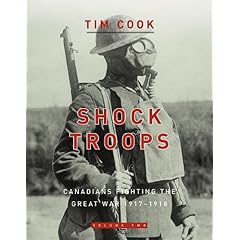
Shock Troops: Canadians Fighting the Great War 1917-1918

by Tim Cook

This has taken me months to get through, not because it was a chore, but because I knew that I never wanted to enter into it unless I could devote a good chunk of time and mental energy into reading it. It's a very dense, information-heavy recounting of the experiences of the Canadian Expeditionary Force during the last two years of the First World War.

Cook has spent a decade researching this book (and its companion first volume), and has read through millions of pages of archival material, synthesizing it all into a thoroughly readable, and at times exciting, chronicle of Canadian strength, bravery, sacrifice, and maturity.

In many chapters, especially when describing the large set-piece battles at Vimy Ridge and Passchendaele, or the rapid advances of the last hundred days of the war, Cook's pages fairly vibrate with tension and excitement. He frequently lets the soldiers themselves narrate the story through their letters, diaries, and memoirs, providing a human face to the largely mechanized slaughter. Cook also portrays the growth of the Canadian forces, as the difficulties and failures of earlier battles lead to a more de-centralized command structure, fluid advancement techniques, and improvements in tactics and equipment.

The last chapter of the book is perhaps the best, as Cook examines the way in which the memory of the war has been constructed in Canada from 1919 to today, as only one veteran remains alive (at least at the time of publication). While describing the war in minute and exacting detail, and demonstrating how it forged Canada's identity into the 20th century, this book never loses sight of the experiences of the common infantry soldier who served at the sharp end of the spear, doing the lion's share of the work and fighting, and placing himself at the greatest risk.

This is a massively important book for any Canadian to read.