Showing posts with label Adrian Tomine. Show all posts

Sunday, May 10, 2015

Optic Nerve #14

by Adrian Tomine

It's always exciting when Adrian Tomine releases a new issue of his very occasional anthology series Optic Nerve, but it's even more exciting when that issue is available at TCAF before it's released in comics shops.  This issue is made up of two stories, 'Killing and Dying', and 'Intruders'.

'Killing and Dying' is a story about fatherhood, comedy, and loss.  Jessica is an odd fourteen year old with a stutter who has developed an interest in stand-up comedy.  Her mother encourages her to take a course at the Learning Annex (for $500), while her father's disapproval is palpable.  Her first performance goes well, but her father figures out that her teacher has written all of her material for her.  Later, Jessica decides to try out her own material at an open-mic night that her father sneaks into, and what follows is one of the most awkward scenes I've read in comics.

An undercurrent that is never discussed in this story, but is made clear through Tomine's art, is the mother's illness.  I love the way this story becomes more about what is not being discussed, and how that affects everyone.  Tomine uses a twenty-four panel grid for most of this story, which gives it a tight and claustrophobic feeling, much as the father must feel, trapped in his own head.

The second story, 'Intruders', is about an aging guy who has found himself alone and unhappy in life.  When a chance encounter with a young woman who once apartment-sat for him leads to him having the keys to the apartment he once shared with his ex, he begins a disturbing habit of breaking into his former home on a daily basis.

The guy's actions seem more or less reasonable at first, even though they are deeply transgressive, but as is the way of such things, events escalate.  This story is told with a larger nine-panel grid, and is drawn with thicker lines.

Tomine's work is always impressive.  He creates complete realities in very short amounts of space, and his stories stick with you long after you've finished reading them.

Thursday, August 1, 2013

Optic Nerve #13

by Adrian Tomine

It's always cause to celebrate when a creator like Adrian Tomine comes out with a new book, and even more so when he continues to release his material in the single-issue format.

This issue of Optic Nerve contains two short stories inside of it, and another short strip of Tomine being an artistic Luddite making up the cover (no wasted space here).

The first story, 'Go Owls' is a wonderful study of an abusive relationship.  A man meets a woman at a twelve step program, and the two of them hook up.  At first, the guy is loving and supportive, but over time, Tomine's portrayal of him changes to show that he's really a bit of a creep.  This guy is demanding and belittling, and also pretty weird in his pursuit of 'his sexy stuff', but the woman has nowhere to go, and so she stays with him.  It's not as bleak as it sounds though - there are some genuinely funny moments, and the ending is downright awesome.

The second story, 'Translated, from the Japanese' is beautiful.  It's narrated by a young mother who is returning to America with her daughter after a sojourn in Japan.  Each panel is either architectural in subject, or an extreme closeup of the things around the narrator.  None of the main characters are actually shown.  Most of the story takes place on the flight to California, where a Japanese professor befriends and entertains the young girl.  A flight attendant mistakes the trio for a family.  Upon landing, it becomes clear that the woman's nuclear family is going through a bit of a crisis.

These stories show Tomine at his best.  His pieces are literary and original, and show insight into the human condition.  His art is top notch, and the only thing I have to complain about this book is that it's probably going to be another year before we see any new work from him.  I cannot recommend this book enough.

Tuesday, December 20, 2011

Summer Blonde (Stories)

by Adrian Tomine

Summer Blonde collects four stories from Adrian Tomine's Optic Nerve, each of which is a minor masterpiece of literary comics.

In Alter Ego, a struggling writer obsessed with issues from his childhood that he hasn't been able to let go, enters into a strange relationship with the teenage sister of a girl he had a crush on in high school.  The writer lives in a different town, and is in a stable relationship, but can't seem to tear himself away from this young woman, with whom he has a platonic relationship, at least until she makes a move.  This story has a bit of a Paul Auster feel to it - the writer wrote one derivative autobiographical novel to middling acclaim, and then ghostwrote another for a celebrity, which received great praise.  One cannot escape the feeling that he is pursuing this young woman with one eye on how it would turn out to be a good story for his next book.

Summer Blonde is an interesting study in jealousy and obsession.  Neil is a sad, quiet man, who has decided he is in love with a girl who works in a gift card store, despite the fact that their interactions with one another do not extend past him going in and buying cards that he never sends to anyone.  He gets a new neighbour, Carlo, who has all sorts of success with women, including the card shop girl, who already has another boyfriend.  Neil steps up his game to stalking, and lets the boyfriend know that Carlo is around, with interesting results.

Hawaiian Getaway follows Hillary, a dour young woman who loses her job answering phones for a mail order catalogue, and descends into her own brand of weirdness.  She makes audio tapes of her roommate having sex, and starts prank calling a payphone across the street to amuse herself.  She has problems with her Chinese immigrant mother, and can't maintain normal friendships.  Strangely, she meets a nice guy through her prank calling, and begins to see a brighter future for herself.

Finally, Bomb Scare is about Scotty, a high school student with one friend - Chris, who is kind of odd.  There are rumours flying through the school that the two are lovers, and Chris ends up alienating Scotty through his interest in extreme pornography and his forceful ways.  Scotty begins to get close to Cammie, a party girl with a reputation for being easy.  This story is a fascinating look at the horrors of high school.  Being roughly the same age as Tomine, the time period depicted in this story is incredibly familiar.

Tomine's stories are excellent.  He has a tendency to not provide any sense of closure in his endings, preferring to close his tales on potentially pivotal scenes.  He has a strong understanding of people who find it difficult to interact with people.  Hillary receives a book on making small talk from her sister, while Neil and Scotty are equally uncomfortable in the same types of settings.

I really enjoyed this book, and am sad that I've now read Tomine's complete body of work, at least until he gives us another issue of Optic Nerve.

Wednesday, October 19, 2011

Sleepwalk and Other Stories

by Adrian Tomine

Having decided to get caught up on Adrian Tomine's library, I was fortunate to find two of his collections in used bookstores this summer.  Sleepwalk collects the tales in the earliest issues of Optic Nerve, his very occasional anthology series which recently had a new issue published.

There are a lot of stories in this lovely hardcover collection, although they tend to return again and again to Tomine's usual themes - recent breakups, broken families, and lonely young people.  I suppose it's easy to find Tomine's work a downer, since so many of his characters are so sad and downtrodden, but there is also plenty of beauty to this book, and not just in his wonderful art.

Characters are faced with a lot of adversity here - they miss their ex, they have trouble communicating with their family, they hate their jobs but don't see any other prospects - but there is also an underlying belief in the resilience of people that makes each story an enjoyable read.  Tomine frequently ends his stories in odd places, and many of the just feel like they stop, instead of end.  It's a cool technique for this type of story, and where it would be pretty annoying somewhere else, here it works.

I love Tomine's art.  His pencils are nice and clean, for the most part, and I like his use of ziptones for shading.  This is a good book, and I can't wait to get to Summer Blonde, which is also on my shelf waiting to be read.

Thursday, September 8, 2011

Optic Nerve #12

by Adrian Tomine

I know everyone in comics land is very excited about DC's 'New 52', but finding the new issue of Optic Nerve in my pull-file was my big thrill of the week.  I'll confess from the start - I never read this title before, but did read Shortcomings, which was collected from the most recent issues (most recent meaning several years old).

This issue has two stories, and a two-page strip.  The first story, 'A Brief History of the Art Form Known as Hortisculpture', is told as a series of four-panel comic strips, with every seventh chapter being a full page in colour, evoking newspaper strips.  It's about a gardener who comes across the idea of marrying traditional sculpture with plants, having them grow within the structure, and spread out through various openings.  The comparison to Chia Pets is made early on, although I kept waiting for someone to discuss bonsai.

Unfortunately, Harold's bold new art form doesn't take off the way he'd hoped, and over a course of about six years, we follow his (and his wife's) growing frustration.  This story is quite funny, but also speaks to the inherent misery of the creative process when it is not recognized or appreciated.

The second story, 'Amber Sweet', is about a woman with more than a passing resemblance to an Internet porn star.  This association, made by fellow college students, boyfriends, and random people on the street, has a deleterious and lasting affect on the young woman's life, and when she finally meets the real Amber, we would expect that anger to rear its head.  What really happens is much more interesting of course.  This story is fully coloured, and drawn in a much more expansive style than Hortisculpture.

Taken together, we see that Tomine continues to be a master observer of relationships and the human condition.  The book is completed with a self-deprecating two-page strip about Tomine's own defense of the 'floppy' format of comics.  This book isn't actually coming out in most stores until next week (my store has a hook-up I suspect), and you won't find anything better on the shelves.  Pick it up.

Saturday, February 5, 2011

Scenes from an Impending Marriage

by Adrian Tomine

I picked up this short, slim little book as an impulse buy, mostly because I loved Tomine's Shortcomings, and wanted to read more from him. 

Scenes from an Impending Marriage is a series of short strips, and the odd Family Circus-styled circle, that details some of the trials and tribulations of organizing a wedding these days.  Tomine and his fiancee, Sarah, go about the mechanics of wedding prep - jogging together, selecting florits, DJs, venues, hair styles, and wedding socks, while both realizing just how ridiculous the entire thing really is.

The book is pretty funny - I loved the DJ Buttermilk scenes, and also pretty honest.  It's amusing to watch Tomine, who is at first not terribly concerned about many of the details, become whole-heartedly involved in minutia like the type of printer given the contract to print their invitations.  It seems that many of the stories here made up the wedding favours that the couple gave out on the 'big day'.

The book is overly too quickly to be a satisfying follow-up to a book like Shortcomings, but if seen as being like a mixtape released between albums, it has whetted my appetite for more of Tomine's work.

Monday, August 30, 2010

McSweeney's Quarterly Concern #33

A year or two ago, I read Nicholson Baker's wonderful book Double Fold, which was about 'Libraries and the Assault on Paper', as the text beneath the title calls it.  In this book, Baker rails against recent library practice of disposing of tons of old and historic newspapers, replacing them with commercial (poorly) made microfiche, citing storage and space requirements.  Baker himself now owns a large collection of almost full early runs of such celebrated and wonderful papers as Joseph Pulitzer's New York World.  The descriptions that Baker furnished of large broad-sheet papers with detailed diagrams and loving illustrations, not to mention legendary comics sections, made me envious of people living in an earlier time.  We now live in a time of great newspaper poverty, as dailies suffer from endless cut-backs and diminished readership.

Into this dismal scene comes the 33rd issue of McSweeney's, Dave Egger's literary quarterly.  For this issue, Egger's et. al. constructed the San Fransisco Panorama, a one-time old-school newspaper of gigantic proportions.  The paper is a week-end edition, including two supplemental magazines, various sections, a generous and lovely comics section, and even a fold-up paper toy rocket ship.  The entire paper comes off as a labour of love and an almost forgotten sense of American journalistic craftsmanship.  It took me just about forever to read this thing.
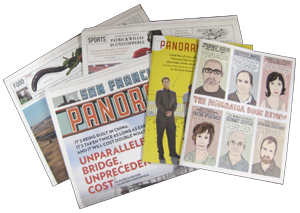
The list of contributors to this thing is as impressive as the span of topics discussed and reported upon.  There is Baker himself (writing about paper mills in Maine); William T. Vollmann discussing mining issues in Imperial, an area about which he is most definitely an expert; Jesse Nathan on the marijuana growers of Mendocino; and J. Malcolm Garcia reporting from Afghanistan. 

San Francisco is the main topic of the paper, with various articles examining the state of the city and its inhabitants.  There is an eight-page section devoted to the new Bay Bridge, and all of the problems associated with that project, which features stunning illustrations and makes good use of the large-size format of the pages (this thing is much wider than today's newspapers).  The Sports, Food, and Arts sections represent the Bay Area a great deal.  There are also tons of human interest articles and interesting charts throughout.

The two magazines are very impressive.  The Panorama Magazine is modeled after the New York Times Magazine, with many long-form articles, some of which I've already reviewed.  Were this a weekly or monthly magazine, I would gladly subscribe.  The Panorama Book Review Supplemental was also very impressive, containing some great short stories from authors such as Roddy Doyle and George Saunders, as well as an interesting conversation between Dave Eggers and Junot Diaz.  The book reviews were wonderful in their variety, and I liked the way each review reproduced the first page of the book so potential readers could sample its style.

Of course, I wouldn't be me if I didn't say something about the comics section.  Art Spiegelman, Dan Clowes, Michael Kupperman, Gene Luen Yang, Adrian Tomine, Chris Ware, Erik Larsen (!!), and many others contributed, and it was a very nice little compilation.  

It's a shame that this project is not to be repeated.  I doubt very much that there is a market anywhere in the world for a regular paper like this, and that is all of our loss.  Reading this allows you to imagine a time when people were very well informed (and not just up on the celebrities), and also had the leisure to read the damn things.  This is a truly unique and impressive work of art.

Thursday, April 15, 2010

McSweeney's Quarterly Concern #13

Edited by Chris Ware

This is the comics issue of McSweeney's, which received a fair amount of attention when it was published in 2004 for showcasing a lot of up-and-coming talent in the arts comics field.  It contains a wide range of short comics and excerpts from longer pieces, as well as a few essays or memoirs about comic books, their history, or their influences on other artists or writers.

The biggest problem with reading this book for the first time six years after it was published is that I've read a lot of the material in here in its complete, finalized form.  This is not really a problem, as I am very happy to return to some of the works here, but it did limit the novelty of reading such a well-produced and designed hardcover with some of my favorite 'independent' artists contained in it.

Ware and company have assembled a very interesting collection, with contributions from people like Adrian Tomine (Shortcomings), Joe Sacco (The Fixer),Charles Burns (Black Hole), Art Spiegelman (In the Shadow of No Towers), Chris Ware, and Los Bros. Hernandez.  There were also plenty of lesser-known cartoonists included, some of whose work I found irritating, while others were quite enjoyable.

Strangely, there was a very visible Canadian delegation to this collection, with and excerpt from Joe Matt's Spent, David Collier's strips about moving to Hamilton, and a long excerpt from Chester Brown's classic Louis Riel, detailing the death of Orangeman and agitator Thomas Scott, a pivotal moment in Riel's story, and a great example of the genius of that book.

Some of the pieces that were new and interesting to me were Ben Katchor's Hotel and Farm strips, one-pagers that dealt with those two topics; David Heatley's Portrait of my Father; and Kim Deitch's Ready to Die, about a man on Death Row.  I also really enjoyed Chip Kidd's memoir on friendships and Batman merchandise.

Of course, as with any anthology like this, there were plenty of things that I either had no interest in, or just flat-out hated (I'm looking at you Kaz), but overall, this was a very worthy purchase.

Sunday, October 11, 2009

Shortcomings

by Adrian Tomine

I loved this book. I've been hearing for a while about how good it is, and I enjoyed some of 32 Stories back in the summer, but really, this comic has exceeded my expectations.

Tomine's story is about Ben, a cantankerous guy who lives with his girlfriend in the Bay Area. They don't seem to get along very well, and when Miko, his girl, gets the chance to take an internship in New York for a few months, she jumps at it. See, part of the reason why their relationship is suffering is because she believes Ben has a thing for white girls.

Once she's out of the picture, Ben decides maybe it's time to achieve a goal he's had for a long time, even though that would prove her right about him.

The book rises above it's Dany Laferierian roots (go read 'Eroshima' if you don't know what I'm referring to) because of the pure strength of Tomine's characterizations. Ben is a complicated, not terribly likable guy, yet I developed a lot of sympathy for him. Miko is a little more of a cipher, but Alice, Ben's lesbian college friend is a riot. There are many moments where this book had me laughing.

I like that Tomine has created a work that is so racially sensitive, yet completely accessible and easy to relate to. He really is a major talent.

Sunday, November 23, 2008

32 Stories

by Adrian Tomine

I've never read any of Tomine's work before, but I've always been aware of his buzz. When I saw this for a very low price, I figured it would be worth picking up.

At first, I wasn't sure of this book. Some of the earlier stories feel decidedly unfinished, but as I progressed through them, I found that they became increasingly charming and enjoyable.

Most of these stories are simple slice-of-life tales, but they reveal a thoughtful, careful eye.

Now I guess I need to get Shortcomings, and some issues of Optic Nerve.....