Showing posts with label Richard Corben. Show all posts

Wednesday, March 13, 2013

Hellboy: House of the Living Dead

Written by Mike Mignola
Art by Richard Corben

Over the last couple of years, I've found myself getting very bored with Hellboy stories set in the current continuity.  The trilogy with Duncan Fegredo, which resulted in HB's death, did very little for me.  The current Hellboy in Hell series has me contemplating dropping the title completely, as it seems to be all pretension, scenes of HB falling through floors, and boring prophecy.

Then I pick this one-off graphic novel up, and remember just what makes this character work well in the first place.  House of the Living Dead is a follow-up to the excellent Hellboy in Mexico one-shot that was also drawn by Richard Corben, and that established that for a while in the 1950s, Hellboy was a Mexican luchadore.

This story picks up on the time where Hellboy was hanging around Mexico, fighting, and drinking himself to oblivion every night over what had happened to his friend Esteban, who had been turned by vampires.  It is while in this state that a man approaches him, and gets him to come to Dr. José Luis Kogan's creepy castle, where he has a Frankenstein monster he wants Hellboy to fight.  The rest of the comic is a bit of a tribute to the Universal movie monsters, as HB has to deal with this monster, a werewolf, and a couple other surprise appearances.

The story is a lot of fun to read, and lacking any of the prophecies that seem to follow Hellboy around everywhere.  Corben's art is always wonderful, and is worth the price of admission on its own.

Thursday, November 22, 2012

Edgar Allan Poe's The Conqueror Worm

Adapted by Richard Corben

I will confess that I've never really loved Poe.  I've found his work to be a little overwrought, or maybe even a little pretentious.  I've tried a few times to really absorb his writing, and it seems that no matter how many times I've read 'The Raven', I've never paid attention to it right through the very end.

Richard Corben, however, I do like.  He's always been a comics artist that has stood out for me as someone whose work I can immediately recognize, and I've appreciated his eye for the bizarre.  I've been enjoying his Poe adaptations in Dark Horse Presents lately, although I've often wondered about just how many liberties he's been taking with the source material, as it's always just seemed a little too weird, even for Poe.

With this one-shot which adapts one of Poe's more famous poems, I feel like I finally have a handle on how Corben adapts things.  Basically, it seems that he takes Poe's more bizarre poems, and then transplants them into the types of settings he most enjoys - the deserts of the Southwest.

In this book, he shows us what happens to a Colonel Mann, whose wife has just run off with his cousin (and a servant).  He kills them, and then has a strange encounter with some Aboriginal puppeteers, who invite him and the rest of his family to a puppet show.  The show itself is a grotesque business that looks to tell Mann's story, complete with real guns and the prerequisite nude buxom women (a Corben specialty).  Oh yah, and there are some carnivorous worms.

The poem is reprinted on the last page of this comic, and while there is little in it to connect it to the surrealistic, dream-like narrative Corben has constructed from it, I will never be able to read it without thinking of this comic again.  I'd love to see Corben adapt some other writers in a similar vein.

Wednesday, November 21, 2012

Dark Horse Presents #18

Written by Joshua Williamson, Carla Speed McNeil, Ulises Farinas, Erick Freitas, Edgar Allan Poe, Richard Corben, Dara Naraghi, Phil Stanford, Peter Hogan, Caitlin R. Kiernan, Colin Lorimer, and Mike Richardson
Art by Victor Ibáñez, Carla Speed McNeil, Ulises Farinas, Richard Corben, Victor Santos, Patric Reynolds, Steve Parkhouse, Steve Lieber, Colin Lorimer, and Ron Chan

This issue of Dark Horse Presents is much stronger than some of the recent issues, as some new serials begin, some of the better ones continue or return, and we are given an excellent one-off memoir.

The book opens with a story about Captain Midnight, by Joshua Williamson and Victor Ibáñez.  A WWII plane comes flying out of the Bermuda Triangle, piloted by the Captain, who ends up on the deck of a US aircraft carrier.  It's clear that he is lost in time.  What's not clear is if this is a new character or one that has shown up before (the title loudly proclaims that he 'returns').  All I know is that I enjoyed this story, but I'm not familiar with this character.

From there, we get a new chapter of Finder, my now-favourite science fiction comic.  Jaegar is in a city he hasn't been to before, where it appears that all the citizens suffer from something called Apex Sudden Death Syndrome.  Consequently, no one goes outside, and are instead represented by different types of holographic avatars.  This is pretty typical work from Carla Speed McNeil - it's dense with ideas and characterization, and there is a general assumption that we already know what she's talking about, even though these ideas are brand new.  I'm completely hooked on this serial.

After that comes 'Gamma', a new serial by Ulises Farias and Erick Freitas.  It's a bizarre little story that starts off being about a 'coward' who hangs out a bar all day, where people pay $50 to punch him in the face.  Later, he's asked to help a battered woman stand up to her husband, and suddenly this story is about people using holographic 'monsters' to fight each other.  Farias's art has a bit of a Brandon Graham meets Moebius vibe to it, so I'm on board.

Richard Corben gives us another adaptation of an Edgar Allen Poe poem or short story, and as is always the case with these things, it's lovely and odd.

One of the best pieces this month is Dara Naraghi's memoir of growing up on the shore of the Caspian Sea in Iran.  It's lovingly illustrated by Victor Santos, and very nicely evokes a lost time and place.  I really wish we'd see more things like this in anthologies and comics in general.

Resident Alien, which is an excellent series, returns this month with a strangely-paced story.  It opens with a dream shared between the alien doctor's assistant and her grandfather (I think?), before we move back in time three years, and see the US military men who found the doctor's spacecraft, as they investigate his arrival on Earth.  I'm not sure where this is leading, but I'm happy to see more of this story.

Alabaster returns, and City of Roses continues, but neither really grab my attention.  I feel the same about The Secret Order of the Teddy Bears, which is an all-ages story that is lacking the complexity of some of the other all-ages pieces that have run in this book (I'm thinking of Beasts of Burden, which is brilliant).

UXB, another on-going serial, continues to mystify me in its lack of narrative cohesion.  I really do not understand what is going on in this series.

Still, this is a very successful issue overall.

Friday, October 26, 2012

Dark Horse Presents #17

Written by Carla Speed McNeil, Phil Stanford, David Chelsea, John Layman, Jimmy Palmiotti, Justin Gray, Edgar Allen Poe, Richard Corben, Michael Avon Oeming, Tony Puryear, Erika Alexander, Robert Alexander, Colin Lorimer, and Michael T. Gilbert
Art by Carla Speed McNeil, Patric Reynolds, David Chelsea, Sam Kieth, Tony Akins, Richard Corben, Victor Santos, Tony Puryear, Colin Lorimer, and Michael T. Gilbert

I don't know if it's just my mood when I read this anthology this month, but I came away from it feeling a little less than impressed.  There are still some great comics in this book, but somehow, it became much less than the sum of its parts this time around.  Let's review:

  • I love 'Finder', Carla Speed McNeil's epic comics series.  The DHP stories are usually excellent, as they are beautiful.  This month's could have benefitted from the annotations that McNeil has filled her trades with; I kind of had no clue what was going on here, as Jaegar runs with some Laeske females, before being captured by some young people with horns, who appear to be poaching Laeske eggs.  I think.  Like I said, footnotes.
  • For the second month in a row, Phil Stanford's 'City of Roses' feels like a lot of set-up with no pay-off.  Something solid needs to happen here soon.
  • David Chelsea's 'The Girl With the Keyhole Eyes' finally finishes.  It's a cool idea - a free-form poem or stream-of-consciousness comic, but that kind of thing doesn't work in a serial format, and it got kind of repetitive.
  • John Layman and Sam Kieth's Aliens story ends as most Aliens stories do; there's never a surprise there.  This story had some potential, but it never quite reached it.
  • I think that 'Deep Sea', Jimmy Palmiotti, Justin Gray, and Tony Akins's ocean adventure series is very interesting, and one of the most effective pieces here, while still being a standard B-movie genre piece.
  • Richard Corben adapts another Edgar Allan Poe poem, 'The Sleeper'.  It's creepy and atmospheric, and less gender-ambiguously creepy as last month's.  Good stuff.
  • There is a story here by Michael Avon Oeming and Victor Santos, called 'The Sacrifice', which I guess is a one-off.  It's fine, if you're okay with stories about elves and magic swords in trees.  It's pretty.
  • I've been loving Concrete Park, by Tony Puryear, and I'm excited to see that the two storylines have finally collided (more or less literally), in this, the last chapter of the first 'book'.  Puryear told me that there is going to be more of this story coming soon, and I look forward to that.
  • I vaguely remember the first chapter of Colin Lorimer's UXB from six months back or so, and I remember that I liked it, but I found this new chapter very ambiguous (at the end), and totally lacking in context.  
  • I'm not very enthusiastic about Michael T. Gilbert's Mr. Monster.  Actually, I never bothered to finish this story.
Here's hoping that next month's DHP is a little more impressive.

Thursday, September 20, 2012

Dark Horse Presents #16

Written by Phil Stanford, John Layman, David Chelsea, Jimmy Palmiotti, Justin Gray, Carla Speed McNeil, Erika Alexander, Tony Puryear, Edgar Allan Poe, Richard Corben, Nate Cosby, Bo Hampton, Robert Tinnell, and Chad Lambert
Art by Patric Reynolds, Sam Kieth, David Chelsea, Tony Akins, Carla Speed McNeil, Tony Puryear, Richard Corben, Evan Shaner, Bo Hampton, and Apri Kusbiantoro

Another month, another collection of short comics of varying topic and quality.  Let's see what was impressive...

Of course, I continue to love Carla Speed McNeil's Finder the best.  This episode has Jaeger wandering the desert looking for water, which is the way to complete the ritual he began last month.  I love the complexity of McNeil's world, although I do really miss the explanatory notes that she has filled her collections with - not because I need them to understand the story, but because they help me appreciate how truly layered and well-realized her fiction is.  The colours this month, done by Jenn Manly Lee and Bill Mudron, look very different from what we've seen before.

Jimmy Palmiotti and Justin Gray, probably the two most prolific writers and idea creators in comics, start Deep Sea this month.  Usually these two work for DC or Image, and it's interesting to see them providing a story for DHP when they could just as easily include it in their own anthology Creator-Owned Heroes (unless, of course, there is no one heroic in their comic).  This is an ocean bottom exploration/love story/potential time travel story, and it looks pretty interesting.  Art by Tony Akins never hurts.

Concrete Park has another good chapter, as the two strands of the story get closer to colliding.  Tony Puryear and his crew have really caught my attention with this series, and I look forward to seeing where this is going.

Richard Corben adapts Edgar Allan Poe's 'Berenice', a strange story about an obsessive young man who marries a woman with alluring teeth.  For some reason Corben adds a gender-bending element to the story that is probably not in the original, and it makes the story extra disturbing and bizarre.

Chad Lambert returns with another comic memoir about his days in the radio industry.  I particularly appreciated the love Lambert shows for my all-time favourite sitcom 'WKRP in Cincinnati', both literally and figuratively.  What is it about Cincinnati and autobiographical comics anyway?

John Layman and Sam Kieth's strange Aliens story takes a turn for the worse again, mostly due to Kieth's rushed-looking art.  Bo Hampton's Riven continues to feel like a big part of the story is missing, and Nate Cosby and Evan Shaner's Buddy Cops continues to be amusing, but not my cup of tea.  David Chelsea's 'The Girl With the Keyhole Eyes' is a cool idea that is being done to death; I think if this free-form thought poem of a comic were shorter, it would be much less exasperating.

The new serial, 'Crime Does Not Pay', by Phil Stanford and Patric Reynolds was pretty underwhelming.  The trick with crime comics is to not make them be something everyone has read multiple times before.  This is not that.


Saturday, June 23, 2012

Ragemoor #4

Written by Jan Strnad
Art by Richard Corben

This horror comic has been utterly bizarre, but that is what made it wonderful.  To summarize briefly, Ragemoor is a living castle from outer space, which is, on the one hand, protecting the Earth from an ancient worm god creature, but is also slowly torturing its master by twisting its layout and taking from him the woman he loves.

This issue has Herbert finally reach his breaking point when he discovers that his loyal servant has been experimenting on the poacher that came and fell for the beautiful Anoria.  Stuff gets stranger than ever before, and that says a lot in this book where Jan Strnad and Richard Corben really let loose.

This series has a real throw-back quality to it, reminding me of some of the stranger horror comics of the 70s, and of Heavy Metal.  As bizarre as this book is, there's nothing particularly memorable about it, aside from the terrific artwork.  It's definitely a novelty to be able to read a book like this again.

Saturday, May 26, 2012

Ragemoor #3

Written by Jan Strnad
Art by Richard Corben

Well, this is one weird and creepy comic.  Strnad and Corben came out of nowhere with this haunted, sentient castle story, and have managed to keep what sounds like a great short story or done-in-one comic going as a four-issue mini-series quite nicely.

In this issue, Herbert, Master of Ragemoor, continues to care for the colony of baboons that live in the castle, and therefore doesn't notice that the poacher Tristano has been visiting Anoria, the beautiful woman being held at the castle as the object of Herbert's affections.  Broderick, the loyal manservant takes some strange hallucination-causing tea, and sees a vision of fighting golems, and Anoria makes plans to steal the mineral riches of the local countryside.

This book is unpredictable and strange, as every comic drawn by Richard Corben turns out to be.  There is a very memorable scene towards the end where Broderick examines his injured arm.  This comic appeals to a very niche audience, and while I wouldn't necessarily place myself in the middle of it, I am enjoying this book.

Thursday, April 19, 2012

Ragemoor #2

Written by Jan Strnad
Art by Richard Corben

The first issue of Ragemoor read like a one-shot, and I wondered what else could happen to fill this series.  Ragemoor is about a young man who resides in a horrifically haunted castle.  This is not the usual home to restless spirits who maybe slam doors and kill the odd college student whose car breaks down on the property - this is a gigantic castle that is constantly readjusting its floorplan, and which has a taste for human blood.

As this issue opens, Herbert, the master of the castle, is mooning over Anoria, the woman who came to the castle with his uncle last issue, and who lost her mind after seeing what happened to the uncle, who had paid her to pose as his daughter.  Herbert realizes that a local poacher is trying to win her affection, and he decides he needs to take action to impress her.  He decides to kill the ape-creatures that live in the castle's bowels, a decision that leads to his being trapped well beneath the lower levels of the castle, at the mercy of worm-like creatures.

Over the course of the issue, Herbert begins to gain some appreciation for the various creatures that inhabit the castle, and who all appear to serve some sort of greater purpose.  We are also introduced to the insect creatures that work in the kitchen, preparing Herbert's meals (from what, one would like to know).

This is a creepy comic that really gives Richard Corben space to stretch his artistic wings.  I imagine that this type of comic appeals to a pretty specific demographic, but I can't imagine those people would have anything to complain about.

Thursday, March 22, 2012

Ragemoor #1

Written by Jan Strnad
Art by Richard Corben

When I saw this book solicited a couple of months ago, I knew exactly what to expect from it.  Richard Corben, while always brilliant, tends to stick to what he does best, and so I figured that a collaboration between him and Jan Strnad would lead to a good old-school horror comic, featuring at least one buxom woman who would have to spend at least some of the comic in the nude. 

Basically, that's what we get, and it's terrific.  Ragemoor is a castle that has a mind of its own.  It grows and changes, restructuring hallways on a whim.  The main character of the book, Herbert, feels that he and his father are prisoners of the castle.  When his uncle and cousin arrive for a visit after many years abroad, Herbert tries to warn them away for their own safety, and comes off sounding as crazed as his father is.  The uncle is not what he seems though, and has his own designs for Ragemoor.

This is a comic that could have been written just about any time between now and the late seventies, but that is part of the appeal.  There is a comfort in getting just what you expect out of popular media (why else would anyone watch network television), but it an extra special treat when what you expect is Corben's impossible to imitate textured, creepy, and beautiful art.  This debut issue of the mini-series reads like a done-in-one, and so I'm not sure where this story is going, but I'm definitely sticking around to find out.

Saturday, February 25, 2012

Dark Horse Presents #9

Written by Mike Mignola, Brian Wood, Paul Pope, Tony Puryear, Erika Alexander, Robert Alexander, Edgar Allen Poe, Richard Corben, Rich Johnston, Alan Gordon, Steve Horton, Caitlin R. Kiernan, and MJ Butler
Art by Joe Querio, Kristian Donaldson, Paul Pope, Tony Puryear, Richard Corben, Simon Rohrmüller, Thomas Yeates, Steve Horton, Steve Lieber, and Mark Wheatley

Dark Horse, as a comics company, has been on fire lately.  Where two years ago, I was only buying one or two titles from this company, and now I think I'm getting somewhere around nine a month.  Like they did back in the day, with the first run of Dark Horse Presents, they are wisely using this monthly anthology title as a proving ground or launch pad for new series and ideas.

This month has some pretty impressive comics.  There's a Paul Pope story, which was a nice surprise.  Basically, Pope shows us what happened when the Apollo 12 lunar module landed on the moon.  It feels pretty authentic, and is perhaps a bit of a strange choice for Pope, but it's also a wonderfully drawn piece of history.

The book opens with a Lobster Johnson story by Mike Mignola and artist Joe Querio, which follows the usual trajectory of a Mignola short story.  These are always good reads, but I am beginning to get a little bored of them.

The second chapter of Brian Wood and Kristian Donaldson's The Massive introduces another new character; this time it's a Tamil boy who tried to kill fishermen who were poisoning the ocean where his family fished.  I'm much more interested in what Wood is doing with this story this month than I was last.  This is beginning to feel like it could be as great a story as DMZ.

Tony Puryear's Concrete Park continues to interest me.  Puryear has said that this his story is going to be moving to its own title soon; I'll definitely be on board for that.  Richard Corben adapts an Edger Allen Poe poem, which is creepy and interesting.  Rich Johnston's 'Many Murders of Miss Cranbourne' continues to be amusing, and it's nice to see how the old lady is manipulating half the town she lives in to aid her in her murderous work.

Of less interest were the Tarzan and Skultar stories.  Two new features, Amala's Blade and Alabaster: Wolves were not all that impressive, but thankfully, there was no new chapter in Neal Adams's horrible Blood story.

Saturday, August 27, 2011

Dark Horse Presents #3

Written by Dave Gibbons, Robert Love, David Walker, Carla Speed McNeil, Paul Chadwick, Howard Chaykin, Jim Steranko, Patrick Alexander, Richard Corben, Chuck Brown, David Chelsea, Neal Adams, and Michael T. Gilbert
Art by Dave Gibbons, Robert Love, Carla Speed McNeil, Paul Chadwick, Howard Chaykin, Jim Steranko, Patrick Alexander, Richard Corben, Sanford Greene, David Chelsea, Neal Adams, and Michael T. Gilbert

There are a lot of comics in this book.  This issue of DHP, while keeping it's $7.99 price point, increased its page count to 104 pages, which is appreciated, as that is a nice chunk of comics to digest.  I do wish I liked all of them though...

Dave Gibbons 'Treatment' is not bad.  Really, it's a lot like Archaia's French reprint comic Cyclops, starring a group of SWAT-like police officers who are broadcast live on a mix between a football game and a reality show.  It may be an interesting idea, but it's going to need more developing than we get in this first installment (I assume there will be more).

As always, the two stand outs in this book are Paul Chadwick's Concrete, and Carla Speed McNeil's Finder.  In Concrete, Chadwick addresses the issue of unjustified police tasering.  I know that sounds ridiculous, but the best Concrete comics are the ones that have the stone giant explore a social issue that doesn't often get much play, especially in comics.  Chadwick's environmental stance had a huge influence on me when I was younger, and it's nice to see that he's still using his work as an engine for some kind of social change.  I think this may meander a little too close to being preachy, but I admire Concrete's usual stance that there can be a better way of doing things than what is current practice.

Finder is incredible.  Having read Voice, the most recent graphic novel, I now get a lot more of the context of this DHP strip, and I'm loving it.  In this chapter, Jaeger helps an old lady who has missed her train stop by taking her through a short-cut which crosses the incredible city that McNeil has built.  The story ends on a pretty creepy note that I thought was very effective.

I'm enjoying Love and Walker's Number 13.  There is more happening in this chapter that is getting me interested in this post-apocalyptic story, and I'm curious to read what's going to happen next.  Also, I've been enjoying Richard Corben's pieces, although I found this month's to be a little disjointed.

Beyond that, the book becomes kind of mediocre.  I know this may be sacrilegious to many comics fans, but I didn't feel Steranko's Red Tide excerpt much at all.  For all his bombast about his own ingenuity, he's written a fairly standard and cliche-ridden private detective prose story, which is only marginally assisted by his art.  I don't think I'll be looking for the full book when it comes out.

Howard Chaykin's Marked Man is growing on me a little, but I still don't like his art.  Likewise, Neal Adams's Blood continues to be incomprehensible and way over-written, but pretty.  I find Brown and Greene's Rotten Apple, which debuted last issue, to be pretty incomprehensible too.  Snow Angel, which I found refreshing earlier, doesn't even appear to have a point this month.  It's pretty rambling.  And, after having been burned last time, I didn't even bother to read Michael T. Gilbert's Mr. Monster.

Saturday, June 25, 2011

Dark Horse Presents #2

Written by Paul Chadwick, Robert Love, David Walker, Neal Adams, Carla Speed McNeil, Howard Chaykin, Michael T. Gilbert, Patrick Alexander, Chuck Brown, Richard Corben, and David Chelsea

Art by Paul Chadwick, Robert Love, Neal Adams, Carla Speed McNeil, Howard Chaykin, Michael T. Gilbert, Patrick Alexander, Sanford Greene, Richard Corben, and David Chelsea

It's pretty difficult to look at an anthology like DHP, which has no unifying theme, as a single, whole entity.  It's easier to break it down into its components and review them individually.  I will say that I still wish there was more originality to the book - as much as I love things like Concrete and stories by Richard Corben, I'd like to read the next big thing even more.

Concrete - I'm always happy to read a new Concrete story, although I thought this one was kind of strange, with its hinting that the aliens that made Concrete could be returning, and Maureen's explorations of the roots of religion.  I think it should have been a bit longer, but mostly that's because I'd much prefer a new Concrete mini-series.

Number 13 - This appears to be a pretty cool post-apocalyptic story about a young kid who is a cyborg or bioweapon or something, and the three-eyed girl he rescues from an ogre.  There's not much more than establishment going on here, but it's pretty interesting.

Blood - I'm not sure why Neal Adams thinks that he should be writing without some help.  This story shifts from what looked like a crime-fighting thing to a combination of The Secret History and I Am Legion, but not as good.  Just wordy.  Adams's terrific art does not make up for the story.

Finder - The Finder stories in this series so far are becoming favourites of mine.  It's the first I've read of McNeil's series (I do have the Voice graphic novel in my to-read pile), so while I'm not sure of the context, I am finding it amusing to explore her world through the eyes of a courier.

Marked Man - This is still not doing it for me (mostly because of Chaykin's art, which is better here than his recent New Avengers work), but I found the second chapter of this 'career criminal as family man' story to be better than the first.

Mr. Monster - I find this kind of thing unreadable, and therefore did not read it.  I'm still impressed with myself for making it through the first chapter...

The Wraith - This is also not really kind of thing - I guess it's cute, but it doesn't fit with the rest of the stuff in this book.

Rotten Apple - Now this is a new entry that has some promise.  Brown and Greene are building an interesting world populated by rival zombie gangs, religious orders, and cartoon animal mercenaries.  I think that this would have benefited from more space to build the setting, but I like Greene's art and am curious to see where the story goes.

Murky World: The Treasure - Richard Corben stories don't have to make a lot of sense, because they are always so well-drawn.  This chapter has our hero get tricked by the women he helped last time, and we meet a gigantic monstrous cabbie.  This is good stuff.

Snow Angel - In the first issue, I found this story to be pretty charming, but this chapter is just kind of cute.  I can see getting tired of Snow Angel - a girl who gains powers when she lies in the snow.

Saturday, May 28, 2011

American Splendor: Another Day

Written by Harvey Pekar
Art by Ho Che Anderson, Zachary Baldus, Hilary Barta, Greg Budgett, Gary Dumm, Eddie Campbell, Richard Corben, Hunt Emerson, Bob Fingerman, Rick Geary, Dean Haspiel, Gibert Hernandez, Leonardo Manco, Josh Neufeld, Chris Samnee, Ty Templeton, Steve Vance, Chris Weston, and Chandler Wood

This is the first that I've read any of the late Harvey Pekar's autobiographical comics series American Splendor, and I was surprised by two things.  The first is the caliber of artist involved in this anthology project.  Look over the list above - there are some incredible artists contributing here.  What I enjoyed most about that is seeing the different ways in which they draw Harvey.  He's always recognizable, but each artist plays with his image subtly, emphasizing different aspects of his personality or appearance.  I think Richard Corben's take on him was the furthest from the mark, but it was still very cool to see how he went about it.  I love Chris Weston's contribution, and am always up for some Ty Templeton.

The second thing that surprised me was the utter aimlessness of the writing.  I expected that Pekar's stories would be small, slice of life things, built around the struggles of everyday life.  What I didn't expect was that they would be so dull in their depiction of the quotidian.  A typical story in this collection has Harvey get up in the morning, go to the bank, and then go to the pharmacy to get his prescription filled.  When it isn't ready, he has to go to the HMO.  End of story.  There is no observation about life, or lesson learned; that's just it.

Another good example has him call over the neighbour to help him fix the toilet.  Then he feels gratitude.  That's it.  There's another toilet-fixing story earlier in the book, but at least in that one, we can revel in Harvey's victory.  Better stories involve conflict with his foster daughter, and there is one in which he remembers hurting a friend as a child.  These fit better into the autobiographical mode.  I know that the minute attention to boring detail was Pekar's thing; it just doesn't make for compelling reading.  Thankfully, the art is really good.

Monday, May 16, 2011

Hellboy: Being Human

Written by Mike Mignola
Art by Richard Corben

It's about time we see Roger the Homunculus again.  I was pretty surprised when he was written out of the BPRD series (oh yah, spoiler), as he was developing into a find character, and I'm glad that Mignola has brought him back for this one-shot set in the year 200o.  I could be wrong, but I think this is the first of the Hellboy one-shots that fits between stories that fit in contemporary continuity, as opposed to being stories from his time in the Bureau before his comics started.  As the Mignola-verse more or less runs in real-time (kind of like Hellblazer), it does provide a lot of opportunity for "untold tales".

Anyway, this is a very cool issue, featuring Hellboy and Roger going to investigate what is supposed to be a simple haunting, to give Roger a bit of field experience.  The set up is very similar to the BPRD series that is being published right now, which features Liz Sherman's first assignment for the Bureau as well. Of course, the haunting is not as simple as expected.

What makes this book work so well is more terrific art from Richard Corben.  He's so good on this book, and this issue is no exception.

Friday, April 22, 2011

Dark Horse Presents #1

by a lot of different people

Well, that was kind of disappointing.  I loved the original Dark Horse Presents series (and its companion, Cheval Noir), which I can credit with introducing me to a large number of new creators, characters, and series.  Its diverse selection always held something to enjoy, and while there were stories I didn't like, I don't think there was ever an issue where I didn't find something to enjoy.  The Myspace DHP of recent years was a less satisfying grab bag, but still managed to entertain me in its collected editions.

I was very excited to learn of this new, quarterly edition of the title, in an eighty-page format.  Sure, the price is higher, but with its publication schedule, that wouldn't cost more than a monthly would.

This first issue is good in plenty of places, but I feel like Dark Horse missed an opportunity here by focusing so strongly on the past.  The book opens with a Concrete story by Paul Chadwick, and then goes on to feature work by Howard Chaykin, Neal Adams, Michael T. Gilbert, Richard Corben, Paul Gulacy, and Harlan Ellison.  In other words, this could have been an issue of the original run.  The strength of DHP was that it uncovered new creators.  Okay, this issue also has the first Finder story I remember ever reading (granted, that series has been running for like 20 years too), and features work by David Chelsea, who is new to me.

The point is that, while comics fan are notorious for looking to the past and living in a nostalgic world, there is also a market for work that is more forward-looking, and talented up and comers need more platforms that will lead to greater exposure.

As for the actual content of the book, it's pretty varied.  The Concrete story is great, of course, as are Corben's barbarian and zombie story, and Ellison's interesting prose story.  I liked Carla Speed McNeil's Finder (I should totally start reading that series), and found Chelsea's Snow Angel story charming.

I can't stand Howard Chaykin, especially when he writes his own stories, and so wasn't surprised that I disliked his Marked Man.  Neal Adam's Blood was overly wordy and kind of ridiculous (not all that unlike his Batman: Odyssey), and the Frank Miller interview felt like filler.  The Star Wars story left me cold, despite some nice Gulacy artwork.

I'm hoping that future issues do a better job of finding a balance between commercial appeal, support of Dark Horse's licensed properties, and innovative comics.

Friday, November 19, 2010

Hellboy: Double Feature of Evil

Written by Mike Mignola
Art by Richard Corben

It's a one-shot with two Hellboy stories, both drawn by Richard Corben.  So, of course it's good.

The book opens with a strange framing sequence involving a busted up old movie theatre.  Since my first job was at a struggling live theatre, I've always felt connected to run-down theatres, be they for movies or plays.

The first story is a haunted house tale, with Hellboy investigating a building that has somehow compelled a man into committing many murders.  The second story, which is pretty short, has Hellboy dealing with a museum employee that has been possessed by an Egyptian god.

While neither story is particularly groundbreaking or stretches the Hellboy mythos into new territory, both are exceptionally nice to look at, and are well-written.  It was Corben's art that first got me to give Hellboy a chance, and I'm always happy to see him work on the character (or do any other comics for that matter).

Friday, July 30, 2010

Gangland

by a whole lot of people

I love good anthologies.  A good comics anthology is one that provides you with a multi-faceted exploration of a theme or topic.  This one looks at organized crime, but doesn't limit itself to mafia-oriented Godfather knock-offs.  There are a few 'gangster' stories, like the one by Darko Macan and Kilian Plunkett that has a bored dentist sign up with some bootleggers in the Prohibition days for some excitement, or Simon Revelstoke and Richard Corben's creepy story of gangster love.

Most of the rest of the tales are merely riffing off the notion of organized crime.  Peter Kuper gives us one of his silent, mosaic-like stories.  Jamie Delano and Randy DuBurke give us a corporate tale, while Dave Gibbons explores post-Soviet Russian mafia business practices.  David Lloyd gives us a tale from the perspective of a drug lord's guard dog who gets recruited by the police (it's much cooler than it sounds).  Scott Cunningham and Danijel Zezelj take a look at the Men in Black as a form of the ultimate gangster.

Perhaps the best story here is the one by Ed Brubaker and Eric Shanower, which shows us how a group of bored suburban teens got turned into master cat burglars by the local life guard.  This story reminded me of their classic collaboration 'An Accidental Death', which I now really want to read again.
In all, this is a very skillful and interesting collection.  I know that it's long out of print, but it's worth hunting for on some comic store shelves.

Friday, July 2, 2010

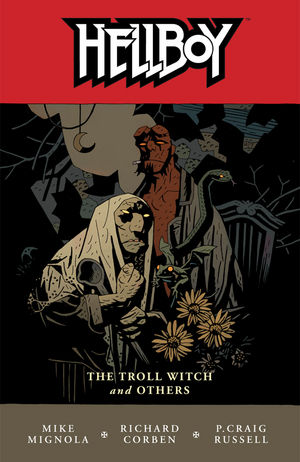
The Hellboy Project: Hellboy Vol. 7: The Troll Witch and Others

Written by Mike Mignola
Art by Mike Mignola, P. Craig Russell, and Richard Corben

As I've been trying to read the different Hellboy stories in the order in which they were originally published, this volume has taken me a long time to get through.  Most of the stories here were published as one-shots or as part of anthologies, although there are a couple that were mini-series and one story that was published especially for this volume.
Most of the stories in this book are structured around Mignola re-writing or adapting a myth or legend from some part of the world.  Instead of just worrying about British and Celtic folklore, he casts a wider net, encompassing Asia, Eastern Europe, and Africa.  This results in a wide variety of stories, although most of them have a similar simple structure of: Hellboy encounters monster; Hellboy destroys monster.  The differences are in the settings.

This volume is also unique because, for the first time, Mignola has allowed other artists to work on Hellboy.  Not one for half measures, the two artists employed here are P. Craig Russell and Richard Corben.  Russell illustrates an interesting vampire story set in Prague, where he spends a large number of panels illustrating the statuary that adorns that city.

The Corben story might be the most unusual Hellboy story I've read yet, as Hellboy imagines himself as the lead player in the African legend of Makoma, and his quest.  This is a gorgeous story, as anyone would expect.

Friday, May 7, 2010

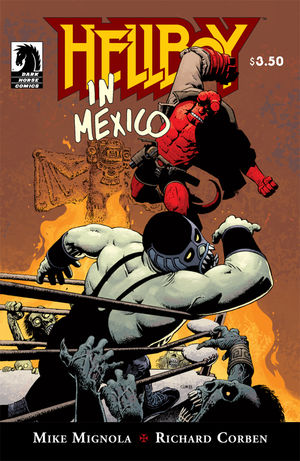
Hellboy in Mexico

Written by Mike Mignola
Art by Richard Corben

I started, a little over a month ago, to read my way through Hellboy and the rest of the Mignola-verse titles.  My goal is to get caught up to the titles, and to then start picking them up monthly.  The problem with this title is that it's difficult to trade-wait, as individual comics such as this one are sometimes not collected for a few years.  And also, when the subject matter involves Hellboy fighting vampire luchadores with art by Richard Corben, it becomes impossible to wait at all.

This is one of the best Hellboy comics I've ever read.  While on a mission in Mexico in 1982, Abe Sapien discovers old newspaper photos of Hellboy with a trio of luchadores.  He then begins to tell the story of the year he spent in Mexico in the 50s, fighting vampires and witches alongside these three wrestlers.  One of the brothers, the youngest, is captured by vampires, and things go from light-hearted to grim pretty quickly.

As usual, Corben's artwork is brilliant, and Mignola tells a simple story not weighted down by a ton of mysticism or prophecy.  Great stuff.

Thursday, December 24, 2009

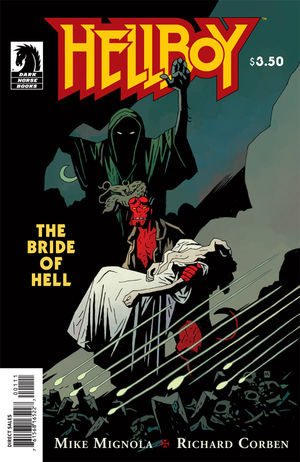
Hellboy: The Bride of Hell

Written by Mike Mignola
Art by Richard Corben


Lately I've found myself drawn to Hellboy, and I'm not sure why. I bought and read the earliest few series back in the day, and liked them well enough, but never stuck with the book. For the last year or so, I've become curious about it, and figured this one-shot was a good way to test the waters again.

And it's okay, but not really blowing me away. In this issue, Hellboy tries to free some girl from some demon. He then gets a history lesson, and there's an interesting twist. I kind of feel like I've read it before; it's definitely not breaking new ground.

On the up side, Corben's work is as good as Corben's work always is. He's a really talented artist, who continues to impress.