 A year or two ago, I read Nicholson Baker's wonderful book Double Fold
 , which was about 'Libraries and the Assault on Paper', as the text beneath the title calls it. In this book, Baker rails against recent library practice of disposing of tons of old and historic newspapers, replacing them with commercial (poorly) made microfiche, citing storage and space requirements. Baker himself now owns a large collection of almost full early runs of such celebrated and wonderful papers as Joseph Pulitzer's New York World. The descriptions that Baker furnished of large broad-sheet papers with detailed diagrams and loving illustrations, not to mention legendary comics sections, made me envious of people living in an earlier time. We now live in a time of great newspaper poverty, as dailies suffer from endless cut-backs and diminished readership.
Into this dismal scene comes the 33rd issue of McSweeney's
 , Dave Egger's literary quarterly. For this issue, Egger's et. al. constructed the San Fransisco Panorama, a one-time old-school newspaper of gigantic proportions. The paper is a week-end edition, including two supplemental magazines, various sections, a generous and lovely comics section, and even a fold-up paper toy rocket ship. The entire paper comes off as a labour of love and an almost forgotten sense of American journalistic craftsmanship. It took me just about forever to read this thing.
The list of contributors to this thing is as impressive as the span of topics discussed and reported upon. There is Baker himself (writing about paper mills in Maine); William T. Vollmann discussing mining issues in Imperial, an area about which he is most definitely an expert; Jesse Nathan on the marijuana growers of Mendocino; and J. Malcolm Garcia reporting from Afghanistan.
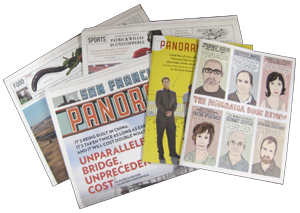 San Francisco is the main topic of the paper, with various articles examining the state of the city and its inhabitants. There is an eight-page section devoted to the new Bay Bridge, and all of the problems associated with that project, which features stunning illustrations and makes good use of the large-size format of the pages (this thing is much wider than today's newspapers). The Sports, Food, and Arts sections represent the Bay Area a great deal. There are also tons of human interest articles and interesting charts throughout.
The two magazines are very impressive. The Panorama Magazine is modeled after the New York Times Magazine, with many long-form articles, some of which I've already reviewed. Were this a weekly or monthly magazine, I would gladly subscribe. The Panorama Book Review Supplemental was also very impressive, containing some great short stories from authors such as Roddy Doyle and George Saunders, as well as an interesting conversation between Dave Eggers and Junot Diaz. The book reviews were wonderful in their variety, and I liked the way each review reproduced the first page of the book so potential readers could sample its style.
Of course, I wouldn't be me if I didn't say something about the comics section. Art Spiegelman, Dan Clowes, Michael Kupperman, Gene Luen Yang, Adrian Tomine, Chris Ware, Erik Larsen (!!), and many others contributed, and it was a very nice little compilation.
It's a shame that this project is not to be repeated. I doubt very much that there is a market anywhere in the world for a regular paper like this, and that is all of our loss. Reading this allows you to imagine a time when people were very well informed (and not just up on the celebrities), and also had the leisure to read the damn things. This is a truly unique and impressive work of art.


 is a pretty typical Baker book. Emmett, the narrator, gets up early every morning, makes a cup of coffee in the dark, and then lights a fire in his fireplace. While he enjoys the fire, his mind wanders. That's it, on the surface. There is no plot. Some stuff happens, like Emmett gets a cold, but the appeal of this book is the sameness of the chapter structure (each chapter opens with 'Good morning, it's _:__ a.m.').


