Showing posts with label Archaia. Show all posts

Thursday, December 28, 2017

Americatown

Written by Bradford Winters and Larry Cohen
Art by Daniel Irizarri

It's crazy to think that this terrific graphic novel started being published in the summer of 2015, considering how well it seems to be responding to the events of 2017.

Americatown, written by a couple of TV writers, is about undocumented immigrants from America eking out a life for themselves in Buenos Aires, having to deal with ruthless smugglers, heartless Immigration officers, and an orange-skinned mayor who is staking his reelection campaign on showing "tough love" to people who are in the country illegally.

The story is set in the near future (Bruce Springsteen is a very old man) and, as inequality and climate change have worked hand in hand to erode living standards in the US, many people find they have no choice but to risk their lives to arrive in Argentina, where the lucky ones subsist by working multiple jobs and living in shared apartments.

Owen Carpenter is a new arrival, but he's had some help getting there.  His son has started working for Tonto, an American Native who runs a successful smuggling ring.  While Owen and the people he travelled with are waiting in a safehouse, La Migra raids them, and Owen and his son, Derek, are able to escape, running over an officer in the process.

Derek gets nabbed, and ends up in prison, while Owen tries to figure out how things work in Buenos Aires's Americatown.  He finds jobs and friends who are willing to help him, and puts a plan into action to try to reunite his family.

This book is a very compelling read.  The inversion of having privileged Americans selling hot dogs on the street and complaining that they can't celebrate the Fourth of July openly is a novel one.  It draws attention to the plight of migrants, but also raises some much needed warnings about where the world is headed.

Winters and Cohen put together a tight story, although I thought that the ending was a little needlessly ambiguous (maybe I'm just tired though).  Irizarri's art is very nice, and I especially like the little ways in which he introduces extrapolated versions of modern technology.

Apparently the serialized version of this series got cut short, with half the run only appearing online, but this handsome hardcover is probably the best way to read the story anyway.

Wednesday, November 15, 2017

The Killer Vol. 4: Unfair Competition

Written by Matz
Art by Luc Jacamon

I remember being very impressed with the first Killer mini-series, when Archaia first started published translated versions of the French series.  It had a tight plot and I loved Jacamon's art.  I was also intrigued by the title character, who floated through the world as an expert assassin, and who doesn't think much of people, or connect to them.

I followed The Killer through his next two miniseries, but when Archaia was bought by Boom!, either they never published this fourth volume as a mini, or I somehow missed it.

It was good to return to these characters, but the storyline in this volume is pretty unfocused and a little unbelievable.  The Killer's drug connected friend decides to diversify, what with the drug cartels becoming too murderous, and decides to start an oil exploration company in Cuban territory that really irks the United States.

The business stuff, even when the wheels are greased with drug money, seems just too easy and quick in the context of the story, and there is a definite lack of suspense or danger to this story.  There are places where things wake up, but in the final analysis, this series became a case of diminishing returns.

Jacamon's art remains a real high point, but this volume incorporates a lot more photography than the previous one.  There is one more volume in this series, which was published last winter, but I'm not sure that I'm all that interested in reading it.

Friday, December 30, 2016

The Realist

by Asaf Hanuka

I've been a fan of both Asaf Hanuka and his twin brother Tomer for a while now, but had never read any of his strips done for the Calcalist, an Israeli newspaper.  For a number of years, beginning in 2010, Hanuka provided the paper with a weekly strip, consisting either (typically) of a nine-panel grid or a single splash page (although other formats were used).

The content of these strips, collected in The Realist in English for the first time, is very autobiographical.  Hanuka covers fatherhood, his rather turbulent relationship with his wife, their trips as a couple or a family, and what life is like in Tel Aviv for someone in the creative class.

Of course this book can get pretty political in places, but Hanuka rarely strays from looking at how things affect him.  When politics or conflict creep in, it's because I imagine it touches everything in the country, and is inescapable.  Hanuka is careful to avoid expressing clear opinions on the major issues that Israel faces - its occupation of Palestinian territory, its apartheid policies, or the rise of fundamentalism within Israeli society.  Instead, we see how he goes about his days, and what effect all of these things have on him and his family.

Hanuka's art is beautiful.  He employs a variety of styles here, depending on what kind of short story he's trying to tell, or what point he wants to make, but every page is gorgeous.  It's hard to imagine these pages in a newspaper.

This is an impressive book.

Tuesday, January 12, 2016

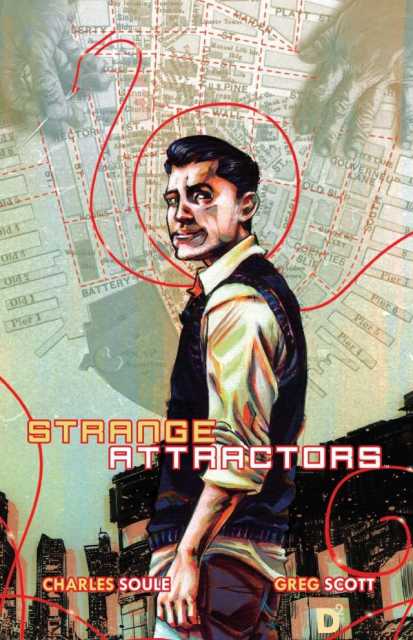
Strange Attractors

Written by Charles Soule
Art by Greg Scott

It's not uncommon, for a comics reader, to find a moment when a character discusses how magic is science that is just not understood yet.  Strange Attractors, by Charles Soule, upends that maxim, and gives us a story about mathematics so hard to understand that it may as well be magic.

Heller Wilson is a PhD. candidate who is working to complete his thesis in New York City.  He's studying complexity theory, and is led to meet with Dr. Spencer Brownfield, an ex-professor who did groundbreaking work on this concept before stepping down for reasons that are shrouded in secrecy.

We learn that Brownfield, who is more than a little eccentric and obsessive, spends his days adjusting the ebb and flow of New York City in a variety of ways, all in an effort to keep the living organism of the city healthy.  It's just about impossible to try to understand the mathematical underpinning in Brownfield's actions, but the concept fascinates Wilson, who begins working with the older man.

As the story progresses, it becomes obvious that something cataclysmic is about to happen to New York.  The professor has a plan, but it's all pretty hard to believe, and Wilson goes through a lot of doubt as to whether or not he should commit to the project.  We, as readers, have a good idea of what the problem will be, as we keep seeing glimpses of terrorists constructing a dirty bomb, as well as some behind-the-scenes moments at City Hall, where a police strike looms.

Soule is a very impressive writer.  I love his Letter 44, and have been very impressed with his work at Marvel (She-Hulk, Daredevil, even the Inhumans) and DC (Swamp Thing).  This is one of his earliest published works, but it's clear at this point that he has a new way of constructing comics stories.  Greg Scott is a capable artist, and he manages to make what is largely a talking heads comic visually interesting.

I don't know how the mathematics behind this story could possibly work, or how an algorithm to map so many different data sets into a cohesive image could possibly be developed in such a rush, but the idea of cities as living creatures is a compelling one, and this book opens up some interesting notions for future exploration.

Monday, August 3, 2015

Okko: The Cycle of Water

by Hub

I'd read the second and third Okko miniseries when they were published by Archaia in the 00's, but never saw the first volume, The Cycle Of Water until recently, and was happy to get the chance to read it.

Okko is a French comic set in an imagined Medieval Japan, where magic, spirits, demons, and combat puppet suits are common.  Okko the character is a ronin and demon-hunter for hire.  He travels with a large, demon-masked man and a drunken monk.  At the beginning of this series, they are hired by the younger brother of a geisha who has been abducted by strange people, in exchange for his service.

Their journey to rescue the young woman is fraught with danger, and when they find the floating fortress to which she has been taken, they discover some very disturbing things.

Hub's art is fantastically detailed and impressive.  The smaller scale of the North American comics page does not fully do it justice, as it feels a little cramped and hard to read at times.  Still, this is a very good read, and now I need to try to track down the fourth volume, The Cycle of Fire.

Monday, December 29, 2014

Hawken: Genesis

Written by Dan Jevons, Miles Williams, Khang Le, and Jeremy Barlow
Art by Fracisco Ruiz Velasco, Alex Sanchez, Kody Chamberlain, Sid Kotian, Bill Sienkiewicz, Bagus Hutomo, Michael Gaydos, Federico Dallocchio, Nathan Fox, and Christopher Moeller

I picked up two issues of Archaia's Hawken: Melee mini-series, because they featured work by Jim Mahfood and Nathan Fox, both of whom are on my buy-on-site list.  I was impressed with the depth of the Hawken world, and its celebration of war-suit pilots on a level we reserve for athletes, pop singers, and actors.

I don't play video games, and have no knowledge of Hawken outside of those two comics, but Hawken: Genesis caught my eye because of the lovely design work by Archaia, and because of the list of artists associated with the project.  It explains why the planet of Illal, a resource-rich colony planet controlled by various corporations, has become a blasted war zone, infected by a nano-virus that is taking over the surface.

The writers of this book focus the story around two men, Rion Lazlo, a ruthless corporate spy with unbridled ambition, and James Hawken, a brilliant scientist responsible for the best and worst advancements on the planet.  When the book opens, Hawkens is toiling away in obscurity for Sentium, one of the two big corporations that run everything on the planet.  Lazlo has defected to Prosk, Sentium's rival, and he manages to bring his friend over.

Eventually, Hawken develops the technology that allows for lightweight and fast mech devices, which are of course, immediately put into warfare.  As relations between the two corporations worsen, and as resource scarcity makes war more profitable, things just keep getting worse on Illal, although the depth of the problems take a while to be revealed.

This book follows these two characters over a few decades, setting up what I assume is the environment and rationale for the game to exist in.  The writers do a good job of covering the human and business reasons, and make good use of text pages to fill in some backstory.

The big draw to this book is the art, which is provided by comics artists as well as game design types.  Each chapter and interlude has been drawn or painted by somebody different, although there is decent visual stability throughout the book.  This was an impressive project, and I hope it's something that Archaia revisits.

Sunday, August 10, 2014

Rubicon

Written by Mark Long (from an idea and story by Christopher McQuarrie and Dan Capel)
Art by Mario Stilla

I love a good war comic, and am always a sucker for a nicely-designed book, so picking up Rubicon, from Archaia's Black Label imprint, seemed like an easy decision.

This story, conceptualized by screenwriter, written up by a former SEAL, and then finally written for comics by a novelist and video game designer, modernizes the concept behind Akira Kurosawa's Seven Samurai, and sets it in Afghanistan.

We are introduced to Hector Carver, a fire team leader, who gets word that one of his close friends was killed in a suicide bombing within a forward operating base in the Panjshir Valley.  His team is on its way (although I'm not entirely sure why - it's not like the military would send special forces in after such an event), despite the fact that this puts Carver in hot water with his ex-wife, and his current girlfriend.

We learn that the bombing was carried out by a resident of a local village of opium farmers, who are opposed to the Taliban.  This guy was forced into doing this because his family was being held captive.  When Carver's team find the guy who made the bomb, they drop him off in the village so that the bomber's father can have his revenge.  The village decides to let the guy go so as to not anger the Taliban, who decided to come back and steal all the opium anyway.

The soldiers decide to dig into the village and protect it, even though that leads to some difficulties with the locals.  Carver's team is supported by two FOBbits, one of whom feels a serious need to prove himself in the eyes of the more experienced operators.  Much violence and bloodshed ensues.

This is a pretty standard story, and one that reminded me of a lot of fiction from the Vietnam War.  The base is surrounded, everyone depends on one another, as they slowly get picked away by an overwhelming number of enemies.  In that sense, the story works well, but there are some things that I felt weren't very clear.  I was not sure what the relationship between the village and the base was, and why there wouldn't be more support during the big fight.  I also was never clear on why Carver's team was there in the first place.  Perhaps this story needed a little more workshopping to make it smoother.

Mario Stilla's art was very nice.  He is an Italian artist, and so things look pretty European, in terms of layout and design.  I especially liked the establishing shots that really captured the look and feel of a remote Afghan village.  He also handles the action very well.

One thing I really liked about this book was the envelope at the back, which contained a variety of documents, such as a letter home, a Purple Heart certificate, and some military papers like maps and reports.  I've always been a sucker for that kind of thing, and it helps add a level of veracity to the whole affair.

Sunday, July 13, 2014

Old City Blues

by Giannis Milonogiannis

I've liked Giannis Milonogiannis's work on Brandon Graham's Prophet, so I thought it might be time to check out his web-comic turned graphic novel Old City Blues.

This book is set in New Athens in 2048, after a flood wiped out much of Greece, and the country (except for the walled off Old City) was rebuilt with the help of the Japanese Hayashi Corporation.  This is a police comic, centred on Detective Solano, who has been investigating a string of strange and seemingly connected murders.  They escalate to the point where Mr. Hayashi himself is the target, although a string of clues suggest that it was Hayashi's own company that did him in.

This book is a love letter to manga, and so cops use 'mobile guns', which are armoured suits that can fly above the city tracking criminals.  We also have cybernetically enhanced humans, and advanced cars and things like that.  I can see why Milonogiannis was tapped to work on Prophet, as there is a similar visual aesthetic, although his work is rougher here than it appears these days.

Milonogiannis uses a lot of speed lines and rough figures to add excitement and kinetic energy to his story.  There is minimal character development, and the plot rolls out along somewhat predictable lines.  At the same time, there is a level of enthusiasm about this work that is pretty infectious.  I see that Archaia has recently released a second volume; I definitely enjoyed this one enough to want to read the new one.  I'd be curious to see how Milonogiannis has grown as a writer after working with Graham and his crew for the last couple of years.

Sunday, February 23, 2014

The Grave Doug Freshley

Written by Josh Hechinger
Art by mpMann

I'd always meant to pick up The Grave Doug Freshley back before Archaia comics imploded for a while, and ended up cancelling the mini-series.  By the time it came out in hardcover, I'd kind of forgotten it, until I saw it in a comics store a little while ago.

The main reason why I'd wanted this comic was for the art of mpMann, whose other comics (The Lone And Level Sands, Inanna's Tears, and Some New Kind of Slaughter) were all pretty impressive.  His minimalist cartoony style works very well for comics set in different time periods, and reminds me a little of Darwyn Cooke's work.

The story of The Grave Doug Freshley can be summed up as "Lone Wolf and Cub set in the Old West, if the Lone Wolf were dead".  A vicious gang of cattle thieves, the Delanceys, have been making life difficult for folk, killing everyone on a ranch before running off with their cattle.  They attack the McNally family, killing everyone there except for their young son Bat.  Doug Freshley, an old friend of Bat's father and Bat's tutor, is also killed, although he gets up shortly after taking a bullet to the head.  He rescues Bat from the fire the Delanceys set, and the odd pair head off looking for justice.

The story is a pretty familiar one, although the fact that Doug is dead does add a little twist to things, as does the fact that the Grim Reaper is hunting him.  This is a lighthearted and enjoyable comic, and like all Archaia hardcovers, it's built quite beautifully.

Saturday, December 21, 2013

Hawken: Melee #2

by Jim Mahfood

In such a busy new comics week as this last one was, it would be very easy to overlook something like this comic, but luckily, I noticed that Jim Mahfood was writing and drawing a video game comics tie-in.  I guess this Hawken: Melee series is a series of one-off issues, although it appears that the other issues are a little more traditional in their creators.

This issue, however, has Jim Mahfood doing a science fiction comic.  I couldn't possibly pass it up.  I have no idea what this Hawken stuff is all about, but it looks like it involves people fighting each other in walking battle tank things.

The story is about a single pilot, Lance Armourstrong, who while skilled, is a complete narcissist and liability to his team.  When the comic opens, we see Lance out for a night on the town with his fellow pilots, who are quietly plotting against him.

Mahfood is a master cartoonist, and it's a real treat to see him handle something like this.  He brings a hip-hop sensibility to everything he touches, and I like seeing how that applies to a project that would have presumably had a fair amount of direction from the game makers.

I hope to see more things like this coming from the newly revitalized Archaia (of course, I'd be even happier to see them finish off more of extant and unfinished projects like The Secret History).

Saturday, December 22, 2012

Jim Henson's Tale of Sand

Screenplay by Jim Henson and Jerry Juhl
Realized by RamĂ³n PĂ©rez

I'm sure it's not possible to find someone who doesn't have fond memories of something done by Jim Henson, be it his Muppets, his work on Sesame Street, Fraggle Rock, or the Dark Crystal.  He was clearly a visionary artist, whose oeuvre has had a lasting influence on children's entertainment and the psyches of generations.

Personally, I didn't realize he was such a surrealist visionary as well.  A Tale of Sand was the name he put on a screenplay for a live-action movie he wrote with his frequent collaborator Jerry Juhl back in 1967 or so.  The film was never made, but the script was recently uncovered and adapted as a beautifully produced hardcover graphic novel by RamĂ³n PĂ©rez.

The story doesn't explain much - a man is attending a party in a small town in the middle of a desert.  He is escorted away by the town's Sheriff, who rather vaguely explains that he has a ten minute's head start to run out of town, and that if he makes it to a group of mountains, he should be safe.  The guy has no clue what's going on, but quickly heads out of town, with only a backpack of supplies, and an over-sized skeleton key to aid him.  It's not long before he realizes that he's being followed by a slim, bearded man, who starts shooting at him.

The guy continues to try to escape, and his journeys lead him through a surrealistic desert landscape, populated with angry Arabs, football players, Kalahari bushmen, busy highways, a shark-infested saltwater swimming pool, and other odd things.

As strange as all of this sounds, on the page, it seems to make perfect sense.  PĂ©rez has done a phenomenal job of drawing this book in such a way as to present its internal logic as ultimately sane and very compelling.  He plays with colour and page layouts to help propel the story, and generally, has created one of the most gorgeous graphic novels I've read in a while.

This book is highly recommended.

Saturday, June 16, 2012

The Secret History Book 20: Watergate

Written by Jean-Pierre Pécau
Art by Igor Kordy

I was very surprised and impressed to see that the newest volume of The Secret History actually came out in the month that it was solicited for,something that I don't think has ever happened.  I was prepared to praise Archaia for finally getting their schedule in order, and figuring out their shortcomings.

And then I read the issue, and realized that for it to make complete sense, one would have had to have read The Secret History: The Games of Chance, a spin-off that was originally solicited as a five-issue mini-series, and then, after those books were ridiculously late, as a hardcover that has yet to appear.  According to Amazon, it was supposed to come out back in April...

Anyway, this is an interesting issue, as it incorporates the Vietnam War into the on-going struggle between the three remaining Houses of Archons.  The war brings with it a great deal of chance and unpredictability, which works wonders for the various players drawn to that conflicted zone.  We are introduced to a pilot named Chance, who appears to be flying for Air America, and doing a little drug running in and out of Laos on the side.  There is a German ex-SS officer there, playing Mister Kurtz.  Later, Stateside, Chance is involved peripherally in the Watergate scandal.

It feels like PĂ©cau is using Chance to replace the character of Curtis Hawk, who would be too old to be of continued use in this series.  Now that the storyline has moved into a time that is more familiar, I find it much easier to follow, as it continues to jump all over the place, geographically and in terms of plot.

Thursday, April 26, 2012

The Secret History Book 19: The Age of Aquarius

Written by Jean-Pierre Pécau
Art by Igor Kordey

The second issue of The Secret History to come out this week is a much smoother read.  Perhaps it's just that Book 18 refamiliarised me with the world of the Archons and their centuries-long interference with human history, but I found that this is a much more balanced and readable volume.  It also checks in with more characters, and advances the plot much further.

This issue opens in 1968 with the assassination of Martin Luther King (all a part of Howard Hughes's plans), before moving over to check in with Reka, who is embracing the hallucinogenic potential of the time.  She finds that dropping LSD makes it possible for her to visit the lost city of Kor, and she plans a gigantic event that will let her tap in to the love energy and drug-fueled excitement of thousands of people to amplify her own trip (what is that event?  the cover makes it clear).

Curtis, now in his seventies, gets a tip as to the whereabouts of his enemy Kim Philby, and travels to Prague during the Prague Spring to take him out.  Dyo is also pulling strings in Prague, making sure that his Soviet Union gets what he wants.

Erlin, meanwhile, is trekking through the jungles of Mexico, searching for Mayan ruins, which predict the date of the end of the world, which also matches up with the predictions of his old friend Nostradamus.  As we all know, the date for this is set to take place this year, and unfortunately, the way things have been working at Archaia, we aren't likely to see another issue of this comic until after the world ends.

I have long enjoyed Igor Kordey's work on this series, and have used it as an example to counter-balance his vilification at the hands of American comics readers after his notoriously rushed issues of New X-Men, but was extra impressed by his work on this volume.  In addition to his usual pencils, he has also retouched photographs of Woodstock to fit with the needs of the story - I thought it was a cool change in the look of the book.

Wednesday, April 25, 2012

The Secret History Book Eighteen: The End of Camelot

Written by Jean-Pierre Pécau
Art by Igor Kordey

It's been four months since the last issue of The Secret History came out, and now this week, Archaia decides to release two issues at the same time - one that was supposed to come out in November of last year, the other December.  I know that sometimes companies that are trying to get caught up will release two issues of the same comic in the same week (Marvel did it a little while back with Captain America), but this book is $6 an issue, so that's a little rough on peoples' wallets.  Especially when it could be another four or five months before the next issue comes around - why didn't they simply warehouse it for three weeks or so?  I'm never going to understand the way Archaia does business.

Case in point:  This issue references things that happened in the Games of Chance spin-off mini-series, which was supposed to come out months ago, and then was canceled and resolicited as a single hardcover, which hasn't come out yet. This is especially egregious when you consider that this is one of the most continuity-drenched, complex comics published.

This particular volume has two points of focus.  It opens with the story of a mysterious artifact that has been lost in Lake Meade, near the Hoover Dam.  It causes strange happenings in Las Vegas, downriver, and later affects the behaviour of the Lake's most famous resident - Howard Hughes, who wants to assassinate JFK.

The other story that takes up most of this book is that of recurring character Curtis Hawk, who is still hunting St. John Philby, and his son Kim, who were responsible for the death of his wife.  Curtis has been the most accessible character in this book to date, so it's good to see him, at an advanced age, keeping up the good fight.

This book is always a dense and complicated read, but I enjoy it for that.  Kordey's art feels looser in this issue.  Now to go read the other one that came out...

Sunday, March 18, 2012

Inanna's Tears

Written by Rob Vollmar
Art by mpMann

I've been waiting a long time to read this book.  Inanna's Tears began life as a mini-series back in 2007, around the time that I was becoming infatuated with most of the books that Archaia was publishing.  Sadly, that coincided with their implosion as a publishing house, and so only two issues were ever published (this happened with other books they were publishing, like Some New Kind of Slaughter or had solicited, such as The Grave Doug Freshley, oddly, all of my examples have the same artist...).  Eventually, Archaia figured things out (more or less - they are usually very late), and this got published as a hardcover.

Inanna's Tears is set in Ancient Sumeria, at a time when writing was just beginning to be used to keep records and accounts.  In the city of Birith, people worship the goddess Inanna, and society is structured around the temple, and run by the Ugula, who are more or less guild-masters, controlling the people who have various functions within the city.  At the top of the social order is the En, the consort of the goddess, who attends her feedings three times daily, and whose wisdom and advice are well respected.  Outside the city lies a teeming tent-city of outsiders, who were given rights to farm the land so that they would not attack or conquer Birith.  They are run by the Lugal, an ambitious man.

When the book opens, the En, an old man named Ardru, is at the end of his life.  He names his successor - a young woman named Entika, who he raised and who has always lived within the temple.  It is unheard of for a woman to be the goddess's husband, although Entika quickly shows herself to be an inquisitive and capable En.  However, the Lugal uses this as an opportunity to take control of the city, and conflict quickly breaks out.

It is very interesting to see such a distant time portrayed in comics with such realism.  It is difficult to ascribe motivations and behaviour that we recognize to a people we know so little about, but Vollmar's story rings true and works well as historical fiction.  mpMann is no stranger to portraying ancient times - his work with A. David Lewis on The Lone and Level Sands and Some New Kind of Slaughter fits very well with this book, stylistically and thematically.  I'm very fond of his minimalist approach to comics, and would like to see more from him.

If you are looking for an intelligent and beautiful historical graphic novel that explores themes of religion, duty, and loyalty, you can't do much better than this book.

Wednesday, January 4, 2012

Cyclops #8

Written by Matz
Art by Gaël de Meyere

I guess there aren't a lot of ways that this series could have ended - even in today's world, let alone the future, it is very difficult to go up against a corporation and get a favourable outcome.  Our hero, Douglas Pistoia and his friends have exposed Multicorps as war criminals, and are on the run when the issue opens.

This issue sags a little, as do many action movies as they get closer and closer to their conclusions; so much time has been spent setting up the big finale that it can't really live up to expectations.  This ending feels a little rushed in a few ways - we see Doug's wife's reaction to the big climax, but not how it affects all of his fans, nor the woman who was manipulating him earlier.  As a reader, I feel a little robbed of an emotional connection with the conclusion.

Still, this has been a very well-executed comic, which has a few things to say about the celebrity and realty TV-focused world we live in today.  The book lost some real steam when original artist Luc Jacamon left the book, and while GaĂ«l de Meyere did a good job, he just wasn't as skilled.  I wonder, now that this is over, if Archaia is going to continue publishing Matz and Jacamon's The Killer.

Thursday, December 15, 2011

Cyclops #7

Written by Matz
Art by Gaël de Meyere

I think Cyclops dragged a little somewhere in the middle, but this seventh issue was originally published as the first half of the last French issue, and there is a definite sense of momentum that propels the story now.

Doug Pistoia is a world-wide celebrity, starring as the leader of a unit of Peacekeepers whose every movement is recorded and streamed live on a reality show.  Pistoia and his crew have gone rogue, having discovered that their corporate masters at Multicorps had manipulated them into killing some civilians - an action that both ensured their silence and pushed a region into war, thereby giving Multicorps a lucrative UN Peacekeeping contract.  Now Doug and his crew are on the run from Multicorps, and go on a rival news station to present their evidence of wrong-doing.

This series has never been huge on characterization beyond Doug, and it's a little hard to tell how everyone is holding up under pressure, but this Fugitive-style story works very well.  I do wish that original series artist Luc Jacamon had stuck around, because I loved his jungles scenes in The Killer, and the way he textured light filtered through the canopy.  Replacement artist de Meyere does this well, but not as well as Jacamon would have.

I look forward to seeing how this series finishes, and (as usual with Archaia), hope that that conclusion comes sooner rather than later.

Wednesday, December 14, 2011

The Secret History Book Seventeen: Operation Kadesh

Written by Jean-Pierre Pécau
Art by Igor Kordey

I really have no idea what's going on with Archaia, but it's nice to see that they are publishing books again, and it's always nice to see another issue of The Secret History.

This is probably the most sprawling and complex comic I've ever read.  This issue alone takes place in Egypt, Soviet Russia, Hungary, and the US, with further discussion of events in Lebanon, Korea, and Israel.  The series has followed the established events of human history, and worked them into an alternate history, founded on the existence of four (now three) Archons, powerful immortal beings that are able to use four rune stones to magical effect.

Now, in the post-nuclear world, the remaining Archons are losing their influence on events (Erlin even gets tossed out of the White House by Richard Nixon), but are still finding themselves involved in the course of history.

Much of this particular volume is confusing, as the story flits from location to location, without centring for very long on any one character or group of characters.  Once the comic decides to focus on the events of the Soviet takeover of Hungary, things improve considerably.  The introduction of Lizbeth, a Hungarian Roma player (in other words, a person with abilities) helps ground the story, and make things much more interesting.  I hope we see more of her in the next issue (whenever that gest published - there is as much chance of it coming out next week as next June).

As always, Igor Kordey does a terrific job of keeping this massive cast of characters straight, while still creating some dynamic pages.  This is a fascinating book, but sometimes reading it really feels like work.

Wednesday, August 24, 2011

Cyclops #6

Written by Matz
Art by Gaël de Meyere

Oh, Archaia.  Sometimes, I just don't know what's going on at that place.  They put out some of the most beautiful comics on the stands, and have very high production values, but on the last issue, they had the wrong artist's name credited, and this issue, which is issue 6, states on the cover that it is actually #5.  Don't people check for this kind of thing?  It's a little embarrassing.

The comic itself is always good.  Pistoia, our hero and general puppet of his Multicorps bosses, is finally pushed a little too far.  His affair with a Multicorps employee (who seduced him) is exposed as a way of trying to rein him in, and has the opposite effect.  On a mission, Pistoia and his squad decide to disobey orders, and expose to the world what they know about their commanders' dirty dealings in the international security business.

This comic has been slow in building to this point.  Matz has methodically set the stage for Pistoia's awakening of conscience, and now it looks like the rest of the series will involve mercenaries hunting down the good guys.  This has been a very solid story, and it's really heating up.

Art wise, I miss Luc Jacamon a great deal.  His replacement artist, de Meyere, is decent, but Jacamon has a much stronger sense of human expression, and panel design.

Tuesday, August 23, 2011

The Secret History Book Sixteen: Zion

Written by Jean-Pierre Pécau
Art by Igor Kordey

What I like most about this title is that it asserts, with almost every issue, that history is important.  Now that the storyline has moved into the post-war, early Cold War days, PĂ©cau is mining the events of earlier issues to help provide context for these current ones.

Now that the Archons have lost one of their number, they need to redivide the city of Jerusalem, which has always belonged equally to all four (each getting one of the historic quarters).  The problem now, is that humanity has moved beyond the Archons, and no longer feels the need to bow down to their guidance or counsel.  In other words, the 'American Century' is under way, and we all know what it's like to try to tell Americans something...

Actually, it's a little easier than trying to tell something to the Israelis, which is also documented through the actions of Adam and his band of fighters (who were introduced last issue).  They are now fighting against Jordanians, and require the help of their friend from the war, our recurring hero Curtis.  He is also in Israel, working as a mercenary, and he makes a pretty significant break with Reka.

As always, a lot happens in this issue, but it doesn't suffer from the occasional lack of coherence that often plagues this comic.  Of course, even when it's at its most confusing, I still enjoy it, because, as someone with a degree in history, I appreciate the importance it gives it.