Monday, October 10, 2011

Bite Club

Written by Howard Chaykin and David Tischman
Art by David Hahn

I've made no secret of the fact that I'm not exactly a fan of Howard Chaykin's work, but that usually applies to his art, and I've enjoyed his collaborator, David Tischman's writing on Fraction and Greatest Hits.  Plus, this book is drawn by David Hahn and the original comics had amazing covers by Frank Quitely, so I thought I'd check this out.

Bite Club is about a Latin American crime family in Miami, who happen to be vampires.  Vampires aren't exactly rare in this world (although, if you were to know our culture only through our popular entertainment, they aren't exactly rare here either), and people are generally accepting of them, which is kind of strange, and goes unmentioned throughout.

Anyway, the Del Toro family pretty much own Miami, although they've gotten someone mad at them, as their patriarch, Eduardo, gets killed in the first chapter.  After that, his family empire is in disarray, especially after it's discovered that he left everything to his son Leto, the only Del Toro who had left the family and entered the priesthood.  From here, the story is about Leto's wrestling with his new role, and the various problems of his two siblings, his mother, her lover, and their lawyer (it could be a Peter Greenaway movie).

The comic is entertaining enough, but I felt like the plot never gelled, and was stuck in a very episodic progression, with too many characters that needed their requisite screen time each issue, but who ultimately didn't contribute much to the story.  Hahn's a great artist, but even in his hands, this story stayed stiff and kind of artificial.  The First Second graphic novel Life Sucks covered similar ground, but with a lot more heart and heft.

McSweeney's 38

Edited by Dave Eggers

I've never attended church or any other religious ceremony with any sort of regularity, saving such things solely for weddings, funerals, and a pair of odd attempts by my mother to 'try it out' when I was young.  As a book lover, and having no way to understand what was going on (I don't see this as a problem, but it does persist to today), I was usually more interested in the books conveniently stored in ledges in the back of the pew in front of me.  At least, until I opened them...

I bring this up because aesthetically, the newest edition of McSweeney's the literary quarterly, evokes for me the stiff, textured paperback hymnals of those days, right down to its deep forest green cover.  The difference, of course, is that I actually enjoyed reading this McSweeney's.

The book opens with a strong short story by Ariel Dorfman about a woman and her husband who have gone to Paris to enact a ritual of remembrance for the woman's brother, who disappeared thirty years prior in Chile.  I find her actions, which take on the role of performance art, as she places rag dolls at sites where partisans were shot during the Second World War to be touching, but the true weight of the story lies with the man in the hotel room next door, who is either attempting to kill someone, or is just making it sound like he is.

After that, we are given a lengthy piece of reportage on The Special Populations Unit of the Israeli army - forces made up of non-Israeli soldiers, mostly Bedouin and Druze.  Not unexpectedly, they are lured into the army with promises of equality and improved stations, but are still treated poorly.  The author, Chanan Tigay, tells of a reservist who receives his call to duty on the same day that he is informed that his house (where he was relocated by the army years prior) was illegal and would be bull-dozed.  With every article I read about Israel, my opinion of its leadership and institutionalized racism gets even worse.

My favourite piece in this McSweeney's is Nathaniel Rich's 'The Northeast Kingdom'.  This is a terrific short story about a very old man who just wants to work on his model airplanes.  As he gets closer and closer to holding the longevity world record, and as he gets increasingly harassed by reporters and relatives who want to know his 'secret', he and his grandson decide to fake their own deaths.  It's a very good piece of writing, with a nice ending.

Also of interest is Roddy Doyle's story 'The Hens', about a Polish architect who is hired by an Irish woman to look after her backyard chickens, and becomes embroiled in open warfare between three upper middle class women with nothing better to do.  It's hilarious.

This is followed by Steven Millhauser's re-working of the Rapunzel myth, Biji Adjapon's brutal story of girlhood in Ghana, and Rachel Glaser's tale of a woman who is at drift after her relationship ended.

There is an excerpt from the new Voices of Witness book that collects oral history around the topic of the 9/11 attacks and their aftermath.  This story, told by Talat Hamdani, whose son went missing on September 11th, is pretty interesting.  Her son, Salman, is believed to have gone to help out at the World Trade Center site, and was never seen again.  Later, the authorities began to act as if he was a suspect, and then the family suddenly received his body, or at least what they were told was parts of it.  The whole thing is suspicious, but as this is only an oral history, no investigative journalism was conducted to try to find out what really happened.  While I found the woman's story gripping, I feel like this piece also reveals some of the weaknesses and limitations of oral history.

Finally, the book ends with the first chapter of an upcoming novel (it is not named) by Dave Eggers.  It's about a fifty-six year old man who is facing bankruptcy, and has one final chance to make his fortune, by starting up a business in Saudi Arabia.  It's Eggers, so it's good.

Once again, this quarterly does not disappoint.

Sunday, October 9, 2011

King Gampo

by Prof

Earlier this summer, Atmosphere played my city as part of their Family Business tour, alongside Babu, Evidence, Blueprint, and Prof.  I calculated that the show wouldn't start on time, and that the guy I'd never heard of would go on first, so I took my time getting to the venue.  When I arrived, I could hear Prof on stage, but decided to take my time checking out the room where the merch tables were set up, and therefore basically missed his whole set.  No big deal, I figured.

At the end of the night (and it was a great night), Prof was outside handing out free copies of King Gampo.  When I listened to it, I realized I'd made a mistake in not seeing this cat live.  He's a decent rapper who specializes in the types of songs that work best with a large, exuberant audience.

I guess this is white trash rap (the Gummo-inspired cover art confirms this).  Prof raps about being poor and coming from a rough home.  On one song, he raps 'Ima be as rich as you, I just need a little time'.  He does have a unique voice, and is often pretty funny.

Brother Ali shows up to help out on one number, and another has a beat provided by Ant, proving that this guy has some serious support from the Rhymesayers camp.  He's probably an artist to keep an eye out for.  You can get the album here.

The Strange Talent of Luther Strode #1

Written by Justin Jordan
Art by Tradd Moore

It's easy to not expect anything from this comic.  Two creators that I'm not familiar with are crafting a six-issue mini-series about an unhappy, geeky, skinny kid who sends away for a Charles Atlas-style booklet, and gains superpowers.  It's pretty much a cliché, right?  I wasn't going to get this book, but then I heard some positive buzz around it, and liked the art when I flipped through it at the store.

It's really a very good comic.  Sure, all of the elements that I mentioned above are overly familiar to anyone who's been reading comics for some time (or even just their ads), but Jordan is doing a few interesting things with it to make it stand out.

To begin with, he's leaving things for the reader to pick up on.  That Luther's mother is the victim of some sort of domestic abuse is an interesting element to the story, especially since it's not really explained.  Likewise, Luther's confusing relationship with Petra needs more screen time, because it is a little unconventional.

Clearly, the powers that Luther has tapped into by reading about the 'Hercules Method' will lead to trouble beyond practically knocking the head off the school bully.  There are a group of guys in chains, speaking with someone they call the Librarian, about a new potential candidate.  Later, this Librarian is shown on a boat, obviously coming to find Luther.

There are a few elements here which don't really make a lot of sense.  First, we have the overly erudite school jock, a figure which really only exists in comics these days (at least he's not as poorly written as Ronnie Raymond in last week's Firestorm #1).  Also, people still mail order from comic book ads?  Why doesn't the Hercules Method have a website?

What makes this book work is the way it mashes together influences like Kick-Ass, Invincible, Lee/Ditko Spider-Man, and Flex Mentallo.  The art is squarely in the Cory Walker and Ryan Ottley, especially when the blood gets flowing.  I found this to be a very enjoyable read, and will stick around for the rest of the mini-series.

Saturday, October 8, 2011

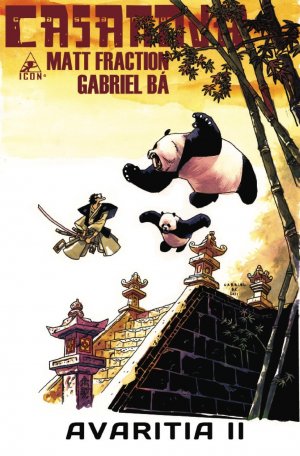
Casanova: Avaritia #2

Written by Matt Fraction
Art by Gabriel Bá

Just pause for a moment and take in that cover.  The fact that the scene it shows doesn't exactly happen like that in the book doesn't actually matter, does it?  That is one freaking amazing cover.

Actually, this is one pretty freaking amazing comic, even if reading it does lead to a level of cognitive fatigue not found in comics since Grant Morrison's Invisibles finished.

Casanova Quinn has stopped having to delete entire alternate timelines now, as he has instead discovered the true identity of arch villain Newman Xeno, and is instead working his way systematically through hundreds of alternates, taking him out.  Were that all that was happening in this book, it would be kind of simple, and we could just sit back and enjoy the different situations and settings that Cass finds himself in.  We could also enjoy the ways in which Fraction and Bá play around with things on a meta level.  Cass goes to kill Luther Desmond Diamond (aka Newman Xeno), the aspiring pop star, in an ancient Chinese setting with pandas, and on the next world, Diamond is signing copies of the comic he drew about that very thing.  There are lots of neat little tricks like that throughout this comic.

Where things become confusing though, is in trying to chart Casanova's feelings towards Diamond, his sorta girlfriend Sasa Lisi, and towards his compatriots at EMPIRE, the organization he works for.  There is a lot of subtle character stuff going on, made all the more difficult to follow because of the way the story is chopped up and spread across different timelines.

Fraction is putting his full brilliance behind this book, making it enjoyable on a number of levels (so unlike his recent Marvel work), and Gabriel Bá is straight killing on the art.  I may not catch everything that happens on the first read, but I am definitely loving this comic.

Severed #3

Written by Scott Snyder and Scott Tuft
Art by Attila Futaki

Scott Snyder has, over the last two years, become a 'big name' comics writer, first receiving accolades for himself on American Vampire, and then taking over DC's Detective Comics and making it the best its been in years.  During the DC Relaunch last month, he had the second best-selling (and one of the most positively-received) titles in the whole line with Batman.  But it's Severed people should really be reading.  It's a shame too, because I'm sure the comic will be lucky to sell one twentieth of Batman #1, despite being vastly superior.

Severed is about a twelve-year-old boy named Jack who has run away from his adoptive mother to try to find his father, a traveling musician, somewhere in Depression-era America.  Currently he's in Chicago, having just missed his father, and is making money to continue his journey by busking.  He is being watched over by Sam, a girl about his age who has disguised her gender for protection on the road.  The pair have caught the attention of a mysterious serial killer, who we know has already cannibalized a boy about their age.

In this issue, the killer approaches them, in the guise of a salesman for RCA Victor.  He attempts to befriend them, inviting them back to his accommodations for beer and duck.  He seems like a good guy to Jack, but Sam is more astute, and knows something is up.

There's a very suspenseful scene involving a bear trap, as the older guy tries to see if he can drive a wedge into their newly-formed friendship.  Snyder and Tuft layer on the suspense once they are in the killer's home, and with each page, I expected something seriously bad to happen.  Futaki's art helps add to this feeling by playing things very straightforward and ordinary - there is no use of shadow and light to try to make things seem scarier than they are, and that's why the book works so well.

I'm very excited to see the next issue.  Much more than I am for Batman #2...

Sweet Tooth #26

Written by Jeff Lemire
Art by Matt Kindt

Both Vertigo books that I bought this week were given over to flashback, although Lemire took things much further back in Sweet Tooth than Chris Roberson did in iZombie.  This month (and, I presume, for the next two, as this is the start of a three-part story) we a told the start of the story of Dr. James Thacker, which begins in 1911.

Thacker's soon-to-be brother-in-law left some six months ago to complete some missionary work in Alaska before marrying Thacker's sister.  He, and his expedition, have gone missing, so the Thacker family has paid a lot of money to hire a boat and send James on a rescue mission.  The journey is difficult, and Thacker doesn't exactly see eye-to-eye with the other men on-board, which becomes more clear when they need to trek in-land to search for the missionaries.

After a few days of hiking, the rescue party wake up to find their sled dogs slaughtered, and things become even more problematic once they reach the church that the missionaries had built.  I have no idea what any of this has to do with Gus, Mr. Jeppard, and the regular Sweet Tooth cast, except for the fact that they were traveling to Alaska when they found the dam that has been the setting for the last few issues.

This story arc is being drawn by Matt Kindt, who is an excellent cartoonist.  He employs his usual artistic technique to make the comic look much older than it is, and to add a sepia-toned, scratchy look to the art, reminiscent of old photographs.  This book reads well on its own, and would be enjoyable even to people who don't normally read this comic.

The Walking Dead #89

Written by Robert Kirkman
Art by Charlie Adlard and Cliff Rathburn

When a series is as character driven as The Walking Dead, I'm sure it can become difficult, after many years, to find ways to keep the principal characters fresh, interesting, and alive.  There is a thin line between keeping characters and their situations believable, and ending up in soap opera territory.  There have been times where I've felt that The Walking Dead may be veering too close to that direction - the recent drama with Carl being one such example, even though I found it thrilling - but Kirkman continues to impress me with his ability to get inside the heads of these characters, especially Rick.

This issue opens with Rick being all emotional.  He's leading a small group of people through the town around their community, hunting for supplies and other useful items, and has ducked into a building to have a good cry.  It makes sense, what with all that he's been through, and his conversation with Andrea, who discovers him there, is frank and very believable.  At the centre of his worries is Carl, who Rick is beginning to believe is stronger than him.  It's a nice moment.

At the end of the issue though, we see Rick in full-on bad ass mode, as he returns to the community to find his leadership being challenged by one of the place's earlier inhabitants.  This guy has roused up just about everyone, and has been chasing after Glen, who has heard of his plans to kill Rick.  What works well here is that in facing him down as he does, Rick is confirming the guy's suspicions about him.  Next issue should be pretty interesting.

iZombie #18

Written by Chris Roberson
Art by Jay Stephens, with Michael Allred

This month we're given a flashback chapter, which focuses on Diogenes, the scarred and kind of surly veteran of the Fossor Corporation, the vampire and monster hunters who have begun to investigate the goings on in Eugene.  Currently, Diogenes is partnered with Horatio, who has become iZombie's main character, Gwen's, boyfriend.  Horatio found out last issue that Gwen is really a zombie, and I expected this issue to show us how that revelation affects their relationship.

Instead, we get a story about Diogenes on his first field mission, to Rio De Janeiro, to hunt a vampire infestation.  Diogenes was originally partnered with Britia, a legendary Fossor, who prefers a sword to any other type of modern weaponry.  Their trip takes them deep into the Amazon, and after handling were-jaguars, zombies, a poltergeist, and a village of dream-walkers, they finally reach the temple, and the vampires, they were searching for.

This is a useful story, in that it helps flesh out Diogenes rather nicely, and provides an interesting connection between his past and Horatio.  The art is by Jay Stephens instead of Michael Allred.  Stephens is good, but I do prefer Allred's take on these characters.

Friday, October 7, 2011

Skullkickers #11

Written by Jim Zubkavich
Art by Edwin Huang and Misty Coats

Skullkicker's second arc, 'Five Funerals & A Bucket of Blood' finishes with this issue, which features both that fifth funeral, and that bucket of blood.  This story has our two heroes fighting a gigantic blood-sucking plant, while still being pursued by soldiers, an angry mob, and the local Thieve's Guild.

The giant plant is central to the plans of Kusia, the woman who our boys have been running into since the first issue, although after she has a revelatory chat (to which we are not privy) with the woman who I still think looks like Gran'ma Ben from Bone, she sort of switches sides.

Basically, this is a big fun fight comic, with plenty of opportunities for Jim Zub to write large sound effect captions that say things like 'dynamic action', 'embarassing [sic] demise', and 'property depreciation'.  The story is wrapped up well, and the last couple of pages both set up the next arc, and give us a sight that is a little confusing, but which I imagine will help propel the series forward.

Skullkickers is always a fun read, and I'm pleased to see that the series is doing well.

Echo Vol. 3: Desert Run

by Terry Moore

Echo is a great series.  The premise is that Julie Martin has been covered with bits of a high-tech atomic suit, which has bonded to her skin.  She was covered in the material after witnessing an explosion in the sky, caused by HeNRI, the company that developed the suit, attacking its test pilot, Annie.  Now Julie and Annie's boyfriend are on the run from HeNRI, a homeless vagrant who also has some of the suit, and Ivy Raven, a woman who was originally hired by HeNRI to find Julie, and is now looking for her for her own reasons.

Sounds complicated, doesn't it?  The thing is, Moore writes this story so smoothly that all of the pieces work very well together.  With this volume, we start to learn a little more about HeNRI, confirming that Annie's death was not as accidental as it may have seemed at first, and that the big military research corporation is, indeed, evil.  Of course, corporations in comics (and the news) just about always are evil, so that's not a surprise.  A new scientist is introduced to the story, as is his weapon that can be used against the beta suit that Julie is now wearing more of.  Why this new character, a Chinese scientist, looks like a bad drawing of Whilce Portacio of Sebastian Shaw's son Shinobi on the cover, I don't know.  He doesn't really look like that in the book.

With all this plot, Moore still finds plenty of time for some nice character moments, reuniting Julie with her damaged and mentally delicate sister.  He also raises (if not resolving) the issue of how one goes to the bathroom in a metallic body suit that has bonded completely with one's body.  This is good stuff.

Caligula #4

Written by David Lapham
Art by German Nobile

From the beginning, this has been a strange and depraved book, but I feel, with this issue, like it's beginning to lose its way.  The first three issues of Caligula has followed young Junius (called Felix by Caligula) on his quest to extract revenge on the mad emperor for the vicious rape and death of his family.  What made the book especially interesting were the supernatural elements that David Lapham has given to Caligula, and the way in which Junius struggled to maintain his sense of purpose around so much madness.

Following last issue's attack, Caligula has remained on his gigantic palace-boat, where he feels safe (despite being apparently invulnerable and therefore safe everywhere he goes).  Most of this chapter is taking up with an elaborate 'murder mystery' Caligula has concocted for a small group of senators and other notables he's invited to his boat.  Each person is required to play a different role, with most of them centred around infidelity and jealousy.  Even Junius is expected to play a role, which puts him in a position of revealing his duplicity.

The problem with all these scenes is that none of the new characters are developed enough to care about.  It's difficult (especially with Nobile's art) to remember who any of them are, and who is supposed to be married to whom.  The anonymity of the actors in this farce rob it of any emotional weight.  Junius/Felix takes some action at the end, which is interesting in terms of his character, but I think I would have preferred to learn more about his plot with the honest Centurion Laurentius, which is given very little space here.

Wednesday, October 5, 2011

Chew #21

Written by John Layman
Art by Rob Guillory

I love Chew.  I'm pretty sure I've written about that before, but it's still true, so there you have it.  It's a hard comic to keep writing about, because as a reviewer, I have to wonder how often I can use phrases like 'gets better with every issue', despite the fact that it's a true statement.

This issue begins a new arc, 'Major League Chew'.  The interesting thing about arcs on this comic is that they are almost always a series of done-in-one stories (at least lately) that could just as well fit with the previous arc.  I guess every writer has to keep one eye towards the eventual trade these days, and that helps provide the structure of the book.

In this issue, Tony starts his new job.  After the disaster of his last mission for the FDA, he's been fired.  Actually, he's been reassigned to the city traffic division, but Applebee, his former boss, prefers to use the word 'fired'.  (He also gets a dance number, which opens the issue).  Being a traffic cop means that Tony has to wear a helmet with a light on it, and a kilt.  He also has to ride around on a Segway, marking him as one of the lowest of the low in the world.

Strangely though, the job gives him the opportunity to shine, and actually get appreciated for his talents for a change (at least, until the last page).  Layman and Guillory give us a fun issue which focuses mainly on Tony, although it does raise the questions of what happened to his daughter, and where his former partner Colby has been reassigned.  Great stuff.

Monday, October 3, 2011

Proposition Player

Written by Bill Willingham
Art by Paul Guinan, Ron Randall, and Bill Willingham

I totally understand why I passed over this Vertigo mini-series when it was first published in 1999 - it had John Bolton covers, and I was working hard at cutting back on my comics intake then.  Picking it up now, I see that I'd missed out on a fun, if inessential, little mini-series.

The book is set in Las Vegas, specifically at the Thunder Road Casino, which is a B- or C-list establishment.  Our hero, such as he is, is Joey Martin.  Joey works at Thunder Road as a Proposition Player, which means he fills empty seats at poker tables, stirring up some action, and then bowing out when there is enough demand at a table.  Joey's a creep.  He is rude to the regulars, and treats his girlfriend Lacy like garbage.  He doesn't really have friends, and is only concerned with building his stake, so he can move into the big time one day.

One night, when Joey is drinking with some of his co-workers, he ends up offering to buy one of his companion's soul for the price of a beer.  Everyone thinks this is a great joke, since Joey never buys, and soon some thirty-odd people have sold their souls away.  It all seems like a big joke, until an agent of Heaven shows up looking to negotiate for the souls, and to shut down what he sees as Joey's incursion into their territory.  It isn't long before someone working for the other side comes calling as well, and Joey and his circle find themselves in uncharted territory.

Like I said before, the book is a lot of fun.  It questions the power base of religions, and shows how Christianity was able to usurp the primacy of other religions through the acquisition of assets; Joey has created a religion for a capitalistic, ironic age, complete with a great Chaos Monkey (who on one of the covers reprinted within looks a lot like Detective Chimp, a great character Willingham recently resurrected).  The commentary is good, and never overshadows the sitcom-like presentation of the plot.

Willingham's writing here is much closer to Jack of Fables than anything else he's done, and I found it curious that he drew the first handful of pages before handing the book over to Paul Guinan and Ron Randall.  The book looks pretty strange, although that's mostly because of the character of Bill, Heaven's agent.  He's overly over-sized, in a way that makes Marvel's character Strong Guy look like a model of proportionality.  I don't know why they decided to draw him like this, but I found he ruined just about every page he's on.

The book is perhaps a little predictable (the guys from Heaven are much more vicious than the hot chick from Hell, for example), but this is a fun read.

Saturday, October 1, 2011

Wholphin No. 8

Edited by Brent Hoff

It's hard to know what to expect out of one of these.  The eighth edition of Wholphin starts out strong, but I kind of thought that this one had a few more skipable pieces compared to earlier entries in the series.

The first film, Destin Daniel Cretton's 'Short Term 12' is an incredible study of characters in a youth detention centre.  Denim, the man in charge, is a pretty conflicted guy.  It's clear that he loves everyone in the facility, from the angry and damaged teenagers in his care to his staff, particularly Natalia, who is carrying his baby.  The problem is that he's not so good at expressing himself with her.  What comes naturally with the kids is impossible for him where Natalia is concerned.  It's rare to find child actors as skilled as the ones that play explosive, goth-y Jaden, and quiet brooding Mark.  Great stuff here.

'Kids + Money' is a documentary I've seen before, but it remains very powerful in its depiction of kids with insane opinions of what they are owed by the world, who casually drop hundreds of dollars for items of clothing and expect weekly manicures.  I like how the filmmaker, Lauren Greenfield, doesn't let her own opinion enter into the film; the kids show how vacuous they are just by speaking.

'Love You More' plays like a prequel to the British TV show Skins.  It's about two teenagers, a boy and a girl, who both like the Buzzcocks.  When a new single comes out, they knick it from the local record shop, and go back to the girl's place, where they make love while listening to it.  This is an excellent study in fumbling teenage desire set against working class London.

'Hidden' is a very powerful animated documentary.  That sounds odd, but it works here.  The subject is Giancarlo, a twelve year old boy who is living in hiding in Sweden, so he won't be deported.  He talks about growing up alone in Peru, where he worked as a shoeshine boy and ran from the police.  Now that he is in a 'safe' country, he still has to watch his steps around the authorities, and can't ever make friends at school in case they figure out what's going on.  The filmmakers interviewed the boy, and then animated his account, helping to protect his anonymity, and giving his story true visual power.

Another animated piece is 'From Burger It Came', a Terry Gilliam-esque story about the AIDS hysteria of the animator's childhood.  'Great Man and Cinema' is an attempt by an American to make a North Korean propaganda film, for reasons I don't really understand.  It fell flat.

From here, things get pretty bad.  'My Friends Told Me About You' is an experimental film that manages to be exceptionally boring while working very hard to be cool and profound.

Equally dull is the triptych of films that make up the DVD menus.  Dave Eggers hired three different actors to trash his brother's bedroom.  James Franco's sequence is ridiculous, both in his behaviour, and in the tediousness of it's length.  Marginally better are Creed Bratton and Maria Bamford's versions of the same general thing; luckily they are shorter.  I will say that the interview with Bamford about her character and her own rage is hilarious.