Friday, August 20, 2010

Farscape #10

Written by Rockne S. O'Bannon and Keith RA DeCandido
Art by Will Sliney

I just recently re-watched the fourth season of Farscape, and followed that up with the Peacekeeper Wars, which served as a nice refresher on the state of the Farscape galaxy before reading this issue of the now very good Farscape comic.

In this issue, Chricton and Aeryn, along with the PK deserter Captain and her Lieutenant scout out the weapons that Commandant Grayza is preparing to sell to the Grennij, who are advance troops for a larger invasion force crossing an inter-dimensional divide. Later, the gang meets with Grayza, which always works well, as she must be an insanely fun character to write, so full of certainty and hubris.

As I've written a few times recently, this comic has gotten very good since it became an on-going series.  DeCandido has these characters down pat, and it's cool to see the way he and O'Bannon are working in the series' history to recent events.  A good example of that comes in this issue, where the commerce planet they visit is the same one that was visited in the very first episode of the show.

Most interesting to me is the way in which Aeryn is developing her own vision of what the Peacekeepers should be.  It's been clear that she never really accepted leaving the service, and now that she has discovered her spiritual side through studying the Books of Yemahl, it is nice to see her work to implement her vision.

The Sixth Gun #3

Written by Cullen Bunn
Art by Brian Hurtt

The Sixth Gun has been a pretty enjoyable mystic Western, but it was a little unclear at times.  With this third issue, Bunn provides a ton of exposition and explains the backstory surrounding General Hume and the strange guns at the centre of the book.

Most of this exposition comes from Drake Sinclair, as he journeys away from the resurrected Hume, and tries to protect the girl that now possesses Hume's gun.  It's pretty clear that Sinclair is hiding some secrets and has a particular goal in mind, and it is this lack of clearly recognizable heroes that makes this book work so well.

With each issue, I find myself liking this title more, and I'm very curious to see where things are headed next.

The Light #5

Written by Nathan Edmondson
Art by Brett Weldele

This was a very cool little mini-series.  The Light is an interesting variation on the typical zombie story.  Something in transmitted light (streetlights bad, headlights good) is infecting people and burning them up.  Coyle, a drunk and wife abuser, is trying to keep his teenage daughter Avery alive, despite the fact that she hates, resents, and even blames him for everything that is going on.

In this issue, Coyle is being chased by one of the men he had been traveling with, but is also still hoping to knock out a major power plant in the hopes that it will protect anyone still alive.  The issue is fraught with suspense, but it is the truly dysfunctional relationship between father and daughter that makes the book work so well.

In the textpiece at the back of the book, Edmondson talks about the usual portrayal of light in literature as being inherently good and beneficial.  It's very cool that with this series, he and Weldele flipped that idea, and made light something to be feared.  This title should read great in trade format, and I highly recommend giving it a chance.

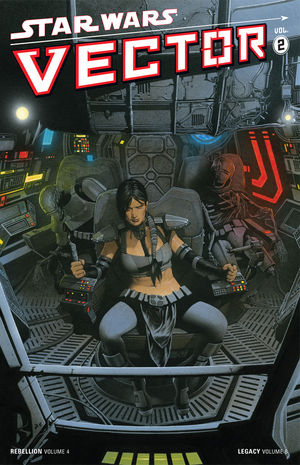
Star Wars Vector Vol. 2

Written by Rob Williams, John Ostrander, and Jan Duursema
Art by Dustin Weaver, Jan Duursema, and Dan Parsons

While I've been enjoying reading John Ostrander's wonderful Star Wars Legacy series, I got a little confused when it came time to find a copy of volume six.  As it turns out, it's because volume six is really volume two of Star Wars Vector, a novel crossover idea that was tried out in all the Star Wars series a couple of years ago, and which is sure to confound new readers.

Vector is about Celeste Morne, a Jedi who has become bonded to a Sith artifact known as the Muur Talisman.  It holds the spirit of an ancient and long-dead Sith named Karness Muur, who is in constant battle for control with Morne, and also gives her the ability to turn any creature into a Rakghul, a mindless monster.  Volume One of this series contains the Knights of the Old Republic and the Dark Times issues, whereas this book covers off the Rebellion and Legacy legs of our tour.  Not being too interested in Star Wars books not written by John Ostrander, I just picked up volume one.

The Rebellion story is okay.  It seems to take place between the first and second Star Wars movies (Episode 4 and 5, for people that want to acknowledge the newer films), and features a still-green Luke Skywalker, and all the rest of our favourite characters.  What is most notable about this story is that the art is by Dustin Weaver, who is currently doing very impressive work on Marvel's oddball SHIELD comic.  Everything else is pretty forgetful.

Then we get to the Legacy part of things, and it all takes a turn for the better.  Ostrander integrates Morne and her story with his ongoing plot perfectly.  We meet up with Cade Skywalker and his crew as they make their way into the Galactic Core to set up their assassination of Darth Krayt, the Sith Lord that has been plaguing the galaxy.  On the way, they come across Morne in a stolen Imperial Destroyer.  They get her on-side in their mission, and lots of stuff happens.

Legacy has to be the best Star Wars comic ever written (and drawn - few artists are as consistently great as Duursema), and I love the attention to detail, both in terms of character and in terms of providing a consistent and interesting setting for these stories that the creators bring to this book.

Thursday, August 19, 2010

Welcome to Tranquility: One Foot in the Grave #1 & 2

Written by Gail Simone
Art by Horacio Domingues

My store got short-ordered on the first issue of this mini-series, and it took a while for me to finally track down a copy, which meant that I got to read the first two issues back-to-back, and that was definitely a treat.

I really liked the original Welcome to Tranquility series, which was set in a small town populated by retired super heroes and villains, and their families.  It had a nice Picket Fences oddball vibe going for it, and the comic was filled with likable characters, most especially Sheriff Thomasina Lindo.  Then, Wildstorm mandated their Worldstorm crossover, and the book went into what I thought was an indefinite hiatus.

Now, Simone has brought back these characters, and is joined by the able Horacio Domingues, whose art on this title is so close to original artist Neil Googe's, that I didn't realize a switch had been made at first.  The story picks up shortly after where the series left off.  The murderous Mayor Fury is being released from jail after a key witness changed her testimony, and the town is preparing to welcome him back.  There is a strange outpouring of love for the Mayor upon his release, and the citizens of Tranquility have prepared a surprise for him at his wife's restaurant.  The only problem is that someone else shows up, who is supposed to be dead, and the Mayor and the two cops driving him, including Lindo, are attacked, and the Mayor taken prisoner by a new character, with a close connection to Fury.

As always when Simone is let loose, the writing is incredibly sharp and funny, but also well paced and plotted.  This is one of those quirky books that Wildstorm used to be known for, and which deserve way more attention than they get.  This new series is new-reader friendly; you'll be brought up to speed in no time.

Ex Machina #50

Written by Brian K. Vaughan
Art by Tony Harris

When Ex Machina started back in 2004, it really stood out on the comics stands.  On the surface, it was a superhero book, telling of the adventures of The Great Machine, the hero of 9/11 (he stopped one of the airplanes, thereby saving one of the twin towers, although the other still collapsed).  The thing is, by the time the story opened, The Great Machine had hung up the jetpack, and was instead taking office as Mayor of New York.

What followed, over a stellar fifty-issue run, was what could be the first truly political comic.  As Mayor, Mitchell Hundred sounded off on any number of controversial issues, such as gay marriage, abortion, terrorism, and others.  The book was squarely grounded in New York City, and incredibly smart.  In the background, there were always hints of a threat from the interdimensional beings that gave him his powers, but this book was about city politics first, and Hundred's relationships with friends, family, and employees second.  And I think that's why I've enjoyed this book as much as I have over the years.

The last few issues, where Vaughan was rushing to get the Suzanne Padilla threat from beyond plot over with, kind of lost their focus on Hundred and his people, so this issue was a huge treat.  In it, Mitchell basically deals with the consequences of the craziness that happened, including the legal ramifications of his putting his superhero suit back on.  Hundred's one of those teflon kind of politicians, so in no time, he's back on his feet serving as Ambassador to the UN, something that had been hinted at before.

This issue is full of surprising character moments, from Bradbury's drunken revelation to Kremlin and Mitchell's last conversation.  Some of the biggest surprises of all come from seeing where Hundred's political career takes him, which I'm sure will have lots of fans talking, but I found it made perfect sense, as well as giving the book one last jolt.

In the end, this was a pretty experimental book, which can be considered a huge success.  Vaughan's writing has been great, and Tony Harris, who was an amazing artist when the series began, has become even better.  This issue is absolutely gorgeous.  I can't wait to see what these two are going to be up to next (hopefully soon).

Chew #13

Written by John Layman
Art by Rob Guillory

Regular readers of Chew have come to expect certain things - sharp humour, and compelling storytelling being the main attributes.  What's cool about this series is that the creators don't leave it there.  Layman has been increasingly experimental in the plotting and pacing of his stories.  Last issue began with a page that was 'out of order', effectively foreshadowing where Tony Chu was going to end up later in the book.

This month's issue takes place between the pages of last month's.  It's not a gimmicky Rosencrantz and Guildenstern Are Dead kind of thing, it's simply a creative way of telling a story that helps to fill in some of the mysteries that have been building around this title for some time now.

The comic opens with the Tarantino-inspired scene on the cover, as Caesar, previously seen as the black ops guy for a company that combines chicken and frog DNA (Fricken!), is revealed to be a deep undercover FDA agent (and that sentence right there is enough of a reason to go buy this book as far as I'm concerned).  Later, said Fricken (actually called Poultplus on the cans), is receiving a lot of attention, and Tony and his partner raid the facility.

There's a lot of crazy, funny stuff going on within this comic.  I particularly like the strained relationship between Tony and his boss.  This is a book that keeps getting better with every issue, and is well-deserving of the Eisner it won this year.

Saturday, August 14, 2010

Torso

Written by Brian Michael Bendis and Marc Andreyko
Art by Brian Michael Bendis

I find it a little hard to believe that it's taken me this long to get around to reading Torso, Bendis and Andreyko's historic true crime novel and love letter to Prohibition-era Cleveland.

This is quite possibly the best Bendis comic I've ever read (it's definitely in my top three).  In this, Bendis and Andreyko tell the story of the Torso killer, a serial killer who terrorized Cleveland at the same time that Eliot Ness took control of the police force, looking to drive out corruption and booze.

The story has been meticulously researched (as evidenced by the newspaper articles included in the backmatter), and carefully constructed.  Bendis has always drawn from photos, and so the characters are very close approximations of what the actual police detectives assigned to the case looked like.  As well, there has been some real thought put into the personalities and characters of the principal people involved in this case.  This reads better than most true crime, because the writers decided to avoid lurid description of the mutilated bodies (the killer was called Torso for a reason - that's usually all that was found of the victims), leaving that to the illustrations.

As usual, Bendis has a strong ear for dialogue, although I got a little tired of some of the slang from the era.  If I have any complaint about this book, it's that it seriously needed a proof-reader.  I was frequently pulled out of the story as I tried to figure out which 'there' the authors intended to use.  That's a little shameful really - it's a collection; there would have been plenty of opportunity to fix mistakes.  This is a whole other rant though, so I'll leave it for now...

Friday, August 13, 2010

Groom Lake

Written by Chris Ryall
Art by Ben Templesmith

I'd wanted to pick up the individual issues that made up this series when they first came out, but I was put off by the $4 price (not that $20 for a trade is better - thank you used bookstores!).  I'm glad I got around to reading this, as it's a lot of fun, and quite pretty.

Groom Lake is named for the location of Area 51, but the story starts elsewhere, with the abduction one night of a man in New Hampshire.  Some two years later, his twenty-year old son is contacted by agents for the US Government, and they take him to Area 51 to see his father, long presumed dead, who had been experimented on horribly by the little gray aliens that anyone who has ever seen a copy of Communion would be familiar with.

As it turns out, our young hero, Karl Bauer, has altered genes after generations of alien experimentation on his family.  All of his experimented upon forebears have died from exploding genitals, and the aliens want to study Karl.  The government has been working with these aliens, to develop genetic weapons.  It turns out that all of your favourite aliens from the movies - the Blobs, ET - have been living at Area 51, assisting with black ops projects.

The story is a little predictable - Karl escapes with Archibold, the pilot for the little gray aliens, and all sorts of stuff happens.  It's the execution of this plot, and the little details, that make the book so good.  The aliens are obsessed with human genitalia (lacking any of their own), and like chocolate and cigarettes.

Templesmith's work is as good as it always is here, and Ryall shows a good ear for dialogue.  This is a good quick read.

Thursday, August 12, 2010

The Veil

Written by El Torres
Art by Gabriel Hernandez

When this book was first published as a mini-series, I remember it getting some positive attention at the Comics Should Be Good blog, so I figured it was worth checking out. 

Really, this is a strange project.  It stars Chris Luna, a female private investigator (are there comics about male private investigators anymore?) in New York who can see and speak to the dead.  Taking on the cases of the dead is not terribly lucrative, so when she receives word that her recently deceased aunt's home is being appropriated, she heads back to Crooksville Maine, her childhood home.

When Chris was a kid, she was one of the few survivors of a terrible train accident (which caused her abilities to manifest), and she'd had it tough from that time.  Upon her arrival in the town, things quickly start to fall apart, as she realizes that her nightmares of the last twenty years had been visions of what was to come.

At this point, the book becomes a pretty standard horror story, complete with a hideous monster with a silly name (The Slug Man).  From here, I found the book a little less enjoyable, but that's because I'm not a fan of this type of horror.

Hernandez's art is pretty cool.  It looks like a more sedate Ben Templesmith (I guess that's how you know you're reading an IDW book), and Hernandez uses a lot of browns, giving the book a very earthy feel.  It's an interesting read in the first half, but unfortunately can't rise above the dictates of its genre.

As a side note, I don't understand why the writer and artist's names aren't on the cover or on the IDW on-line store entry for this book.  I know they aren't terribly well known, but it seems disrespectful.

The Unwritten #16

Written by Mike Carey
Art by Peter Gross

While this series has been running for the last year and a half, Carey has kept readers almost as much in the dark about things as Tommy himself has felt.  With this issue, plenty gets explained, as Tommy is finally reunited with Wilson, his father, although the creepy muttonchops guy shows up as well.  The theme of fatherhood is also present when Lizzie Hexam, having returned to her own book, chapter, and original home, gets to meet with her dad.

This was a good issue, and the coolest stuff in it revolved around the scenes with the launch of the 14th Tommy Taylor book, as the publisher revealed how he pulled one over on the Cabal, although it looked to the rest of the world like he was simply avoiding press reviews and bootleggers.  It's a very cool publicity stunt that Carey describes, and I wonder how well it would really work.

From its inception, this has been a series that has required a fair amount of reader attention and faith, and I'm interested to see where things go from here.

Northlanders #31

Written by Brian Wood
Art by Riccardo Burchielli

This is a strange arc.  Prior to this arc, Northlanders has stayed focus on historical accuracy and realistic portrayals of life in the Norse period.  With this arc, Wood is introducing some of the old gods, as Erik, our protagonist, has frequent conversations with one god.

This leads me to ask if Erik is crazy, or if this is a shift in tone for the series.  Regardless, it's a good story, as the consequences of Erik's actions last issue (slaughtering a delegation of Christians and burning their half-built church) are explained to him by Ulf, the man who was berating him at the start of the arc.

Wood has chosen to focus on an interesting part of European history, and I'm interested in seeing how this conflict between the Christians and the Norse will play out.  In a lot of ways, this story works as a counterpoint to the earlier arc, The Cross + The Hammer, which had an Irishman resisting against Viking invaders.

The Walking Dead #76

Written by Robert Kirkman
Art by Charlie Adlard and Cliff Rathburn

After the end of the last issue (before the aliens showed up), I would have thought this issue would be more of a game-changer than it is.  If Rick acted the way he did just about anywhere else, he'd be out on his ear, but instead, he gets to keep his job, and we get to learn the history of the community, including the story about this Davidson guy that we've been hearing about since they got there.

When he first showed up in the story, I wasn't that fond of Douglas, the de facto leader of the community, but as I read through this issue, I began to admire his even-handedness and sense of consequence.

Most of this issue is made up of long conversations between Rick and Douglas.  It's a talking heads comic this month, but because of the genius of Charlie Adlard, it's never boring.  I can't wait to see how Carl reacts to the last page, and I look forward to seeing if Rick will be able to patch things up with Michonne.

DMZ #56

Written by Brian Wood
Art by Nathan Fox

The Collective Punishment arc is examining recent events in the DMZ to see how they affect some of the various back-up characters that we've gotten to know over the last few years.

This issue shines a light on Wilson, the protector (or warlord, depending on your point of view) of Chinatown.  Wilson has ruled the area for a long time, and the people who live there are very thankful to him for the protection he has provided them.  Now though, with the American army about to invade the island, Wilson is in a difficult position.

A representative visits, giving him a classic helicopter and 20 million in gold as payment for clearing Chinatown before the tanks roll in.  Wilson has never been one to roll over for anybody, and so he is left with a difficult decision to make.

The art for this issue is by Nathan Fox, who has appeared in this title before, and has recently done an amazing job on the Dark Reign Zodiac mini-series.  He provides his usual brand of detailed, slightly scratchy art, but also shows the odd flashback panel that has been inked with a finer line and coloured differently, making it really stand out.

My favourite panel of the issue (and possibly of recent memory) is the one where Wilson is buttoning his shirt on his bed before going out to address his followers, with David's famous 'La Mort de Marat' hanging in the background, suggesting a connection between Wilson and either Marat or perhaps his assassin, Charlotte Corday.  It's a very powerful page.

morning glories #1

Written by Nick Spencer
Art by Joe Eisma

I've said it before, but it bears repeating.  Nick Spencer is going to be the next Jonathan Hickman.  He's been showing a remarkable range across his recent Image mini-series (Forgetless, Shuddertown, and Existence 2.0 and 3.0, which I haven't read yet), and has now started this new title, which is unlike all of the others.

This first issue of morning glories is long, and the space is used to good effect to introduce a bunch of new characters who have been invited to study at Morning Glory Academy, an unconventional and secretive school, where 'things aren't what they seem'.

Each of the six main characters have enough space to establish themselves, and while they fall into some recognizable categories (emo girl, nice boy, nice scientific girl, psychopath), Spencer makes their interactions interesting and novel.  There is some strange stuff going on in the school, as we see right from the beginning when a student tries to escape, although that plotline does not get revisited (except for a glimpse through an open doorway).

Eisma's art works well here, reminding me of the look of some of the second-string Marvel X-Men books that focus on the younger students (I can't think of a single name, but I'm sure you know what I mean).

I'm not sure if this is a mini-series or if it's expected to be on-going, but I'm definitely going to be sticking around for a while, as I'm curious to see where this is going.