Friday, November 2, 2012

Ghosts #1

Written by Al Ewing, Toby Litt, Cecil Castellucci, Joe Kubert, Neil Kleid, Mary HK Choi, Paul Pope, David Lapham, Gilbert Hernandez, and Geoff Johns
Art by Rufus Dayglo, Mark Buckingham, Victor Santos, Amy Reeder, Joe Kubert, John McCrea, Phil Jimenez, Andy Lanning, Paul Pope, Gilbert Hernandez, and Jeff Lemire

Once again, Vertigo sends us a nice large anthology comic, similar to Dark Horse Presents, although without using any established characters or properties.  Like any anthology of this size, we are given quite a mixed-bag in terms of the quality of what's being offered.  Part of the problem with this is that Vertigo has lost a number of the writers and artists who have always been a firm part of their stable in the last year.  As such, they have cast a much wider net for this book, bringing in a number of writers I've never heard of before (Toby Litt, Neil Kleid, and Mary HK Choi), while still being able to attract some creators who are not definitely top shelf, like Paul Pope.  The theme here is suggested by the title, but not every story is a ghost story, which is a good thing, as that single note would have gotten played out quickly.

Let's go through the book, and see what's what.

  • The anthology opens with a fun little story about a man who is haunted by the ghost of what he could have been.  When he takes a job as a data entry drone, the part of him that wanted to be a rock star literally starts to haunt him, although when it becomes clear that everyone can see and hear the ghost, things change.  This is a very British story, by Al Ewing and Rufus Dayglo.  It's nice.
  • Much is made on the cover about the inclusion of a new story featuring the Dead Boy Detectives, who originally showed up in Neil Gaiman's Sandman comics.  This story is a complete disappointment - it's disjointed, childish, and doesn't even end in this volume; it is to be continued in the next Vertigo anthology, which hasn't even been solicited yet.  On the up side, it's drawn quite nicely by Mark Buckingham, whose work is the only thing I miss since I dropped Fables a few months back.
  • Cecil Castellucci and Amy Reeder provide 'Wallflower', a very nice story about a family, and how it changed with America, as the wife in the family discovers who she really is only after raising a child and looking after the house for many years.  Lovely.
  • Joe Kubert's last story is printed in this book, which alone makes it worth the purchase price.  Kubert never finished the story - only his rough pencils are reproduced here - but it is a nicely-written tale of an Aztec grandfather and his grandson, on the eve of the older man's death.  There's a lot to read in to this, if one is so inclined; for myself, I was just happy to read one more Kubert tale.
  • Demonic chili is the subject for the story by Neil Kleid and John McCrea.  It's a cute tale; there's not much more to say than that.
  • Mary HK Choi and Phil Jimenez, on the other hand, tell a downright strange story about a young man who is mourning for the death of his much older wife.  This story is full of excess and strangeness, but neither horror nor ghosts, so its inclusion here is strange.
  • The best thing about this anthology is 'Treasure Lost', a story by Paul Pope (with scripting by David Lapham).  It's a science-fiction epic about two children, heirs to a throne, who are kidnapped by space pirates, and who both undergo a form of Stockholm Syndrome.  Introspective, and beautifully illustrated, this is a good reminder of what a huge talent Pope is.  It totally doesn't fit with the themes of this book, but really, who would care?
  • Gilbert Hernandez has a nice little story with a conceit made way too obvious by the themes of the book - had it shown up in Dark Horse Presents, it may have given a bit of a surprise to the reader.
  • Geoff Johns and Jeff Lemire finish off the book with a nice little story about two brothers who are in the haunting business - a task made easier by the fact that one of the brothers is a ghost.  Really, I'm just happy for any chance to see some of Lemire's art.
In all, this is a decent anthology.  I appreciate that Vertigo is giving some new talent the chance to show their stuff, and find it regrettable that none of those new faces impressed me much.  It would have killed them to get Becky Cloonan to do something for this?  Still, Paul Pope and Joe Kubert...

Fatale #9

Written by Ed Brubaker
Art by Sean Phillips

Fatale is one of the best series on the stands right now, period.  Each issue is packed with excellent pacing, dialogue, and character work, and each issue is absolutely gorgeous.  Ed Brubaker and Sean Phillips do some amazing things each and every issue.

In this issue, we learn the fate of Suzy Storm, a messed up young 70s actress wannabe who has fallen afoul of the Method Church, a cult centred on the evil Hansel (who has been in this series since it was set in the 30s).  Miles, Suzy's only friend, searches for her, but isn't sure if he is worried about her because she is her friend, or because her disappearance hurts Jo's chances of recovering the book she wants from the Method Church's library.

Jo, you see, is the femme fatale who gives this series its name.  She's immortal, and has some strange effect on men.  Miles is beginning to recognize that effect, as he learns a little more about his new woman.

I've been enjoying this 70s arc even more than I had the prior one, as the occult weirdness of the story translates nicely into that time period.  Brubaker's writing and characters are very sharp, and I found this to be a story that is very easy to get lost in.

The best thing about this issue is the announcement in the back that Brubaker and Phillips are expecting the story to last past issue twenty.  It's great to see an independent book by a couple of highly acclaimed creators reach such success since leaving the confines of Marvel's boutique line Icon (Criminal and Incognito, their previous series were published under that imprimatur).  This really is the decade of the independent comic...

Thursday, November 1, 2012

Whispers #4

by Joshua Luna

Whispers is a really interesting, bizarre comic.  It's about a guy who develops the body to 'remote view', or project an astral form (to use a Marvel Comics explanation).  The guy has obsessive compulsive disorder, and great difficulty relating to the world around him.  He used his power to check in on people in his life, and became aware of a demonic entity inhabiting a man, causing him to do some pretty horrible things to small children.

In the last issue, he figures he can save an ex-girlfriend from a drug dealer who has been threatening her, and get rid of the serial killer at the same time, but this plan does not work as hoped in this issue.

To begin with, our man discovers that there are other demons working through people, including a guy who likes to lock up women in a tiled cell for weeks on end.  Also, the drug dealer figures out that he's involved in his downfall, and comes looking for him.

This is a pretty unique horror comic.  I don't have a good feeling for where Joshua Luna is taking the story, and that's probably the thing I like the most about it.  He's spent a lot of time building up this main character, and now he's landing him right in the middle of some very strange things.  His art, without any contribution from his brother, continues to surprise me, in the way that it can take a while to get used to someone you know well when they wear a new hairstyle.  I do wish this book would fix its scheduling issues though, as it's running pretty late, especially considering that it's a bi-monthly book to begin with.  Still, this is a very good series; I hope that enough people are checking it out.

Wednesday, October 31, 2012

303

Written by Garth Ennis
Art by Jacen Burrows

I've become very skeptical about Garth Ennis's writing, having become pretty bored with his gross-out humour, but I'm still more than willing to dive in to one of his war comics.

If there's one character that Ennis excels at writing, it's that of the hardened soldier, surrounded by incompetents and/or newbies.  In 303, he introduces us to an unnamed Russian Colonel who fits the mould perfectly.  He is stuck leading a pretty useless group of Russians on a mission in Afghanistan.

It seems that an American plane has gone down in a remote, mountainous region, and it clearly holds some secrets that someone in the American government needs kept that way.  In advance of the American recovery effort, both Britain and Russia have sent men in to take a look around.  Our Colonel and his crew are trailing behind the Brits, but he's determined to catch up.  This leads to some of the usual Ennis-style messed up situations, as the three groups demonstrate the lengths to which they will go for this mission.

The second half of the book is much stranger (I presume this trade is collecting a couple of mini-series or something, as there are three separate stories featuring the same character), in that it features our Colonel embroiled in the plight of migrant workers from Latin America working in an American slaughterhouse.

Still, Ennis writes this book very well, and Jacen Burrows capably illustrates in the usual Avatar house style.  What I like best about this book is the way in which it can be read as a tribute to the Enfield 303 rifle.

Sunday, October 28, 2012

Zanta the Living Legend

by Jason Kieffer

Toronto has a proud history of being home to many a street-corner eccentric, and it appears that cartoonist Jason Kieffer has taken on the task of chronicling them through his cartoons.  Kieffer is best known in the city for his controversial book The Rabble of Downtown Toronto, a field guide to the downtown's homeless, drug addicts, and harmless weirdos.  Now, he's turned his gaze on one of our most storied folk, Zanta.

For people not from the city, Zanta is a muscle-bound man who, from 2003 at least until 2008, would pop up around the city, yelling at people, and performing very theatrical push-ups.  I distinctly remember eating lunch at Maison du Croissant (man I miss that place) watching him block traffic while yelling at cars and doing push-ups in the middle of the intersection at Yonge and Gerard.

Zanta was immediately recognizable - he was always wearing just a pair of shorts, a pair of boots, and a Santa hat, no matter the weather.  He often performed his calisthenics on top of newspaper boxes, or upside down in the subway, while making a hydraulic noise, or wishing everyone a "Merry Christmess".

Kieffer's book consists of a few sections.  It begins with a graphic novel transcription of a long interview Kieffer conducted with the man in 2006.  They discuss Zanta's love for this 'character', and he chronicles his many issues with Toronto Police Services and the Toronto Transit Commission's Constabulary.  As time went by, Zanta became banned from an increasingly large section of the downtown core, and TTC property excluding bus routes.  Much of the interview is made up of Zanta defending his actions.

The second section is more straight-forward transcription of a radio interview Zanta gave while locked up in the Don Jail.  In this part of the book, Zanta seems much more mentally ill than he does in the first; gone is the harmless eccentric, replaced by the ravings of a man who seems pretty deluded.

Later, we check in with Zanta when he is free once again, and see that the constant police harassment has broken the man.  That there is no indication that he ever received any kind of useful support or assistance can be seen as an indictment on our whole city.

Still, Kieffer paints Zanta as the type of person who makes the city exciting and unique.  He suggests that we need these types of characters in our lives, and is sympathetic to the man throughout.  This is a fun read, and a nice reminder of an aspect of our city that I haven't seen in many years, and that I miss.

Saturday, October 27, 2012

Revival #4

Written by Tim Seeley
Art by Mike Norton

Revival just keeps getting stranger, but that is by no means a bad thing.  Tim Seeley and Mike Norton's 'rural noir' story is moving in directions that I didn't really expect when I read the first issue, but I'm enjoying the ride quite a bit.

In this small area of rural Wisconsin, the recent dead have come back to life.  What started off as a positive miracle has taken a turn for the negative as some of these 'revivalists' have begun killing people or otherwise acting very strangely.  The police are only beginning to put this together, while the quarantine on the area is causing tempers to fly out of control (the odd handful of poop too).

Seeley is playing with a lot of different characters here, as it's becoming increasingly apparent that characters that originally seemed pretty minor in fact have large roles to play in the story, such as the television reporter we see featured on the cover.  It also seems that the creature we've seen lurking in the woods is possibly a demon; I was thinking alien myself.

While this issue didn't have any references to Doomtree (the main reason why I loved the last issue), it does have a compelling story and terrific artwork.

The Unwritten #42

by Mike Carey and Peter Gross

I've felt that The Unwritten has been floundering a little of late, and while this issue looks backwards more than it does forward, I find that my enjoyment of the series has not diminished because of this lack of momentum.

I think what's making this book work so well right now is the addition to the cast of Didge, the Australian police detective whose dyslexia saved her from Pullman's wooden hand, and consequently caused it to short out.

In this issue, Didge tells Tom that she met Lizzie Hexam when she was sent to the Leviathan, and that in turn sets Tom off on a quest to enter the story-world Hades and find her.  Doing this involves an old Australian novel about missing school-children, and a legend about whales (it always comes back to legends about whales with this comic).

Carey and Gross continue, month after month, to impress me with this series, although after Tom's latest foray into the world of fiction, I'm hoping that something is going to happen to move this series towards a final conclusion; I don't want it to become like Fables, and keep creaking along well past it's day.
 

Prophet #30

Written by Brandon Graham, Giannis Milonogiannis and Simon Roy
Art by Giannis Milonogiannis and Brandon Graham

Two Brandon Graham books in the same week?  What a great time to enjoy great comics!

This issue of Prophet is one of Graham's best (and that's saying a lot) as he starts to tie together some of the different threads of his story by having characters begin to meet and work together.

This issue opens with a focus on Rein-East, an assassin sent to kill one of a ruling clan on a world we haven't seen before.  She is successful, but also captured.  This part of the comic is very cool, as once again, Graham throws a large number of strange concepts and ideas at us, which all seem perfectly normal within the world he's created.

After that, we check in with Old Man Prophet and his traveling companions.  They've come to the same planet, where Prophet once lived with his greatest love.  Their arrival reminds me of a key scene in The Empire Strikes Back, and they are soon fighting for their lives, joined by Rein-East, and Jaxson, the robotic creature we were introduced to a few months back.

Giannis Milonogiannis handles most of the art in this issue, and his work has really grown on me to where I think he is equal to Simon Roy, the artist who first worked on this book when Graham relaunched it.  Graham himself finishes off the issue with his own art, something I didn't expect and was very happy to see.

Prophet remains one of the best comics being published today.

Friday, October 26, 2012

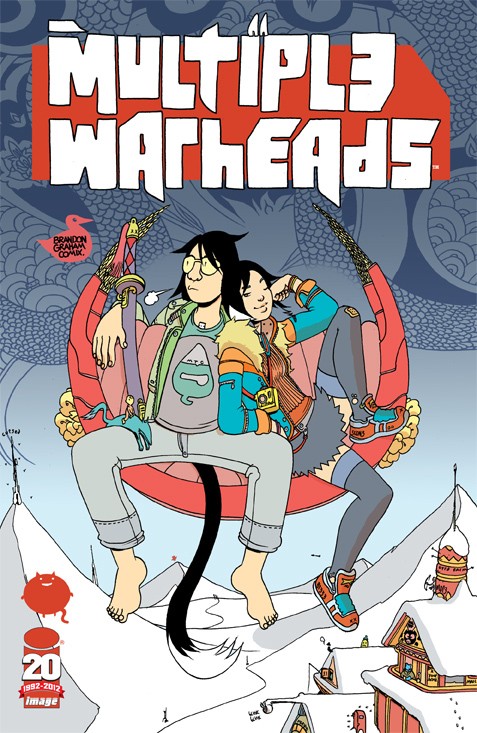
Multiple Warheads: Alphabet to Infinity #1

by Brandon Graham

It has been years since I read Brandon Graham's Multiple Warheads one-shot from Oni Press, and I never really expected to see its main characters, Sexica and Nikoli, again.  I was very pleased to hear that Graham was returning to this title for what he promises the first of many yearly mini-series.

Multiple Warheads began its life as a porn comic, which explains the main character's name, and why Sexica, the organ smuggler, sewed a wolf's penis to Nikoli, causing him to have 'wolf dreams'.  In the Oni Press issue, which abandoned the porn angle, a spaceship crashed on their neighbourhood, spurring the couple to hit the road.

This series is set in the type of weird future world that has become Graham's stock in trade.  King City, his wonderful comic, is set in a similar world, where familiar things exist alongside weird, wonderful, and pun-based items of amusement.  Our two heroes in this book are driving across the country (world?) to travel to the Impossible City.  We see what their journey is like, as they come across strange beings (Otto Barons are people who are somehow physically attached to their cars), listen to their singing cigarettes, and bemoan the lack of high-quality pastries.

Running parallel to this story, Graham introduces another organ smuggler, Nura.  Her story feels like a bridge between this book and Graham's hugely successful run on Prophet, as this character heads out to track down a Shov Puppet, a person who is able to grow magic organs, and has to kidnap him from a castle perched atop a large walking city.

Graham is one of the most inventive and funny creators working in comics today (I love the Misogyny Parlour - where men declare their hatred of women while getting deep tissue massages by other men with porn star moustaches).  His art is terrific, and also very funny, and the best thing about this comic is that it's a solid 48 pages, with no ads, for $3.99.  This has been a wonderful year for new comics, and Graham has just made it even better!

Mind MGMT #6

by Matt Kindt

The first volume of Mind MGMT ends in a way that makes a lot of sense, as Meru's meeting with Henry Lyme continues to reveal some of the secrets of the Mind MGMT organization, and Meru's place in the world.

Matt Kindt is an incredible comics creator.  He's woven together a rich and dense story, and infused it with situations that are logical, if you accept that people with mind control powers really do run the world.  Meru is an interesting character, as much a puppet of this organization as are the Immortals, even though we are no longer really sure if it still exists or not.

Kindt is clearly having a lot of fun with this book.  He has built up a rich mythology, and has given himself a place to play with some of his wildest ideas.  The blue text running along the left side of each page discusses the existence of the Mind MGMT Field Guide this month; a collection of rules and tips for agents that exists in a virtual environment in their own minds, and which defies description, explanation, or transcription.

As always, Kindt's art is a bit of an acquired taste, but I don't think any other artist would be able to pull this book off the way he does.  Next month, we're being given a 'zero issue', a concept I usually don't like, but I look forward to seeing where Kindt takes this story next, as he transitions into his next big arc.

If you are not reading this comic, you really should be.

Dark Horse Presents #17

Written by Carla Speed McNeil, Phil Stanford, David Chelsea, John Layman, Jimmy Palmiotti, Justin Gray, Edgar Allen Poe, Richard Corben, Michael Avon Oeming, Tony Puryear, Erika Alexander, Robert Alexander, Colin Lorimer, and Michael T. Gilbert
Art by Carla Speed McNeil, Patric Reynolds, David Chelsea, Sam Kieth, Tony Akins, Richard Corben, Victor Santos, Tony Puryear, Colin Lorimer, and Michael T. Gilbert

I don't know if it's just my mood when I read this anthology this month, but I came away from it feeling a little less than impressed.  There are still some great comics in this book, but somehow, it became much less than the sum of its parts this time around.  Let's review:

  • I love 'Finder', Carla Speed McNeil's epic comics series.  The DHP stories are usually excellent, as they are beautiful.  This month's could have benefitted from the annotations that McNeil has filled her trades with; I kind of had no clue what was going on here, as Jaegar runs with some Laeske females, before being captured by some young people with horns, who appear to be poaching Laeske eggs.  I think.  Like I said, footnotes.
  • For the second month in a row, Phil Stanford's 'City of Roses' feels like a lot of set-up with no pay-off.  Something solid needs to happen here soon.
  • David Chelsea's 'The Girl With the Keyhole Eyes' finally finishes.  It's a cool idea - a free-form poem or stream-of-consciousness comic, but that kind of thing doesn't work in a serial format, and it got kind of repetitive.
  • John Layman and Sam Kieth's Aliens story ends as most Aliens stories do; there's never a surprise there.  This story had some potential, but it never quite reached it.
  • I think that 'Deep Sea', Jimmy Palmiotti, Justin Gray, and Tony Akins's ocean adventure series is very interesting, and one of the most effective pieces here, while still being a standard B-movie genre piece.
  • Richard Corben adapts another Edgar Allan Poe poem, 'The Sleeper'.  It's creepy and atmospheric, and less gender-ambiguously creepy as last month's.  Good stuff.
  • There is a story here by Michael Avon Oeming and Victor Santos, called 'The Sacrifice', which I guess is a one-off.  It's fine, if you're okay with stories about elves and magic swords in trees.  It's pretty.
  • I've been loving Concrete Park, by Tony Puryear, and I'm excited to see that the two storylines have finally collided (more or less literally), in this, the last chapter of the first 'book'.  Puryear told me that there is going to be more of this story coming soon, and I look forward to that.
  • I vaguely remember the first chapter of Colin Lorimer's UXB from six months back or so, and I remember that I liked it, but I found this new chapter very ambiguous (at the end), and totally lacking in context.  
  • I'm not very enthusiastic about Michael T. Gilbert's Mr. Monster.  Actually, I never bothered to finish this story.
Here's hoping that next month's DHP is a little more impressive.

Thursday, October 25, 2012

Antibalas

by Antibalas

Fela Kuti is alive and well, and curiously, living in Brooklyn.  That's what you might think, were you to listen to Antibalas's latest, self-titled album, without knowing what you were listening to.

The band, having made the move to Daptone Records, continue to channel the Black President in all that they do, while also modernizing his sound, and singing about contemporary issues which Fela would probably be tackling himself, were he still with us.

The album starts with 'Dirty Money', a horn-drenched commentary on our wealth-obsessed culture.  'Rat Catcher' tells a story that also sounds like one Fela would have told.  While the band is excellent and swinging, it is the presence of vocalist Abraham Amayo, who was raised in Nigeria, that elevates this music to a new level.  His lyrics and vocal mannerisms really bring all of these tracks together.  I love waiting for that point in each song (sometimes quite a ways in) where he joins the music.

I saw these guys play about a month ago, and I have to say, if you ever get the opportunity, make sure you don't miss them.  They put on an incredibly high-energy show.

Wednesday, October 24, 2012

Totem

by Ryat

Ryat's album Totem is hard to describe without invoking the names of other projects, even though it is a very individual project.  Basically, this beautiful forty-minute disc could be pitched as "female Flying Lotus by way of Portishead and Mezzanine-era Massive Attack without the heavy bass lines".  Does that make sense?

Ryat both produces and provides vocals for this breath-taking album.  The Brainfeeder influence is clear on every track - she's clearly hanging out with FlyLo, Thundercat, and the rest, and she holds her own in their company.

Her lyrics and vocals are spacey and rather out there, but the entire album comes across as a very solid package.  This is worth checking out.

Tuesday, October 23, 2012

Building Stories

by Chris Ware

Does a book have to be a book to be considered your favourite book of the year?  Chris Ware's new graphic novel Building Stories is a large cardboard box filled with fourteen separate pieces of comics art.  Some of the pieces are hard-bound graphic novels, others large tabloid newspaper shaped stories (think Wednesday Comics), others mini-comics, and still others just long folded strips of paper.

The subject matter is typical Ware.  People live lives of isolation and displeasure in strips meticulously designed with an obsession for architectural and design detail.

The pieces of this box can be read in any order, but I found going in ascending size order more or less progresses through the larger story in a linear fashion.  The earlier pieces I read are all centred around a single three-story apartment building in Chicago.  The later stories are narrated by the woman on the top floor, after she left the building.  This nameless protagonist is the main character, although some of the other residents (including a bee from the hive outside) get a sizeable chunk of story for themselves, as does the building itself.

The old woman on the main floor is the building owner.  She was raised in the building, and looked after both it and her infirm mother until her death, and the time when she settled into an unhappy old age of her own.  The second floor is occupied by a couple who don't seem to get along anymore, yet don't know how to live apart from each other.

The woman on the top floor is the real centre of this box, however.  We slowly piece together her entire life, from the accident (never shown) that takes her leg as a small child, her first serious relationship, her unhappy period of isolation, and eventually her marriage and entrance into motherhood.  Branford (the best bee in the world) also gets some screen time.

I remember having read parts of some of this work in the New Yorker and/or in McSweeney's, but when placed in the context of the rest of the material, everything is much more meaningful and impressive.  Ware is an excellent observer of the human condition, and is capable of casually tossing in moments that can just blow you away with the honesty they portray in the fallibility of his characters.  I found much of this work depressing, but even as it bummed me out, it blew me away.

It's hard to explain the visual wizardry that Ware creates on the page.  His pages set up their own rhythm and flow that is unique among working cartoonists.  He doesn't use a traditional grid, but manages to craft his work in such a way that it's instinctive to follow.  I cannot recommend this book/box enough.

Saturday, October 20, 2012

The Zaucer of Zilk #1

Written by Brendan McCarthy and Al Ewing
Art by Brendan McCarthy

When I heard that IDW was publishing a two-issue mini-series by Brendan McCarthy, I immediately knew a few things about it - that it was going to be visually stunning and psychedelic, and that I probably wouldn't understand much of it.

Surprisingly, this comic was pretty straight-forward in terms of its story and plotting, even if it was completely ridiculous from the beginning.  Basically, the role of Zaucer is a hereditary one, and the current Zaucer was the bastard child of his predecessor.  The Zultan of Zilk wants his powerful wand for himself, and so he has been obstructing his cousin's heroic duties.

Enter into all of this Errol Raine, a drippy fellow who also wants the wand's powers.  He abducts Tutu, a groupie who communicates through texting, and the Zaucer has to go rescue her.  The problem is that the Zultan has forbidden interdimensional travel, leaving the Zaucer no choice but to capture himself a pair of wild fancypants, which will let him travel to other worlds.

Like I said, this book is utterly ridiculous.  I love how McCarthy and his co-writer Al Ewing make use of many of the standard features of a hero's journey, as outlined by Joseph Campbell, to tell a story that is pretty much all LSD-induced nonsense so wild that it makes Brandon Graham look like Marv Wolfman.

In terms of a comic delivering exactly what it promises, you can't find a better example than The Zaucer of Zilk.  This book is a lot of fun, and is more inventive than any five books from the Big Two put together.