Friday, March 18, 2016

The Black Widow: The Coldest War

Written by Gerry Conway
Art by George Freeman, Ernie Colon, Mark Farmer, Mike Harris, Val Mayerick, Joe Rubenstein

Once again, I find myself wondering about the decision process that went into approving these Marvel graphic novels.  The Black Widow: The Coldest War was published in 1990, after the fall of the Iron Curtain, but tells a story from three years prior.

Natasha is contacted by a pair of KGB agents, who convince her that her former husband, the first Red Guardian, is still alive.  The promise to reunite them so long as Natasha does a job for them, and steals a microchip that runs SHIELD's Life Model Decoys.

This book shows us a very capable Natasha, who is working her own angle the entire time she is dealing with the Russians.  The story is steeped in Avengers history, and has a good Daredevil cameo, but in the short space that Conway has, never really becomes all that gripping.

George Freeman's art is very nice, although with so many inkers on this book, it often looks very different from one chapter to the next.  I feel like Klaus Janson would have been perfect for this book, as the art often reminds me of his work.

Nemo: The Roses of Berlin

Written by Alan Moore
Art by Kevin O'Neil

Nemo: The Roses of Berlin is the second of the Nemo graphic novels, building on the world Alan Moore and Kevin O'Neil created in The League of Extraordinary Gentlemen.  Compared to the previous book, Nemo: Heart of Ice, I enjoyed this one more, but still had some problems with it.

Janni Nemo and her consort, Jack, discover that their teenage daughter Hira has been captured by the Germans (it's roughly World War II), and they head to Berlin to rescue her.  Like with Heart of Ice, we got tossed very quickly into the story, without taking any time to care about the characters at all.

Berlin has become a dystopian nightmare out of Fritz Lang's Metropolis, and we quickly learn that Maria, the robot from the movie, is as much in charge of things as Herr Hynkel (Charlie Chaplin's stand-in for Hitler).

There is a brothel, a rescue, sleeping soldiers, and a fight with the woman from the last volume.  It's all handled well, but it also feels like Moore and O'Neil are going through the motions, as if the clever references to literature and film are sufficient replacements for compelling story.

I liked it, and as always, enjoyed puzzling out some of the references (while knowing that way more of them went over my head), but never felt invested in the story at all.

Thursday, March 17, 2016

Pistolwhip: The Yellow Menace

Written by Jason Hall
Art by Matt Kindt

I enjoyed the first Pistolwhip book, and was a little surprised to see that Matt Kindt was not credited with any of the writing on the second one, The Yellow Menace, despite the fact that the story feels very much like a Matt Kindt story.

Like the first book, this one is steeped in radio dramas, but also incorporates film, comic books, and pulp novels.  Our private detective, Pistolwhip, becomes embroiled in a weird plot involving a "Yellow Menace", basically a serial killer going around murdering people in manners influenced by baser popular culture.

At the same time that this is going on, a travelling lecturer, Roderick Loom, is warning of the dangers of this type of entertainment, especially on children.  He is clearly based on Frederick Wertham, the guy who wrote Seduction of the Innocent and became ultimately responsible for the introduction of the Comics Code Authority.

Opposing the Yellow Menace is Jack Peril, a character popular in the pulps, movie serials, radio dramas, and comics, who seems to be real.  He first appears after an explosion at the radio station where his adventures are broadcast.

Pistolwhip is usually a pretty clueless character, and Hall builds on that with this volume.  The story can be hard to follow in places, but is ultimately entertaining.  Kindt works on some cool transitions between scenes.  I particularly like the way he moves the camera into a character's ear, and then shifts to something else.  In one place, suggesting that a character is not mentally stable, we see a loose screw inside that character's ear, which then becomes part of a moving vehicle, establishing the next scene.

Reading this, you can see the growing talent in Kindt (this came out in 2002), and it's cool to compare to his more polished work of today. These stories have recently been collected as The Complete Pistolwhip, and that is probably the best way to interact with them, although I do like the oversized format of this book.

Wednesday, March 16, 2016

The Dreamwalker

Written by Bill Mumy and Miguel Ferrer
Art by Gray Morrow

I really don't know who at Marvel would have greenlit a project like this, which could not exist today, but any opportunity to get a full book of Gray Morrow artwork is not something to turn down, when discovered in a group of low-priced graphic novels.

The Dreamwalker tells the story of Joshua McGann, an American secret agent who went rogue after the death of his girlfriend.  He continued to work his own missions, but this put him in the crosshairs of the Chairman of the organization he worked for.  They attempt to kill him, but it goes awry.  After this, he blackmails the Chairman into leaving him alone.

Reconnecting with his family, McGann finds his father very ill.  His stepmother, a prominent DA, is working to take down a mobster, when a hitman executes her in her own home.  The shock kills his father.

Later, McGann discovers that his father was once the masked adventurer known as the Dreamwalker.  He adopts this guise to ensure that the mobster faces justice, but quickly learns that there are even more complications in the case.  He continues to seek justice, putting his spy training to good use.

The book ends with a very strange connection between the mobster and McGann's family, which is pretty hard to believe, and leaves the door open to followup stories, which I don't believe ever happened.

The book is very straightforward in its approach and deliver, doing nothing new with a character like this (even though McGann's background could have been mined in more interesting ways).  There's really nothing to set this character apart from many 40s masked adventurers like the Crimson Avenger or Phantom Reporter, making me wonder why the writers didn't just use a character like that for this story.

Morrow's work is excellent, if a bit stiff in places.  This feels like a real throw-back of a comic today, but I doubt that it would have felt less so in 1989 when it was published.

Monday, March 14, 2016

Ka-Zar: Guns of the Savage Land

Written by Chuck Dixon and Tim Truman
Art by Gary Kwapisz and Ricardo Villagran

I've recently come into a small pile of Marvel OGNs from the late 80s and early 90s that I got for a very low price.  I can't resist something like this, but I was a little disappointed to learn that Tim Truman was a co-writer on this and not the artist.

I was pleased to see that the real star of Ka-zar: Guns of the Savage Land is Wyatt Wingfoot, the Fantastic Four supporting character who never really got enough space to call his own.  He's summoned to Nevada when a First Nations person turns up in a remote stretch of desert, showing signs of having had not prior interaction with the modern world.

After talking with the man, Wingfoot believes that he has come from an ancient underground land that may or may not be the source of the Hopi people, and may or may not be connected to the Savage Land.  He heads to England to recruit the Plunders - Ka-Zar and Shanna - to his cause.

We learn that Ka-Zar's gone a little nuts after being exiled from the Savage Land by its united people.  Shanna hopes that this job for Wyatt might help him, so they join up.  They eventually arrive in this place, finding the pre-Hopi people they were looking for, but also finding evidence that they have been in contact with the modern world, in the form of Pluto Fuel, an energy company that Ka-Zar actually owns.

It's not really clear if they are under the ground (there is light in the sky, but no sign of a sun, nor discussion of how the place is illuminated) or in a distant corner of the Savage Land that the Plunders hadn't traveled to.  There are dinosaurs, but absolutely no one finds that weird at all.

In no time, Ka-Zar gets the natives mobilized against the oil people, and the ex-French mercenary who runs their paramilitary.  Wingfoot does not like the way that Ka-Zar acts like a colonial power unto himself, and Shanna doesn't like the way Ka-Zar bosses her around.  I hope that this type of thing wasn't considered very progressive in 1990, because it feels a little forced and pandering today.

I also don't know where this OGN fits with the character's continuity.  At the end of the book, he's staying put in this land, and I don't remember much about the only other time Ka-Zar got any real play in the 90s, which was in Mark Waid's run with him, which I remember as being actually good.

While I didn't love the writing in this book, the art is very nice.  Gary Kwapisz is a talented artist who does not get enough recognition (I was recently reminded of his talent while rereading the Hawkworld ongoing series a little while ago).  Ricardo Villagran painted this book, and that makes it quite lovely, if a little bright.

This was an interesting artifact of a time when Marvel put out OGNs regularly, and gave them to C-list characters for no apparent reason.

The Interman

by Jeff Parker

Jeff Parker has had an impressive comics career, with his run on the Thunderbolts being a highpoint for me, and I suspect that The Interman is one of his first published comics.  Until I picked it up, I didn't know that Parker drew as well as wrote.

The Interman is Van Meach, a young man who was created as part of the Interman project, a Cold War era attempt at creating a super soldier.  Funding for the project came from five Western nations, but Van was the only successful product of the experiment.

The project was sabotaged at an early stage, and Van was raised secretly by his adopted parents.  As he grew, he demonstrated an ability to adapt to his situation or circumstances, in a manner similar to Darwin of the X-Men.  Now an adult, Van is trying to live off the grid, working jobs that make good use of his abilities, but avoiding attention at the same time.  When the book opens, he is trying to retrieve a satellite from the bottom of the ocean.

This job has a higher profile than he is used to, and now 'messengers', assassins from the various countries involved in his birth, are coming after him.  He has no choice but to try to research his past and figure out what is going on.

Parker blends superhuman activity with espionage very well, giving this a Jason Bourne feel to it, while keeping Van a likeable and believable person.  There are places where the writing is not as clear as it could be, but the charm of this book wins out.  Parker's art is nice; his lines are a little thick, but it works well here.

I'd like to see more from Parker.  His talents have been wasted at DC lately, and I think I'd be happier to see him return to independent comics, especially since his series Underground was brilliant.

Monday, March 7, 2016

Prince of Cats

by Ron Wimberly

I'll admit that I haven't read or really even thought about Romeo and Juliet since I was in Grade 10, so I'm sure that much of the innovation and coolness of this book was lost on me.  Even still, The Prince of Cats, Ron Wimberly's adaptation of Shakespeare's famous play, set in Brooklyn and featuring rival sword-wielding gangs, is pretty amazing.

The titular prince is Tybalt, of the Capulets, who spends his days and nights roaming his neighbourhood, trying to raise his status in the Duel List, a ranking of neighbourhood sword fighters.  He's interested in Juliet, but is also happy to spend time with Rosalyn.

Wimberly's characters spill blood on the dance floor, and chase each other through and atop moving subway trains.  His kinetic art propels the story along, often evoking Kyle Baker and Dark Knight-era Frank Miller.

Wimberly does some very cool things with language here, blending Shakespearian English with hiphop slang in a way that ends up sounding natural and not as affected as you might expect.

This entire project feels very organic and cool.  I've heard that Wimberly, who also drew rapper MF Grimm's biographical book Sentences, is currently working on adapting Saul Williams's brilliant MartyrLoserKing album into a graphic novel with him.  I cannot wait to see how that project turns out.

Saturday, March 5, 2016

How Loathsome

Written by Tristan Crane and Ted Naifeh
Art by Ted Naifeh

The comics shop that I've been buying from for close to twenty years is having to move by the end of 2016, since a developer has bought up two city blocks, and it looks like they are either going to be taking down the beautiful Victorian-era street that it operates out of, or the rent is going to be ridiculous.  Because of this, they've been blowing out backstock like mad, and I found this handsome hardcover in their discount annex for only a dollar.  Knowing nothing about it beyond the fact that it looks nice, I picked it up.

How Loathsome is a very good comic.  It was published in 2004 (presumably it was a four-issue miniseries first), and is set in San Francisco's seedy underbelly.  The main character is Catherine Gore, a writer, who runs with a group of genderfluid drug users.

Each of the four chapters tell a complete story featuring Catherine and some of her circle, as they fall for someone new, party, use, and talk about it.  Nothing major ever happens, but when the book ended, I was wishing there were more stories about these characters.

On two occasions, we read stories of Catherine's.  One features a monk who enters a suicide pact with his young lover, but then doesn't follow through after the boy kills himself.  The other is a ghost story.  They stand out a little, and disrupt the story, but give more insight into Catherine's character.

There is a definite early Vertigo feeling to this book, and Ted Naifeh's art matches that aesthetic well too.  I'm pleased I picked this up, and would recommend it to people who enjoy Ross (now Sophie) Campbell's Wet Moon.

Monday, February 22, 2016

Petrograd

Written by Philip Gelatt
Art by Tyler Crook

When Petrograd came out back in 2011, I knew that I wanted to read it, but for whatever reason, it's taken me this long to get a copy and dive into it.  What a shame that I didn't read it sooner, as this is a truly spectacular historic graphic novel.

This book tells the story of the assassination of the Russian mad monk Rasputin.  I don't know a whole lot about Russia just before its revolution, and so can't speak to the extent of truth in Philip Gelatt's story.  We meet a British spy, Cleary, who is tasked with helping his friend, a Prince, in his goal to kill the man who has the most influence on the Tsarina.  England sees Rasputin as pushing for peace with Germany (this is set in 1916), and so wants him out of the way.

Cleary's old friend, Felix, is a true hedonist, and is at first easily manipulated into thinking the plot is his own idea, but as things progress, he makes the plan overly complicated and shares too much information with people who can't be trusted.  When it comes time to put the plan in action, it's a disaster almost from the beginning.

There's a lot more going on in this book than just the assassination plot, however.  We get a good look at everyday life in the final days of the Tsar's rule, and get to know a few of the Bolsheviks who are pushing for systemic change.  We also get a good look at the extent to which the royal family is out of touch with daily reality, as the cold winter and famine take their toll on the peasant class.

Cleary is an interesting character.  He has no desire to kill Rasputin, but is also terrified of being returned to the front lines of the Great War.  He has entered into a relationship with a revolutionary, but is also comfortable drinking away the night at a gypsy encampment with his old friend, who is wearing a dress.  I like the way Gelatt builds up Cleary's character.

It is interesting to wonder if England really was so instrumental in Rasputin's death, as that raises a whole bunch of questions about their complicity in the entire Russian Revolution.  I don't know anything about that.

Tyler Crook's work here is fantastic.  I believe this is his first major published work, and it shows a lot of the skill that he took to books like BPRD since then.  His facial expressions are clear, and he makes great use of the monochromatic orange he has chosen for the story.

This book has made me interested in learning a little more about Rasputin's death.  The figure, as he is portrayed here, has no resemblance to the Starets we got to know in Alex Grecian and Riley Rossmo's recent Rasputin series (which was excellent in its own rights).  This is the kind of well-researched historical fiction that I've always really enjoyed.  I hope we get to read more from Gelatt soon...

Sunday, January 31, 2016

Fashion Beast

Story by Alan Moore and Malcolm McLaren
Adaptation by Antony Johnston
Art by Facundo Percio

So apparently back in the day, impresario Malcolm McLaren convinced Alan Moore to write a movie script for a story idea he had.  The film was never made, and the script languished for a while, before being acquired by Avatar Press, who then got Antony Johnston and Facundo Percio to adapt it for comics.  In some ways, the idea of two icons like McLaren and Moore working together is as interesting as their final product, but this story also stands on its own without worrying about its providence.

Fashion Beast is set a little ways into the future (as seen from the vantage point of the 80s), after England has been plunged into a nuclear winter, while it still fights some sort of war against an unnamed enemy.  London is slowly emptying of young men of fighting age, as well as undesirables.  The economy has tanked, and things are looking pretty grim.

This is not the case, though, for the fashion empire of Celestine, a reclusive designer whose gigantic salon remains brightly lit.  Doll Seguin is an androgynous young woman who works in the coat check of a local nightclub, until an unruly patron causes her to lose her job.  She ends up auditioning as a model (really, as a mannequin) for Celestine, who hires her against the wishes of the two simian Madames who actually run his operation while he sits in the dark and sketches clothing.

Not long after being hired, Doll discovers that the person who caused her to lose her job, Johnny, works at the salon.  Their rivalry pushes the two of them to do greater work.  When Johnny criticizes Celestine's designs, it is Doll that takes that criticism to the great man, and they are incorporated into his collection, which further enrages Johnny.  Things continue like this for a while until the tragic secrets behind Celestine's self-imposed exile from the world come to light, and Doll has to decide whether or not she will remain complicit in the deception at the heart of her new job.

I'm not sure how this would have worked as a film, unless it had been directed by Peter Greenaway, with a big, ostentatious score by Michael Nyman.  It definitely feels like a story whose time has passed, but that doesn't make it ineffective.  Johnston, as always, does a fine job of adapting Moore's screenplay, pacing the comic nicely to make it work across ten issues.  Percio is pretty Avatar-esque in his art, but that's not exactly a bad thing.

At the end of the day, this is really just a footnote in Alan Moore's career, and an odd piece of trivia in McLaren's, but it's good that it managed to make its way into the world.

Sunday, January 24, 2016

Saints

by Gene Luen Yang

I read Gene Luen Yang's Boxers a little while ago, and felt it was time to dig into Saints, its companion graphic novel.  Where the other book looked at the Boxers Rebellion from the perspective of a young Chinese man who played a key role in that conflict, Saints is concerned with the experiences of one girl who converted to Christianity and lived in a small Christian community.

Four-Girl is born to a difficult life, shunned by her family, and convinced of her own inherent devilry.  At the age of eight, she goes around making a face at everyone she sees to convince them that she is a devil, something she's been told by her family her whole life.  Her mother takes her to an acupuncturist, who introduces her to his Christianity.

Four-Girl, believing in her powers, places a hex on her aged grandfather, and then within days, he dies.  She feels guilt, and starts visiting the acupuncturist daily, mostly to eat cookies, avoid her chores, and nap through his stories, but the religion begins to stick.  When Four-Girl announces that she has converted, her family beats her, and she runs away, joining a French missionary as he moves to a new community.

She grows up there, taking on the name Vibiana.  Where before she imagined conversations with an old raccoon, as the story progresses, she begins having lengthy conversations with Joan of Arc, who often visits her in the evening and shares information about her life.  As Vibiana grows up, she becomes a little less religious, especially around the time that she starts to feel interest in Kong, a minor character from Boxers.

Vibiana sees herself as the new Joan of Arc, and as the person who is going to protect her community, as news arrives of the coming of the Society of the Righteous and Harmonious Fist, the group that has been killing Christians and foreigners.

Yang's work here is very nice.  He makes Vibiana a sympathetic character, while also making it completely okay to question her sanity and motivations.  I've personally always wondered about convert communities, and how 'pure' their faith must really be, or to what extent they are just looking to make substantive changes in their lifestyle, and their new religion becomes a means to that end.  Yang allows me to keep my cynicism with this book, as Vibiana really just looks out for herself.

I found it interesting that Yang kept the colours for this book pretty drab, while Boxers was brighter and more vibrant.  It's not hard to imagine which side in the conflict between traditional and missionary cultures Yang feels more sympathy towards.  I particularly like his portrayal of Father Bey, the priest whose strict devotion and judgemental ways landed him in China in the first place, where he really didn't trust even his closest followers.

This book, both on its own and with its companion title, belong as part of the larger conversation of post-colonial literature.

Monday, January 18, 2016

Blankets

by Craig Thompson

I can't really explain why it's taken me this long to read Blankets, especially since I read Thompson's incredible Habibi as soon as it came out, but I read a lot of comics, and there are a lot more that I've never read, so it happens when it happens.

Blankets is a beautiful, beautiful book.  It's a very honest look at Thompson's early days, living in a remote farmhouse in Wisconsin as a child, and it follows him through his first love in his final year of high school.  More significantly, it looks at his evolving ideas about religion, and how he eventually walks away from the harsh, unforgiving Christianity of his parents.

As a kid, Craig is an true outsider.  He's artistic and sensitive, uninterested in sports, drinking, or drugs.  He does not easily fit into large groups, but also at home, is not all that interested in spending time with or getting to know his younger brother.  Craig is not mean or snobbish, he's just pretty self-sufficient.

In high school, as he's forced to attend yet another Christian camp during his winter break, he meets Raina, a girl from Michigan who is just about a perfect match for him.  They have a lovely (chaste) time together at camp, and then begin a relationship held through the mail.  Eventually, Craig is invited to stay at her house for two weeks (it says a lot about how trusting both kids' parents are that they never even assume there could be problems with this), and we get to see their relationship grow.

I'm not sure to what degree Thompson chose to fictionalize some of these events, but what we get to see is one of the more touching coming of age stories I've ever read.  Craig is the type of kid who feels sad sitting next to the girl he's in love with because he knows that soon he won't be.  Raina, on the other hand, is dealing with a lot at home - her parents are divorcing, her sister keeps using her to babysit her baby, and her other two (adopted) siblings have intellectual disabilities of differing severity.  She's looking for someone to make her feel less alone and overwhelmed, but is not exactly after the level of commitment that Craig is.

Woven through all of this is the austere Christianity that Craig's been raised in.  He's been taught forever about the rewards of heaven (which, to be honest, sounds pretty terrible, even if you like to sing), and has been singled out as a good candidate for seminary school from an early age.  He reads the Bible nightly, but, as we see, begins to question a lot more than word choice in the various translations.

This is a very good read.  Thompson's art is lovely, and he plays with layout and design in interesting ways.  He is able to convey a great deal of emotion in pretty simple facial drawings, and makes great use of white space (the snow that blankets Craig's life so often) to help focus the narrative.  I can easily understand why this is such an acclaimed graphic novel.

Tuesday, January 12, 2016

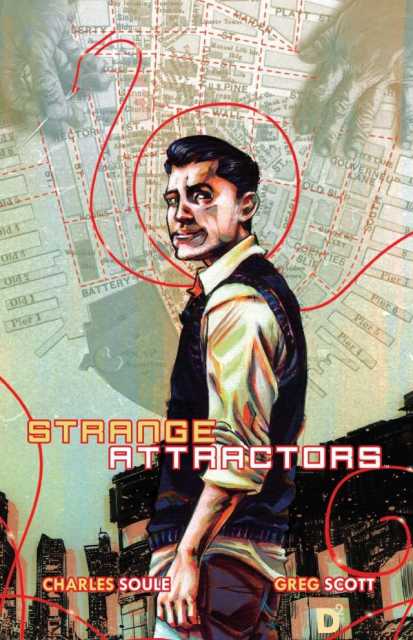
Strange Attractors

Written by Charles Soule
Art by Greg Scott

It's not uncommon, for a comics reader, to find a moment when a character discusses how magic is science that is just not understood yet.  Strange Attractors, by Charles Soule, upends that maxim, and gives us a story about mathematics so hard to understand that it may as well be magic.

Heller Wilson is a PhD. candidate who is working to complete his thesis in New York City.  He's studying complexity theory, and is led to meet with Dr. Spencer Brownfield, an ex-professor who did groundbreaking work on this concept before stepping down for reasons that are shrouded in secrecy.

We learn that Brownfield, who is more than a little eccentric and obsessive, spends his days adjusting the ebb and flow of New York City in a variety of ways, all in an effort to keep the living organism of the city healthy.  It's just about impossible to try to understand the mathematical underpinning in Brownfield's actions, but the concept fascinates Wilson, who begins working with the older man.

As the story progresses, it becomes obvious that something cataclysmic is about to happen to New York.  The professor has a plan, but it's all pretty hard to believe, and Wilson goes through a lot of doubt as to whether or not he should commit to the project.  We, as readers, have a good idea of what the problem will be, as we keep seeing glimpses of terrorists constructing a dirty bomb, as well as some behind-the-scenes moments at City Hall, where a police strike looms.

Soule is a very impressive writer.  I love his Letter 44, and have been very impressed with his work at Marvel (She-Hulk, Daredevil, even the Inhumans) and DC (Swamp Thing).  This is one of his earliest published works, but it's clear at this point that he has a new way of constructing comics stories.  Greg Scott is a capable artist, and he manages to make what is largely a talking heads comic visually interesting.

I don't know how the mathematics behind this story could possibly work, or how an algorithm to map so many different data sets into a cohesive image could possibly be developed in such a rush, but the idea of cities as living creatures is a compelling one, and this book opens up some interesting notions for future exploration.

Saturday, January 9, 2016

Palestine

by Joe Sacco

At this point in my life, after spending just about all of it reading comics, I'm always a little surprised when I realized what some of my gaps are.  For example, I've never read a complete Joe Sacco book before now.  Palestine collects his individual comic books from the mid-90s, recounting his visit to that unfortunate place.

I don't know what kind of response this book got when it came out, but it clearly wasn't strong or outraged enough.  In this book, Sacco walks around the towns and refugee camps of the Gaza Strip and the West Bank, going into peoples' homes, hearing their stories, and observing their living conditions.  He gives a very honest portrayal of Palestinian life as it was twenty years ago.

That things have only gotten worse in this occupied land is unbelievable to me.  I don't want to get into my political thinking here, but as someone who likes to see himself as a humanist, this book made me angry and sad.  Knowing that, were Sacco to find these same people and talk to them again, their lives are not likely improved, is a tragedy.

I think the main reason why I never read a Sacco book is because his art kind of turns me off.  His people are strange looking, and their teeth disturb me.  That said, his draftsmanship is great, and his establishing shots, or his panoramas of Palestinian life, really impress.

It took me a little while to adjust to his use of cascading text boxes, and the overall wordiness of this book, but by the time I had read the first three issues collected here, I was hooked.  Sacco should be admired for the bravery and sensitivity he brought to this comic, and I liked the way he kept himself front and centre, providing us a perspective to react through.  This is a classic piece of graphic literature.

Tuesday, January 5, 2016

Bone Sharps, Cowboys, and Thunder Lizards

Written by Jim Ottaviani
Art by Big Time Attic (Zander Cannon and Kevin Cannon)

I remember that this historical graphic novel was promoted in a Free Comic Book Day giveaway back when it was first published, and it caught my attention as entertaining and original, but I never got around to buying a copy until not that long ago.

Bone Sharps, Cowboys, and Thunder Lizards: A Tale of Edward Drinker Cope, Othniel Charles Marsh, and the Gilded Age of Paleontology is a book that looks at the (un)professional rivalry between two giants of the field of Paleontology at the end of the nineteenth century.  Edward Drinker Cope is an obsessive collector of dinosaur fragments, constantly looking to expound on his theories (even to German-speaking fellow coach passengers) and promote his ideas, well beyond his meagre financial capabilities after losing most of his money in some bad mining investments.  Othniel Charles Marsh is a fatuous gasbag whose inheritance and social position has provided him great privilege in bending the ears of influential people in Washington DC.

To say that these two men hate each other is to minimize the extent of their feelings for one another.  Marsh plants fake fossils in the badlands in hopes of discrediting Cope, and has him removed from his lucrative position in the US Geological Survey.  Cope never misses a chance to put down Marsh, and carries around documents that disprove his rival's theories that he has sewn into the front of his pants for safe keeping.  Along the way, we meet some of their other colleagues or acquaintances, including Charles R. Knight, the artist whose dinosaur paintings were responsible for constructing the public attitude towards dinosaurs to today.

Ottaviani does a great job of exploring these two eccentrics, and carefully documents the places in his story where fact is stranger than fiction.  I'm always attracted to well-sourced historical fiction, and so found the notes in the back almost as enjoyable as the story itself.

What really struck me was the casual, dismissive attitudes of both scientists towards their lives' work.  They were more interested in mashing pieces together to form their preconceived idea of the larger puzzle, and were usually much more interested in showing up the other than conducting proper scholarship.  This is a book about ego more than anything else.

The Cannon brothers do fine work in this black and white comic.  I started to get a real feel for these characters based upon their appearances and facial expressions.

In all, this is a very enjoyable book.  It might be a little hard to track down, but it's worth it, especially for anyone with an interest in the intersections of history, science, and paleontology.