Saturday, December 8, 2012

Blackacre #1

Written by Duffy Boudreau
Art by Wendell Cavalcanti and Sergio Abad

Having no familiarity with any of the names involved in Blackacre, a new Image series, I didn't add the book to my pull-list.  I'm fortunate to shop at a store that orders deeply on new, unproven independent titles (it's not luck, seeing as I live in a city with a lot of comics stores to choose from), so after flipping through this on the stands, I figured it looked good enough to buy.

The series opens with a university lecture being delivered in the year 2202 which outlines the root causes of America's Dark Age, which is nicely summed up as being the conflict between zombies and pirates.  According to writer Duffy Boudreau's understanding of our current culture, the majority of Americans have fallen victim to the zombie meme, clutching themselves in the dark, waiting for everything to fall apart in one sweeping catastrophe.  The rich, however, have been taking their cue from the growth of pirate activity on the open seas, and have decided to simply take what they feel they are owed from the world.

This has led to the existence of Blackacre, a gigantic gated community for the super-rich and powerful. They've stayed comfortably behind the walls while the rest of the country went to hell.

The rest of this book is set in 2114, and it tosses a lot at us.  We learn that there is a class of young people raised in Blackacre as soldiers and guards.  We watch one of them graduate from his service along the wall and get recruited for a special meeting outside the gates, a place that very few people go (at least so far as the rest of Blackacre is aware).

We also get the sense that the outside is a pretty messed up place.  We meet a family that is in hiding.  They are attacked by one group of men, who kill the father, and are then attacked by a second group.  The issue then ends with the lesson that rich men in large towers can't always be trusted, but I feel like we should have already known that.

Blackacre is a well-thought out and nicely told comic.  Boudreau has put a lot of thought into how this is going to play out, and has created an interesting, if familiar, world.  Cavalcanti's art is clear and serviceable.  I'm probably going to check out the next issue.

Stumptown Vol. 2 #4

Written by Greg Rucka
Art by Matthew Southworth

As much as I have come to love Stumptown and its rather difficult private investigator main character Dex Parios, I didn't expect the newest issue to be so exciting.

This story arc, "The Case of the Baby in the Velvet Case" has had Dex chasing down a rock star's guitar that was stolen, and may be involved in some sort of drug smuggling.  The guitar has mysteriously shown up at Dex's house, and she stashes it at her office before going to collect Mim, the guitarist.  When they get to the office, they find the pair of rednecks that have also been searching for the instrument, holding a gun to Mim's drummer.

What follows is an excellent chase scene as the rednecks take off, with Dex giving chase.  At this point, Matthew Southworth turns the art sideways, so as to best utilize the wide-screen format that a landscaped page allows.  When the cars stop, the pages return to portrait orientation, but as soon as the chase is back on, the art goes sideways again.  It's a very effective technique, and I have to say that the bridge-jumping scene is executed perfectly.  Rarely does a comic book sequence create such excitement in me.

I am very excited to see what happens in the next issue of Stumptown, although I'm also saddened, because I imagine that will be the last we see of Dex for a while.

Friday, December 7, 2012

Storm Dogs #2

Written by David Hine
Art by Doug Braithwaite

I'm really enjoying David Hine's new science fiction series.  It concerns a group of cops who have been sent to a backwards mining planet where a number of attacks have been happening against workers there.

Most of this issue is centred on Jered Hofman, the team's medical examiner.  He discovers a crystal on the body of one of the men who died last issue, and evidence of drug use on all of the bodies.  From that scene, we move to the local bar, where we learn more about society on Amaranth, and its two indigenous species.

By treaty, humans are supposed to stay away from the natives, yet three of them show up in the same bar.  Hine is doing a terrific job of world-building here, as we learn more about these different races, and the structure of the whole galaxy.  It's easy to tell that he's put more thought and planning into this book than this one mini-series will ever be able to reveal, and I hope that means that we will be seeing more stories set in this world once this one is finished.

Doug Braithwaite has always been an excellent artist, but his work here gives the impression of his being completely unfettered to create as he wishes.

Great Pacific #2

Written by Joe Harris
Art by Martin Morazzo

Corporate malfeasance, environmental degradation, indigenous rights, and father issues are all colliding rather nicely in Great Pacific, a new mini-series from Image Comics.

Chas Worthington, son of the founder of Worthington Energy, has faked his own death after stealing millions of dollars, and has now laid claim to the Great Pacific Garbage Patch, a collection of plastic garbage from around the world, loosely held together by centrifugal forces.  He's named his new land New Texas, and has already sent out feelers for recognition among the international community.

Much of this issue is taken up with the mechanics of starting a new country, which of course necessitates surveying it.  While Chas does this, he discovers some indigenous people, who perhaps have come from another island.  They give chase, but that kind of things doesn't go well on land that is really only two feet of floating plastic.

There are also squids, and government-corporate dealings back home.

I enjoy the way that Joe Harris has worked an environmental message into his story, which is just as much about corporate greed as it is about conservation.  I'm curious to see where the story goes, and wonder just what Yalafath, a name spoken by the Natives and by the seamen Worthington hired to take him to New Texas, is.  I'm hoping it's not the squid.

If you're looking for an intelligent thriller with a bit of a message to it, this is a good book to check out.

Alone Together

by Karriem Riggins

Karriem Riggins is one of those artists whose names I've always kept an eye out for, yet have always found difficult to find.  It amazes me that this is his first album, despite his having spent years in the music industry, playing drums and producing.

He bridges the worlds of jazz and hip-hop effortlessly, although it is his hip-hop work that has always caught my eye, especially since he's worked with people like J Dilla, The Roots, Erykah Badu, and Madlib.

Alone Together is a collection of 34 instrumental tracks that he produced, mostly using an MPC 3000 or 5000.  As expected, these tracks a terrific, as Riggins marries his two musical disciplines into a series of short tracks that highlight his beat-making skills.  Riggins is an artist who deserves more recognition, and my hope is that this album will lead to more production work for him, as his blend of Detroit hip-hop with jazz is something I'd like to hear more of, and hear more people spit over.

There is, of course, a Dilla tribute track at the end of the disk, and that is fitting, as Dilla's influence is all over this album.

Creator-Owned Heroes #7

Written by Darwyn Cooke, Jimmy Palmiotti, Justin Gray, Steve Niles, Jeffrey Burandt, Seth Kushner, Chris Miskiewicz, and Dean Haspiel
Art by Darwyn Cooke, Jerry Lando, Scott Morse, Dean Haspiel, and Seth Kushner

With the news breaking this week that Creator-Owned Heroes, the comics anthology/self-publishing 'zine being produced by Jimmy Palmiotti, Justin Gray, Steve Niles, and a group of other people being canceled next month despite the ninth issue already being solicited, it's hard not to read this new (now penultimate) issue without a tinge of sadness.

I've been a little critical of this title in the past, finding its non-comics content amateurish, self-serving, and ultimately uninteresting, but I have been supportive of the goal of the book - to champion creator-owned work.

The saddest part of the cancellation is that the folks involved in this book have really begun to fine-tune what this book does.  They've added more creators (most notably Darwyn Cooke), and have given over more of the book's space to comics pages.  Also, instead of interviewing people like Jimmy Palmiotti's personal trainer, or cosplayers, they've focused the editorial content on creating creator-owned comics, offering advice to those starting out, and interviewing independent legends like Evan Dorkin.  Still, I buy this for the comics, so let's talk about those.

Darwyn Cooke's 'The Deadly Book' is a terrific tale, about a book that kills anyone who reads it, and thief who tries to steal it from his collector grandfather.  The story combines Borgesian conceits with the type of crime comic that Cooke does so well, and it tells a complete story in a short number of pages.  It's great.

Palmiotti, Gray, and Jerry Lando's 'Killswitch' story continues in fine form, as we learn a lot more about the title character and his upbringing, just as the collected mass of the world's assassin community come gunning for him.  I like Palmiotti and Gray on these types of stories best.

I don't always care for Steve Niles's writing, but when you pair him with artist Scott Morse, I'm going to be there for it.  Their new story, 'Meatbag' is about a private investigator who finds his contracted help ripped to ribbons (although his clothes are perfectly intact) on what was supposed to be a routine cheating wife case.  Morse paints this book in full-page panels that are gorgeous.

This issue also has a couple of shorter pieces.  'Blood and Brains', written by newcomer Jeffrey Burandt and pencilled by Dean Haspiel, shows us what happens when two fan-favourite horror concepts collides.  'The Complex' is a fumetti-style story about a video jockey who uses holograms and drugs to seduce women; I think it's a preview of a longer piece, but there is no explanation provided.

It is sad that as the quality of this book increases, it's publication is set to finish.  I believe there is a place for a book like this, and hope that something else will come along.

Thursday, December 6, 2012

Bedlam #2

Written by Nick Spencer
Art by Riley Rossmo

You have to hand it to Nick Spencer - he does know how to put together an incredibly strange comic.  The first issue of Bedlam felt like a Joker story translated into a creator-owned venue, but with this second issue, Spencer reveals that he's going somewhere very different with this book.

Most confusingly, the issue opens with two old friends running into each other at a Somethings Anonymous meeting, and going out for coffee, where they talk about old friends.  Then the one drugs the other, takes him home, strips him, ties him up, gets naked, and puts on metal angel wings and fishnet stockings.  Yes, this does happen.

From there, the book shifts back to Fillmore, the guy we met last issue, who is probably Madder Red, the Joker-analogue character.  Fillmore is back in a medical clinic with the doctor we met last issue, who had Red tied up after his supposed death.  It looks like this doctor is in the business of lobotomizing criminals and reintegrating them into society on a secret basis, for reasons we have yet to understand.  We know he's up to no good though, because his assistants are a mixture of dwarves and women with slashed-up faces.

We also learn the consequences of Fillmore's rather bizarre call to the police last issue.  Things don't get too weird until the end of the comic though, which involves a horse dragging part of a corpse through traffic.

The weirdest part, though, is that as you read the book, none of these things seem all that odd.  Like with his Morning Glories, Spencer creates enough story logic and internal consistency in his tale that you just kind of follow along, and it's all good.  It's only when you try to recap the book that you realize how strange it is.

At the same time, there seems to be a growing interest in brain-experimentation in comics lately.  I'm thinking of the work of the character Dr. Rot in Jason Aaron's Wolverine run (later revisited in Cullen Bunn's), and of what's been going on in Uncanny Avengers.  I wonder if this trend comes out of the zombie-obsession that has gripped comics for years...

I continue to not be overly impressed with Riley Rossmo's art on this book, but I'm used to that.  I'm still not sure if this is an ongoing series or a limited one.  I can see sticking with this title for 6 issues or so - I don't see it becoming a long-term commitment the way Morning Glories has.

Sunday, December 2, 2012

Shooters

Written by Eric Trautmann and Brandon Jerwa
Art by Steve Lieber

America's involvement in Iraq is starting to provide as rich a literary and filmic tradition as the Vietnam War did, as Americans come to grips with the extent of the damage their actions in that far-off country caused both places.  Among the more worthy of the explorations I've enjoyed of that war is Shooters, a graphic novel that explores the effects Iraq had on one soldier.

Terry Glass was a Chief Warrant Officer until the day that a friendly fire incident wiped out most of his troops and ended his war.  Back home, he had great difficulty adjusting to life with his wife and daughter, especially given that the military was hiding the truth about the incident, and that his soldiers were not being formally recognized for their sacrifice.

The book is a solid study of the effects of Post-Traumatic Stress Disorder on soldiers who never quite manage to reconcile their military life with their civilian one.  Eric Trautmann and Brandon Jerwa capture the irrational rages that grip Terry, and the crushing apathy that keeps him from holding down a successful job, or keeping his marriage together.  Eventually, Terry returns to the only world he feels comfortable in, but as a private contractor.  Now he's still an outsider, despite being involved in military operations.

This book is pretty gripping.  The reader feels for Terry and his situation; his desire to make things right is palpable, but he's just not capable of pulling it off in a meaningful way.  I felt that the writers really captured the dilemma that a lot of former soldiers go through, and that they didn't need to sensationalize things to make it feel dramatic.  I'm not sure how I feel about the confrontation that ends the book though; it feels a little too neat and predictable.

Steve Lieber is just the right kind of artist for this kind of thing.  He's proven himself a capable artist for military-based action, but he also excels at portraying quiet human moments.  It's rare these days for Vertigo to produce original graphic novels (or, increasingly, much of anything else), and I really wish they would create more work of this caliber.

Country, God or the Girl

by K'Naan

Sometimes it's tough to watch a favourite artist grow in a direction you don't agree with.  I'm not one of those people who complains about artists 'selling out', or falling off when they make a conscious decision to craft an album that appeals more to a different demographic than me, but that said, I kind of wish K'Naan had gone in another direction with this, his third full-length studio album.

Dusty Foot Philosopher, his first album, was a revelation.  K'Naan spoke plainly about his upbringing in Somalia, and hinted at his troubles in moving to the West.  He confronted many of the West's views of his country and culture, and revealed the poetic and artistic nature of his people.  His lyrics were often beautiful and still unsentimental.  There was a street-level urgency to his thoughts, and he showed he could rap hard when he wanted to.

Troubadour, his second album, continued in this vein, with songs which had him rapping in Somali, and which sampled heavily from artists like Mulatu Astatke.  This album also embraced the mainstream in a much more calculated way, culminating with 'Wavin' Flag', his most famous piece of music.

Now, with Country God Or the Girl, K'Naan has stripped his music of African influences, preferring to rap or sing over some very radio-friendly, anonymous beats.  He's also continued to court the mainstream with guest appearances by artists like Nelly Furtado, Nas, Bono, Keith Richards and will.i.am.  I feel like this disc has been carefully curated to appeal to the CBC-listening middle-aged middle class, who will find it slightly subversive.  You know, the people whose only other rap album is by the Black Eyed Peas.

That's not entirely fair though, because K'Naan can still deliver some strong, exciting verses, and can gift us with some truly lovely songs.  The best tracks on this album are the ones that he appears on alone, such as 'Gold in Timbuktu', 'Hurt Me Tomorrow', and 'More Beautiful Than Silence'.  I miss his more individualistic voice, and his strong stance on many issues.

This is not a bad album, and I enjoy listening to it, but no single track stands up next to songs like 'Soobax', 'Fatima', 'Somalia', or 'Blues for the Horn'.

Saturday, December 1, 2012

BBNG2


by BADBAD-NOTGOOD

One of the most exciting releases of the year for me was BBNG2, a free album put out by local boys BADBADNOTGOOD (you can get it here).

This band, which I first came across live opening for Aloe Blacc, but then later discovered that I had their first album in my ipod, defies easy description.  I guess they are a jazz trio, but they play from a place that marries hip-hop beats with a punk sensibility.  Live and recorded, these guys are beasts.

This album is eleven tracks deep (which, somehow, feels a little too long after the tenth), and is mostly made up of original material, and a Kanye West cover (Flashing Lights).  The band is at their best when they lull you into a safe space of meditative contemplation before going absolutely berserk on their instruments, such as they do a few times on 'Rotten Decay' and 'Bastard/Lemonade', my two favourite tracks.

These guys are beginning to get some love outside of the local community, backing Talib Kweli on the best track on The Man With The Iron Fists soundtrack (which is the only reason why I bought it).

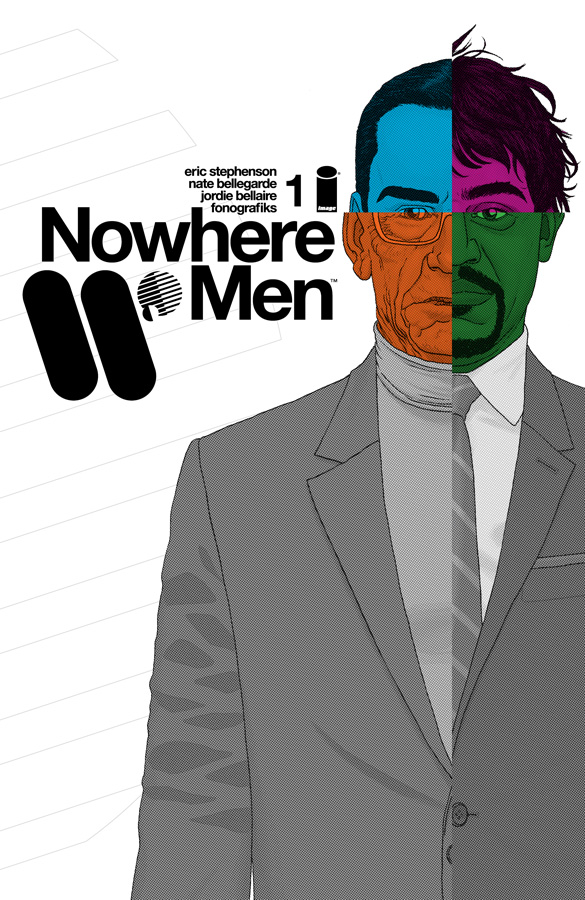
Nowhere Men #1

Written by Eric Stephenson
Art by Nate Bellegarde

When I think of Eric Stephenson as a writer, and not as the publisher of Image Comics, two things come to mind - god-awful work on Rob Liefeld's god-awful comics back in the day, and hipster romance books like The Long Hot Summer.  That last one was enjoyable, but he's never been a writer whose work I've sought out, and in the last ten years, he really hasn't written much.

I was intrigued a little by Nowhere Men though, mostly because Nate Bellegarde's name has been popping up in a few different places lately, and I'm always willing to try a new Image title.

This book owes a little to the success of The Manhattan Projects in making people want to read about scientists again, as Stephenson gives us a slightly confusing first issue.  When the book opens, we are introduced to four scientists who have just formed their own company - World Corp (they are all supposed to be brilliant, but that is the best name they can come up with apparently).

A couple of pages later, and we're watching footage of an indestructible gorilla tearing through a lab.  We learn that it's been ten years, and that there are only three of the World Corp. crew still around, and they do not get along with each other.

From there, we are introduced to a group of people who are working for World Corp. somewhere, and they are all getting sick with some unknown disease.  They discover that their funding has been cut, and that they are to remain where they are under quarantine in perpetuity.  The last page reveals where they are (which, so far as surprises go, wasn't that momentous).

Stephenson spent most of this issue on exposition and introducing a large cast of characters.  He piqued my interest a little, and I definitely liked Bellegarde's art, which is a little like a cross between the Luna Brothers and Nick Pitarra.  I'll probably pick up the next issue, but I'm not sure if I'm in for the long-haul or not.

Wasteland #41

Written by Antony Johnston
Art by Russel Roehling

It is so good to see this series back on track again, as new regular artist Russel Roehling shows improvement in his art and his handling of the regular characters, and Antony Johnston does what he does best, providing another exciting chapter to his post-Apocalyptic epic saga.

Michael and Abi were visiting the small settlement of Far Enough when they saw an object come crashing from the sky into the nearby Pre-city.  They investigated with a man they had just met, Thomas, who has the ability to get a psychic reading off of people and objects.  The object that fell, an old satellite, provides Thomas (and a reader) with an image of how the world came to its end.

Our heroes don't get much time to dwell on this new information however, as Thomas's daughter, Diana's boyfriend shows up in the Pre-city, being accosted by some Dwellers.  The group's fight and flight from these mutated creatures ends with them back in Thomas's home, where they all discover that they have a few things in common.

Johnston's always done a remarkable job of building his fictional world, both through the main story and the text pieces narrated by explorer Ankya Ofsteen, and this issue continues that.  There is some dispute as to whether or not the 'talking machine' that Abi relies on to lead her and Michael to A-Ree-Yass-I, the fabled land they think they were born in, is leading them astray.  Johnston has been building the mystery of that place since the very first issue, and I hope we'll get to see it for what it really is soon.

Saga #7

Written by Brian K. Vaughan
Art by Fiona Staples

I know this issue came out a couple of weeks ago, but the store where I shop got shorted their entire order (thanks Diamond!), so it took until this week before I scored myself a copy.  As expected, it was worth the wait.

In the last issue, which marked the ending of the first arc, Marko's parents appeared rather suddenly on the family's new tree-ship.  They zapped Izabel, the ghostly baby-sitter, and now are confronted with the fact that their son has married an 'enemy', and that they have had a child together.

Marko and his mother take off to try to rescue Izabel (as it turns out, she wasn't killed, but banished to another planet), while Marko's father starts to get to know Alana, although the two of them don't hit it off so well.

Among all the things that make Saga such a rich and gorgeous read is the extent to which Vaughan has structured this as a character-driven series.  We know that Marko's parents are going to be around for a while, and I like how Vaughan has tossed the family into two different situations that are going to give the readers a chance to get to know them.

This book reads very smoothly, and is drop-dead beautiful.

Prophet #31

Written by Brandon Graham, Simon Roy, and Giannis Milonogiannis
Art by Giannis Milonogiannis

I feel like, as Old Man Prophet has gathered up a group of allies to help him stop the Earth Empire, this book is getting a definite Farscape theme to it, and that is something I don't mind at all.

In this issue, John and his companions travel to the remains of the body of Ixpoliniox, a space giant whose body has now been colonized by creatures that mine his blood, muscle, and flesh.  The body parts are the site of an active trading colony, and, for some reason, are a target of the Earth Empire.

John's crew confront one of his clones, while John runs in to The Troll, another one of Rob Liefeld's characters from back in the day that I only vaguely remember (after looking at images on-line) as a bit of a cross between Wolverine, Puck, and the Beast.  He hints that another Youngblood mainstay is still bumping around the galaxy as well, but this is really not the focus of the book.

The characters are beginning to interact with each other a lot more, with the tree-alien Hiyonhoiagn providing some comic relief, and helping to add to the general Farscape feeling I mentioned earlier (this whole issue reminded me of the episode where the crew of Moya ended up on the body of a space-whale).

Graham is the master of the inventive and strange, and he uses a vastly different tone here than he does in Multiple Warheads, although both books are fantastic.

Multiple Warheads: Alphabet to Infinity #2

by Brandon Graham

I wonder if it would be exhausting to hang out with Brandon Graham.  The man crams so many ideas onto one single page of comics, it makes me wonder if he does the same thing when you talk to him.

Multiple Warheads: Alphabet to Infinity continues to tell two, so-far separate, stories.  Sexica and Nikoli continue their road trip, driving up into some mountains.  Along the way, they meet some death-obsessed druidz, survive an alligator attack, and hang out in a nice hotel.

While this is happening, the organ smuggler (her name escapes me) finds a few more clones of her target, and enjoys some noodles (in a Pol Pot, of course).

It becomes clear, while reading this, that the plot mostly exists to serve as the vehicle for Graham's next crazy idea, as he strings together strange sets and cute wordplay.  The characters feel developed however, and the book chugs along very nicely under its own set of rules.

Graham's art is always beautiful, the lovechild of Geof Darrow and Moebius, and the comic is frequently very funny.  Highly recommended.