Sunday, August 5, 2012

Kurosagi Corpse Delivery Service Vol. 6

Written by Eiji Otsuka
Art by Housui Yamazaki

I think this is the strangest volume of The Kurosagi Corpse Delivery Service that I've read so far.  A usual volume has four to six chapters, which are usually self-contained stories, but occasionally a story will take up two or three chapters.  This volume has six chapters, and tells a total of three stories, one of which doesn't feature any of the regular characters in this comic.

The first story has the group, which carries out the last wishes of the recently deceased, and takes their corpses where they want to go, return to their roots, in Japan's famous Aokigahara Forest, where many people go to commit suicide.  The problem is, there aren't many corpses to be found, as the local postal office has begun branching out into the Kurosagi's territory, by offering their own corpse delivery service.

In the next story, a woman's body is discovered in an apartment.  When the Kurosagi group show up to offer their services, they discover that a new rival, the Shirosagi Corpse Cleaning Service has beaten them to the scene.  There's something odd about these Shirosagi people though, as we learn when another body is found in the attic to the apartment (found only after Numata, the KCDS's dowser, moves into the apartment for its cheap rent).  This leads to a long story which is not fully resolved in this volume, a first for this series.

After that, there are two chapters of a gaiden story.  This is translated as a 'side story', something peculiar to Japanese comics.  This one is set in the past, around the beginning of the 20th century, and involves a killer murdering women in Tokyo.  It is especially notable for two reasons - it brings the Jack the Ripper myth to Japan, and it features a young boy with some strange abilities who has facial scars matching those of the ghost that is always protecting Karatsu.  It's a good story, but it only makes me more curious to find out what the connection between this child and Karatsu is.

This book is always a good read, and that has not changed with this volume.  I love the way that Otsuka blends humour into his horror, and continue to appreciate the editor's notes in the back, which cover most of the cultural references that don't otherwise translate into English.

Saturday, August 4, 2012

Myriad of Now

by Hawthorne Headhunters

I've had Myriad of Now in pretty heavy rotation for the last few months.  It's a collaboration between Black Spade and Coultrain, and it runs the gamut of beat-driven, heavy hip-hop, lighter sung and rapped songs, and some very nice instrumental tracks.

Black Spade is an artist I'd admired since I first came across his work on Nicolay's first album, and Coultrain is someone I've always been aware of from a number of Waajeed's Bling 47 projects.  They compliment each other perfectly on this album.

Much of the production is handled by Black Spade (in his guise as Stoney Rock), and by I, Ced (who I'll admit I've never heard of).  There is also a track by Dam Funk, but unlike a lot of the stuff he does for Stones Throw, I actually like this.

Stand-out tracks include 'Sum People Don't Change', which opens the album, 'If U Were My Baby', 'Yellow Cougar', 'No Cryin' Now, No Lyin Down', 'Fairweather', which features Von Pea and Haz Solo, and 'Hole in the World'.

This album is highly recommended.

I Am A Japanese Writer

by Dany Laferrière

There are certain things that I've come to expect from a Dany Laferrière novel, and this novel did not deliver any of them.  I haven't decided if that's a good thing yet or not, as I do like my traditional Laferrières, but that doesn't mean I think the author shouldn't change and grow.

I Am a Japanese Writer doesn't really have a plot - it weaves and meanders, and contradicts itself at times, and is really more about identity than it is story.  The narrator (who for a change I don't feel is really Laferrière) sells his publisher on his new novel just by giving him the name - I Am A Japanese Writer.  It's a bold statement for a Haitian-born writer who has settled in Montreal to make, and it has unexpected consequences.

Having decided that he is a Japanese writer, the narrator sets about making it true, which means he spends long stretches of time reading Basho, the 17th Century Japanese poet, and musing on the writings of Yukio Mishima.  He also decides to meet some real Japanese people, and becomes a little fixated on a group of university-age girls.

His story becomes known to the cultural affairs people at the Japanese embassy, and soon enough the narrator has become a cultural phenomenon in Japan itself, despite the book's having never been written.  People begin calling him from Tokyo nightclubs, and he is interviewed for the television.  Through all of this, all he wants to do is give his landlord a hard time about the rent and read for hours on end in the bathtub.

As I said, Laferrière is all over the place with this book.  About thirty pages in, I was convinced that I was reading a book by William T. Vollmann and not Laferrière, as he was rambling in a very Vollmann-esque way (I think it was the introduction of the Japanese girls that did it).  Still, I found it very easy to get wrapped up in Laferrière's odd ideas, and enjoyed the notion that, in our increasingly cosmopolitan world, a Caribbean writer can declare himself an Asian one.

Friday, August 3, 2012

Mind the Gap #3

Written by Jim McCann
Art by Rodin Esquejo and Sonia Oback

The thought of building a series around a woman in a coma sounds a little boring, doesn't it?  Yet, Mind The Gap is anything but, as Jim McCann continues to weave a strange web of deceit and conspiracy around Elle as she lies in her hospital bed, doing everything she can to contact the world outside of her mind.

This issue doesn't build as much on the mysteries of the last two, and instead introduces other new story elements, such as the house that Elle retreats to in The Garden, the shared mindspace of other coma victims, and the Memory Wall, upon which she is able to project some of the shards of her shattered mind.

As this series progresses, I find that I want to see much more of Dr. Geller than I do any other character, but that's mostly because she has been the most proactive, in trying to treat Elle, and in trying to figure out what is going on with her colleague, Dr. Hammond, who seems to be working his own agenda here.

The story is smooth, as is Rodin Esquejo's art.  I'm also really liking the variant covers to this series (Esquejo's covers look too much like issues of Morning Glories), especially Skottie Young's contribution this month.

Planet of the Apes Annual #1

Written by Darryl Gregory, Corinna Bechko, Jeff Parker, and Gabriel Hardman
Art by Carlos Magno, John Lucas, Benjamin Dewey, and Gabriel Hardman

Last week Darryl Gregory and Carlos Magno's Planet of the Apes series ended without resolving everything in the story, but they are already revisiting those characters in this Annual, which has a prequel to their epic.  In this story, Sully, the eventual Mayor of the humans, and Alaya, the future Voice of the ape city of Mak, are still young girls and sisters, each adopted by the Lawgiver.  In a story reminiscent of the school desegregations that happened during the Civil Rights Movement in the States, Sully attends her first day of school with apes.  This story nicely underscores why Gegory's series has been so good - he finds parallels between human history and current events and how those same stories would play out in a PotA society.

The second story is by Corinna Bechko (co-writer of the upcoming Cataclysm series) and John Lucas.  It's a cute take on the standard 'boy and his dog' story.  Lucas's art reminds me a little of Mike Ploog's.

Jeff Parker is the only writer here new to the Apes universe, and he turns in a cool little story about life on the fringes of Ape civilization, where an outpost has developed its own rules and forms of entertainment.  Cool stuff, with terrific art by Benjamin Dewey, an artist I'm not familiar with.

To close off the comic, Gabriel Hardman gives us a prequel to his and Bechko's 'Betrayal' and 'Exile' series, featuring the young gorilla soldier Aleron, who would eventually become a celebrated general and lawyer, before becoming an exile.  This story shows us how Aleron lost his eye, and the beginning of his disenchantment with the way Ape society was run.  It's nice to see Hardman drawing his own stories again.

If you have been on the fence about Boom's Planet of the Apes stuff, I suggest you use this as a sampler to see what the two main series have been like.  You won't be disappointed.

Sweet Tooth #36

by Jeff Lemire

The last arc of this series, 'Wild Game' begins with this issue, and in his usual fashion, Jeff Lemire starts off by doing something unconventional.  The comic opens with Gus, the main character, dreaming about many of the key events that have happened in this comic so far, before we see some foreshadowing as to how the series will end.  Lemire coloured these pages himself (Jose Villarrubia colours the rest of the comic), in garishly bright watercolours, giving everything that surreal dream-like quality that is so hard to achieve.

Once Gus wakes up, we find that he and his friends have made it to Alaska, where they hope to find the secrets of Gus's birth, and find the now-deranged Dr. Singh, who has figured out everything that this series is based on - the creatures in the tombs under the ice, the plague, and where Gus really came from.

It doesn't look like the group is going to have long to puzzle through all this new information though, as Abbot, the militia captain who has been hunting them is also on his way to Alaska.  With three issues remaining, it's a little easy to predict how things are going to go (especially with Lemire dropping hints at the beginning of the book), but I still look forward to following this book through to its conclusion.

Thief of Thieves #7

Written by Robert Kirkman and Nick Spencer
Art by Shawn Martinbrough

I always love that moment in a good heist movie where the perpetrators sit down and explain what all went on off-screen, to show how the audience, like the police, were chasing the wrong thing, or were seeing events from the wrong angle.  Kirkman and Spencer pull off that same moment in this issue, as Redmond explains to his assistant the secrets behind his supposed 'snitching' out of his peers.

This is a masterful issue, showing Redmond to be as smart as we've been told he is since the series began, and showing the FBI Agent who has become obsessed with him as the victim of her own hubris.  Everything here is very nicely balanced, and Shawn Martinbrough does a great job of tying it all together visually.

I know that with the next issue, James Asmus is coming on board as the writer, and continuing with a new story arc.  I'm of mixed feelings about that - this issue ends so well, that I kind of feel like this would be the right place to finish the series.  I'm definitely on board to keep buying the book, but I worry that, like too many comics series, sometimes people don't know when to just finish their story and move on (like Fables).  I would hate to see this series end up in the same predicament.

Thursday, August 2, 2012

iZombie #28

Written by Chris Roberson
Art by Michael Allred

The days of Vertigo being able to sustain long-running series (that aren't Fables or starring vampires) seem to be long-gone.  iZombie had all of the right elements to be a successful and long-running Vertigo series, but it was not to be.  I think people just don't like good comics the way they used to.

I am pleased that Roberson was given enough time to finish off this story in a satisfying way.  I'm sure, given more time, the story would have been a little more fleshed out - for example, we never learned much of the connection between Dixie the diner owner and Dixie Mason, the Barbie-like doll that we often saw in the comic.

Still, Roberson did what he could, having Gwen face down the elder god Xitulu, and figure out a way to stop it that didn't involve having to sacrifice everyone she loves, likes, and has met a few times.  There are some big cosmic moments in this comic, but it remains grounded in the strong character work that made this series flow so well.

iZombie is not the most memorable series that Vertigo has ever published, but it did have a lot going for it - a cool, hipsterish approach to the undead, complete with an explanation that made sense (in a comic book way, of course), likeable characters, and a lot of wonderful art by Michael Allred.  I know this is the last time we will see a Chris Roberson comic published by DC, which is really their loss.  He's someone whose career I'm going to be following for quite some time, I imagine.

Mind MGMT #3

by Matt Kindt

I love the fact that it's not until the end of this third issue that the words 'Mind MGMT' are even mentioned in the main story.  Since this series began, we have been following Meru, a True Crime writer who has been trying to track down Henry Lyme, a mysterious figure who may have been responsible for an entire airplane full of people contracting total amnesia at the same time.

Meru has been chased by Immortals - unkillable agents of some sort of organization (Mind MGMT?) and aided by a CIA agent, a crazy woman who writes long rambling prose on a typewriter in Zanzibar, and now a talking dolphin (okay, a spelling dolphin) and an old Chinese man who tells her a legend.

There is definitely a sense of a trail of breadcumbs being left for Meru, a fact that is confirmed by the narrator (who is also revealed this month).

Kindt is taking his time getting this series up and under way, and that is one of the things that I love about it most.  All of the information we have about Mind MGMT so far has come from the short strips on the inside cover (called 'The Second Floor') and the case files that make up the last two pages of each issue.  What is slowly emerging is an organization that has influenced advertising and popular media for almost a century, whose goals are unknown to us.

Is Meru going to expose and write about the group?  Are they recruiting her?  I'm not too sure what's going to happen, but I do know that I like the way Kindt is writing this, and I love his art.  With its washed-out colour scheme and yellowed paper, it is like nothing else on the stands right now.

Rasl #15

by Jeff Smith

Jeff Smith's second creator-owned series (actually, aside from Bone and that Captain Marvel book he did, has he done anything else?) comes to its end with this issue, which explains almost everything.

Basically, this series fits into the growing comics sub-genre of 'Tesla'.  If you are willing to accept that 'Kirby' is a genre now (and there is plenty of examples of this), I think it's time to give over a corner of the market to books influenced or inspired by the great inventor Nikolas Tesla.  This entire series ended up being about Tesla's ideas and his secret notebooks.

Rasl, our art thief, confronts Sal, the lizard-faced guy who has been chasing him across dimensions since this series started.  After that, we find out who has really been pulling the strings from the beginning, as there is a final showdown over the journals and the use of the St. George's Array, a powerful energy weapon that has unfortunate consequences on other realities.

This was a smart series, with some great art, but I feel like it dragged a little too much in the middle.  Too many issues felt similar to previous ones, and I had a hard time drumming up any great love for the characters.  As well, there were a few too many mysteries, including one that doesn't really get resolved (that of the little girl that looks like she stepped out of a Munch painting).

In the final analysis, this was a decent series, but it is in no way going to eclipse Bone as Smith's greatest work.  I do admire him for trying something so outside of what was expected from him, and will check out his next project, unless it's specifically designed for children.

Wednesday, August 1, 2012

Mondo #3

by Ted McKeever

If there's one thing in comics that you can always count on, it's that Ted McKeever's work, post-Metropol, just keeps getting stranger and more obtuse.

This issue finishes the three-part Mondo series with all the various characters and plot elements coming together at Venice Beach.  A gigantic squid is threatening the Beach, and Catfish, our irradiated Hulked-out main character, shows up to fight it.  As does the mayor.  The girl on roller-skates rolls by too, and the crashing satellite also puts in an appearance.  So do three naked Teletubby-like children, who are apparently monks who protect the giant squid.

I really don't know what McKeever was trying to say with this series.  His recent META 4 at least seemed structured around some kind of internal logic, but this series has read as one long, strange acid trip of a story, and I think in the end, I'm a little bored of it.

On the positive side, McKeever draws like no one else in the business.  His completely unique style works well for this type of story, but it also makes me think that he just wanted to write a story about a 'roided up freak, a giant squid, and a hot girl, and this is what he came up with.

The back cover advertises the upcoming McKeever series Blacktop Apocalypse as 'a transcendental road-trip through the zombie wasteland'.  Even though I'm a little tired of this type of thing, I predict I'll end up buying this as well.  I just hope it's a little more focused.

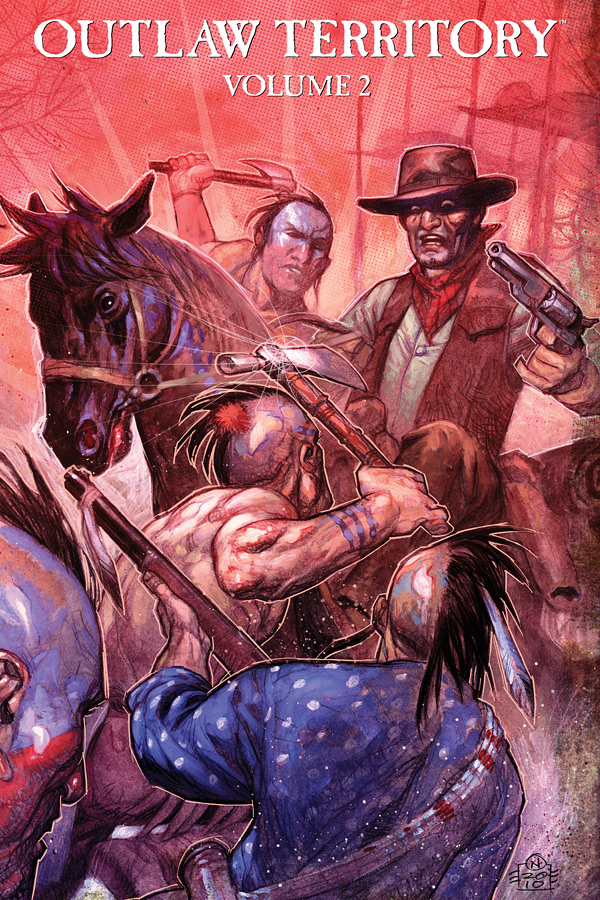
Outlaw Territory Volume 2

Edited by Michael Woods

Reading through this anthology of western comics, I started to wonder if such a thing could have ever existed were it not for the HBO show Deadwood, which treated cursing as Shakespearean oration, but also made it okay to portray the Old West in terms of gender, race and class.

Anyway, as with any anthology of this size (almost 250 pages), there is a lot of variety when it comes to quality in this book.  Some of the better pieces belonged to Rich Johnston and Tom Fowler, who started the book off on an amusing note; Michael Woods and Rafael Albuquerque; Jeremy Barlow and Dustin Weaver (whose art is incredible, and very European); A. Freeman, M. Bernardin, and D. Lafrance; John Whalen and Werther Dell'Edera; Josh Wagner and Jose Jaro (whose art I though belonged to Skullkicker's Edwin Huang at first, it's so similar); Robert Kirkman and Shaun O'Neil; Joshua Hale Fialkov and Jeff Lemire (that's an interesting creative team); Christian Beranek and Vivian Lee (exploring the contributions of Chinese workers to the railroads); Francesco Francavilla (probably the prettiest story in this book); Moritat (with what I assume is a tribute to Moebius's Lt. Blueberry comics, as the protagonist's name is J. Giraud); and Joshua Dysart and Paul Azaceta.

One reason why I enjoy these types of books is because they invariably expose me to an artist whose work I've never seen before.  There are a few people I'd like to see more from, including Rick Lacy, Jorge Coelho, Connor Willumsen (who has a bit of a Paul Pope thing going on), and Diego Tripoli.

In all, this is a successful anthology.  

Tuesday, July 31, 2012

Wholphin No. 14

Edited by Brent Hoff

I'd fallen behind on Wholphin lately, and I don't even know why, because each disc is full of great shorts.

The strongest piece in this edition is Pioneer, directed by David Lowery and starring Will Oldham, as the father of a young boy who asks to be told the story of his missing mother.  Oldham's story is beyond incredible, involving many fantastical elements that are too horrifying to be told to a young child trying to sleep.  The long, quiet shots are full of menace, but also a certain sweetness.

Chicken Heads, directed by Bassam Jarbawi, is another strong short.  It's set in Palestine, and shows the stresses of living there on a sheep farmer and his two sons.  The story doesn't address the troubles, giving us instead a story about an ibis that gores the family's prize sheep, which is the youngest son's fault, but they are lurking in the background throughout.

Soft, directed by Simon Ellis, is yet another strong short, showing the actions of a father and his teenage son when they are targeted by a group of British thugs.  These two films go well together.

In Quadrangle, director Amy Grappell examines the polyamorous love square that her parents found themselves living in back in the 60s.  This is a pretty powerful piece, made more interesting by running both of her parents' accounts simultaneously on a split screen.

I Am A Girl! is a Dutch film about a young transsexual that explores the topic in a very straight-forward manner.  Feeder is a very short piece that was filmed from the back of a man's throat while he eats, drinks, smokes, and makes out with someone.  Don't watch it while eating.  Styrofoam shows a woman tying a prodigious amount of Styrofoam to her bike before riding away to recycle it in China.  It's kind of incredible.

Inside Report From Fukushima Nuclear Reactor Evacuation Zone straight terrified me, as two journalists drove into the excluded area, and their Geiger counters kept raising.

As always, something for everyone on a Wholphin disc.

Monday, July 30, 2012

Taddle Creek No. 28

Edited by Conan Tobias

From the very nice Ethan Rilly cover through to Dave Lapp's visit to the Toronto Humane Society comic strip at the end, this is a quality issue of Taddle Creek, my favourite Toronto-centric literary magazine.  Which actually makes it my favourite Canadian literary magazine.  Although, in the interest of fair disclosure, the only other Canadian magazine I read is Spacing, and while it's great, it's not the least bit literary...

Anyway, this issue opens with a strong story by Stuart Ross about a man who wakes up while on a family trip to Black Creek Pioneer Village to find the place completely abandoned.  I haven't been to Black Creek in probably 25 years, but much of it came back to me while reading this story, and it reminds me that this is probably not somewhere I want to go.  That is one of the better features of good literature.

Kevin Chong's story 'Professions' is the strongest in the magazine.  Julian is a young lawyer who accompanies his fiancee to a ski chalet with her family, a group of upper class liberals, with whom he has no end of problems.  I love the scene where the brother takes Julian to task for having an iPhone, and then whips out his clunky FairSmart, the phone "made in Denmark from recycled materials by an industrial design collective with the help of at-risk youth and sex workers leaving the trade who are paid a living wage."  Brilliant stuff.

Sara Heinonen contributes a story about teens on the verge of going off to university that helps show the effect of underemployed parenting on the next generation, and Stacey May Fowles writes a strong story about dangerous flirtation at a cocktail party.  There is also a tough little comic strip by Nina Bunjevac about the politics of lesbian friendship and depression.

The magazine also has a nice little piece about author Lauren Kirshner, and another on the fading villages of Digby Neck in Nova Scotia.  There is an article about the changes in TTC street signage, and about an artists collective that decorated phone booths in the city to make an artistic point.  My favourite non-fiction piece in this issue is Sarah Gilbert's short article about attempting to access the beautiful art deco restaurant in Montreal's Eaton's store that has been boarded up for years.

In all, another very good issue of a very good magazine.

Saturday, July 28, 2012

A Flight of Angels

Written by Holly Black, Louise Hawes, Bill Willingham, Alisa Kwitney, and Todd Mitchell
Conceived and Illustrated by Rebecca Guay

I think I need to preface any discussion of this book with the honest admission that I know that I am not the target audience for a graphic novel such as this.  I love the fact that comics are appealing to ever more diverse groups of people, and niche audiences.  I enjoy a variety of those genres and sub-categories, but need to be perhaps a little more careful in recognizing when a book is not for me.  The thing is, I've enjoyed Rebecca Guay's art since she took over on the short-lived Black Orchid Vertigo series many years ago.

A Flight of Angels is the right book to give someone (not to pigeonhole too much, but someone female most likely) who misses Neil Gaiman's The Sandman, or Bill Willingham and Matthew Sturges's House of Mystery.  This book opens with a variety of faerie creatures gathering in the woods around the still-living body of an angel.  The reason why the angel has fallen, and whether or not that falling represents his having "fallen", the quotations signifying great Biblical meaning, takes up much of the framing story.

One of the faerie, an exiled courtier with a fondness for dalliances with courtesans, suggests that they hold a tribunal, which seems to consist of each fair creature telling a different story about angels, which they do.  How this serves as judgment, and why the youngest of the group acts as he does, is never quite made clear.

The stories are generally well-written.  In putting together this book, Guay has gathered five writers for the different stories.  I'm only familiar with two of them - Bill Willingham, best known for Fables, and Alisa Kwitney, who I remember as having attempted to stretch out the Sandman property after Gaiman left with the Dreaming series (which I never read) and a couple of companion books.  The others are either young adult or fantasy writers.  The stories shift in time and place, from a modern, big-city set story about an angel who fails at all tasks given him to stories set in the Jewish Russian countryside.  Louise Hawes alternate telling of the story of the Garden of Eden is probably the best in the book.

Guay's art is spectacular.  She makes changes to her style in approaching each of the different stories, painting some, while drawing others.  Her work really is the main reason why someone would want to read this book, and in that area, she doesn't disappoint.

I'm underwhelmed by this book though.  Partly, it's because I don't share in or care about the mystical view of angels that I feel has become such an American thing in the last twenty years.  These are (aside from in Willingham's story) the types of angels one would find if Harlequin had an angel series (which, for all I know, they do).  This book borrows a great deal from Gaiman, without reaching his level of planning and insight.  It's not horrible, but it's definitely not for me.