Saturday, November 10, 2012

Sweet Tooth #39

by Jeff Lemire

There was a short stretch in the middle of this issue of Sweet Tooth, its penultimate, where I began to worry that the final conflict between Mr. Jeppard and Abbot, the horrible militia commander, might require some divine intervention, in the form of the hybrid 'gods' worshiped by the Inuit long ago.  Luckily, Lemire chose to keep this book firmly grounded, and had the characters work out their problems for themselves.

It's difficult to discuss this book without giving away any of its key moments, so my comments are going to stay pretty general and curtailed.  Suffice to say, Lemire has been building up to this issue since the series began, and its satisfying to see how he chose to finish things off.  Sure, there's still another issue left in the series, but I expect that it's going to be set a ways into the future (like the last issue of Y: The Last Man was).

This book has been about the evolution of Mr. Jeppard as much as anything else, and I like where the character has arrived at in this issue.  I've grown to care about him and Gus over the last few years, and Lemire, as always, does not disappoint.

Key to the Kuffs

by JJ DOOM

After his last solo album a few years back, and the frequent reports of him not showing up in person for concerts he's booked, I'd given up on DOOM (or is it MF DOOM again?).  The guy was mad talented back around the time of Madvillainy, which remains his greatest album, but it felt like he'd lost the plot.

Why did I buy Key to the Kuffs then?  Well, I find his collaborator on this project, Brazilian producer Jneiro Jarel, to be a pretty exciting beatmaker, and I was curious to see how his rather left-field approach would work with DOOM; at the least, I figured this would be a good beat cd, and that I'd just ignore Mr. Dumile, if I didn't like what he provided.

Imagine my surprise then, to find all my expectations upended.  DOOM comes correct on this album, in a way we haven't heard in some time.  He's back to his usual, nonsensical, smooth flowing self, and he rides these beats like he's actually interested in completing the project; something I haven't felt from him in some time.

As for Jarel, well he brings in some more conventional beats than I would have expected.  He still sounds like himself, but it's clear he thought about what DOOM's strengths are, and worked to support them.  This is still no Madvillainy, but it is a solidly good hip-hop album that holds up to repeated plays.

Creator-Owned Heroes #6

Written by Darwyn Cooke, Steve Niles, Jay Russell, Jimmy Palmiotti, and Justin Gray
Art by Darwyn Cooke, Andrew Ritchie, and Jerry Lando

I've complained a few times that Creator-Owned Heroes, the comics 'magazine' put out by Jimmy Palmiotti, Justin Gray, and Steve Niles, which is designed to showcase and promote the creator-owned cause, needed more comics and less second-rate editorial content.  Perhaps someone was listening...

This issue debuts a new section, which will feature the work of Darwyn Cooke.  Cooke is best known for work like The New Frontier, and now Before Watchmen, as well as his excellent adaptations of the Parker novels.  Now, Cooke is going to begin offering up some of his own, new creations in this space.  That is something to be excited about.  For this issue, he reprints a piece he did a few years ago (published in the Free Comic Book Day book put together at The Beguiling, the incredible comics store where I shop).  The piece is a tribute to Alex Toth, although, with its architectural theme, it could almost be read as being about Gaudi.

The rest of this issue is pretty decent.  Palmiotti and Gray's new serial, 'Killswitch', is an engaging read about a hitman who is now himself being chased.  It's rather standard, but the writers toss in a few interesting twists, and lots of violence, to keep things moving.

Steve Niles, Jay Russell, and Andrew Ritchie's 'Black Sparrow', which concludes here, ends with a nice little twist that almost redeems what has been a clumsy attempt at American Gothic horror.

In the backmatter, there is some improvement, as there is a nice interview with Bernie Wrightson about his Frankenstein work, as well as a page wherein the various creators recommend some good comics.  The rest of the material, save for a couple of pages by or about Cooke, still are pretty skippable.

To end on a positive note, though, Darwyn Cooke!  And next month, Scott Morse!

Friday, November 9, 2012

Thought Bubble Anthology 2012

Written by Lucia Harris, Pete Doree, Skottie Young, Gail Simone, Richard Starkings, Matthew Sheret, Emma Vieceli, Ivan Brandon, Clark Burscough, Steve Reynolds, Martin Simpson, Ben Haith, Stephen Mooney, Dave Johnson, Lee Barnett, Warren Ellis, Kate Beaton, Chris Lackey, JG Roshell, and Fiona Staples
Art by Tony Harris, Sean Phillips, Skottie Young, Tula Lotay, Boo Cook, Kristyna Baczynski, Emma Vieceli, Leigh Gallagher, Richard Hughes, Steve Reynolds, Martin Simpson, Ben Haith, Stephen Mooney, Dave Johnson, Ollie Redding, Kate Beaton, Chris Lackey, Gabriel Bautista, and Fiona Staples

I guess it's the season for anthology comics, as the week after Vertigo's newest one hits, and the CBLDF Liberty Annual, we get the second Though Bubble Anthology - the collection sold to celebrate the Leeds Comic Art Festival in England.

This book is different from most anthologies, in that it is formatted as a folded newspaper tabloid, providing each page with a lot more space than a regularly-sized comic, and it's printed on wonderful newsprint, which always makes me feel nostalgic for the old days.

As with any project like this, which consists mostly of one- or two-pagers, the contents are a pretty mixed bag.  There are some big names here, but also a number of lesser-known (at least in North America) creators, and some up-and-comers who won a contest to be published here.

My favourite piece in this book is cover artist extraordinaire Dave Johnson's memoir about meeting Bob Layton in embarrassing circumstances.  I also enjoyed Pete Doree and Sean Phillips's memoir about collecting and swapping comics as children.  Gail Simone gives us a cool strip (with Tula Lotay, the only artist who appears twice in this book) about superheroes, as they would have been imagined in Victorian times.

I was surprised to find a multi-page story that crosses Richard Starkings's Elephantmen series with Strontium Dog, the long-running British series.  I was also impressed by Due Returns, a story by Matthew Sheret and Kristyna Baczynski, which reminded me of Borges's love of libraries.

In all, this is a very enjoyable little collection.  I'm pleased to see that this book is going to be an annual event.

Thursday, November 8, 2012

Storm Dogs #1

Written by David Hine
Art by Doug Braithwaite

I've been looking forward to this new science-fiction series since I saw it solicited - David Hine is a very talented writer, and Doug Braithwaite is a terrific artist; also, there is just not enough intelligent science fiction in the world, and I wanted to read some more.

Last week's CBLDF Liberty Annual had a short story which introduced one of the characters of Storm Dogs, and established that Hine's future world has a great deal of complexity and history to it.  Now, with this first issue, I feel pretty confident that this is going to be a good series.

The setting for this issue is Amaranth, a remote world at the edge of Union control.  It is being used for mining, and interaction with the indigenous races is kept to a minimum, as they are not very technologically advanced.  There has been a problem in the mining community, as mysterious attacks have been leaving miners dead.  A group of investigators is dispatched, and they arrive just as a new attack is being carried out, although not in time to stop it.  Things are made more difficult by the presence of a storm - it seems that the rain on Amaranth is acidic, or deadly in some other way that affects human skin (although not indigenous).

Hine has filled the book with some interesting looking characters.  The investigators are not developed too much, although by watching them interact with their families via the future version of holographic Skype, we do get to learn a few things about them.  Likewise, the two police on the planet are shown as grizzled archetypes, but I suspect there's a little more going on below the surface.

I also get the feeling that much of this book is going to revolve around the human's meeting with the indigenous races.  There might be something of an Avatar (the James Cameron movie) thing going on here, except that it's intelligently written.  Braithwaite has done a terrific job of visualizing this world, and I look forward to reading the next issue.

The Manhattan Projects #7

Written by Jonathan Hickman
Art by Nick Pitarra

Jonathan Hickman spent the first six issues of this series introducing the characters, and establishing just how wonderful and weird his universe was.  Now, he's gotten all the groundwork laid out, and it's time to start moving this book into high gear.

The American Manhattan Projects, supposedly under the control of General Leslie Groves (although it looks more like Nazi scientist Wernher Von Braun is calling the shots) enter into secret talks with their counterparts from the Soviet Star City program.  The basis of these talks?  They want to work independently of their governments to explore new options, after the Americans' recent interaction with alien lifeforms.

As much as I've loved this comic, I've been unable to predict where Hickman was taking things; now, I have a good sense of what is going to happen in this title, as the two groups settle into an uneasy alliance, while earning the enmity of President Truman (whose orgy is interrupted by the news of what the Projects are up to).

This is a truly wonderful comic.  Hickman has done a great number of strange and twisted things to the actual historical figures involved in the American atomic weapons project (this issue, we get to see just how alien Enrico Fermi really is), but has also imbued the book with some humanity, especially through the character of Helmutt Gröttrup, a German scientist who has been prisoner of the Soviets for years.

Nick Pitarra is more than up for any crazy idea that Hickman throws at him, and his art just keeps getting better and better.  This book is incredibly unique, and never boring.

Sunday, November 4, 2012

Solidarity

by The Souljazz Orchestra

The Souljazz Orchestra's last album, Rising Sun, was a beautiful exploration of the two schools of music that make up the group's name, with a decidedly Ethiopian influence to it.  That album was firmly instrumental, and a move away from the more Fela Kuti-inspired afrobeat of their earlier work.

Now, with Solidarity, their new album, the band has evolved once again, while staying close to their roots.  They've constructed ten wonderful tracks which range from afrobeat to Caribbean and Brazilian inspired songs.  They've also invited a number of guests to join them, encompassing a number of different traditions.

Included on this album are artists from (or with parents from) Sénégal, Brazil, Jamaica, as well as Canadians steeped in North American jazz, soul, and Quebecois music.  In many ways, this band from Ottawa has put together a multi-lingual album which reflects the diversity and beauty of Canadian society.  It's all about Solidarity.

This is a fun album to listen to.  The band has a number of crowd-pleasing tracks, full of high energy, but also some that are more introspective and beautiful.  It's good stuff.

Saturday, November 3, 2012

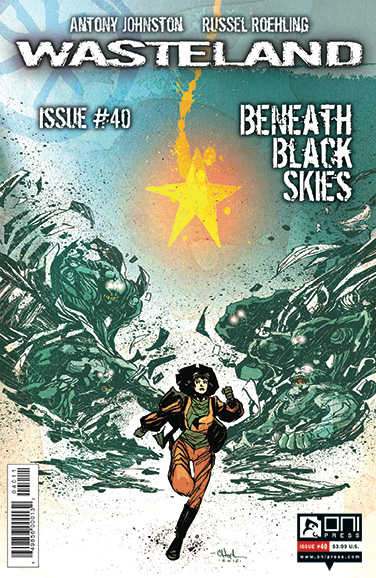
Wasteland #40

Written by Antony Johnston
Art by Russel Roehling

Yet again, Wasteland has a new artist.  Since Christopher Mitten left this title, it's seemed that Antony Johnston has had great difficulty in finding someone to stick with the book.  I don't know why some of the other artists - Remington Veteto and Justin Greenwood were both announced as new regular artists - have moved on, but I do hope that Roehling sticks around.

His work is more realistic than Mitten's or the others', and that takes a bit of getting used to, but he's an accomplished artist.  At times, I've found the level of abstraction in this book to be kind of annoying, as it's not always been clear what has been happening.  Greenwood gave the book a more cartoonish feel than I felt appropriate for this series.  Roehling works for me, especially if his joining the crew means this book will come out regularly.

That is because Wasteland is one of the best-written comics on the stands.  This new issue starts a new arc, which has Michael and Abi, still travelling across the wasteland, arrive at a town just before an asteroid crashes to the Earth, obliterating a nearby pre-city.  At the town, they meet Thomas, a learned man who has the ability to pick up psychic traces off of objects and people (kind of like Longshot's power).  His daughter Diana scavenges for interesting items from the pre-city (like the 'fown' she finds this issue)), and together they seem to be more enlightened and knowledgeable than their neighbours.

Johnston is definitely taking his time in getting these characters to their destination - the mysterious A-Ree-Yass-I - but as he keeps diverting their attention in ways that reveal a little more about their strange provenance, I don't mind.

Happy #2

Written by Grant Morrison
Art by Darick Robertson

I still have a hard time believing that this is a Grant Morrison comic.  It feels and reads like it was written by Garth Ennis more than anyone else, although this issue borrows from Who is Jake Ellis? as well.

Basically, Nick Sax is an ex-cop who now works as an assassin.  He's had a heart attack, and is being held in a mafia hospital by people who believe he has the password to an off-shore bank account.  Nick's only friend at this moment is Happy, a small blue winged horse, who only he can see.  Happy is the imaginary friend of a young girl who has been kidnapped by a pervert in a Santa suit.

Happy has to keep Nick alive in order to get him to go rescue Hailey, but Nick is pretty sure the horse is just a hallucination.  This leads to him sitting down at a high-stakes poker game, so that Happy can help him out.

This is a fun read, with the right amount of rough-hewn weirdness and viciousness (hence the reason why I keep ascribing it to Ennis, and not Morrison).  There doesn't appear to be any sort of meta-textual stuff going on here; perhaps Morrison just felt like cutting loose.

Darick Robertson is always great, so the book looks very good.

The CBLDF Presents Liberty Annual 2012

Written by Jonathan Hickman, Andy Diggle, Howard Chaykin, Steven T. Seagle, Joe Keatinge, James Robinson, James Asmus, Richard Starkings, Chris Roberson, Chris Giarrusso, David Hine, Brandon Graham, Jim McCann, Kieron Gillen, Terry Moore, and Robert Kirkman
Art by Jonathan Hickman, Ben Templesmith, Sina Grace, Marco Cinello, Chynna Clugston-Flores, J. Bone, Takeshi Miyazawa, Ian Churchill, Roger Langridge, Gabriel Bá, Chris Giarrusso, Doug Braithwaite, Brandon Graham, Janet Lee, Nate Bellegarde, Terry Moore, Charlie Adlard, and Cliff Rathburn

I'm always impressed with the line-up that Image and the Comic Book Legal Defense Fund are able to put together for these Liberty Annuals.  There is an impressive list of creators involved in this book, and while the stories are all very short, there is a lot of stuff to love about this book.

First and foremost, there is a Walking Dead story featuring the Governor.  This story doesn't really fit into the book's theme of preserving free speech, but at the same time, it is so rare for there to be side-projects featuring the characters from this series, that for many, this alone should be worth the purchase price.  Basically, in this story, we learn about the origin of the Governor's collection of fish tanks (seen in last week's episode of the TV show).

The rest of this book does deal with the free speech or liberty themes, in a variety of ways.  David Hine and Doug Braithwaite preview their upcoming Image series Storm Dogs by giving us some of the history of the science fiction world it is going to be set in - this series looks like it's going to be very good.

Andy Diggle and Ben Templesmith give us a great story wherein the Devil appears in front of a trio of young people, only to learn that the people of the 21st century have moved beyond many of the concepts that once gave him entry into peoples' minds.  If only this were more true...

Jim McCann and Janet Lee tell a nice story of a conversation between an older woman and a young man who has what can be referred to as an 'unconventional family', although the theme of their conversation is that it's not all that unconventional.

James Robinson and J. Bone totally grabbed my attention with their short story of an American soldier who has come to Canada to escape something, and is being pursued by two men who are probably something other than men.  The story is tagged as a prologue to 'The Saviors'; I hope this means that these two gentlemen are working on a new series together.  Bone's art is wonderful - blocky, and coloured only in green, it doesn't look at all like his all-ages work.

Joe Keatinge and Chynna Clugston Flores share a nice little story about a family movie theatre.  James Asmus and Takeshi Miyazawa give us a great short story about the things that people do when they know that the world is about to end.  Beyond that, there are some terrific one- and two-page strips by the rest of the creators listed above, and a beautiful Gabriel Bá cover.

This book is well worth buying, even if the proceeds didn't go to support the CBLDF.  Go get it.

The New Deadwardians #8

Written by Dan Abnett
Art by INJ Culbard

Eight months ago, Vertigo launched four new titles in a mini-wave of new material, perhaps in an attempt to replicate some of the attention given to their new 'waves' of New 52 titles.  The plan didn't seem to work too well, as one of the ongoing books has already been cancelled (Dominique Laveau Voodoo Child), and the best of the bunch, The New Deadwardians, never received much press or critical buzz.

That's a real shame though, as Dan Abnett put together a very well-constructed and interesting mini-series with this book.  It's set in a world where much of the upper crust of Edwardian England became vampires (called The Young) in the wake of a massive outbreak of zombies (known as The Restless).  This series has followed London's last homicide detective, Inspector Suttle, as he investigates a case involving the murder of one of the Young, something no one thought was possible outside of the usual methods.

Suttle's investigations revealed to him the machinations of a secret society, the presence of magic in his world, and the stirrings of his own dead heart.  This issue wraps things up very nicely, as Suttle confronts the magician Salt, and learns just what has been going on for behind the scenes.

Is I've been saying all along, Abnett has done a terrific job of building up this world, and thinking through how people at each level of society would feel about it.  INJ Culbard was a great choice for the art, with his style that reminds me of Guy Davis.  This was a very satisfying little series.

Bedlam #1

Written by Nick Spencer
Art by Riley Rossmo

Bedlam is a very strange new series from Nick Spencer, a writer who excels at writing strange comics (Morning Glories is excellent, but almost impossible to predict).  Basically, this is a Joker comic, but featuring creator-owned characters.

Madder Red is very similar to the Clown Prince of Crime - he wears a creepy mask which shows off a toothy grin, and he likes to kill people - especially children.  As the series opens, in a flashback, we see his greatest crime - slaughtering a large group of children on a field trip to the symphony.  This vicious crime ends with his incarceration, after The First (in other words, Batman), beats him down.  This is part of Red's plan though, as he has a broadcast arranged that announces that, if he is not killed within an hour, bombs that have been planted at a number of local schools will go off.  This leads to bedlam in Bedlam, and the police station explodes, killing Red.

There are the usual conspiracy theories that he wasn't actually killed, although after then years, he's never resurfaced.  In the 'now' part of the book, we meet a man who is clearly mentally ill, and is taking a great interest in the murder of a few old men in a series of home invasions.  This man ends up interrupting an internal dispute among some drug dealers, and generally gives us the impression that he may be Madder Red.  The flashbacks suggest that he did survive the explosion, but not in a way that makes a lot of sense.

Basically, Spencer is using some of the same tricks that work so well for him in Morning Glories - setting up some mystery, and effectively using flashbacks to lead our thinking in one direction, without ever revealing the truth.  It works, as I'm very curious to see where this goes next.

Riley Rossmo has become Image's go-to guy for mini-series.  Since Proof, his ongoing series, went on what looks like a permanent hiatus, Rossmo has been involved in a large number of books, often having more than one comic on the stands in any given month.  That's pretty impressive, especially considering that this first issue is double-sized.  He's never been a favourite artist of mine - his work is pretty scratchy and hard to follow at times, but I do think he did a great job of constructing a sense of dread in this comic.  The use of colour (the flashback scenes are coloured only with some reds) works well to support the dual narrative of this comic.

I'm not sure how long this series is set to run, but they've got me on board for a mini-series at least.

Friday, November 2, 2012

Ghosts #1

Written by Al Ewing, Toby Litt, Cecil Castellucci, Joe Kubert, Neil Kleid, Mary HK Choi, Paul Pope, David Lapham, Gilbert Hernandez, and Geoff Johns
Art by Rufus Dayglo, Mark Buckingham, Victor Santos, Amy Reeder, Joe Kubert, John McCrea, Phil Jimenez, Andy Lanning, Paul Pope, Gilbert Hernandez, and Jeff Lemire

Once again, Vertigo sends us a nice large anthology comic, similar to Dark Horse Presents, although without using any established characters or properties.  Like any anthology of this size, we are given quite a mixed-bag in terms of the quality of what's being offered.  Part of the problem with this is that Vertigo has lost a number of the writers and artists who have always been a firm part of their stable in the last year.  As such, they have cast a much wider net for this book, bringing in a number of writers I've never heard of before (Toby Litt, Neil Kleid, and Mary HK Choi), while still being able to attract some creators who are not definitely top shelf, like Paul Pope.  The theme here is suggested by the title, but not every story is a ghost story, which is a good thing, as that single note would have gotten played out quickly.

Let's go through the book, and see what's what.

  • The anthology opens with a fun little story about a man who is haunted by the ghost of what he could have been.  When he takes a job as a data entry drone, the part of him that wanted to be a rock star literally starts to haunt him, although when it becomes clear that everyone can see and hear the ghost, things change.  This is a very British story, by Al Ewing and Rufus Dayglo.  It's nice.
  • Much is made on the cover about the inclusion of a new story featuring the Dead Boy Detectives, who originally showed up in Neil Gaiman's Sandman comics.  This story is a complete disappointment - it's disjointed, childish, and doesn't even end in this volume; it is to be continued in the next Vertigo anthology, which hasn't even been solicited yet.  On the up side, it's drawn quite nicely by Mark Buckingham, whose work is the only thing I miss since I dropped Fables a few months back.
  • Cecil Castellucci and Amy Reeder provide 'Wallflower', a very nice story about a family, and how it changed with America, as the wife in the family discovers who she really is only after raising a child and looking after the house for many years.  Lovely.
  • Joe Kubert's last story is printed in this book, which alone makes it worth the purchase price.  Kubert never finished the story - only his rough pencils are reproduced here - but it is a nicely-written tale of an Aztec grandfather and his grandson, on the eve of the older man's death.  There's a lot to read in to this, if one is so inclined; for myself, I was just happy to read one more Kubert tale.
  • Demonic chili is the subject for the story by Neil Kleid and John McCrea.  It's a cute tale; there's not much more to say than that.
  • Mary HK Choi and Phil Jimenez, on the other hand, tell a downright strange story about a young man who is mourning for the death of his much older wife.  This story is full of excess and strangeness, but neither horror nor ghosts, so its inclusion here is strange.
  • The best thing about this anthology is 'Treasure Lost', a story by Paul Pope (with scripting by David Lapham).  It's a science-fiction epic about two children, heirs to a throne, who are kidnapped by space pirates, and who both undergo a form of Stockholm Syndrome.  Introspective, and beautifully illustrated, this is a good reminder of what a huge talent Pope is.  It totally doesn't fit with the themes of this book, but really, who would care?
  • Gilbert Hernandez has a nice little story with a conceit made way too obvious by the themes of the book - had it shown up in Dark Horse Presents, it may have given a bit of a surprise to the reader.
  • Geoff Johns and Jeff Lemire finish off the book with a nice little story about two brothers who are in the haunting business - a task made easier by the fact that one of the brothers is a ghost.  Really, I'm just happy for any chance to see some of Lemire's art.
In all, this is a decent anthology.  I appreciate that Vertigo is giving some new talent the chance to show their stuff, and find it regrettable that none of those new faces impressed me much.  It would have killed them to get Becky Cloonan to do something for this?  Still, Paul Pope and Joe Kubert...

Fatale #9

Written by Ed Brubaker
Art by Sean Phillips

Fatale is one of the best series on the stands right now, period.  Each issue is packed with excellent pacing, dialogue, and character work, and each issue is absolutely gorgeous.  Ed Brubaker and Sean Phillips do some amazing things each and every issue.

In this issue, we learn the fate of Suzy Storm, a messed up young 70s actress wannabe who has fallen afoul of the Method Church, a cult centred on the evil Hansel (who has been in this series since it was set in the 30s).  Miles, Suzy's only friend, searches for her, but isn't sure if he is worried about her because she is her friend, or because her disappearance hurts Jo's chances of recovering the book she wants from the Method Church's library.

Jo, you see, is the femme fatale who gives this series its name.  She's immortal, and has some strange effect on men.  Miles is beginning to recognize that effect, as he learns a little more about his new woman.

I've been enjoying this 70s arc even more than I had the prior one, as the occult weirdness of the story translates nicely into that time period.  Brubaker's writing and characters are very sharp, and I found this to be a story that is very easy to get lost in.

The best thing about this issue is the announcement in the back that Brubaker and Phillips are expecting the story to last past issue twenty.  It's great to see an independent book by a couple of highly acclaimed creators reach such success since leaving the confines of Marvel's boutique line Icon (Criminal and Incognito, their previous series were published under that imprimatur).  This really is the decade of the independent comic...

Thursday, November 1, 2012

Whispers #4

by Joshua Luna

Whispers is a really interesting, bizarre comic.  It's about a guy who develops the body to 'remote view', or project an astral form (to use a Marvel Comics explanation).  The guy has obsessive compulsive disorder, and great difficulty relating to the world around him.  He used his power to check in on people in his life, and became aware of a demonic entity inhabiting a man, causing him to do some pretty horrible things to small children.

In the last issue, he figures he can save an ex-girlfriend from a drug dealer who has been threatening her, and get rid of the serial killer at the same time, but this plan does not work as hoped in this issue.

To begin with, our man discovers that there are other demons working through people, including a guy who likes to lock up women in a tiled cell for weeks on end.  Also, the drug dealer figures out that he's involved in his downfall, and comes looking for him.

This is a pretty unique horror comic.  I don't have a good feeling for where Joshua Luna is taking the story, and that's probably the thing I like the most about it.  He's spent a lot of time building up this main character, and now he's landing him right in the middle of some very strange things.  His art, without any contribution from his brother, continues to surprise me, in the way that it can take a while to get used to someone you know well when they wear a new hairstyle.  I do wish this book would fix its scheduling issues though, as it's running pretty late, especially considering that it's a bi-monthly book to begin with.  Still, this is a very good series; I hope that enough people are checking it out.