Thursday, October 20, 2011

'68 #4

Written by Mark Kidwell
Art by Nat Jones

It's been a while since we last saw an issue of this series, which we are told in the back is going to be an on-going series now.  My advice to the creators is that they get their scheduling together before soliciting any more issues, aside from the two one-shots that were supposed to come out quite some time ago.

'68 is a cool comic, so a lot can be forgiven, but it's always tough to read the end of a series a couple of months after the previous issue; I find it really difficult to remember what had happened before, and who the characters are.

This series ends as many a zombie comic must, with the principle characters facing a massive horde of the undead, and with a very high body count, which means that the on-going series will need some new characters.  Firebase Aries, somewhere in the jungles of Vietnam, is surrounded by zombies, protected only by the group of VC who are now manning the perimeter of the base, while the Americans within continue to argue and drink themselves into oblivion.  The sense of impending destruction is palpable, and the idea of having the zombies use muscle memory to attack with scythes, knives, and rifles is a cool one, as is the closing scene, which pays homage to the famous escape from the Vietnamese embassy.

'68 takes a neat idea, and presents it with good artwork, that reminds me a lot of Steve Dillon.  What more can we ask for?  Oh yah, that the book come out on time...

Wednesday, October 19, 2011

Sleepwalk and Other Stories

by Adrian Tomine

Having decided to get caught up on Adrian Tomine's library, I was fortunate to find two of his collections in used bookstores this summer.  Sleepwalk collects the tales in the earliest issues of Optic Nerve, his very occasional anthology series which recently had a new issue published.

There are a lot of stories in this lovely hardcover collection, although they tend to return again and again to Tomine's usual themes - recent breakups, broken families, and lonely young people.  I suppose it's easy to find Tomine's work a downer, since so many of his characters are so sad and downtrodden, but there is also plenty of beauty to this book, and not just in his wonderful art.

Characters are faced with a lot of adversity here - they miss their ex, they have trouble communicating with their family, they hate their jobs but don't see any other prospects - but there is also an underlying belief in the resilience of people that makes each story an enjoyable read.  Tomine frequently ends his stories in odd places, and many of the just feel like they stop, instead of end.  It's a cool technique for this type of story, and where it would be pretty annoying somewhere else, here it works.

I love Tomine's art.  His pencils are nice and clean, for the most part, and I like his use of ziptones for shading.  This is a good book, and I can't wait to get to Summer Blonde, which is also on my shelf waiting to be read.

Sunday, October 16, 2011

The Unexpected #1

Written by Dave Gibbons, G. Willow Wilson, Alex Grecian, Josh Dysart, Jeffrey Rotter, Mat Johnson, Joshua Hale Fialkov, Brian Wood, and Selwyn Seyfu Hinds
Art by Dave Gibbons, Robbi Rodgriguez, Jill Thompson, Farel Dalrymple, Lelio Bonaccorso, David Lapham, Rahsan Ekedal, Emily Carroll, and Denys Cowan

I really like that Vertigo has started putting out these random, slightly thematically-linked anthology books every few months, even if they are pretty expensive.  Like the last one, Strange Adventures, The Unexpected is a nice mix of stories by established Vertigo stars, and some up-and-comers.  This collection has a supernatural theme, but it's not one that is used in every story.

There is a lot to like in this book, but my favourite story is the one by Joshua Dysart and Farel Dalrymple, which tells the story of a Mexican laborer in 1950s or 60s Texas, who is accused of murdering the grandchild of his employer, although he knows the boy was killed by an ancient Aztec monster.  As with his Unknown Soldier series, Dysart makes good use of a particular culture's fears and legends, and Dalrymple's art is perfect.

I also quite enjoyed Alex Grecian (from Proof fame) and Jill Thompson's story about a female zombie who has retained enough of her faculties to use her feminine wiles as a way of attracting prey.  Dave Gibbons tells a great story of an escape artist who cheats on his wife, and Mat Johnson and David Lapham give us a deliciously twisted tale of a brother and sister trying to survive in post-apocalyptic America.

Joshua Hale Fialkov reunites with his Echoes collaborator Rahsan Ekedal for a story about a man who is recently deceased and finds himself haunting his wife.  Ekedal makes good use of layout in this story, and uses a pixelated approach to imply ghostliness.

Brian Wood and newcomer (to me) artist Emily Carrol contribute a nice short story about a woman who is raised in a post-governmental United States.  It's a similar vision to the one we've seen in Wood's DMZ, but this time he takes a nicer, gentler approach to the disintegration of a country.  It's pretty interesting, even if it ends a little abruptly.

I wanted to like G. Willow Wilson's story about dogs taking over a town, but Robbi Rodriguez's dogs were just a little too creepy and odd-looking for me.  To be fair, I think that dogs are among the hardest things to draw (check out how Dan Jurgens draws them if you need a laugh), which is why I have so much respect for Beasts of Burden.  The story 'A Most Delicate Monster' by Jeffrey Rotter and Lelio Bonaccorso (neither of whom I'm familiar with) was just a little too obvious to be successful.

Finally, Selwyn Seyfu Hinds and Denys Cowan provide a prelude to the upcoming Voodoo Child series, which really didn't work for me.  I'm not sure what it is, but I feel like they were trying to cram too much into too few pages, with the effect that I wasn't drawn into the story at all.  I'll probably give the new series a try still, because I like reading about New Orleans.

Cinémetropolis

by Blue Scholars

I know this album came out a while ago, but I've never quite gotten around to writing about it, mostly because I think I haven't picked up on all of its messages yet.

This fifteen track album, called a 'visual soundtrack' by the group, really represents growth in the Scholars, both musically and lyrically.  When I first heard it, I was disappointed that it wasn't more like Bayani, their last release, but then this started growing on me in a number of ways.

Each track other than the first and last is named after someone, usually a filmmaker or a left-wing activist.  As such, the album honors people like Seijun Suzuki, Lalo Schifrin, George Jackson, Rani Mukerji, Chief Sealth (more commonly known as Chief Seattle), Anna Karina, and Tommy Chong.  Many of the songs don't actually mention the person they honor, but instead strive to do so through thematic means.

One of my favourite tracks, Yuri Kochiyama, is much more directly about the influence that activist, who was present when Malcolm X was shot, had on Geo, the Blue Scholars's MC.  It also has one of the more infectious hooks on the album ("I swear to my kosamas, when I grow up I want to be just like Yuri Kochiyama").

Musically, Sabzi has really stripped his beats down to the most minimal possible.  Again, at first, I was disappointed, because I preferred the more lush approach taken on past projects, but with repeated listening, I grew to love what he's done here.

The Blue Scholars are an important, if often overlooked hip-hop group.  They have a different perspective from most of their brethren, which makes sense considering they are a Seattle-based group consisting of a Filipino-American rapper who grew up in Hawaii, and an Iranian-American producer who is Baha'i. They are a very progressive group in terms of their politics, and I wish they had a wider audience.  Even when I don't agree with them (which is rare), I appreciate their perspective and drive, and I applaud the fact that they financed and promoted this album through Kickstarter.

Saturday, October 15, 2011

The Unwritten #30

Written by Mike Carey
Art by Peter Gross, with Vince Locke

'On to Genesis', the story arc that has explored Wilson Taylor's time working for The Cabal, and his connection to the Golden Age of comics concludes with this issue, and it's another good example of just how strong this comic has become.

When the comic opens, Tom Taylor comes under attack from The Tinker, the comic book hero created by Miriam, Wilson's lover in the 1930s, and the woman he betrayed.  The Tinker is like Tom - a fictional character that somehow has a real life in the real world.  He's really Milton, Tom's half-brother.  They fight for a bit, Frankenstein's monster and the flying cat show up, and everyone has a little cat.  Basically, this issue follows the standard procedure for superhero team-ups.

I like how Tom is maturing throughout the run of this series, and is becoming a much more likeable character.  At the end of this issue, he learns something that causes him to have to step up his game in dealing with The Cabal, which then leads to the next big storyline.

I really like how Peter Gross draws The Tinker in a style that suggests the Golden Age, but is consistent with the look and feel of this comic.  Extra recognition is owed to the letterer, Todd Klein, for using an old-school font for The Tinker's speech.  Cool stuff.

The CBLDF Presents Liberty Annual 2011

Written by Matt Wagner, JH Williams III, AJ Lieberman, Brandon Montclare, Steve Niles, Carla Speed McNeil, Kazim Ali, J. Michael Straczynski, Dara Haraghi, Judd Winick, Richard Starkings, Mark Waid, and Dave Grilli
Art by Fábio Moon, Gabriel Bá, Matt Wagner, JH Williams III, Riley Rossmo, Joelle Jones, Michael Montenat, Carla Speed McNeil, Craig Thompson, Kevin Sacco, Christopher Mitten, Thiago Micalopulous, Rodney Ramos, Shaky Kane, Boo Cook, Jeff Lemire, and J. Gonzo

I've never bought an issue of the Comic Book Legal Defense Fund's Liberty Annual before, but seeing a number of creators I admire attached to it, I figured it was time to give it a try.  As with any anthology like this, the stories within are a pretty mixed bag, but I definitely admire the goals of the organization, which provides legal assistance to people in the comic book world who face censorship or legal difficulties related to comics.  The CBLDF is a champion of free speech, and as such, the stories and strips in this book are concerned with promoting that freedom.

There is a large emphasis in this issue on the rights of gay, lesbian, and transgendered people.  Many stories focus on that, but none more effectively than Kazim Ali's memoir strip, which is beautifully drawn by Craig Thompson.  Compared to it, Matt Wagner's story, which features Hunter Rose, feels amateurish and ham-fisted.

Also of note in this book is JMS's rant about the separation of church and state, which raises some good points, and Mark Waid and Jeff Lemire's defense of superhero worship in children.  Carla Speed McNeil has a strip about her child, who has Down's Syndrome, and the ridiculousness of trying to maintain a vocabulary that doesn't cause offense.  Dara Haraghi and Christopher Mitten contribute an interesting story about growing up in Revolutionary Iran, which would be a nice companion to a story in the last issue of Dark Horse Presents.

Another item that is worthy of discussion in this book is the nude Elephantmen, just because that's not something you see everyday.

This is a very decent anthology, and really, anyone who loves comics should be willing to plunk down the $5 to help support the cause.

Northlanders #45

Written by Brian Wood
Art by Declan Shalvey

The first arc of The Icelandic Trilogy was pretty decent, but I think that this second one, set in 999 AD, is much superior.  In the time since Ulf Hauksson had his first child, Iceland, and the Hauksson family, have grown in stature.  Now, the family is run by the impressive Brida, and her twin brother Mar.  She is a healer and competent administrator, while Mar is successful at viking.

The feud between the Belgarssons and the Haukssons continues to this point, and the book opens with an attempt on Brida's life.  Having survived it, she goes about the business of discovering who was involved in it, and exacting a pretty vicious vengeance.  Later, a priest from Spain visits, with news that could turn a simmering feud into full-blown warfare.

What I particularly like about this issue is that Brida feels nostalgic for a simpler time and way of life, a good thousand years ago.  Wood has frequently made use of this sentiment in this book, and therein we find the strength of Northlanders.  His characters, despite a gulf of a thousand years, are more like us than historical characters are often portrayed.  The conflict between Christianity and the old ways is another recurring theme in Northlanders, and I'm pleased to see it addressed one more time before the series ends.

This arc is being drawn by Declan Shalvey, who is best known for his work on Thunderbolts in recent months.  On that book, his art is loose and sketchy; here, it is cleaner and less rushed-looking.  I wouldn't have recognized it as his.

Pigs #2

Written by Nate Cosby and Ben McCool
Art by Breno Tamura

I guess the fact that this second issue has come out on time puts to rest my main fear about this book - namely that Ben McCool would keep it off a monthly schedule (check his track record; neither of his two Image mini-series have finished yet).

Pigs has all the signs of being a pretty interesting comic.  It's about a sleeper cell of Russians who have been living in Cuba, waiting to be activated.  That activation happened last issue, and we saw that the cell infiltrated the States, and that they've managed to do something to the President.

This entire second issue, however, is set somewhere between activation and implementation, as the members of the cell pay a visit to Felix, a possible member of their group who lives with his wife and daughter in Miami.  It becomes apparent, both through flashback and discussion, that Felix is a reluctant participant in this endeavour, feeling no great love for Russia or Cuba.

I like that the writers are taking their time in establishing this book, its characters, and their relationships with one another.  This series reminds me of The Losers, although is perhaps more sophisticated, especially in the way in which it jumps around through time.  I'm going to be adding this to my pull-list for sure now.

American Vampire: Survival of the Fittest #5

Written by Scott Snyder
Art by Sean Murphy

As Vertigo shrinks as an imprint - a number of titles are being canceled, but we haven't seen them replaced at the same level - it seems to be increasingly focused on creating a few franchise titles.  Fables has spun-off into a few different mini-series, graphic novels, and on-goings, with some success.  Unwritten is going twice-monthly for a while, which is kind of like launching a second book.  And American Vampire was given this mini, which starred two supporting characters from earlier arcs, and showed us one of their missions for the Vassals of the Morning Star.

Cash and Felicia's mission to extract a Nazi scientist who perhaps has the cure for vampirism has gone all to hell, as giant ancient vampires have woken up and are fighting Nazi vampires all around them.  Cash and Felicia need to make their escape, although such things are never simple.

This issue does a good job of wrapping up the series, but also at hinting towards where Felicia's story will take her.  She's an interesting character, and I wonder how long it will be before we see her in the main title again.

The art on this mini has been terrific, and Murphy has outdone himself with this issue.  The scenes where the Nazis fight the old vampires is great, but the best page of the book has to be the silent splash page that comes after Felicia is rescued.  Great stuff all around.

Blue Estate #6

Written by Viktor Kalvachev, Kosta Yanev, and Andrew Osborne
Art by Viktor Kalvachev, Toby Cypress, and Nathan Fox


Blue Estate continues to be a complex book, which has me pretty drawn in.  The book has a large cast of characters, and they don't all appear in every issue, so it can sometimes be a little tricky to remember who is who, although the recap page at the front of the book is helpful.

In this issue, Tony the mobster has taken Billy captive over a bad land deal, and has called in his sister, Rachel, to pay him off.  The only problem is that, despite the fact that Rachel is married to a famous movie star, she has no money.  Rachel, meanwhile, is trying to escape from her controlling and psychopathic brother, so she suggests to Tony that, were Bruce to die, she would be able to pay him.

There are layers upon layers of deceit in this book, which is what makes it so interesting.  When Tony's father wants him to arrange for the assassination of someone else, it gives Tony the chance to bump off Bruce, although we'll have to wait to see how that plays out.

As before, there are three artists working on this book, but their different pages work very well together, and I'm never quite sure who is doing what.  Blue Estate is a very cool comic, and it seems to be going pretty strong.  The first trade just came out recently; I recommend getting caught up on the series, because it is very good.

The Homeland Directive

Written by Robert Venditti
Art by Mike Huddleston

This is the second time I've been impressed by Robert Venditti.  The first was with his Surrogates graphic novel, which later became a movie that I've never bothered to watch, because as a movie, the story doesn't interest me at all.

Actually, as I was preparing to write about this book, I started to think about how it would have worked with a more conventional artist, and I think I've stumbled on the secret of what makes Venditti's books work so well.  In a lot of ways, his stories are kind of standard fare, but he's always been paired with a more experimental artist, who has helped elevate the material to a more sophisticated level (Brett Weldele drew The Surrogates).

The Homeland Directive is about a plot at Homeland Security to help increase their powers of surveillance and access to the lives of all American citizens.  Their plan is complicated, but it involves a bio-weapon, the end of paper money, and the death of a scientist at the Center for Disease Control.

The only problem is that the scientist, Dr. Laura Regan, is rescued by a trio of government agents (who only met because of the new era of post-9/11 inter-governmental cooperation) who have gone rogue, and are attempting to put a stop to the plot.  What follows is a pretty interesting twist on the standard thriller movie, as the three agents have to keep a step or two ahead of their agencies, and try to figure out just what is going on.

As I said above, what really makes this book work is the fantastic art of Mike Huddleston, who has also been wowing me on Butcher Baker the Righteous Maker.  Instead of playing this like a straight thriller, Huddleston mucks around with the art a great deal, incorporating collage and a variety of drawing and colouring styles.  Just about every page looks different from the one before, as he adjusts his style to the setting and content of each new scene.  I found this level of inventiveness really heightened my enjoyment of the story, which has some pretty interesting things to say about the level of 'protection' the American government offers its citizens.

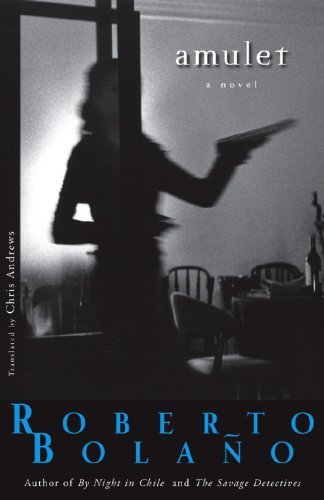
Amulet

by Roberto Bolaño

 It's always a little strange to read an author's most celebrated books first, and then backtrack through their lesser known, and less-recognized, earlier work.  That is especially true with a writer like Roberto Bolaño, who mines his earlier work for recurring themes, situations, and even characters.

At the centre of Amulet, a slim novel first published in Spanish in 1999, and first translated into English in 2006, is Auxilio Lacouture, the 'Mother of Mexican Poetry.'  Lacouture's defining moment came in 1968 when, as a sometimes intern at Mexico's Autonomous University, she spent a period of around ten days in the women's washroom as the military combed the building and detained just about everyone in it.  The political and legal reasons for this action are never explained; instead we have Auxilio's less than reliable accounting of the event, during which time she had visions of future.

The book is told in first person, and as such, we never get a clear understanding of which events are real, and which are imagined, as she stares at the reflection of moonlight on the tiled walls of the washroom.  It doesn't really matter though, as the book is an often fascinating examination of Bolaño's favourite topic, writers.  Auxilio, who is missing her front teeth and therefore almost always keeps her hand in front of her face, never has a very stable life, moving from job to job and apartment to apartment (when not staying with friends).  The only constant is that she is a fixture of the Mexico City poetry scene, getting to know all the young writers.  She herself is not a writer, and her self-selected title as 'Mother of Mexican Poetry' might be more accurate if read 'Mother of Mexican Poets'.

Within Auxilio's circle is the young Arturo Belano, Bolaño's usual fictional counterpart.  Also with him is Ulises Lima, who we get to know much better in The Savage Detectives.  Actually, Auxilio also appears in that later novel, telling her story about her time in the University washroom, which caused no small amount of deja vu.  Other characters are shared between the two novels, such as the gay poet Ernesto San Epifanio, who I believe is also a character in 2666, but I would need to do some checking (and that book is way too dense to flip through for this purpose).

What I found most interesting in Amulet is the scene where Auxilio trails Belano and San Epifanio, who are on their way to meet with the King of All Rent Boys, who has claimed San Epifanio as his property.  Auxilio muses, as they walk down the Avenida Guerrero, that it "is more like a cemetery than an avenue, not a cemetery in 1974 or in 1968, or 1975, but a cemetery in the year 2666, a forgotten cemetery under the eyelid of a corpse or an unborn child, bathed in the dispassionate fluids of an eye that tried so hard to forget one particular thing that it ended up forgetting everything else."  I've never understood the significance of the title of 2666, Bolaño's greatest work, but I feel like there is a clue here.

Aside from a slow section that involves a reclusive painter and Greek mythology, I found that I enjoyed Amulet a great deal.  If I had the time, I would love to sit down and read all of Bolaño's work in the order in which they were published, as I feel there are a number of things that I miss by reading each book individually.  Maybe if I ever decide to get a PhD in literature...

Friday, October 14, 2011

Morning Glories #13

Written by Nick Spencer
Art by Joe Eisma

I was going to try to talk about this issue without referencing the TV show Lost, but I don't think it's possible, because this is basically the comic book teenage version of that show, as I, and others, have said many times.  It's not just because of the almost utter incomprehensibility of the plot, but also because of the stellar character work that makes each issue, as strange as it often is, completely compelling.

This month, a recent scene between Casey and Hunter is repeated, as Casey breaks off their budding romance.  Almost immediately after that, she receives a note from Ms. Hodge, the guidance counselor, and goes running off to find Hunter.  Just as she does this, an announcement over the Morning Glory Academy PA claims that classes are canceled, in favour of a Woodrun.

Once outside, Casey and Jade are put into a team with Ike, and sent to compete in some mysterious game.  We don't learn what this is though, as Casey has other plans, which include Ms. Hodge, a gigantic underground chamber, and possible escape.

Spencer continues to let information come at us in a slow drip, and so the more we think we learn about the academy, the less we know.  What makes this series such a success is the characters.  I love scenes where Casey has to put up with Ike, and I feel for Hunter, who is clearly devastated that Casey is not interested in him.   Once again, Spencer ends the issue with a good twist.

Wednesday, October 12, 2011

Abe Sapien: The Devil Does Not Jest #1

Written by Mike Mignola and John Arcudi
Art by James Harren

I'm a couple of weeks behind on this, because it was only shipped to my comic store today for some reason.

I really like Abe Sapien, who has been getting the shaft of late in BPRD (assuming he's even still alive - they are being vague about this).  He's become a competent and capable agent in recent years, but his earlier missions were marred by his uncertainty.

This story takes place in 1985, which means that Abe has not been a field agent for long.  He goes to Maine to investigate the fifty-year-old disappearance of a writer whose work he enjoys, only to stumble upon a bit of a supernatural mystery, complete with a creepy old house and a giant creature in a basement.

Really, the set-up of these types of stories in the Mignola-verse is getting pretty old.  I feel like we've seen this exact thing played out time and again in these books, with only the setting and the protagonist switching up.  I understand why they are written like this - the formula works - but just once, I would like to see Mignola and his collaborators play with our expectations a little more, and give us some genuine twists.

The art for this book is by James Harren, another newcomer to the Hellboy/BPRD fold.  His art is pretty good and is not that different from other newcomer Tyler Crook.  It fits the house look of these books nicely.  I love the cover by Dave Johnson.

Who is Jake Ellis? #5

Written by Nathan Edmondson
Art by Tonci Zonjic

It's going to be difficult to talk about the final issue in this mini-series without giving away some of the surprises that take place.  Who Is Jake Ellis? has been a very interesting book since it's beginning.

Jon Moore was an intelligence analyst until he was taken to some strange facility, and experimented on in unknown ways.  Somehow, he ended up with Jake Ellis in his head - a ghost-like character with incredible powers of perception.  He can tell you when a security camera is being watched, and always knows what's on the other side of doors.  The pair of them have been in hiding for a while, using their unique situation to pull off jobs of dubious legality.  Since the series began, they've been on the run again, as both American intelligence agents and the people who run the Facility have been trying to take Moore in.  In the last issue, they'd infiltrated the Facility itself, and found Jake's file.

This final issue answers the question in the title, and has Moore come to understand better what happened to he and Ellis.  Moore's been portrayed as pretty stubborn throughout, and this issue confirms that status.

I've really enjoyed this book.  Zonjic's art is lovely (I especially like the last few pages of this issue), and Edmondson's script is very smart.  It's hard to find new takes on the classic Fugitive story, but Edmondson has done that here.  It's almost impossible to read this issue without thinking about his work on Grifter for DC's new 52, and there are a number of similarities.  Personally, I prefer this title, and look forward to his The Activity, which is coming in December.