Friday, October 29, 2010

Hotwire: Deep Cut #2

by Steve Pugh

I think Hotwire might be just about the most original and interesting science fiction comic being published these days.  The concept, which has to do with 'blue lights', returned spirits or souls taking an electro-magnetic form, is endlessly fascinating, as Pugh continues to explore it in novel ways.

One key factor of this issue has to do with the US military's approach to the Blue Lights, which involves their recognition of them as immortal souls, and not the electric phenomenon that Alice, the hero of the book, has so strenuously maintained.  Of course, with this second volume of Alice's adventures, we are learning that we don't know the cantankerous Detective of Exorcisms all that well, especially since she is living with a former blue light boyfriend.

It's the moral ambiguity, police politics, and paramilitary turf wars that make this comic so interesting, as a militarized blue light makes off with the ghost of a woman who died in last issue's car accident.  This book is stuffed full with story and characterization, helping to demonstrate what a great writer Pugh is.

And then we get to the absolute best part of this comic - the art.  Pugh is incredible, and one of the few artists who paints comics that I find endlessly readable.  I usually get bored with painted comics (which is why I read so few of Radical's other titles), but I love what Pugh is doing here.

Sunday, October 24, 2010

The Devil in the White City

by Erik Larson

The Devil in the White City, Larson's historical true crime book, tells two stories; one of a devil, and another of a white city.  The devil, H.H. Holmes was the most prolific serial killer of his age, murdering anywhere from nine to two hundred people, mostly in Chicago at the end of the nineteenth century.  The 'white city' refers to the 1893 World's Columbian Exposition, more commonly known as the World's Fair.
As Holmes was about his deeds in Chicago at the time of the Fair, Larson tells us both stories within the same book, coordinating events in chronological order, and explaining how the large number of tourists brought into Chicago for the Fair provided Holmes with many opportunities to act on his dark desires.

The book is not smarmy or overly sensational, as many True Crime books can be.  Instead, it is a gripping accounting of these parallel events.  Personally, I much preferred the parts that recounted the stressful and miraculous rush to prepare the Fair in time for its opening.  Lead designers, Charles Burnham and Frederick Law Olmstead are given plenty of space in the book, and are portrayed as dedicated professionals who were able to accomplish the impossible.

The Fair brought about many different forms of innovation in construction, landscape, electricity, urban design, and common amusement (the Ferris Wheel and 'belly dancing' both had their debuts here).  It was a period of intense forward-thinking, all pulled off in a time of economic downturn (perhaps providing us a lesson or two on how we should be weathering recent storms).  Larson's research is meticulous, and these parts of the book are amazing to read.

The Holmes sections (which, towards the end have a Toronto connection that surprised me) are equally riveting, as Larson deconstructs his methods, but ultimately leaves his motivations a mystery. Holmes constructed a labyrinthine and sinister building, which he converted to a hotel for guests to the Fair, many of whom were never seen again.  That he escaped detection and even suspicion for so long is a testament to his gifts of persuasion and charisma.

Larson's writing is very detailed and clear, although at times his style would irritate me.  For example, in telling the story of George Ferris and his desire to build his eponymous wheel, Larson consistently omitted his name, referring to him as the engineer from Pittsburgh, as to preserve the telling detail that would reveal what he was talking about.  At times like this, I kept hearing Paul Harvey telling me that I "know the rest of the story."

These moments of gimmickry, however, were rare, and the book stands as an amazing record of a time that I know nothing about, and that the world has largely forgotten.  I highly recommend this book.

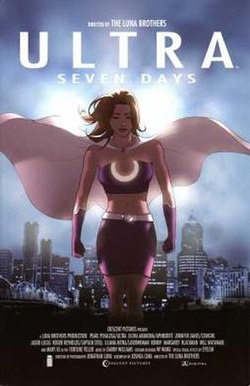
Ultra: Seven Days

by The Luna Brothers

Having enjoyed Sword, and the first volume of Girls, I set out to gather up the rest of their oeuvre, starting with Ultra, their debut eight-issue mini-series.

Ultra depicts a week in the life of three super-powered women who work for Heroines Inc., a para-police/talent agency for superheroines (Heroes Inc. is their male-oriented brother company).  The three women get their fortune told by a cracked-out psychic one night, who, among other predictions, asserts that Pearl Penalosa, Ultra, will find true love within seven days.

This comic is basically a super-powered Sex and the City.  The three friends argue, sleep around, fight crime, and try to push Pearl into a happier life.  She thinks she finds the man that satisfies the prophecy (and her), but things go horribly wrong, and she becomes the centre of a tabloid sex scandal.

The comic is much funnier than I expected from the Luna Brothers (Sword did not have a lot of laughs).  There are many scenes built around some double entendre, and some very funny situations (my favourite being the scene where a white man who can shoot ink-like fluids out of his hands wants to be known as Blackman).  The book is also peppered with faux-ads to help drive home the level of celebrity our heroes have achieved, and each individual issue's cover is modeled on a different popular celebrity magazine.

This is an incredibly solid comic, especially if you consider that this was the first work that the Lunas had published.  Their art is as spectacular, and the writing is sharp and tight.  Recommended.

Saturday, October 23, 2010

Skull Kickers #2

Written by Jim Zubkavich
Art by Edwin Huang

I don't usually read books like this, and have been checking this out on the recommendation of the manager at the comic store I shop at.  The first issue intrigued me enough to come back for a second, and I'm afraid that this book is working its magic on me, and is likely to get added to my pull-list pretty soon.

In a lot of ways, this book reminds me of early issues of Chew.  At the start, I wasn't that interested in the title, partly because of the artwork, and now it's one of my favourite titles.  The same thing is working for Skull Kickers.  I've never been a big fan of what I think of as the Udon house style, which is how I would describe the art in this issue, with its manga influence and bright digital colours (I hate the way the fight in the burning building looks), but I find that it suits this type of story so well that it is growing on me.

The story, about a stupid human and a possibly stupider dwarf journeying to recover the body of a dead political official from a zombie-like creature, is amusing and quick-witted.  The two rescue a pair of merchants and their employees from a goblin attack just to rob them themselves.  This, and the scene where they threaten to eat a prisoner are pretty funny.  I'm not sure if there is enough material here for an on-going comic, but I'm curious to see where the story leads.

DMZ #58

Written by Brian Wood
Art by Danijel Zezelj

With this done-in-one issue, Wood returns to the character Decade Later, a fine art graffiti artist not seen since issue 23, when he was captured by US military forces.  In this book, we get to see where Decade has been kept, and learn about the conditions he's had to endure at Camp Shea Stadium, where he was tortured for information and eventually went on a hunger strike to preserve the only piece of artwork he was able to create in that time.

As the war shifts directions once again, Decade Later is suddenly freed from captivity and allowed to return to Manhattan.  He knows nothing of what has happened - no Parco Delgado, no nuclear explosion, no US bombing campaign.  Once back in the city, he quickly goes back to creating works of art.

The art in this issue is by Danijel Zezelj, who is one of my favourite artists.  I wish he would be used more regularly instead of on all these random stints as a guest artist or on the odd graphic novel.  His approach is perfect for a book like DMZ - his Manhattan looks more desolate than ever.

DMZ has been really good lately (I tend to like the issues that don't have main character Matty Roth in them the most), but this issue was one of the best in a long while.  Wood uses a non-political artist like DL to show just how off-mission the American forces have gone.

The Sixth Gun #5

Written by Cullen Bunn
Art by Brian Hurtt

When The Sixth Gun started, I thought it was a cool comic based around an interesting concept, but I found it had some problems with pacing.  Increasingly, I now see this book as one of my essential reads each month.

Bunn has spun out his tale in such a way as to completely engage my interests, as in this issue, Sinclair and his small band travel to the Maw, the site of the General's old prison camp.  There is something buried in the Maw, and while Sinclair and a group of former prisoners who now live there think it is vast riches, the mystical guns suggest that it is something much more evil than that.

I have enjoyed the way the book's mysteries have been played so close to the vest, as information slowly trickles out to the reader.  Originally I thought this was only going to be a six-issue mini-series, but now I understand this title to be an on-going, which makes me happy.

Fables #99

Written by Bill Willingham
Art by Inaki Miranda

For a while now, the many characters of Fables have been dealing with the incursion of Mr. Dark into Fabletown.  He's been a shadowy figure, working behind the scenes to influence the story, but very little has been revealed about him.

That has changed with this issue, which focuses on him and his plans.  The issue is narrated by Ozma's cat, which has been observing the Dark One for some time now, as he continues to build his castle in Manhattan, and gathers his 'witherlings' to do his bidding.  Mr. Dark is visited by the North Wind, who delivers to him news of Frau Totenkinder's (I forget her new name) challenge to a duel.

The two powerful creatures walk around the city and talk for a while, which has negative consequences for everyone they pass.  This issue does a great job of building up suspense and laying the groundwork for next month's massive one hundredth anniversary issue.  I haven't been this excited to read the next issue of Fables since the war with the Adversary.

This issue is drawn by Miranda, who is a very talented artist.  His cityscapes are wonderful, as is his zombiefied (I mean witherlinged) remake of James Jean's cover to issue seventy-six.  Fabulous stuff.

CBGB #4

Written by Kelly Sue DeConnick and R. Eric Lieb
Art by Chuck BB and Dave Crosland

I hope this series, which was a bit of an experiment for a publisher like Boom, was successful enough that they will repeat it, giving us more thematic anthology mini-series, hopefully not just related to punk.

CBGB has been a pretty interesting title, each issue featuring a couple of stories set in, around, or inspired by the legendary New York punk club, all with a heavily indie feel.  This closing issue has two tales, the first of which, by DeConnick and BB, was amazing.

It's main character, Tex, is about to leave New York for Portland, with her husband and two young children.  Over the course of the story, she reminisces about her life since coming to New York, showing us how she met her husband, and detailing some fantastic conversations with her best friend, a professional fortune cookie fortune writer.  It's amazing how quickly DeConnick is able to develop these characters in such a short amount of space.

The second story, about a man who travels back from the future to CBGB to catalogue it for his society, is decent.  I like Grosland's art, which lies somewhere between Bá and Moon, and Christian Ward.

In all, this has been a cool series, and people should pick up the trade when it is published.

Side a: The Music Lover's Graphic Novel

edited by Rachel Dukes

While by far the most common topic I write about on this blog is comics, I also try to, if not review, at least discuss the music that I love as well.  Comics and music would be my two main hobbies, and I've often wondered at how infrequently the two are paired.  There are titles like Phonogram, CBGB, The Amazing Joy Buzzards, anthologies like the Tori Amos one, and, at the lower end of the spectrum, Dazzler and Wu-Tang comics, but it's rare to find an exploration of music in comics like the one completed by the thirty-odd cartoonists who contributed to Side A.

This black and white anthology pulls together a large number of creators to share their love of music in comics form.  The stories mostly take the form of memoir, although others are a little more fantastical in nature.  There are a variety of forms and styles represented here, and I found that I quite enjoyed moving from one story to the next.

I'm not sure that I'd heard of a single creator in this book before I picked it up, and while I'm not that tempted to check out the various websites listed in the table of contents, I liked being exposed to so many new voices.  At the same time, a collection like this is just begging for work by people like Rick Spears, Vasilis Lolos, Becky Cloonan, Chuck BB, Brandon Graham, James Stokoe, Corey Lewis, or Rob G, to say nothing of Kieron Gillen and Jamie McKelvie.

I found that there was perhaps too much representation of metal, making it harder for me to relate.  For that reason, I loved the story about the guy who dumped a girl because she didn't know who John Coltrane was.  I would have liked to see more hip-hop than a reference to Kriss Kross, but hopefully some of that is in Side B, which is on my pile of books to read.

Friday, October 22, 2010

Pattern + Grid World

by Flying Lotus

It hasn't been very long since Flying Lotus dropped his Cosmogramma album on us, yet he's already back with this very brief, eighteen-minute, seven-track EP, Pattern + Grid World.

This disc is pretty much exactly what you've come to expect from FL.  There are some kooky abstract beats, but there are also some instrumental tracks that seem to tell a story, such as 'Kill Your Co-Workers'.
The EP moves from sparse and calculating to lush and soulful over its short lifetime, and should be checked out.

It's hard to tell what the intentions of the artist are on a work like this, but with track titles like 'Physics for Everyone!', 'Time Vampires', and the aforementioned 'Co-Workers', it's easy to assume that Flying Lotus is just kicking back and letting loose.

The cover artist's work looks very familiar, but is not credited on the case anywhere that I can find.  Can someone fill me in?

The Walking Dead #78

Written by Robert Kirkman
Art by Charlie Adlard and Cliff Rathburn

Is there anything more terrifying than someone with a gun calmly telling you that everything you have is no longer yours?  That's the scenario that Rick and the other members of his community face in this issue, as, during the funeral for the three people who died last issue, a group of strangers show up at the gate demanding entry and implying that means ownership.

Rick being Rick, and being backed up by Andrea in her watchtower, goes about dealing with things in his usual take charge way, but Kirkman lets the scene play out in a gripping manner, while also hinting at even worse to come.  It's great comics, as The Walking Dead always is, although once the shooting started, I had a hard time figuring out who was getting shot.

The rest of this comic is just about perfect, with the various townsfolk reacting to what went down last month.  If I had to complain about something, it would be that the scene depicted on the cover has not happened in the comic at all, although it's been easy to see that something like this might be coming.  I think it's very cool that by the time I read the next issue, The Walking Dead will also be on TV!

Morning Glories #3

Written by Nick Spencer 
Art by Joe Eisma

Morning Glories has been getting a lot of attention, and I feel that it is well-deserved.  The title is weird - it's like Lost, if it was set in a boarding school - but it is most definitely a compelling comic.

In this issue, there is little learned about the Academy, as Spencer prefers to pile up the mysteries.  The issue opens in 1490, with a young Spanish girl imprisoned in some kind of fortress.  She speaks to her neighbour, who had apparently spent some sixteen years in her cell.  This opening also introduces the phrase "The hour of our release draws near", which I suppose is going to be important, as it shows up twice more in the main story.

From this opening, we get Casey in open conflict with her teacher over whether or not she can go and visit the suicidal Jade, while Jade herself explores the rooms beneath the infirmary, where she makes some startling discoveries.

I'm not sure where Spencer is taking all of this, although he's made it clear in this issue that the Academy has something to do with pre-Columbian Spain (when Casey goes to class, the teacher is lecturing on Tomas de Torquemada).  I like the 'Lost' vibe I'm getting off of this series, even if this issue was a little light on character development.  The vaguely psychotic member of the cast (don't remember his name, and it's not provided here) is continuing to be the most interesting and amusing, but the whole book has a lot of strengths.

Thursday, October 21, 2010

Turf #3

Written by Jonathan Ross
Art by Tommy Lee Edwards

Turf is now one-half done, and continues to get better with each new issue.  When I read the first comic, I thought that Ross had a lot of good ideas, but was tossing them all at the page like pasta against the wall, and hoping something would stick.  Now, as the story has progressed, and he's started to tone down his excessive verbiage (this is still a wordy comic, but we're out of Kevin Smith land), it's become clear that he had a pretty involved and solid plot laid out from the beginning.

A lot of big things happen in this issue.  The Strigoli (not vampires) make their move on the police force, while Stefan Dragonmir makes his move for leadership, challenging his brother, who later is helped by Susie, our heroine.  While all this is going on, the gangster Eddie Falco (anyone else think of the Sopranos when you hear that name?) deepens his partnership with the alien Squeed, and they start looking for partners to help them take on the Dragonmir clan.

While this is a lot of plot to cram into this comic, Ross still finds time to work on and develop these characters, especially the crooked Officer O'Leary, who gets his own old school comic page explaining what a rotten sort he really is.

Few artists other than Tommy Lee Edwards would be able to pull off this comic - a Prohibition-era gangster/vampire/alien piece.  His work is phenomenal as usual.  I hope the wait before the next issue isn't as long as the wait for this issue was.

Wednesday, October 20, 2010

Jack Staff Vol. 2: Soldiers

by Paul Grist

I read an collection of Grist's earliest stories with this character quite a while ago, and thought I'd take another stab at the character with this collection of his first colour stories. 

I really want to like this book.  I like Grist's art a lot; his style reminds me of a mix of Tim Sale and Ryan Ottley (from Invincible), and I enjoy his very clean approach to superheroics.  Also, I adore the design of Jack Staff, which is very reminiscent of Marvel's Union Jack.

My problem lies with the plotting of this comic.  Grist often seems to be writing this in four or five page installments (was this material originally used in a British comics magazine?), and I find that the story is very hard to follow because of this.

The plot of Soldiers is about revealing the reason why Jack gave up the Staff some twenty years prior, as he deals with a threat in the modern day.  The time jumps are so sudden it's hard to know which part of the story I'm reading at any given time, especially since there are frequently large sections of story given over to supporting characters.

There is a lot of potential in a character and book like this, and I know it has a large group of devoted followers, but I found this really didn't work for me.

Sunday, October 17, 2010

7 Psychopaths

Written by Fabien Vehlmann
Art by Sean Phillips

I had a few reasons to pick this new trade paperback up this week:
1.  I like Sean Phillips's artwork a lot, and have gotten tired of waiting for the new Incognito series to start.
2.  I like French comics, although I wonder why so many of the ones that get translated and published in North America have a WWII theme (I like war comics, but there is so much more than that being made in France).
3.  I'm always willing to grab a $10 trade paperback or graphic novel.  That seems to be the magic price for me - anything more than that, and I'm likely to just sit and wait for it to show up at a used book store or on Ebay.

Anyway, 7 Psychopaths is pretty cool.  The high concept is a pastiche of movies like The Dirty Dozen and Inglourious Basterds.  As the Second World War gets progressively worse for the British, a Colonel is presented with a plan to gather together a group of mentally ill or criminally insane operatives to travel to Germany to assassinate Hitler.  Most of the book (which was published in three issues earlier this year) is taken up with the Colonel and Joshua Goldschmidt, the architect of the plan and one of the titular psychopaths, assembling their team.

The plan doesn't work as planned, of course, but the way that Vehlmann has the story play out is pretty unpredictable, especially considering what is revealed about Hitler late into the book.  The plotting is very tight, and Phillips's artwork is as perfect as it usually is.  This is a very cool comic.