Sunday, September 30, 2012

The Sixth Gun #25

Written by Cullen Bunn
Art by Brian Hurtt

There's a real sense of things converging in this latest issue of The Sixth Gun.  Drake and Becky are trapped in a vicious snowstorm that has kept them holed up a decrepit fort.  Their friend, Gord Cantrell is looking for them, and he meets up with Kirby Hale on his voyage (and the two do a good re-enactment of the cantina scene from Star Wars), and Asher Cobb, the giant mummy.  The Sword of Abraham are looking for them all as well.

So while all these groups are meeting up, Drake is more at a loss as to what to do next than we've ever seen him.  It's unfortunate that it takes an attack by a gigantic wolf spirit to shake him back into action.

I like the way that Cullen Bunn has woven Aboriginal mythology into this comic.  Earlier, we saw a Thunderbird, and now, we're getting a Wendigo.  I always like when indigenous culture is represented respectfully in comics.

Bunn continues to impress on this book in a way that none of his work at Marvel has, adding weight to the argument that creator-owned comics benefit from being a labour of love in ways that work for hire never does.  Brian Hurtt, as always, is amazing.

Skullkickers #18

Written by Justin Jordan, Blair Butler, Charles Soule, J. Torres, John Layman, and Aubrey Sitterson
Art by Tradd Moore, Enrique Rivera, Michael Mayne, Alberto J. Alburquerque, Rob Guillory, and Ivan Anaya

In some ways, I think I prefer the 'Tavern Tales' issues of Skullkickers that show up between story arcs more than I do the actual comic itself sometimes.  This latest version, 'Son of Tavern Tales', has six short stories that more or less perfectly distill what makes Skullkickers work so well.

The book opens with the Luther Strode team of Justin Jordan and Tradd Moore (who clearly has never seen another picture of a dwarf).  Their story is cute and amusing, as is the one after it by Blair Butler and Enrique Rivera.

Charles Soule and Michael Mayne give us a great story about the world's best beer, and the strange creature that makes it so great.  J. Torres and Alberto J. Alburquerque show what happens with role playing games get out of hand (always zombies).

The Chew team provide the best story in this book, as our favourite mercenaries try to figure out a way to scam themselves free beer for life in a bar where the owner has an interest in collecting mythological    tail.  (I was hoping for a Poyo cameo, but no luck).

The final story, by Aubrey Sitterson and Ivan Anaya show that in medieval fantasy times, guilds operated much like unions do today.

This extra-sized issue was a nice treat.  This series is going on a bit of a hiatus until next year, and I look forward to its return, but I look even more forward to the Tavern Tales issue that comes after the next arc.

Saturday, September 29, 2012

Prophet #29

Written by Brandon Graham, Farel Dalrymple, and Andy Ristaino
Art by Farel Dalrymple and Andy Ristaino

It must be a lot of fun to write this comic.  Since Brandon Graham resurrected Rob Liefeld's god-awful comic from the 90s, each new issue has been a bit of an adventure, as Graham has introduced a wide variety of characters, settings, and strange situations.

For this issue, Graham returns to the John Prophet clone we last saw in the other issue illustrated by Farel Dalrymple.  Prophet is with a group of his clone brothers, escorting an Earth Empire Mother through space towards her home.  These Earth Mother's are powerful psychics, who control the clones.

Their route takes them through a centuries-old battlefield, and our tailed Prophet ends up being captured on a ship, where creatures control their prisoners and force them to work as slaves.  Prophet becomes involved with a group of rebels, and fights for his freedom.

Each and every page drips with creativity, as Graham and Dalrymple create a variety of races and strange creatures.  None of these are throw-aways for Graham; there's a sense that a lot of thought went into each and every story element, no matter how briefly they grace the pages of the book.

Dalrymple's work is always lovely, but I particularly like the way that colourist Joseph Bergin III's limited palette on the pages where Prophet is under mind control really accentuate Dalrymple's skills.

The back-up, by Andy Ristaino, features similar themes to the main book.  It's about a man who is the caretaker of a large colonist spaceship filled with people in suspended animation.  The ship is badly damaged, and the man has to decide what to do with his brethren.  It's a powerful little story.

The New Deadwardians #7

Written by Dan Abnett
Art by INJ Culbard

As we reach the penultimate issue of The New Deadwardians, Dan Abnett is still piling on the intrigue.  The issue opens with the intrepid Inspector Suttle being attacked by some Bright (human) Londoners.  Suttle being Young (a vampire), is able to easily defend himself, but he has no defence for the surprises that Mr. Salt heaps upon him.

By the time he has finished interviewing his only suspect in the murder of Lord Hinchcliffe, Suttle is not sure of anything anymore, including his own complicity in the murder, and in the Restless (zombie) incursion that killed his own cook.

Abnett has constructed an interesting alternate history with this book, and then populated it with an interesting character.

INJ Culbard's art is the real star of this book though.  He's got a Guy Davis meets Rick Geary quality to his work that I enjoy.  This issue feels looser than the previous ones, at least during the action sequences, and it works very well.

Mind the Gap #5

Written by Jim McCann
Art by Rodin Esquejo and Adrian Alphona

Do you ever have this happen to you, where you make some comments (okay, maybe they were complaints) about a comic one month, only to have them addressed the next?  After reading the last issue of Mind the Gap, I commented that I found certain aspects of the book - especially the scenes where Elle, the coma victim, just hangs out in her own mind and The Garden, a shared mindscape for coma victims, and the overly self-congratulatory text pages in the back - to be tiring me out, and causing me to lose enthusiasm for the title.

Then this issue comes out, and neither thing is in it!  Instead of keeping the action in the hospital where Elle is staying, Jim McCann decided to use this issue to explore one of the most important people in Elle's life.  Dane is Elle's boyfriend, and he's been shown to be a difficult person.  Now, he is being accused of attacking her, and his own father has shown up with some pretty damning evidence against him.

The thing is, Dane hasn't seen his father in some ten years.  Most of this issue is told through flashback, as we see Dane's teenage years in a trailer park, where he lived with his abusive drunk of a father.  At age 17, Dane set off on his own, eventually finding himself in New York, and dating Elle.  For the first time since the comic began, Dane is shown as a sympathetic character.

We are also given some pretty big clues as to what has been happening in this series.  The whole point of this book is that the reader has no clue as to who attacked Elle, or why.  One fairly prominent character is shown interacting with 'Hoodie', the hooded character who has been present at every point of the series, although whether or not that character is ultimately responsible for what's happened isn't made clear.  I imagine that there are more than one guilty party in this book.

I've been enjoying Rodin Esquejo's art in this series, but was pleased to see that (the uncredited) Adrian Alphona showed up to draw the scenes from Dane's life.  Alphona's art is much looser than Esquejo's, and had a total Adam Pollina vibe to it that I liked a lot.

This is a comic that was in need of a shake-up, and I'm pleased that McCann chose to do that at precisely the time that I was wondering how committed I was to staying with this title.  Now he's got me on board for a few more months.

Happy #1

Written by Grant Morrison
Art by Darick Robertson

Grant Morrison - DC's biggest name writer (in terms of critical respect, if not exactly in sales) has taken his latest creator-owned project to Image, and that's a big deal.  For years, Morrison has published his bizarre non-superhero projects through Vertigo, but with their terms having recently been changed, I guess Image was a better option (continuing to prove what I firmly believe - that it is the most exciting company publishing comics these days).

Happy is a strange beast.  It opens reading like a Garth Ennis comic, as a pair of hitman (part of a hitman family, the Fratelli Brothers) go to join their brothers in completing a hit on Nick Sax, an ex-cop.  Sax knew they were coming (for a pretty interesting reason), but he didn't know that the fourth brother had recently returned from Italy, and is therefore not as prepared as he would like to be.

Sax ends up in the hospital with a gunshot wound, although not before he is given the password to a secret bank account which holds the Fratelli fortune.  Now, both the police and the mob are after that password, and Nick is hallucinating fiercely.  He sees a small blue horse named Happy.

That's more or less all that happens in this issue.  We do get a rather random page or two of Nick taking out a serial killer who has been killing prostitutes, and there's something weird going on with a creepy homeless looking Santa Claus, but there you go.  Now, this being a Morrison comic, I was looking for other meanings or interpretations, but couldn't really come up with anything just yet.

It's great to see Darick Robertson's art again.  I never even sampled The Boys (it having come out at a point where I'd had my fill of Garth Ennis - maybe I should start looking for it in trade), so I haven't seen Robertson on a comic in many years.  He's a great character artist, although he draws a mean small blue horse with wings and a horn...

I don't see this being one of Morrison's greatest works, but it is definitely interesting and entertaining.

Friday, September 28, 2012

Mind MGMT #5

by Matt Kindt

I really do love this title, and for a variety of reasons.  One of the most striking, and inconsequential, is that this is a comic that actually smells like a comic.  The book is printed on a nice newsprint stock, and it brought back a lot of Proustian memories when I opened it.

The comic itself is excellent.  Kindt has slowly been building up the layers of complexity in this series, which involves a young woman's investigations into the strange world of Mind MGMT, an organization which has so far remained very shadowy, but that we know it is involved in influencing and controlling world events.

Henry Lyme, the central character of the comic (despite his only having really shown up in the last issue), continues to narrate his life story to Meru in this issue.  Previously, we saw how Henry was Mind MGMT's most powerful agent.  At this point in his story, he basically loses his shit, as he begins to question how pervasive his influence has become on the world around him.  Wherever he goes, people give him things for free, and he even questions his own wife and child's love for him, which he suspects is the product of his own abilities, with disastrous results.

Towards the end of the issue, Henry reveals his connection to Meru, which I did not see coming.  That's the thing I like most about this comic; by creating such a unique series, Kindt has made this book hard to predict, something that is rare in comics these days.  Coupled with Kindt's fantastic art, sharp dialogue, and interesting backmatter, this title is terrific.

Thursday, September 27, 2012

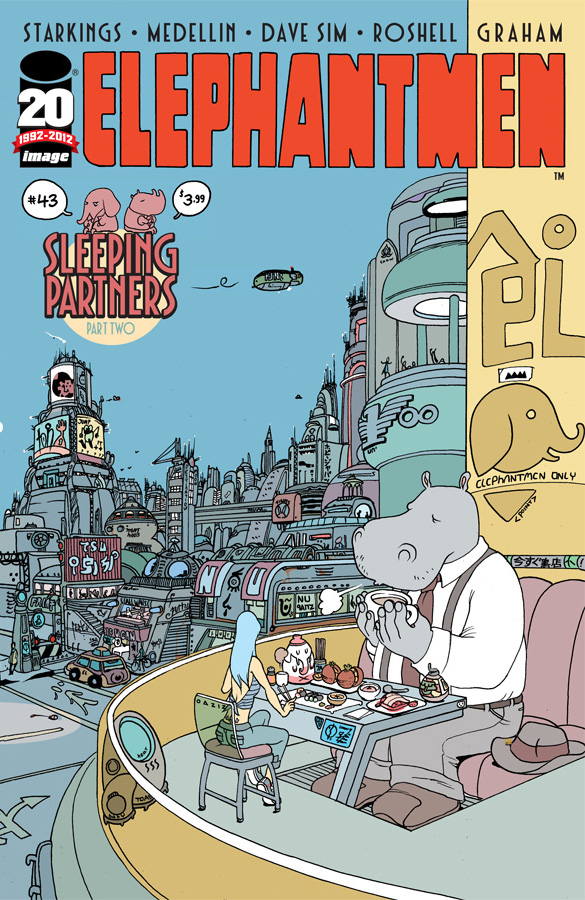
Elephantmen #43

Written by Richard Starkings
Art by Axel Medellin and Dave Sim

I ended up with some pretty mixed feelings when it comes to the forty-third issue of Elephantmen.  First, it's wrapped in a beautiful cover by Brandon Graham, which got me very excited that he may have also done some of the interiors (sadly, he did not).  This is an amazing cover, and it actually depicts a version of an event that happens inside the comic, which is rare these days.

Elephantmen, a series following the travails of some transgenic 'Elephantmen' - former soldiers who are now integrated into human society - who work in law enforcement or organized crime, is often a mixed bag story wise, ranging wildly over a variety of themes and genres.  Right now, it seems that Richard Starkings is mostly interested in giving us an updated form of romance comic, as the series follows the relationships of Hip Flask and Miki (and maybe Vanity Case?), and Obadiah Horn and Sahara (with a dash of Panya tossed in).  The story continues to work on the plot involving the pursuit of the Silencer, a hired killer who has been murdering Elephantmen, but it's the romance angle that gets the most screen time.

Hip gets attacked by the Silencer at the beginning of the book, and spends some time in a Dave Sim-drawn dream, similar to Ebony's from the last issue.  This in itself is fine, but with multiple pages given over to showing details from the same drawing, it kind of felt like filler.  Miki, Hip's new girlfriend finds out that he also has a thing for his fellow officer, Vanity Case, and gets angry.  Meanwhile, Sahara, who is carrying Horn's baby, further imposes on her body-double (and pregnancy-double) Panya to basically become her.

There are other things happening in this book as well, such as a small retcon to establish that Hip, Horn, and Sahara all went to Mars once, and that Mister Purchase, Horn's robotic aide de camp, was originally constructed for that voyage.  I could be wrong, but I don't remember reading about this part of the Elephantmen's history before recently, and I'm not sure why it's being included now.  That's what bothered me with this book; that Starkings will often shoehorn information about the past into a story in a manner that is more distracting than informative.  The reference to Hip being an 'astronaut' made by the Silencer came out of nowhere, and felt out of place.

Artistically, this book is as good as it ever was, with an extended section of pin-ups from various conventions (including art by Becky Cloonan!) given to Starkings taking the place of meatier backmatter.  I think my problem with this issue comes down to the fact that it didn't live up to its wonderful cover.

Wednesday, September 26, 2012

Pope Hats #3

by Ethan Rilly

I was very excited to be able to pick up the latest issue of Ethan Rilly's excellent comics series Pope Hats at Word on the Street last week.  This book festival regularly disappoints, but with this single purchase, it was all worth while, even braving a bit of a downpour.

Pope Hats follows two women, Frances and Vickie, who have both spent years trying to establish themselves in their chosen professions.  Frances is an insomniac law clerk, and Vickie is an aspiring actress.  Last issue, Frances received a promotion, splitting her time between serving the kind and reasonable Seagull, and the imperious senior partner Castonguay.  Now, she finds herself completely snowed under by work and the exhausting oneupmanship, back biting, and careerism that define her workplace.  Vickie, meanwhile, has finally landed herself a part in a TV pilot, and is planning a move to California.

The book follows a slow and meandering path through the two womens' daily lives, although it is clear that Frances is the main character and the heart of the series.  We also get to see much more of her co-workers, including the unfortunate lawyer Nina, who has watched her billable hours decline because of her colleague's active sabotage, and who resorts to having to gamble on the Machiavellian intentions of Castonguay.

Vickie has a sizeable presence in this issue, but she still remains a rather elusive character.  When sober, she is capable of insight and self-reflection, but she is rarely sober.

Rilly's work reads like the best of Adrian Tomine's.  He presents snippets of quotidian existence, making good use of humour and a clean, natural drawing ability.  His plot moves slowly, as life does, and he cuts quickly from scene to scene to maintain momentum.  The more magical realist elements of the first issue (like the ghost that Frances talks to) are gone from the series, as Rilly focuses his story on the contrasts between Frances and Vickie.

Rilly rounds out this issue with a trio of narrated strips.  There are two comics adaptions from Spalding Gray's Morning, Noon and Night, and an interview with the Chinese artist Ai Weiwei.  They are odd choices, but they are also good reads.

I look forward to reading the next Pope Hats, whenever it may come out.  If it sounds like something you would like, it is solicited in the latest issue of Previews - let your comic shop know you want it!

Saturday, September 22, 2012

The Revival #3

Written by Tim Seeley
Art by Mike Norton

Revival opens with a scene that excited me like few have in comics in the last few years.  The scene has the series's main character, Dana, visiting her sister Martha in her dorm room at university.  On the walls of Martha's room are posters advertising Doomtree's No Kings, and Dessa's Castor, The Twin.  I am a huge Doomtree (the hip-hop collective that is home to the immensely talented Dessa, among others) fan, but usually think of them as 'my band', despite them selling out shows every time they play here in Toronto, and being huge in the Midwest.  It makes sense that they'd be big in a school in Wisconsin, since they are based in Minnesota themselves.  I don't know who among the Revival crew is a fan, if Tim Seeley specified this in his script, or if Mike Norton drew them in of his own accord, but it made my day.

The good news continues, because after that, there was a whole great comic to read and enjoy!  Revival is a very cool 'rural noir' comic, involving a region of Wisconsin where the dead have been coming back to life, and are clearly showing signs of being emotionally disturbed.  It's creepy and strange, as we see people reacting to their loved ones behaving in ways that are radially different from normal.

We're three issues in, and Tim Seeley is still introducing new elements to the story.  We get a plotline involving an older Hmong woman who thinks she understands what has been going on, and wants to give the exclusive to a young Hmong reporter.  We also see young Martha continuing to act bizarrely, as her sister is put back onto the police revivalist task force, newly paired with a doctor from the CDC.

There's a lot going on that Seeley is not explaining yet (such as the appearances by an alien-looking creature in the woods), and that is why I keep coming back.  This is an interesting series with some incredible Mike Norton art, and it's worth checking out.

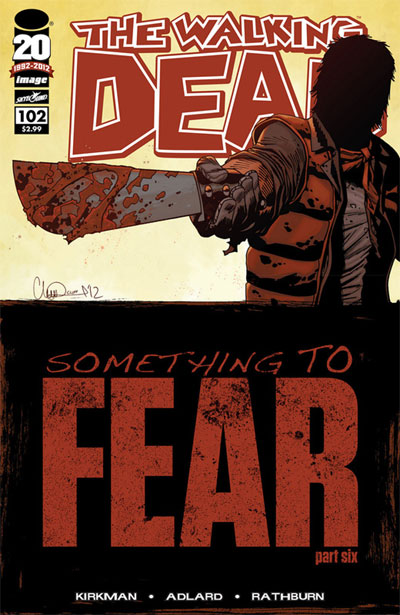
The Walking Dead #102

Written by Robert Kirkman
Art by Charlie Adlard and Cliff Rathburn

A lot of times in comics, when a main character in a comic is killed off, within three issues, it's like they never existed.  Not so when Robert Kirkman kills someone important - their presence continues to be felt in the book for quite some time, such as when Rick had phone conversations with Lori long after she was gone.

Kirkman killed off a pretty important character in issue 100, and while I was sad to see that character go, I do like how his loss is being shown as affecting the entire population of the book (I'm going to great lengths to avoid identifying the character, because I'd hate to be the one to spoil it for the trade-waiters).  Now, the entire community is being threatened by Negan and his band of 'Saviors', and Rick is getting cold feet.

Most of this issue is spent with Rick, Michonne, and others suffering through their own version of survivor's guilt, which ultimately leads Rick to accepting Negan's terms.  He's decided that peaceful subservience has more value than risking the remaining members of the community in a battle that he doesn't think he can win against larger numbers.  This is Rick though, so there may be something more going on...

As always, Kirkman delivers a story full of emotion and good, strong characters.  The loss of that particular character is clearly being felt by the entire Community, and the quiet moments that fill this issue carry great emotional weight.  Also as always, Adlard and Rathburn render this emotion perfectly.  I love this series (even when there isn't a single 'walker' around).

The Unwritten #41

by Mike Carey and Peter Gross

The last arc of The Unwritten was set some time after Tom Taylor's big showdown with The Cabal, and Tom only appeared at the very end of it.  Reading that last issue, there was a sense that many things had happened to Tom in-between appearances, and that is what this issue sets out to explain.

It opens with Richie Savoy, the vampire journalist, bringing an existentially wounded Tom to Villa Diodati, the Taylor estate in Switzerland where the series more or less began.  Tom spends most of the issue in a near-coma state, leaving Richie to look after him and to converse with the various ghosts who suddenly appear all around him.  These are the ghosts of the series - the writers who were slaughtered in the Villa, Tom's ex-girlfriends who were killed by The Cabal, and Miriam Walzer, Wilson Taylor's lover.  Mme. Rausch also makes an appearance, which helps to explain why Richie later went to visit her.

Richie is the focus of this issue, and through his experiences in it, he comes to a few realizations about just how Tom's powers work, and what happens to the people around him.  As always with The Unwritten, it is very well-written and marvellously illustrated.

Friday, September 21, 2012

Godzilla: The Half-Century War #2

by James Stokoe

The longevity and popularity is something that doesn't make a lot of sense to me.  Ultimately, all Godzilla stories have to be about the people trying to kill the giant monster, and they can never succeed in their mission.  There's not a lot there that makes for sustained runs in comics or movies, unless a stream of new monsters is introduced.

Why then, if I have no real interest in the franchise, am I buying Godzilla comics?  The answer is easy - James Stokoe.  This gifted and unique cartoonist brings his wonderfully detailed and strange art style to the big green monster, and therefore is keeping me captivated.

This series follows a Japanese officer, Ota Murakami, who has devoted his life to following the creature and trying to stop him from destroying cities.  This issue is set thirteen years after the last, as Godzilla wanders his way through the middle of Vietnam, during the Vietnam War.  Ota has been sent by his government to work with the US Army and a very manga-looking professor (you know you know what I mean), who has big experimental masers he wants to use.

The issue follows the standard Godzilla set ups and tropes, including the inevitable appearance of a second creature.  It's a very nice looking comic; Stokoe continues to work his usual magic, and that ensures that I'll be back next issue for more.

Thursday, September 20, 2012

Dark Horse Presents #16

Written by Phil Stanford, John Layman, David Chelsea, Jimmy Palmiotti, Justin Gray, Carla Speed McNeil, Erika Alexander, Tony Puryear, Edgar Allan Poe, Richard Corben, Nate Cosby, Bo Hampton, Robert Tinnell, and Chad Lambert
Art by Patric Reynolds, Sam Kieth, David Chelsea, Tony Akins, Carla Speed McNeil, Tony Puryear, Richard Corben, Evan Shaner, Bo Hampton, and Apri Kusbiantoro

Another month, another collection of short comics of varying topic and quality.  Let's see what was impressive...

Of course, I continue to love Carla Speed McNeil's Finder the best.  This episode has Jaeger wandering the desert looking for water, which is the way to complete the ritual he began last month.  I love the complexity of McNeil's world, although I do really miss the explanatory notes that she has filled her collections with - not because I need them to understand the story, but because they help me appreciate how truly layered and well-realized her fiction is.  The colours this month, done by Jenn Manly Lee and Bill Mudron, look very different from what we've seen before.

Jimmy Palmiotti and Justin Gray, probably the two most prolific writers and idea creators in comics, start Deep Sea this month.  Usually these two work for DC or Image, and it's interesting to see them providing a story for DHP when they could just as easily include it in their own anthology Creator-Owned Heroes (unless, of course, there is no one heroic in their comic).  This is an ocean bottom exploration/love story/potential time travel story, and it looks pretty interesting.  Art by Tony Akins never hurts.

Concrete Park has another good chapter, as the two strands of the story get closer to colliding.  Tony Puryear and his crew have really caught my attention with this series, and I look forward to seeing where this is going.

Richard Corben adapts Edgar Allan Poe's 'Berenice', a strange story about an obsessive young man who marries a woman with alluring teeth.  For some reason Corben adds a gender-bending element to the story that is probably not in the original, and it makes the story extra disturbing and bizarre.

Chad Lambert returns with another comic memoir about his days in the radio industry.  I particularly appreciated the love Lambert shows for my all-time favourite sitcom 'WKRP in Cincinnati', both literally and figuratively.  What is it about Cincinnati and autobiographical comics anyway?

John Layman and Sam Kieth's strange Aliens story takes a turn for the worse again, mostly due to Kieth's rushed-looking art.  Bo Hampton's Riven continues to feel like a big part of the story is missing, and Nate Cosby and Evan Shaner's Buddy Cops continues to be amusing, but not my cup of tea.  David Chelsea's 'The Girl With the Keyhole Eyes' is a cool idea that is being done to death; I think if this free-form thought poem of a comic were shorter, it would be much less exasperating.

The new serial, 'Crime Does Not Pay', by Phil Stanford and Patric Reynolds was pretty underwhelming.  The trick with crime comics is to not make them be something everyone has read multiple times before.  This is not that.


Wednesday, September 19, 2012

The Li'l Depressed Boy #13

Written by S. Steven Struble
Art by Sina Grace

How long can a series survive on charm alone?  Really, were this book able to keep on schedule, I would have dropped it a while ago, but when I was putting in my pre-orders, the series was still enchanting me.  There are two or three more issues left before I'm done, so there's always hope that it will pick up enough to lure me back.

Truthfully, I like this comic, but it's way too decompressed and slow-moving to keep my attention.  In this issue, the LDB has a dream, goes on a date, almost gets promoted at work, and is given news that is mildly annoying about his blossoming relationship with his boss, which appears to completely devastating.

A big part of what is turning me off of this book is the ambiguity of it.  When a popcorn popper mishap causes the LDB to be kicked off the concession stand, I was left with no understanding of what he did wrong.  When Spike tells him that he can't be open about his dating her, we see a full-page picture of him maybe looking sad, but I don't know why.

Also, since I'm complaining so much, I'm totally worn out by the way that ironic, pop-culture referencing is used in the place of conversation between characters.  Joss Whedon can pull that off.  It seems that S. Steven Struble can't.

While I'm complaining a lot about this comic, I do enjoy it.  I think the problem is formatting - if this was a nice, thick (300+ pages) manga-sized book that came out every couple of years, I'd probably love it.