Sunday, November 7, 2010

A Good Death

by William T. Vollmann

Vollmann's father died recently, and his plans to avail himself of Switzerland's liberal assisted-suicide laws were foiled by happenstance.  This led Vollmann to examine his (and many other peoples') beliefs about death, and the degree to which we should be able to influence when that inevitable event takes place.

In typical Vollmann fashion, he goes about his investigation in an equally exhaustive and scattershot way.  He interviews the local coroner, doctors, and representatives of various religions.  He goes to a funeral home in Mexico, and speaks to old people in poor rural villages.

The answers he receives vary a great deal, and lead to many interesting ruminations on the nature of faith itself, and how different the United States is compared to Europe.  This is a very reserved and subdued version of Vollmann's usual prose, without the free association I've come to expect in his journalism.  The subject matter is something that many of us would rather avoid, but I think reminders like this have their place.

This is both a very personal, and universally relevant article.

Serenity: The Shepherd's Tale

Written by Joss Whedon and Zack Whedon
Art by Chris Samnee

I'm torn in my reactions to this book, which is an original graphic novel focused on Shepherd Book, the character played on Firefly and in Serenity by Ron Glass.  First, to establish some credentials in this review, I loved Firefly when it was on the air, and have worked my way through the boxed set of dvds a few times.  I liked the Serenity film, but not as much, partly for the way it shuffled off characters like Book in favour of some new folk (Mr. Universe?  That still feels like a bad idea).

Now, I've found the Dark Horse comics to be pretty hit or miss as well.  They're fun while being read, but I felt like they never really contributed much to the mythos.  That's why I was excited about this book - the chance to learn about Book's history, and to find out all of the secrets he'd been keeping.

Book was one of the more compelling characters on the TV show.  He started off being simply what he claimed to be, a Shepherd (think future monk) who is just traveling the 'Verse for a while.  Then the hints started coming - he knew a lot about weapons and ships, and he seemed to be known to the Alliance.

While, this book does fill in all the blanks in his story, and it does it in a very cool backwards narrative structure, so with each new scene, we see a progressively younger Book.  My problem is that the story was over too quickly.  The scene where Book receives his vocation is nicely handled, but I would imagine that a man with his past would have a great deal of trouble adjusting to the life of a holy man, and that is glossed over.  Likewise, there are other things (it's hard to talk about this comic without spoilers) that needed more space to breathe and grow.

I think my largest complaint about this story is that I would have much preferred to see how Book's companions on Serenity would have felt about his past.  It's an incredible story, but without reflecting it through the eyes of the other characters we grew to love on this show, it stays somewhat hollow.

The Whedon's write the book well, although I would have been happier to see some more of the peculiar Whedon-esque speech patterns developed for the show.  Chris Samnee's art is incredible, but that's not really a surprise.  I'm glad that Dark Horse decided to use an artist like him for a book like this - often licensed properties suffer, artistically speaking.

So, in the end, I did enjoy this book, but I think my biggest problem with it is that it only started to scratch my itch for more Firefly-related material (which should not be interpreted as a request for someone to open the floodgates).

Saturday, November 6, 2010

Sweet Tooth #15

by Jeff Lemire

Lemire continues to do some interesting things with this title.  In this issue, we check in with four different groups of people on the move.  Gus and his friends have escaped from their captivity, and are on their way to Gus's home.  At the same time, Abbot and Dr. Singh are at the same cabin, and have discovered some interesting things about Gus's father and where Gus probably came from.  Meanwhile, Gus is being pursued by some of Abbot's men, and Jeppard and his new allies are on their way to Abbot's base to rescue Gus.  Got all that?

The plot is not confusing at all, but Lemire does have a lot of balls in the air.  Complicating things, and spicing them up, is the strange dream that Gus and Jeppard share, and the prophecies and predictions that Gus's dad wrote in his 'bible'.  There's a lot more happening in this comic with each new issue, as Lemire continues to drop more hints about where this is all headed.

Visually, this comic is always interesting.  This month, Lemire experiments and plays around with his scene transitions, posing different characters in the same positions for the switch from one locale to another.  You can almost imagine the fade outs taking place on a television screen.

Sweet Tooth is a great read.  I know that Lemire is going to be getting a lot of attention this week for his new Superboy series, and I hope that some of his new fans pick this up and give it a try.

Album of the Year

by Black Milk

As much as I like Black Milk's brand of post-Dilla production, I find I get a little tired of listening to him rap.  He's improving all the time - the lyrics on this album are better than they were on Tronic, his release of two years ago, but I would still prefer to see him stay behind the boards a little more.

Album of the Year has twelve tracks, and features a nice mix of Detroit hip-hop royalty, with appearances by Royce da 5'9, Elzhi, and Mr. Porter, but most of the tracks are Black Milk solo efforts (or feature someone singing the hooks), and the project becomes a little monotonous towards the end.

Don't get me wrong - I like this album, but I would have liked it a lot more had there been some more variety or substance.  It starts out very promisingly with '365', an accounting of the last year of Black's life, with reference to the friends that have passed (Baatin) or had some serious problems (Hex Murda).  Beyond the first few tracks, everything kind of blends for me, and none of the songs really stand out.

This is a great album for beats though....

24 Seven Vol. 2

Edited by Ivan Brandon

This anthology is the second of two graphic novels that contain only short stories featuring robots.  The trick, or the conceit, is that the robots are the only inhabitants (except, in one story which also has gorillas) of the planet, and they tend to live what we regard as normal lives.  The book is somehow connected to the NYC Mech series that Image put out in the middle of the decade, but these books feature a rich variety of talented writers and artists.

When I read the first volume, I complained that the stories were pretty ordinary, and didn't do much with the robotic concept.  People whined about their jobs or had break-ups, and the fact that they were robots seemed to exist solely in the visual aspects of the comic.  That is not the same with this volume.

Instead, many of the stories deal head-on with the notion that the protagonists are mechanical in nature.  There is a story by Carla Speed MacNeil and Bruno D'Angelo that has the main character slowly trading in his parts so that the he can become a dancer, although it means giving up his family's legacy.  Similarly, Kelly Sue DeConnick and Andy MacDonald tell a story where the hero literally carries his emotional baggage around with him, attached to his body.

There are lots of great stories here by a very impressive list of creators, including Gene Ha (who plays around with a homage to Little Nemo in Slumberland), Fábio Moon, Michael Avon Oeming, Francesco Francavilla, Gabriel Bá, Juan Doe, Rafael Albuquerque, Ben Templesmith, Dave Johnson, Jason Aaron, Fiona Staples, Jason Latour, and Frazer Irving.

This is a very coherent and enjoyable anthology, which covers a number of different genres.  Recommended.

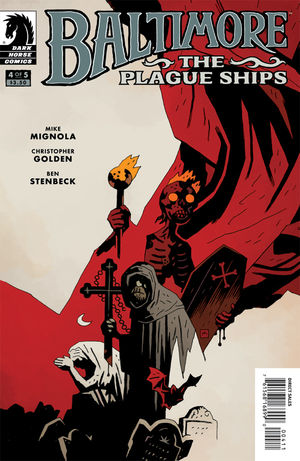
Baltimore: The Plague Ships #4

Written by Mike Mignola and Christopher Golden
Art by Ben Stenbeck

Mignola and Golden have taken an interesting approach to this comic.  Instead of starting the story with the character's beginnings, they have instead been portioning out Lord Baltimore's back story in small chunks, starting with the second issue.  I know this isn't necessarily a new technique, but I find that it is is a strange way of doing things with such a new character whose story has already been told in another medium (there is a novel), which I would presume most of the readership of this comic never read (like me).

It led to the first issue being confusing, although now I find the series to be much more compelling, as I feel more sure of the ground that we're on.

In this issue, Baltimore and Vanessa, his companion, are still stuck on the creepy island with a bunch of wrecked ships that we saw last month.  With no imminent rescue on the horizon, Baltimore continues to tell her his life story, this time talking about the events that took place when he returned home to his ancestral island.  The story is pretty predictable, but Mignola and Golden write it well, and Stenbeck's art is fantastic.

Thursday, November 4, 2010

Unknown Soldier #25

Written by Joshua Dysart
Art by Alberto Ponticelli

This amazing series ends just as you would imagine it would have to (even if you don't notice how much the cover foreshadows events in the book), as Moses finally confronts Joseph Kony at his LRA camp.

That the ending is easily predictable is not really a problem; this has been such a unique title and experiment for Vertigo, that it must be very gratifying for all involved that they lasted two years.  I can't think of another thoughtful, well-researched North American comic that was set in Africa and dealt with important issues like civil war, poverty, American interference in the affairs of other countries, and more.

Dysart has, from the beginning of this title, given us a socially relevant and sensitive portrayal of Uganda that has defied the usual tropes of fiction set in Africa, but written by an American.  He really wanted his readers to understand the country at the turn of the 21st century, but also to tell a fantastic story.  I would say that he, and Ponticelli, succeeded wonderfully.

I like that this comic ended by checking in on many of the long-term supporting figures in the book, and let us know what they ended up doing with their lives.  I do wish Dysart had included Paul, the boy that Moses had rescued from the LRA some time ago, as he was a character I grew to care about.

I cannot recommend this title enough.  I hope it does well enough in trade format that more mainstream publishers feel comfortable telling the stories of other parts of the world, and that Dysart gets another title soon.

Monday, November 1, 2010

Legend Recognize Legend

by Lazerbeak

Before this album was released, Lazerbeak, best known as the producer par excellence of the Doomtree collective, warned his fans that it wasn't going to be what they were expecting.  I appreciated the warning, as I was originally anticipating a strong instrumental album with some dirty beats and chirpy sped-up vocal samples.  Instead, he gifted us with Legend Recognize Legend.

The first time I listened to it, I kind of hated it.  I thought he was doing the same thing that RJD2 did with his Third Hand album, which I couldn't stand (although maybe I should give it another try).  The second time, I started to get it a little better.  Now, it's become one of my favourite albums of 2010.

See, Lazer has bucked all expectations and put out a pop album which is heavy on the synthesizers, and which features his own singing.  It's a pretty weird concoction.  The songs are airy and light, although they occasionally feel a little emo.  There are plenty of guest performers playing live instruments, and the lovely Dessa appears on one track.

The album is short - 10 songs in 34 minutes - and is really meant to be listened to as a single piece.  The songs match up with each other perfectly, and the album just floats along on its good intentions.

I bought this on cd, and it came with a dvd which features a video for each song.  Some are straight up trippy (the video for Dream Team just shows multi-coloured jellyfish floating around), while others are more conventional in their approach.

This is a very cool project.  Congratulations to Lazerbeak for doing his own thing, no matter how non-commercial it may seem.

Sunday, October 31, 2010

De:Tales

by Fábio Moon and Gabriel Bá

If I were to make a list of newcomers to the comics field that have excited me the most over the last five years, I would put Bá and Moon right at the top.  Their recent Vertigo series Daytripper was probably the best mini-series of the year, and their other comics work, like Casanova, Umbrella Academy, and various indie projects like Pixu, have injected some new life and ideas into the medium.

Being aware of all this, I was very tempted to see their earlier work, which has just been republished in a hardcover edition of a trade that Dark Horse put out about four years ago.  De:Tales contains twelve short stories or pieces by the twins, created either individually or in tandem. 

The book is tagged "Stories from Urban Brazil", and that Brazilian flavour informs all of the work herein, most notably in 'Outras Palavas', the final piece, which basically shows the interconnectedness of lovers in nighttime São Paolo through a detailed rendering of complex electrical hook-ups among other things.

Most of the stories share the same few themes.  One or another of the brothers (most of the tales, if not autobiographical, feature the twins) is almost always meeting a new girl, the stories brimming with the possibilities of new love, or the bitter loss of an old one.  There is a suggestion that romances are fated or preordained.  The whole thing is very Latin American.

The brothers show their South American routes in another way; their use of magical realism is natural and almost constant.  An old friend is brought back from the dead to celebrate his birthday in one story, and in the books introductory tale, the brothers share the same dream.

One thing that makes the book fascinating is the way the two switch off their roles; the alternating art duties can be recognized, although it is much harder to tell which brother is writing.  In 'Reflections I' and 'Reflections II', the same story is told, albeit by a different artist each time.  The story is very Borgesian - about a man who keeps meeting himself while standing at a urinal in a bar - and it's curious to see how each twin approaches it from an artistic standpoint.

Most of the stories here are merely good on their own, but when read together, they develop a portrait of a pair of very talented cartoonists at the beginning of their careers.  This is well worth picking up.

The End of Major Combat Operations

by Nick McDonell

This one hundred sixty-odd page book was included as a part of the 34th edition of McSweeney's, and contains McDonell's observations and ruminations, following a period of time being embedded with the 1st Cavalry Division in Mosul, Iraq.

McDonell examines life in Iraq as the Americans begin to wind down their presence (paradoxically through a surge), and the book is written in a choppy, almost fragmentary form, with chapters never lasting more than a couple of pages.  He never concerns himself with giving his readers the 'big picture', preferring instead to tell some individual stories or to explain isolated incidents he observed.

The picture is of an Iraq where no one really knows what's going on.  Most of the American soldiers, young and brash, don't much care about why they are there, and look only to serve.  Their commanders are often equally clueless.

While some Americans get a detailed portrait painted of themselves, the people in this book that stuck with me were the interpreters (or terps).  These people, who provide such an essential service, are in such danger, and seem to be equally vilified by Americans and Iraqis alike.  There are few options available to these men, and I found that I really felt for them.

This book has served as a nice counterpoint to some of the other Iraq war reading I've been doing lately, which has been more concerned with the early days of the war.  This is an interesting and quick read.  Recommended.

Violent Messiahs Vol. 1: The Book of Job

Written by Joshua Dysart
Art by Tone Rodriguez

Having enjoyed Dysart's run on Vertigo's Unknown Soldier title as much as I have,  I figured I should check out some of his earlier work.  Violent Messiahs, originally published by Image Comics, was his first published comic, and it kind of shows.

The book is set on Rankor Island, which seems to be almost completely urban.  The city has been dealing with two large problems.  One is Citizen Pain, a vigilante who has been torturing and dispatching criminals all over the place.  The other is the Family Man, a serial killer who has been targeting the families of abused or mistreated children.  Citizen Pain is being investigated by Cheri Major, your typical tough as nails female police lieutenant who suffers from some sort of panic attacks.

As the story progresses, we learn that the two killers are connected, and tied in to some sort of strange conspiracy theory group called the Keepers of the Snake.  The story falls into some very predictable patterns, but stays entertaining enough, while never being very unique.

The most interesting figure in the comic is Citizen Pain, really named Job.  My problem with him is that he looks way too much like he belongs in Matt Wagner's classic Grendel series.  The art is much like the story - serviceable, without ever being too impressive.

Kill Shakespeare #6

Written by Conor McCreery and Anthony Del Col
Art by Andy Belanger

The Shakespearian equivalent of Fables has now reached its half-way mark, and is showing signs of really picking up the pace, as Juliet's Prodigal Rebellion gets underway, and her small band wins its first skirmish with Richard's troops.

I found the beginning of this issue to be a little jarring - some time has passed from the end of the last installment, and Juliet and her group has found Hamlet again, negating the whole point of having him leave her in the first place.  I felt at first like I had perhaps missed an issue, but everything became clear shortly after that.

It's nice to see Hamlet take some action; he was squarely back in his indecisive mode for a while, although it now seems he's committed himself to Juliet's cause.  Another interesting character this time around is Iago, who also signs up with Juliet, although his motivations are much murkier.

I'm pleased to see this comic is doing well - the first trade comes out this week, and I'd encourage people to pick it up if they aren't already reading this title.  It's pretty good.

Saturday, October 30, 2010

Madame Xanadu #28

Written by Matt Wagner
Art by Marian Churchland

I haven't been all that interested in this title, but when I saw that this issue was a one-off featuring art by Marian Churchland, I knew that I'd be picking it up.

Churchland is the creator of The Beast, a very interesting graphic novel, and is an equally interesting artist.  Her watercolour (I assume) approach to her art is perfect for this story of Carly, a young medical student who, in New York in 1966, decides to experiment with LSD with her boyfriend.

Their trip has consequences for Carly - afterwards, she suffers from Tony Chu-like flashes of memory caused by everything she eats.  Basically, she becomes a cibopath, and finds that she can't eat or drink anything at all (I guess she didn't try beets).  That the story is so remarkably similar to the premise of Chew, the indie darling comic series, doesn't really detract from things here; the two stories are very different.

For a comic that is supposed to be about Madame Xanadu, she plays only a very peripheral role here, but the story is intriguing and quite beautiful.  Had the series started out like this (the next issue will be the last), I would have bought its entire run.

Hellboy/Beasts of Burden: Sacrifice #1

Written by Evan Dorkin (with Mike Mignola)
Art by Jill Thompson

The Beasts of Burden was one of the coolest and creepiest mini-series of the last year.  Now Dorkin and Thompson have returned to the mystically-plagued town of Burden, and they've brought Mike Mignola's Hellboy into the mix.

This is very much a Beasts comic, with Hellboy guest-starring.  He finds himself lured into the woods by a dog, where he meets our usual gang of heroes, who are once again faced with a problem.  As things play out, it becomes apparent that they are dealing with the same evil character that they faced in the last issue of their mini-series, as he tries once again to get resurrected.

There is the usual blend of humor and action that I like in this series, with some minimal character development tossed in for good measure (in other words, Pug actually does something for a change).  They never quite explain why Hellboy can speak to the dogs, and he doesn't seem terribly impressed by being able to understand them, which is odd.  There is a very cool tie-in at the end of the comic to another of Mignola's characters, and of course, the book is gorgeous.

Scalped #42

Written by Jason Aaron
Art by R.M. Guera

Okay, so by now we all know the drill - a new issue of Scalped comes out, and I spend praise it to the best of my meager abilities, and a month later, the cycle repeats itself.

This issue is no different, except for that fact that my usual praise seems paltry when compared to how powerful this comic is.  Last issue ended with Dash and Carol meeting in the road.  This issue, following a dream sequence, opens with them having two conversations.  We get the clipped, reticent conversation they are really having, while also being able to read what they wish they were saying to each other, but are both too afraid or just unable to give voice to.  It's very effective, and fills the pages with emotion.

After that, we see FBI Agent Nitz intercepting Wade on his way to meet with Dash, thereby further entrenching in Dash the opinion that he is all alone.  While this is going on, Carol goes to the abortion clinic.  I don't want to give away what her final decision is, as everything in this arc has been leading to this moment, but I will say that this scene, followed by her conversation with Granny Poor Bear, had me close to tears (which is pretty rare in comics).

I firmly believe that this issue should receive an Eisner for comic of the year.  Every aspect of it is perfect, from Aaron's sensitive writing to Guera's clear and expressive art.  Even if you have never read an issue of Scalped, and have no idea who anyone is, you should be able to be impressed by this comic.