Saturday, September 18, 2010

Northlanders #32

Written by Brian Wood
Art by Riccardo Burchielli

Metal, the latest arc in Northlanders, starts to really get moving with this issue.  Erik, our dumb brute of a hero, continues his vendetta against the Christians that have invaded his world, in the most brutal ways possible.  The Christians have brought in a man to hunt him down.  This character is basically the same person that we saw in the Ryan Kelly-drawn The Cross + The Hammer arc a while ago, which I continue to see as a companion piece to this story, albeit from an opposite perspective.

The two men have a confrontation, but before that we learn a lot more about Ingrid/Agnes, the girl who caused Erik's rampage to begin in the first place.  It turns out that she really is an albino, which was somewhat unclear before, and may be as tapped into the spiritual nature of the old ways as Erik seems to be.  We also get a lengthy treatise on the proper way to make charcoal, which is the type of thing I love this comic for.

Burchielli is doing some cool work in this comic.  He has a couple pages to show Erik at his Christian-slaughtering work, and the style he uses is visceral and unsettling.  There is an undercurrent of hallucination throughout this arc, and it's been very cool to see.

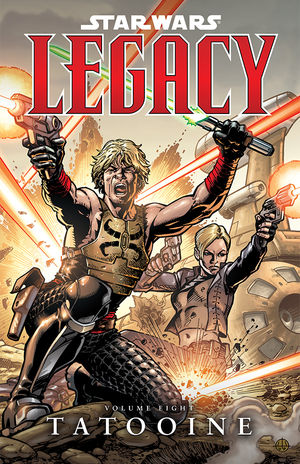
Star Wars Legacy Vol. 8: Tatooine

Written by John Ostrander and Jan Duursema
Art by Jan Duursema, Kajo Baldisimo, and Dan Parsons

As much as I usually praise this series, this particular volume is perhaps the weakest in the run so far.  It feels, in many ways, like it is an interlude volume, giving Cade Skywalker and friends something to do while Ostrander works to set things up for the next big storyline.

For the majority of the book, Cade and his crew are running scams on Tatooine (always Tatooine, the most pivotal backwater in the galaxy) and attacking Black Sun pirates who attack Imperial weapons shipments.  The Empire sends a fighter pilot we've seen before to arrest Cade, and pairs her with Morrigan Corde, a special operative and Cade's mother.  There are also some vampires pursuing Cade, and this is where things all start to feel a little forced.

First, two of the bounty hunters are of a vampiric race that like to refer to the emotions and/or luck they drain from their victims as soup.  It's hard to deliver threatening dialogue that way.  I don't know if these are Ostrander's creations, or if they are from some other aspect of the Star Wars universe, but they're silly.  Also stretching credibility is the revelation about Corde that kind of slips out but isn't used much.  What I love most about this series is the way that Ostrander has been playing with George Lucas's creations, but ignoring much of the overly melodramatic or cloyingly cute crap that chokes the films.  Now, learning what we do about Corde, we're back into the overly complicated family ties that irritated me so much when I was a kid.  Not everyone in the comic has to be related.

Finally, there is a one-off story featuring the Rogue Squadron of the Rebel Alliance.  This is what I usually like most about this comic, but this time around, I got a little lost.  One of the characters is revealed to be Mandalorian, which seems to me to mean being part of a samurai-like warrior tribe that wears Bobba Fett's armor.  Perhaps these guys have been around before (a quick Wikipedia search reveals that these guys have had a long history - who knew?), but nothing is done to introduce them to a new reader.  It's all good, but it threw me a little and made me wonder if I'd just forgotten something important.

In all, I'm still very impressed with this title, but I hope the remaining two trades in the run are better than this one.

Friday, September 17, 2010

CBGB #3

Written by Kim Krizan, Robert Steven Williams and Louise Staley
Art by Toby Cypress and Giorgio Pontrelli

This issue is a disappointment compared to the first three stories across the two earlier issues of the comic.

The first story, written by Krizan (who is a screenwriter) is an odd tale about the origins of rock and roll (I guess), which can be interpreted as culturally insensitive or misinformed, and it has to do with three youth who leave their "tribes" and end up forming a band.  "Boy, do you like Big Noise?" is a good sample of the dialogue.  I was waiting for a character to say something like "Me make-um heap big music."  The art, by Cypruess, is as strange as his art usually is (and I mean that in a good way), especially with wide vertical bands altering the tone of many panels.  The art should be enough to redeem this story for me, but somehow it doesn't.

The second story, written by Williams and Staley (Williams edits the CBGB website) is a music and weed-fueled time travel story that is cute, but came across as flawed.  A professor of music (we assume) goes back in time to the night he broke up with his girlfriend and decides to stay for a concert instead, which somehow alters the timeline, although I don't understand how.

I like this series (more in theory than in practice this month), and hope that the last issue is going to be impressive.  This type of project is crying out for a Vasilis Lolos story, although I think I'm going to be disappointed there...

DMZ #57

Written by Brian Wood
Art by Cliff Chiang

Since the series began, I've liked the one-off issues featuring various supporting characters better than the main storyline, and this issue is the perfect example of why.

As with the other issues of 'Collective Punishment', Wood uses this comic to give us a wide view of life in New York under a bombing campaign by American forces ("The Liberation of Manhattan" their propaganda calls it) by examining what happens during it to one particular person.

The star of the book this month is Amina, the former terrorist who Matty rescued (and also manipulated).  She's living in an apartment that was given to her by the Delgado Nation, and is just enjoying being on her own.  On the eve of the bombings, she sees a young baby that has been abandoned on the street.  She takes her in, and finds herself opening up to people again.  Aside from the bombing, this is a quiet, introspective issue, and is the type that Wood does best.  Amina's only companion before this has been the mysterious pirate radio broadcaster we keep hearing from, who helps to provide exposition and continuity in the comic.  I would really like to know more about her one day.

The art on this issue is by Cliff Chiang, who I think has never worked on this title before.  As always, his work is incredible, although it doesn't seem instantly recognizable as his.  It seems he's channeling the aesthetic that regular artist Riccardo Burchielli has established for the title, and yet is still making it his own.  Great issue.

Morning Glories #2

Written by Nick Spencer
Art by Joe Eisma

While this issue didn't have the intrigue of the first, it's still a very good comic.  Spencer has set up a very strange place in the Morning Glorie Academy, where it seems that the people in charge find ways to torture and test teenagers who all share the same birthday.  This issue opens with Casey, reeling from the discovery she made on the last page of the first issue, as Miss Daramont, her teacher, quizzes her on advanced theoretical physics.

From there, she is sent to detention, alongside her peers, who then explain what they did that got them into trouble (explanations involve crashing a Satanic ritual in the basement and stopping a roommate from killing them).  The testing continues, as the room starts filling with water.

I'm not sure where this is going.  Casey has been established as a genius, and one of the other kids is clearly a sociopath, but the rest seem more or less normal.  This is not some weird take on Professor Xavier's School for Gifted Youngsters, and I'm not sure what Daramont and her colleagues are up to, or what their intended end result is going to be.  Right now it just seems like torture for torture's sake, but I'm sure there is a plan.

Spencer's writing is keeping this interesting, as some of the characters are becoming easy to identify with, although a couple others (psycho boy and the spoiled girl) are very hard to like.  Eisma's art is decent, without being spectacular.  This book is pretty much unlike anything else on the stands, although I'm not sure if there's enough going on to keep me coming back over a long run.  At least, not yet...

Thursday, September 16, 2010

Time Bomb #2

Written by Jimmy Palmiotti and Justin Gray
Art by Paul Gulacy

Time Bomb is a very cool comic.  It feels like Palmiotti and Gray are writing for an eventual screenplay with this, and I think the story would work as well for a movie as it does for the comics.

A group of operatives have been sent through a 'time bomb' to 1945 Berlin to put a stop to a Nazi doomsday device that has devastated their own time.  They have a limited amount of time to secure the device, or destroy it.  They did not expect to arrive at this particular time, thinking instead that they would simply have to convince subsequent German leaders from staying away from it, and now have to improvise.

Most of this issue (the comic is in that wonderful Radical double-sized format) deals with these four splitting up and finding different ways to achieve the same goal.  Their technological advantages give them an interesting edge over the Germans, and it's cool to see how the writers set the characters loose in this time period.

Gulacy's art is great.  I know he's a love him or hate him artist for a lot of people, but I really like his work, and feel that he's well suited for this type of comic.  This comic manages to take some pretty standard ideas - Nazis, time travel, Armageddon - and do something unique with it.

Lucifer Vol. 10: Morningstar

Written by Mike Carey
Art by Peter Gross, Ryan Kelly, Colleen Doran, and Michael Kaluta

I'd started to feel like this comic had played itself out a little over the last couple of volumes, and that feeling extended into the beginning of this penultimate book, but the latter half of the trade is amazing.

In this volume, Carey brings most of the plotlines that ran through the first sixty-odd issues of the comic to a head, as three armies (the Lilim, the Angels, and the combined forces of Hell and its damned) meet outside the gates of heaven while Lucifer fights the Fenris Wolf at the Primum Mobile, the throne of heaven.

The action and warfare is nowhere near as significant as some of the other things going on though, especially with Elaine Belloc and Lilith, who meet Jahweh and debate the future of all creation.

Wisely, Carey intersperses some of the more pivotal scenes with interludes, one of which involves a sorcerer who summons the most powerful demon in Hell to be his thrall, not realizing that Gaudium, the troublesome former cherub is the only creature currently in Hell.  That's a great issue, with art by the incomparable Michael Kaluta.  An earlier interlude returns to some of the earliest supporting characters of this series - the crippled Jayesh and his conflicted ex-skinhead boyfriend.  This story is drawn by Colleen Doran, an artist who we see way too little of these days.

This book goes a long way towards helping me understand why this series is spoken of with such respect, something I wasn't always getting earlier.  I look forward to finishing it all off with the next volume.

Wednesday, September 15, 2010

Joe the Barbarian #7

Written by Grant Morrison
Art by Sean Murphy

In the two and a half months since the last issue of this comic came out, I thought I'd lost interest.  I'd been enjoying Morrison's riff on the old CBC show The Odyssey (which might not be an inspiration, but the parallels are clear), but was starting to find it a little drawn out.  When I saw this issue finally showing up in my pull-file, I expected to be underwhelmed.

Instead, I quickly got back into Joe's story, as he and the various denizens of Playtown (more on whom momentarily) face off against King Death's forces, Joe reaches the Fountain of Life (ie. the soda in the fridge), and then has to make some hard choices about what he does with it.  The pacing of this issue is excellent, and I appreciate some of the more bizarre asides (like the blue crabs).  Now I'm eagerly looking forward to the last issue.

Murphy's art is as great as it's been throughout this series.  The big kick in this issue comes from seeing which DC, Star Trek, Transformers, and other characters get the Playtown treatment and show up in the comic, albeit slightly altered to avoid copyright issues.  There's a lot to look at with this comic, and it's worth reading through it slowly to absorb all the details.

Tuesday, September 14, 2010

Universal War One: Revelations #1-3

by Denis Bajram

It took me a while to track down all the issues of this French comic translated into English, but it was well worth the effort.  As much as I liked the first volume of this series, I enjoyed this one much more.

In the first series, the members of Purgatory Squadron, a group of misfits who were part of the United Earth Force (UEF) were sent to destroy a wormhole weapon (how Farscape!) operated by the Colonization Industrial Companies (CIC), an insurgent force fighting against the UEF.  The men and women of Purgatory emerged from the conflict three days into their past.

As this title opens, the Purgatory crew are rushing against the clock to destroy a wormhole station that is poised to destroy the Earth.  They are unsuccessful, Earth is destroyed, and they are again sent through time and space.  The story, as it plays out over three extra-sized issues, follows the ever-shrinking members of Purgatory as they try to stop the CIC for all time.

There is a lot of very hard science fiction in this title, involving time travel, wormholes, teleportation, and how foreknowledge can be used to influence societies.  Bajram uses some truly complex ideas, but integrates them into the story seamlessly, as the plot remains character driven.  The universe he portrays is very well-constructed and rich.  Each issue contains about as much content as a year's worth of a mainstream North American comic, and it is a treat to read a story so dense and yet so compelling.

Bajram's art is beautiful.  He does well with the human aspect of his story, but is also at his best when showcasing scenes of mass destruction or outer space.  This is a wonderfully designed comic.  I wish that there were more pieces of work of this caliber being produced in the US.

Saturday, September 11, 2010

Weird War Tales #1

Written by Darwyn Cooke, Ivan Brandon, and Jan Strnad
Art by Darwyn Cooke, Nic Klein, Gabriel Hardman, and Steve Pugh

What a shame that this is only a one-shot.  I love war comics, and have been eying the recent single issues that DC has been putting out.  I've ignored the others because of their price, but when I saw the line-up of creators on this one, I decided it was well worth buying.

The comic opens with a story by Darwyn Cooke set in some form of afterlife for soldiers, where their skeletal remains gather each year to engage in some Olympic-style games and some debauchery.  It's a funny little story, gorgeously drawn.

Brandon and Klein (the Viking team) have a story about a submarine crew that is close to running out of fuel in the Second World War.  It's an interesting tale, with great art.  Strnad (there's a name I haven't seen in a while) and Hardman have a pretty standard, but still effective, story about the loyalty of friends during a war.  As expected, it also has great art.

I would gladly buy a mini-series or anthology graphic novel of stuff like this.  I'm sure the recent rebirth of the various old war titles is a copyright-related thing, but I would like to think that DC is testing the market for material like this.  The other one-shots have not had the same caliber of artist and writer attached to it, but this one is a gem.

Daytripper #10

by FĂ¡bio Moon and Gabriel BĂ¡

With Daytripper finishing, I now have my pick for mini-series of the year.

From its beginning, Daytripper has been like nothing else being published by any comic company.  It is the story of a life, BrĂ¡s de Oliva Domingos's, told in different chapters that are each set at a specific age.  They are not chronological, but rather skip through his life at different phases (at least until the ninth issue, which is quite different from the rest).

The story is magical realist in nature, reminding me of the best of Garcia Marquez in its casual weirdness and lyrical beauty.  While Daytripper is about BrĂ¡s, it is really about family and the bonds that help us through our lives.  BrĂ¡s has a complicated relationship with his father, which structures his life even after his father is gone.  In this issue, at age 76, BrĂ¡s is given a recently-discovered letter that his father wrote him on the eve on the birth of BrĂ¡s's son.  It helps echo and solidify the themes of this work, and helps provide a natural ending to the series.

While I've been impressed by the writing (which some might feel a little too self-consciously literary for a comic, but I'd disagree), the art has completely blown me away.  BĂ¡ and Moon are incredible artists, and every page of this book has been beautiful.

Now that this comic is finished, I'm going to miss BrĂ¡s and his family, and also his Brazil, which is a charming and beautiful place.  This is one of those rare comics that has touched me emotionally, and has given me plenty to think about.

Welcome to Tranquility: One Foot in the Grave #3

Written by Gail Simone
Art by Horacio Domingues

Reading through this comic, I was struck by the idea of how much more surprising the revelation that The Furey and The Pink Bunny had a child (an evil child!) would have been, had the characters not just been created a few years ago, but were in fact beloved Golden Age superheroes.

Regardless, this is a great comic.  Simone starts the issue off with a flashback showing what young Derek Furey was like as a child (and what happens if you make him angry), before returning to the modern-day reunion between father and son, which is a little less than touching.

This issue raises a lot of questions, such as where Derek has been for the last twenty years, and exactly what transpired between him and Thomasina back in the day.  Simone continues to write this book as sharply as she does Secret Six, although with a much nicer frame of mind.  Domingues is still the perfect replacement for Neil Googe, as he has seamlessly taken over the look of this book without affecting its aesthetic.

Kill Shakespeare #5

Written by Conor McCreery and Anthony Del Col
Art by Andy Belanger

This title is hitting its stride, as Hamlet continues his wandering through King Richard's lands, seeking some sort of direction, as it seems that people on all sides of the Prodigal's Rebellion are looking to use him for their own purposes.

In this issue, he meets with Lysander and Demetrius (from A Midsummer's Night Dream), while Juliet takes Iago into custody, and Richard and Lady Macbeth scheme around one another.

The story is moving a little slowly, as Hamlet's striking out on his own becomes a vehicle whereby the writers can introduce more characters, but at the same time, I like the way they are establishing the depths of Richard's cruelty, and the wide-spread support for Juliet's uprising.

This continues to be an intelligent and well-drawn comic.

BPRD Hell on Earth - New World #2

Written by Mike Mignola and John Arcudi
Art by Guy Davis

I really like this new direction for the BPRD.  This is a very character-driven arc, which I always appreciate, especially after the Bureau has been through so many changes.

Kate's feeling overworked and is spending too much time having to manage her staff, especially as Johann keeps getting weirder and weirder, and Panya is starting to demonstrate that she's not as trustworthy as previously believed.  I've found Panya, the reanimated Egyptian mummy, to be an interesting character, and I like that she is getting a larger role in the comic.

Most interesting this month is the return of Ben Daimio.  It's unclear as to how affected he has been by the Wendigo, and the conversation between he and Abe is very nicely handled.

This arc is not terribly new-reader friendly, which is odd when you consider that the Hell on Earth era is supposed to be a totally new direction, but this is still a very good comic.

Friday, September 10, 2010

One Bullet Away: The Making of a Marine Officer

by Nathaniel Fick

I've written before about how much I enjoyed David Simon and Ed Burn's Generation Kill, and how it led me to track down the source material, Evan Wright's book.  In both forms of the story, one of the people that intrigued me the most was Lieutenant Nate Fick.  Fick was portrayed as a thoughtful, considerate officer, who weighed the well-being of his men into his decisions, and who frequently bumped up against his superiors in an effort to execute the intent, if not the letter, of their commands.  When I heard that Fick had written a book, I figured it would be an interesting read.

While Generation Kill is concerned solely with the earliest days of the war in Iraq, Fick gives us an overview of his entire military career, from the time he first spent in Officer Candidate School through his time in Afghanistan, followed by Recon training, and then being the tip of the spear for the invasion of Iraq.

Fick's writing is remarkably readable, and he does a great job of capturing the sensory saturation of combat.  What impressed me the most about this book was the restraint and decorum that Fick exhibits.  Wright's book and the TV show revel in exposing the failings of officers and command (other than Fick), yet Fick limits the amount of space given to this topic.  He is clear about having had issues with his Captain (unnamed here, called Encino Man by Wright and the Marines), although he goes out of his way to temper any negative comments with kinder statements about his character.  Captain America, openly mocked by Wright, is not even mentioned in the book.  I was curious to see what Fick really thought about these people, but he was too much of a gentleman to share.

This book sheds some light on what went wrong in Iraq, seen from the ground.  Fick had ideas about how to keep Baghdad from descending into anarchy, yet had no channel to express his thoughts.  Instead, he had to watch with frustration as the seeds of the insurgency started to take root.

What most sticks with me from reading this book is the devotion Fick felt for his Marines, and the pains to which he went to share their story with the world.  He does not fall into easy platitudes about sacrifice, but goes to great pains to show us people we should respect and honour, while never shying away from the realities of what they were asked to do.